Best Coffee Makers 2026: Breville vs Moccamaster vs OXO
You grind fresh beans, measure the water, press start — and your $30 coffee maker produces a flat, slightly bitter cup that makes you wonder why you bothered with the good beans. The grind, water temp, and ratio matter far more than which brewer you choose.
Quick answer
The Breville Precision Brewer is the coffee maker to buy: SCAA brew temperature, bloom pre-infusion, and a thermal carafe at $280 — the best extraction that doesn't cost Moccamaster money. On a tighter budget, the OXO Brew 9-Cup gets SCAA-certified extraction at $200. Technivorm Moccamaster is the 15+ year machine, and Cuisinart DCC-3200P1 handles 14 cups on a schedule.
We assessed each product on flavor profile, sourcing transparency, value per serving, packaging integrity, and how well it performed across common use cases. Documented certifications and verified user reviews were cross-checked against marketing claims.

Breville Precision Brewer Thermal BDC450
Best Overall: The Breville Precision Brewer BDC450 hits the SCAA-specified 92-96°C brew window throughout the cycle, runs a 30-45 second bloom pre-infusion to wet the grounds before the main pour, and pushes water through at the flow rate the SCAA's 6-minute target is calibrated for. The 12-cup (1.4 L) vacuum-sealed thermal carafe holds coffee at drinking temperature for two-plus hours without a hot plate, and the included Gold Tone permanent filter means you can skip paper if you prefer.
Top picks ↓| Product | Price | Link |
|---|---|---|
| $280Reference price | ||
| $350Reference price | ||
| $200Reference price | ||
| $80Reference price | ||
| $71Price as of 2026-09-24 |
| Product | Capacity | Carafe type | Power | Programmable | Certifications | Item weight |
|---|---|---|---|---|---|---|
| Breville Precision Brewer Thermal BDC450 | 12 cups (60 oz) | thermal | 1650 W | yes | SCA Certified Home Brewer (Gold Cup mode) | 10.63 lb |
| Technivorm Moccamaster KBT Coffee Maker | 10 cups (40 oz / 1.25 L) | thermal | 1400 W | no | SCA Certified Home Brewer | 6.0 lb |
| OXO Brew 9-Cup Coffee Maker | 9 cups (45 oz) | thermal | 1400 W | yes | SCA Certified Home Brewer | 11.4 lb |
| Cuisinart PerfecTemp 14-Cup Programmable Coffeemaker DCC-3200P1 | 14 cups | glass | 1100 W | yes | — | 9.5 lb |
| Hamilton Beach 12-Cup Coffee Maker 49350 | 12 cups | glass | 950 W | yes | Works with Alexa Certified / Certified for Humans | 4.58 lb |
Top picks
Related articles

The best overall home drip brewer — SCAA-certified 92–96°C brew temperature, 30–45 second bloom pre-infusion, and a vacuum-sealed thermal carafe that outperforms machines costing $70 more. The non-removable water tank is the only real inconvenience at this price.
The Breville Precision Brewer BDC450 hits the SCAA-specified 92-96°C brew window throughout the cycle, runs a 30-45 second bloom pre-infusion to wet the grounds before the main pour, and pushes water through at the flow rate the SCAA's 6-minute target is calibrated for. The 12-cup (1.4 L) vacuum-sealed thermal carafe holds coffee at drinking temperature for two-plus hours without a hot plate, and the included Gold Tone permanent filter means you can skip paper if you prefer. Build quality is solid without feeling overbuilt and the 36 cm height fits under most kitchen cabinets. The main inconvenience is the non-removable water tank — you fill it from the top with a pitcher or move the machine to the sink — but at $280 it's the most extraction-capable home drip brewer that doesn't cost Moccamaster money.
Pros
- ✓SCAA-certified 92-96°C brew temperature held across the cycle
- ✓30-45 second bloom pre-infusion before main pour
- ✓Vacuum-sealed thermal carafe — no scorching hot plate
- ✓Gold Tone permanent filter included alongside paper compatibility
Cons
- ✗Water tank is non-removable
- ✗Narrow carafe mouth needs a bottle brush for cleaning
| Capacity | 12 cups (60 oz) |
| Carafe type | thermal |
| Power | 1650 W |
| Programmable | yes |
| Certifications | SCA Certified Home Brewer (Gold Cup mode) |
| Item weight | 10.63 lb |

The benchmark for home drip coffee since 1969 — Dutch-made copper boiler, manually adjustable flow valve, SCAA-certified, and built to last 15–20 years. The $70 premium over Breville buys repairability and a flow control feature that no other machine here offers.
The Moccamaster KBT is the reference home drip brewer, handmade in Amerongen, Netherlands and SCAA-certified since the program began in 1969. The copper boiling element heats water to 92-96°C in under six minutes, and the brewing arm's three-position flow valve lets you slow extraction for light roasts or speed it up for darker beans — a hardware control no other machine in this comparison offers. A full 10-cup carafe brews in roughly six minutes versus eight to nine on the Breville. The five-year warranty plus parts availability for machines sold decades ago is the actual case for the $70-150 premium over Breville and OXO — most tasters can't reliably distinguish the cup in blind comparisons, so you're paying for repairability, the flow valve, and a machine that will outlast multiple replacements of cheaper brewers.
Pros
- ✓Manually adjustable three-position flow valve
- ✓Brews a full 10-cup carafe in about six minutes
- ✓Five-year warranty with parts available for decades-old units
- ✓SCAA-certified since 1969 with no major design changes
Cons
- ✗$70+ premium over Breville for marginal in-cup differences
- ✗Single-function — no programmable timer
| Capacity | 10 cups (40 oz / 1.25 L) |
| Carafe type | thermal |
| Power | 1400 W |
| Programmable | no |
| Certifications | SCA Certified Home Brewer |
| Item weight | 6.0 lb |
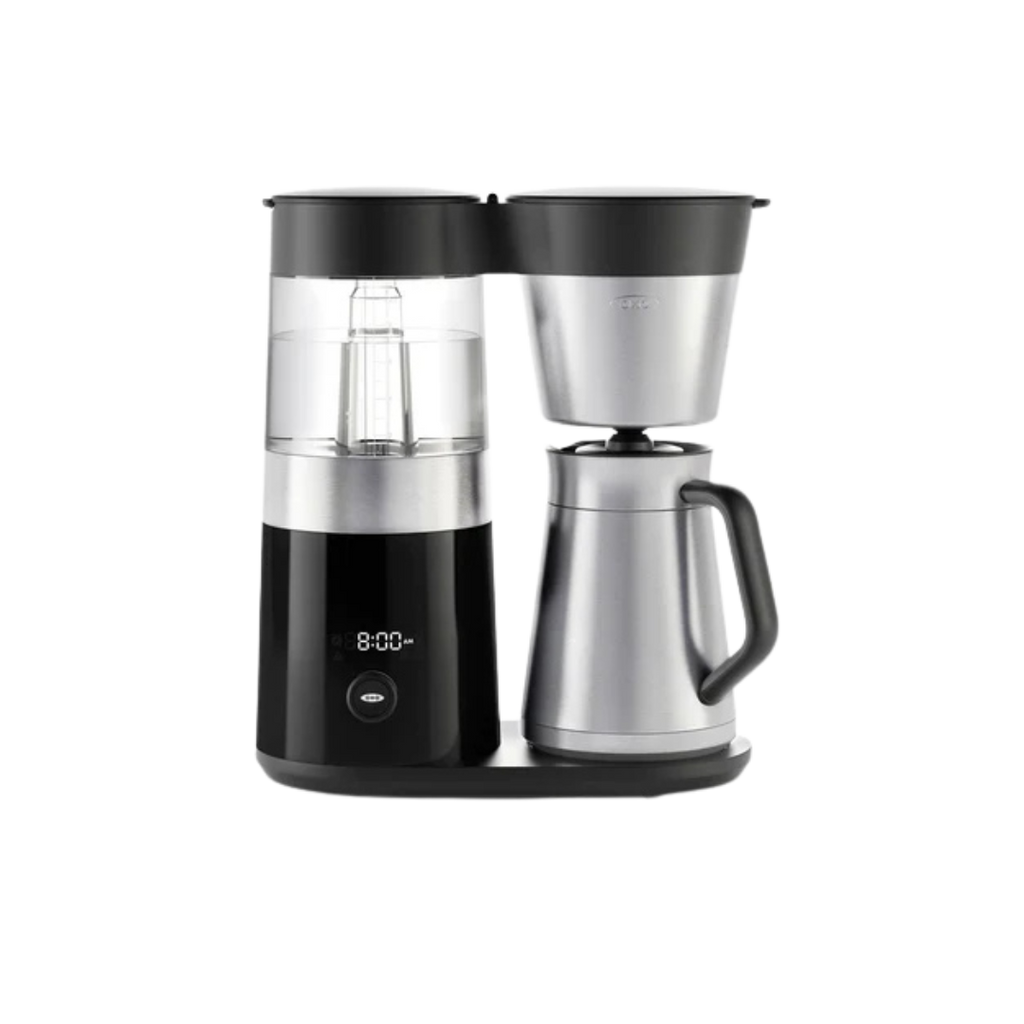
The strongest value in SCAA-certified drip brewing — Rainmaker showerhead, bloom pre-infusion, insulated 9-cup carafe, at $80 less than the Breville BDC450. The best choice for households that brew 4–8 cups and want extraction quality without spending over $200.
The OXO Brew 9-Cup is the entry point into SCAA-certified drip brewing at $200, undercutting the Breville BDC450 by $80 while delivering the same core specifications: 92-96°C brew temperature, bloom pre-infusion, and a calibrated flow rate. The Rainmaker showerhead distributes water across the full coffee bed evenly rather than pouring from a single point, which produces more consistent extraction across every cup in the carafe. The 9-cup insulated carafe is slightly smaller than Breville's 12-cup but keeps coffee hot for a comparable two hours. The brew-pause feature lets you pour mid-cycle but adds a 10-15 second delay when the carafe returns. For households brewing 6-9 cups daily who want SCAA performance without paying Breville prices, this is the strongest value argument in the comparison.
Pros
- ✓SCAA-certified at $80 less than the Breville
- ✓Rainmaker showerhead distributes water evenly
- ✓Insulated carafe keeps coffee hot for about two hours
- ✓Bloom pre-infusion built in
Cons
- ✗Narrower carafe mouth makes filling and cleaning awkward
- ✗Brew-pause adds a 10-15 second delay when the carafe returns
| Capacity | 9 cups (45 oz) |
| Carafe type | thermal |
| Power | 1400 W |
| Programmable | yes |
| Certifications | SCA Certified Home Brewer |
| Item weight | 11.4 lb |
Subscribe to our newsletter
Occasional updates and new releases — no spam.
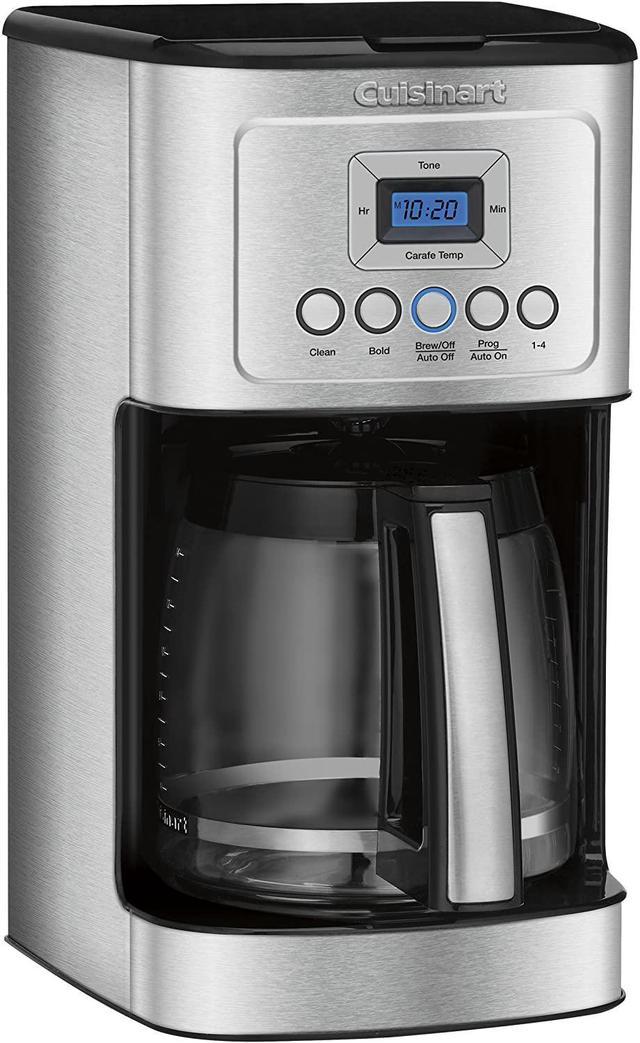
Cuisinart PerfecTemp 14-Cup Programmable Coffeemaker DCC-3200P1
The practical large-batch programmable pick — 14-cup capacity, 24-hour advance scheduling, adjustable brew strength, and a price low enough that replacement is straightforward when it eventually wears out. Keep-warm plate scorches coffee after 45 minutes; pour within that window.
The Cuisinart PerfecTemp DCC-3200P1 is the large-batch programmable workhorse — 14-cup glass carafe, 24-hour advance scheduling, and an adjustable brew strength setting that reduces water flow for smaller 1-4 cup batches. Brew temperature runs roughly 1-3°C below the SCAA-optimal range and the saturation is less even than a showerhead design, so it's not extraction-grade equipment, but for households brewing medium-roast supermarket coffee with morning programming, it does its job well at around $80. The structural weakness is the keep-warm plate: it holds coffee at 65-75°C for up to four hours, but slowly scorches the bottom of the carafe past the 45-minute mark, which affects the last cups of a long-sitting batch. Pour within 30 minutes and this doesn't matter.
Pros
- ✓24-hour programmable start with adjustable brew strength
- ✓14-cup capacity covers large households
- ✓1-4 cup setting partially compensates for small batches
- ✓Replacement cost is low enough that long-term ownership is forgiving
Cons
- ✗Brew temperature runs below the SCAA-optimal range
- ✗Keep-warm plate scorches the carafe bottom after 45 minutes
| Capacity | 14 cups |
| Carafe type | glass |
| Power | 1100 W |
| Programmable | yes |
| Item weight | 9.5 lb |
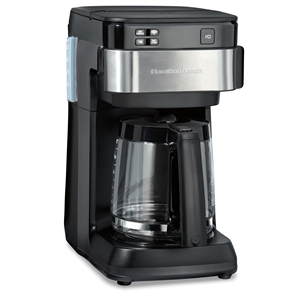
The honest budget option — functional 12-cup drip brewing at $30, with pause-and-pour and programmable start. No SCAA certification, no temperature control, no thermal carafe. Makes perfectly acceptable hot coffee if you use good beans and don't let it sit on the warming plate past 20 minutes.
The Hamilton Beach 49350 is the baseline functional drip brewer at around $30 — 12-cup glass carafe, programmable start time, pause-and-pour that lets you pull the carafe mid-brew, and a 2-hour auto-shutoff keep-warm plate. No SCAA certification, no bloom pre-infusion, no temperature control beyond 'hot.' It makes hot coffee from ground beans in about eight minutes and that's the entire feature list. For households that treat coffee as fuel rather than a considered beverage, this does its job honestly. Realistic lifespan is 3-5 years of normal use, and the total cost of cycling through two of these over eight years is still less than a single Moccamaster — that's the real value argument, not the in-cup quality.
Pros
- ✓Functional 12-cup drip brewing at around $30
- ✓Programmable start time and pause-and-pour feature
- ✓2-hour auto-shutoff keep-warm
- ✓Cheap enough to replace rather than repair
Cons
- ✗No SCAA certification or temperature control
- ✗Glass carafe with keep-warm plate causes scorching past 20-30 minutes
| Capacity | 12 cups |
| Carafe type | glass |
| Power | 950 W |
| Programmable | yes |
| Certifications | Works with Alexa Certified / Certified for Humans |
| Item weight | 4.58 lb |
Which one is right for you?
For 8-12 cup households who want extraction quality
Breville Precision Brewer Thermal BDC450
The Breville hits SCAA brew temperature with a bloom pre-infusion and thermal carafe at $280, which is the best extraction performance available in a home drip brewer that doesn't cost Moccamaster money.
For buyers who want a 15+ year machine
Technivorm Moccamaster KBT Coffee Maker
Technivorm keeps spare parts available for machines sold decades ago and the modular construction means most failures are a replacement part, not a new brewer.
For 4-8 cup brewers on a tighter budget
OXO Brew 9-Cup Coffee Maker
OXO delivers SCAA-certified extraction and a Rainmaker showerhead at $200 — $80 less than the Breville — which is the strongest extraction-per-dollar pick here.
For large households who need morning programming
Cuisinart PerfecTemp 14-Cup Programmable Coffeemaker DCC-3200P1
The 14-cup capacity plus 24-hour advance scheduling and 1-4 cup strength adjustment make the Cuisinart the practical pick for families brewing on a schedule.
For households treating coffee as utility
Hamilton Beach 12-Cup Coffee Maker 49350
At $30 with programmable start, it makes acceptable hot coffee from good beans without trying to be more than that — and replacement after 3-5 years is still cheaper than premium options.
Top pick: Breville Precision Brewer Thermal BDC450
The Breville Precision Brewer BDC450 is the most capable drip coffee maker at its price point and the one most coffee-focused reviewers reach for when they want SCAA-certified extraction without paying Moccamaster prices. The key specs that matter: water temperature held between 92–96°C throughout the brew cycle (the SCAA-specified range for optimal extraction), a bloom pre-infusion phase that wets the grounds for 30–45 seconds before the main pour, a flow rate calibrated to the SCAA's 6-minute brew window for a full carafe, and a vacuum-sealed stainless thermal carafe that keeps coffee at drinking temperature for 2+ hours without a hot plate.
The BDC450 also ships with a Gold Tone permanent filter (reusable, no paper filters required if you prefer) alongside standard basket filter compatibility. The carafe lid seals tightly and pours cleanly — no drips, which is a detail that irritates owners of cheaper thermal carafes for years. Build quality is solid without feeling overbuilt: the machine is 36 cm tall with a standard footprint that fits under most kitchen cabinets.
The honest weaknesses: the thermal carafe holds 12 cups (1.4 L) but the spout design requires a deliberate pouring angle to avoid dribbling on the last cup. The water tank is not removable — you fill it from the top with a pitcher or by placing the machine near the sink, which is a minor inconvenience relative to the $280 price. Cleaning the carafe's narrow-mouth opening requires a bottle brush; it does not fit in a standard dishwasher rack without the lid removed. The BDC450 is the right buy if you want the best extraction available in a home drip machine under $300 and you brew a full carafe (8–12 cups) most mornings.
Premium pick: Technivorm Moccamaster KBT
The Technivorm Moccamaster KBT is the benchmark for home drip coffee and has been since 1969. The KBT uses a copper boiling element that heats water to 92–96°C in under 6 minutes and delivers it through a manually adjustable flow valve that lets you dial in saturation rate — a level of hardware control that no other drip machine in this comparison offers. SCAA-certified since the program began. Handmade in Technivorm's factory in Amerongen, Netherlands. Five-year warranty, with parts available for machines sold decades ago.
The practical difference versus Breville BDC450 is audible and visible: the KBT brews noticeably faster (a full 10-cup carafe in about 6 minutes versus 8–9 minutes on the BDC450), the copper boiler's thermal mass produces more consistent temperature across the entire brew cycle rather than just at the start, and the brewing arm's three-position flow valve allows light-roast extraction (longer contact time) versus dark-roast extraction (faster flow) adjustments that the BDC450's fixed flow rate does not allow.
At $350, the Moccamaster costs $70 more than the Breville BDC450 and around $150 more than the OXO Brew. The premium buys: Dutch manufacturing with 55+ years of documented reliability, the flow valve, and the brand status that makes the machine a kitchen object rather than an appliance. The honest case against it: most tasters in blind comparisons cannot reliably distinguish Moccamaster-brewed coffee from well-calibrated Breville BDC450-brewed coffee with the same beans. If the decision is purely about what's in the cup, the price gap is hard to justify. If you also value durability, repairability, and owning a machine that will outlast the next four or five cheap drip makers you would otherwise cycle through, the Moccamaster's total cost of ownership arithmetic looks different over a 10-year horizon.
Budget picks: OXO Brew 9-Cup, Cuisinart DCC-3200P1, Hamilton Beach 49350
OXO Brew 9-Cup ($200) is the entry point into SCAA-certified drip brewing — the same core specification (92–96°C brew temperature, proper bloom pre-infusion, calibrated flow rate) as Breville and Moccamaster, at $80 less than the BDC450. The Rainmaker showerhead distributes water evenly across the full coffee bed rather than pouring from a single point, which produces more consistent extraction across every cup in the carafe. OXO's insulated carafe is slightly smaller than Breville's (9 cups versus 12) but keeps coffee hot for a comparable 2 hours. The main trade-off: the OXO's thermal carafe is harder to fill (the mouth is narrower) and the brew pause feature — which lets you pull the carafe mid-brew and pour a cup — works but causes a 10–15 second delay when the carafe returns to the brew basket. At $200, OXO Brew is the strongest value argument in this comparison for households that brew 6–9 cups and want SCAA performance without paying Breville or Moccamaster prices.
Cuisinart PerfecTemp DCC-3200P1 (~$80) is a large-batch programmable brewer with 24-hour advance scheduling, adjustable brew strength (1–4 cup setting reduces water flow for smaller batches), a 14-cup glass carafe with a keep-warm plate, and a price low enough that most households replace rather than repair it when it eventually fails. The extraction quality is not SCAA-grade — brew temperature runs 1–3°C below the optimal range and the saturation is less even than a showerhead design — but for a household that wants programmable morning convenience and brews mostly medium-roast supermarket coffee, the Cuisinart DCC-3200P1 is honest about what it is and does it well. The keep-warm plate is the structural weakness: it holds coffee at 65–75°C for up to 4 hours but slowly scorches the bottom of the carafe past the 45-minute mark, which affects the last cups of a morning batch. If you pour coffee within 30 minutes of brewing, this does not matter.
Hamilton Beach 49350 (~$30) is the baseline functional drip brewer. 12-cup capacity, programmable start time, pause-and-pour feature that lets you pull the carafe mid-brew, 2-hour auto-shutoff keep-warm. No SCAA certification, no bloom pre-infusion, no temperature control beyond 'hot.' It makes hot coffee from ground beans in about 8 minutes. For households that treat coffee as fuel rather than a considered beverage, brew good beans on a Hamilton Beach and you will have perfectly acceptable morning coffee for the cost of one bag of specialty beans. The machine will probably last 3–5 years with normal use and then you buy another one — the total cost of cycling through two Hamilton Beach machines over 8 years is still less than one Moccamaster.
How to choose: the three decisions that actually matter
Batch size versus single-cup brewing. Drip coffee makers reward brewing at or near full capacity — the grind-to-water ratio and contact time are calibrated for a full basket of grounds. If you brew 2 cups most mornings and fill a 12-cup machine one-third full, your extraction will be weak and over-extracted in sequence, not because the machine is bad but because you're using it wrong. OXO Brew 9-Cup is the best fit for 2–6 cup households; Breville BDC450 and Moccamaster KBT are built for 6–12 cup batches; Cuisinart DCC-3200P1 has a 1–4 cup strength adjustment that partially compensates for smaller batches but a full 14-cup carafe is where it performs best; Hamilton Beach 49350 is most honest at 8–12 cups.
Thermal carafe versus glass carafe with keep-warm plate. The thermal carafe wins on coffee quality: no hot plate means no scorching, which is the single biggest cause of that 'burnt coffee' flavour that makes the second cup of the morning worse than the first. Breville BDC450, Moccamaster KBT, and OXO Brew all use thermal carafes. Cuisinart DCC-3200P1 and Hamilton Beach 49350 use glass carafes with keep-warm plates. If you pour all the coffee within 20–30 minutes of brewing, the glass-plus-hot-plate setup is acceptable. If you brew a pot and return to it over 1–2 hours, a thermal carafe is worth the extra cost.
Extraction quality floor versus budget ceiling. If you buy specialty single-origin beans from a local roaster and care about brightness, sweetness, and finish length in the cup — buy OXO Brew minimum, Breville BDC450 if you can, Moccamaster if you want the best. The SCAA certification matters here: it means the machine reliably extracts the compounds that make specialty coffee taste the way the roaster intended. If you buy pre-ground supermarket coffee and judge quality as 'hot and not bitter' — the Cuisinart DCC-3200P1 or Hamilton Beach 49350 will serve you perfectly well. The beans you choose will always matter more than the machine at that quality tier.
Frequently asked questions
Does SCAA certification actually matter for home drip coffee?▼
How long does a drip coffee maker actually last?▼
Is a thermal carafe actually better than a glass carafe with keep-warm?▼
Prices change. Check the retailer for the current price.
Head-to-head
Espresso Machine vs Drip Coffee Maker
Sale guide
Amazon Prime Day Deals 2026
Comments & questions
Discussion happens on nattzy, our community forum. Sign in with Google to post — it takes a second.