Best Desk Organizer 2026: 5 Compared
A desk cluttered with loose cables, stacked devices, and drifting paper is not a productivity problem you solve by buying more willpower — it is a physical design problem you solve by redesigning the . Adjustability range matching your actual sitting posture matters more than material grade.
Quick answer
For paper and pen drift, the SimpleHouseware mesh organizer is the pick — it stands documents upright and catches small items in a sliding drawer with a compact footprint. An iPhone-plus-Watch-plus-AirPods household should take the Belkin 3-in-1, which replaces three cables and frees an A5 of desk. Anker's 622 folds to 1 cm for travel, and the IKEA Kallax insert turns a dead cube into a drawer.
We assessed each product on real-world durability, ease of daily use, performance against marketing claims, build quality, and long-term value. Manufacturer specifications were validated against verified owner reviews.
SimpleHouseware Mesh Desk Organizer
Best Overall: The SimpleHouseware mesh organizer solves paper and small-item drift better than anything else at this price by standing documents and folders upright while a sliding drawer at the base catches the small accessories that open compartments alone would lose. The mesh construction keeps the visual footprint light even at full capacity, though it collects dust in the corner joints over time.
Top picks ↓| Product | Price | Link |
|---|---|---|
| $25.87Price as of 2026-09-24 | ||
| $35.99Reference price | ||
| $47.99Reference price | ||
| — | ||
| $19.99Price as of 2026-09-24 |
| Product | Material | Compartments | Storage type | Best for | Finish options | Compatible desks | iPhone charging | Apple Watch charging | AirPods charging | Wall connection | Stand height | Ecosystem requirement | Apple Watch module | Folded thickness | Non-MagSafe Qi speed | MagSafe puck | Apple Watch support | AirPods support | Hinge durability | Cube size | Drawer type | Internal dividers | Slide mechanism | Sunlight resistance | Standalone use | Configuration | Scratch resistance | Weight capacity | Availability | Cleaning frequency |
|---|---|---|---|---|---|---|---|---|---|---|---|---|---|---|---|---|---|---|---|---|---|---|---|---|---|---|---|---|---|---|
| SimpleHouseware Mesh Desk Organizer | Coated steel mesh | Multiple upright sections + sliding drawer | Upright + drawer | Papers, folders, pens, small supplies | Black, Silver | All surface-based (including standing desks) | — | — | — | — | — | — | — | — | — | — | — | — | — | — | — | — | — | — | — | — | — | — | — | — |
| Belkin BoostCharge 3-in-1 MagSafe Stand | — | — | — | — | — | — | MagSafe 15W | Fast-charge (integrated module) | Qi 2W (base pad) | 1× USB-C cable | ~15 cm | iPhone 12 or later | Integrated, non-replaceable | — | — | — | — | — | — | — | — | — | — | — | — | — | — | — | — | — |
| Anker 622 MagGo Magnetic Stand | — | — | — | — | — | — | MagSafe 15W | — | — | — | — | — | — | ~1 cm | 5W | Detachable, replaceable | None | None | Well-reviewed to 12–18 months | — | — | — | — | — | — | — | — | — | — | — |
| IKEA Kallax Desk Insert Drawer | — | — | — | — | White, Black-brown, White-stained oak veneer | — | — | — | — | — | — | — | — | — | — | — | — | — | — | 33 × 33 cm (Kallax standard) | Single undivided pull-out | None (separate insert required) | Basic runner | White finish yellows over time | No — Kallax/Eket required | — | — | — | — | — |
| Sorbus Acrylic Desk Organizer Set | Clear acrylic | — | Compartments + drawers | — | — | — | — | — | — | — | — | — | — | — | — | — | — | — | — | — | — | — | — | — | — | Modular — stackable pen stands, trays, drawers | Low (shows on clear surfaces) | Light — base units flex under concentrated loads | Amazon worldwide | High — fingerprints and dust show readily |
Top picks
Related articles
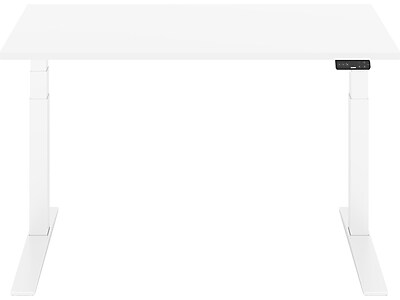


SimpleHouseware Mesh Desk Organizer in coated steel mesh. The open mesh construction is the defining feature: it keeps the visual footprint light even at full capacity and lets contents be seen without opening anything. The unit combines several upright compartments for papers, folders, and pens with a sliding drawer at the base that catches small accessories that upright sections alone would not hold. SimpleHouseware is a widely available organizer brand sold on Amazon. the upright sections are sized for papers, folders, and pens rather than bulky items; mesh construction shows dust accumulation in the corner joints more than flat surfaces do; less reconfigurable than a stackable modular acrylic set.
The SimpleHouseware mesh organizer solves paper and small-item drift better than anything else at this price by standing documents and folders upright while a sliding drawer at the base catches the small accessories that open compartments alone would lose. The mesh construction keeps the visual footprint light even at full capacity, though it collects dust in the corner joints over time.
Pros
- ✓Open mesh keeps desk feeling uncluttered even when full
- ✓Sliding base drawer catches small items upright sections would not hold
- ✓Compact surface footprint suited to small desks
Cons
- ✗Mesh collects dust in the corner joints and needs periodic wiping
Score breakdown
| Material | Coated steel mesh |
| Compartments | Multiple upright sections + sliding drawer |
| Storage type | Upright + drawer |
| Best for | Papers, folders, pens, small supplies |
| Finish options | Black, Silver |
| Compatible desks | All surface-based (including standing desks) |
Belkin BoostCharge 3-in-1 MagSafe Stand
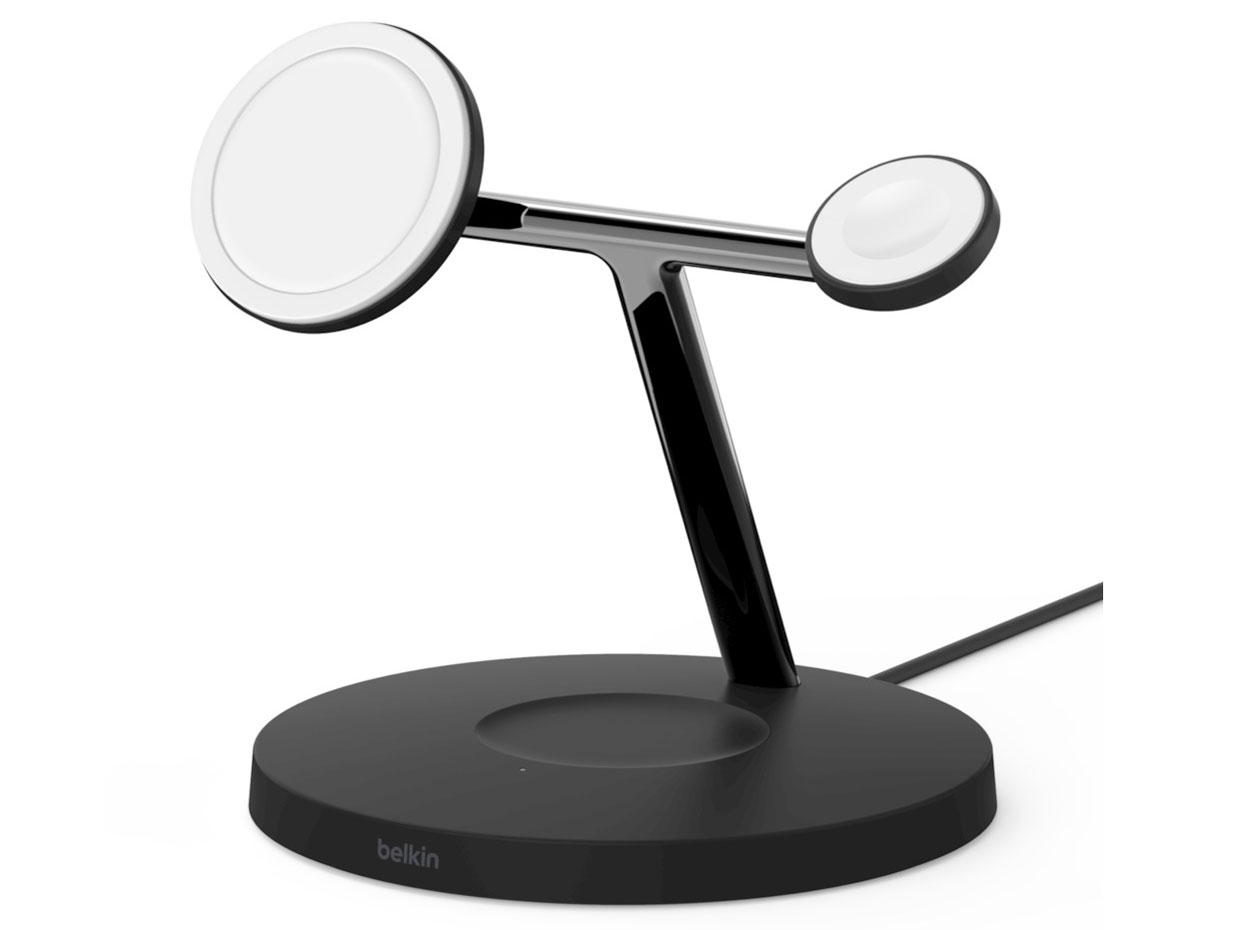
Belkin BoostCharge 3-in-1 MagSafe Charging Stand. Charges iPhone via MagSafe at 15W, Apple Watch via integrated Apple Watch charger at fast-charge speed, and AirPods (any case with wireless charging) via a Qi pad at the base. All three charge simultaneously from a single USB-C cable to the wall. The stand holds iPhone at a viewing angle that is practical for FaceTime and notifications while charging. The industrial design is clean and Apple-ecosystem-neutral — it does not look out of place next to a Mac setup. the Apple Watch charging module is integrated into the stand arm and is not field-replaceable — degradation of the Apple Watch puck requires replacing the full stand; requires MagSafe-compatible iPhone (iPhone 12 or later) to receive 15W charging; MagSafe alignment requires setting the iPhone directly on the pad rather than at an angle, which is less forgiving than some competing stands; priced at $100+ which is at the high end of charging stand category.
For an iPhone + Apple Watch + AirPods household, the Belkin 3-in-1 eliminates three separate charging cables and reclaims a full A5-sheet of desk surface — the structural benefit holds because the cable count actually drops. The integrated Apple Watch charging module is the genuine trade-off: it is not field-replaceable, so Watch puck degradation means replacing the entire stand.
Pros
- ✓Charges iPhone at full 15W MagSafe, Watch at fast-charge speed, AirPods simultaneously
- ✓Single USB-C cable to the wall replaces three separate charging setups
- ✓iPhone held at a practical viewing angle during charging
Cons
- ✗Apple Watch charging module is integrated and non-replaceable if it fails
Score breakdown
| iPhone charging | MagSafe 15W |
| Apple Watch charging | Fast-charge (integrated module) |
| AirPods charging | Qi 2W (base pad) |
| Wall connection | 1× USB-C cable |
| Stand height | ~15 cm |
| Ecosystem requirement | iPhone 12 or later |
| Apple Watch module | Integrated, non-replaceable |
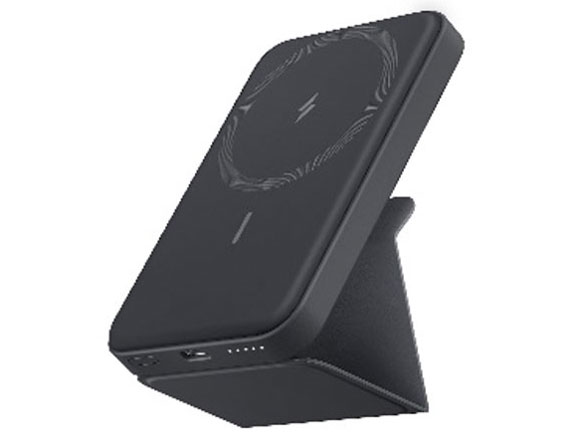
Anker 622 MagGo Magnetic Stand. A foldable MagSafe-compatible stand for iPhone that collapses to roughly 1 cm thickness when folded. The MagSafe puck attaches as a separate magnetic component rather than being integrated, making it a more repairable design than the Belkin. The fold mechanism is the primary differentiator: on a small desk, the stand can be flattened and pushed against the monitor base when desk space is needed for other tasks, then snapped upright when charging. The hinge is well-reviewed for durability in the first 12–18 months. charges iPhone (MagSafe) only — there is no Apple Watch or AirPods charging position; AirPods and Apple Watch still require separate charging solutions, so the 'charging station' framing is misleading for three-device households; the foldable hinge collects desk lint and requires periodic cleaning; not useful for Android or non-MagSafe devices.
The foldable hinge is the only genuinely practical differentiator here — on a small desk, the stand flattens to 1 cm thickness and pushes against the monitor base when the surface is needed, then snaps back upright for charging. The trade-off is real: Anker markets this as a charging station, but it charges iPhone only; Apple Watch and AirPods still need separate solutions.
Pros
- ✓Folds to ~1 cm for bag travel or instant desk-depth reclamation
- ✓Detachable MagSafe puck is replaceable unlike Belkin's integrated module
- ✓15W MagSafe speed for compatible iPhones
Cons
- ✗Charges iPhone only — no Apple Watch or AirPods position despite 'station' framing
Score breakdown
| Folded thickness | ~1 cm |
| iPhone charging | MagSafe 15W |
| Non-MagSafe Qi speed | 5W |
| MagSafe puck | Detachable, replaceable |
| Apple Watch support | None |
| AirPods support | None |
| Hinge durability | Well-reviewed to 12–18 months |
Subscribe to our newsletter
Occasional updates and new releases — no spam.
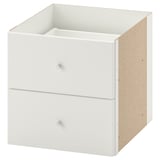
IKEA Kallax Desk Insert Drawer. Slides into a standard 33 × 33 cm Kallax cube unit and converts an open display shelf into a functional pull-out drawer. Relevant for home-office setups that already have a Kallax unit adjacent to or behind the desk — the insert repurposes dead shelf space for active storage (desk supplies, cables, documents, tech accessories) without adding to the desk surface footprint at all. Available in white, black-brown, and white-stained oak veneer. The price point is the lowest in this comparison. not a standalone desk organizer — requires owning a Kallax or Eket unit in the correct cube size; the drawer is a single undivided compartment, so organized storage of small items requires a separate internal tray or divider insert; the drawer slide mechanism is basic and not as smooth as a dedicated filing cabinet; IKEA finish options are limited and the white finish yellows over time in direct sunlight.
If you already have a Kallax unit beside your desk, this insert is the most cost-efficient storage upgrade in the comparison — it converts dead display space into a functional drawer without touching the desk surface at all. The constraint is absolute: it requires a Kallax or Eket unit, and the single undivided compartment needs a separate internal tray for organized small-item storage.
Pros
- ✓Adds usable drawer storage without consuming any desk surface area
- ✓Lowest price in this comparison
- ✓Available in white, black-brown, and white-stained oak finishes
Cons
- ✗Requires an existing Kallax or Eket unit — not a standalone organizer
Score breakdown
| Cube size | 33 × 33 cm (Kallax standard) |
| Drawer type | Single undivided pull-out |
| Finish options | White, Black-brown, White-stained oak veneer |
| Internal dividers | None (separate insert required) |
| Slide mechanism | Basic runner |
| Sunlight resistance | White finish yellows over time |
| Standalone use | No — Kallax/Eket required |
Sorbus Acrylic Desk Organizer Set
Sorbus Acrylic Desk Organizer Set. Transparent stackable acrylic units in modular configurations — pen stands, tray inserts, small-item compartments, and drawers that can be arranged vertically or horizontally. The transparency is functional: you see what is in each compartment without opening it, which reduces retrieval time and makes it visually obvious when a compartment is cluttered rather than organized. Clean, low-visual-noise appearance that suits home-office and vanity setups. Sold on Amazon worldwide. acrylic scratches with normal use, and scratches are highly visible on transparent surfaces — a scratched acrylic organizer looks worse than a scratched matte one; fingerprints and dust show on clear acrylic more readily than on opaque alternatives and require more frequent cleaning; the modular configuration creates decision fatigue — there is no 'set it and forget it' default configuration, and optimizing the arrangement can consume disproportionate time; base units flex slightly under concentrated weight, which is a problem if you rest heavy items on a stacked configuration.
The transparency is functional, not decorative — you see exactly what is in each compartment without opening it, which makes disorganization immediately visible and retrieval faster. The real trade-off is maintenance: clear acrylic shows fingerprints and scratches far more than any matte surface, and the modular system creates configuration decision fatigue if you try to optimize it all at once rather than starting small.
Pros
- ✓Transparent — contents visible at a glance, disorganization impossible to hide
- ✓Stackable modular units with drawers reconfigure without tools as needs change
- ✓Photogenic in home-office and vanity setups; sold on Amazon worldwide
Cons
- ✗Scratches visibly on clear surfaces and shows fingerprints readily — requires frequent cleaning
Score breakdown
| Material | Clear acrylic |
| Configuration | Modular — stackable pen stands, trays, drawers |
| Storage type | Compartments + drawers |
| Scratch resistance | Low (shows on clear surfaces) |
| Weight capacity | Light — base units flex under concentrated loads |
| Availability | Amazon worldwide |
| Cleaning frequency | High — fingerprints and dust show readily |
Which one is right for you?
For paper and pen clutter on a small desk
SimpleHouseware Mesh Desk Organizer
Stands documents upright and keeps the mesh structure visually light, while the sliding drawer catches small items — a compact footprint that fits where other organizers cannot.
For iPhone + Apple Watch + AirPods households
Belkin BoostCharge 3-in-1 MagSafe Stand
Consolidates three separate charging setups into one stand with one cable, freeing an A5-sheet of desk surface.
For frequent travelers or very small desks
Anker 622 MagGo Magnetic Stand
Folds flat to 1 cm for bag packing or instant desk-depth reclamation when the surface is needed.
For existing Kallax shelf owners
IKEA Kallax Desk Insert Drawer
Converts a dead Kallax cube into a functional drawer without adding anything to the desk surface.
For those who want configurable, see-through organization
Sorbus Acrylic Desk Organizer Set
Transparent stackable modules with drawers let you see exactly what is in each compartment and reconfigure without tools.
The three separate clutter problems on most desks
Most desk clutter is actually three different problems that need three different interventions, and buying a single organizer tray without distinguishing between them produces a tidy-looking desk for one week and a worse-looking desk six months later. The first problem is cable clutter — power cables, USB cables, headphone cables, and monitor cables that pool in visible tangles on and under the desk surface. The second is device accumulation — phones, tablets, earbuds cases, smartwatches, and portable chargers that each occupy flat surface space when not in use. The third is paper and small-item drift — notebooks, sticky notes, pens, glasses, lip balm, and the other objects that migrate onto a desk surface and never leave unless something actively routes them elsewhere.
Cable clutter is the most visible problem and the one most organizer products are sold to address, but it is also the one that requires the most upstream thinking. A cable management tray that hides cables under the desk solves the visual problem without solving the underlying cause: too many individual devices plugged into too many individual chargers. Replacing five separate charging cables with one MagSafe charging stand (Belkin BoostCharge 3-in-1 or Anker 622) eliminates three to four of the cables at the source. A cable tray plus the same number of cables is a visual improvement. A charging stand that reduces the cable count is a structural improvement that holds over time.
Device accumulation is the problem that cable management does not address. A phone, Apple Watch, and AirPods sitting on a desk surface each take up roughly 100–200 cm² of flat space. Stacked or scattered, they make a clean desk look cluttered even with no loose cables visible. A charging stand that holds all three vertically (Belkin 3-in-1, Anker 622) frees the equivalent of a sheet of A5 paper on the desk surface. That reclaimed space is not trivial on a 60–80 cm wide desk. Paper and small-item drift is the problem that neither cable management nor charging station design fully addresses. This is where a designated zone — a tray, a drawer insert, a modular organizer — is actually necessary. The SimpleHouseware mesh and Sorbus acrylic organizers address this directly; the charging stands do not.
Vertical vs horizontal space use
Every object placed flat on a desk surface occupies horizontal space. A notebook open for reference, a phone face-up, a pen rolling loose — each one reduces the usable work surface by its footprint. The fundamental organizing principle for desks under 120 cm wide is to move as many objects as possible from horizontal to vertical orientation, and to use the desk's front-to-back depth rather than just its left-to-right width.
The SimpleHouseware mesh desk organizer's upright compartments stand items vertically — documents and folders file upright rather than stacking flat, pens stand in dedicated sections, and a sliding drawer at the base catches small items that would otherwise drift across the surface. This vertical orientation is the core design decision, not the aesthetic. A vertical document rack converts a 20 cm stack of papers lying flat (which occupies 20 × 30 cm of surface) into a 5 cm wide vertical slot that occupies 5 × 20 cm — a 75% reduction in surface footprint for the same paper volume.
The desk's depth (usually 60–80 cm on a standard desk) is routinely underused. Most people pile objects in the front 30 cm of desk depth within arm's reach, leaving the back section empty except for a monitor. Using the back section — installing a monitor riser with a drawer below, placing a charging stand at the back-center so it does not interrupt the primary work zone, or using a shelf-height organizer that occupies only 10–15 cm of depth — frees the front 30 cm for actual work. The IKEA Kallax insert addresses this differently: it uses an entirely different surface (a shelf unit beside or behind the desk) rather than the desk surface itself, treating storage as a spatial design problem rather than a desk-surface problem.
Cable management approaches: source reduction vs concealment
There are two fundamentally different cable management strategies: source reduction (eliminating cables by consolidating charging into fewer connection points) and concealment (hiding the same number of cables using trays, clips, and routing channels). Both improve visual cleanliness, but only source reduction improves durability — the state tends to hold because there are fewer cables to re-tangle.
Source reduction at the desk level means replacing individual device chargers with a multi-device charging stand. The Belkin BoostCharge 3-in-1 MagSafe charging stand accepts iPhone via MagSafe, Apple Watch via its magnetic charger module, and AirPods via a Qi pad — three devices that previously occupied three individual cable-and-pad footprints now charge on one stand with one cable running to the wall. The Anker 622 MagGo works similarly for MagSafe-compatible iPhones and adds a foldable design that reduces the stand's desk footprint when not in use. In both cases, the net cable count at the desk drops from three to one, which is the single biggest reduction available short of going fully wireless.
Concealment approaches — cable clips that route cables along desk legs, cable management boxes that bundle a power strip and cable excess under the desk, adhesive cable channels — are necessary for cables that cannot be eliminated: the monitor cable, the power cable for a desktop, the USB hub cable. These are complementary to source reduction, not alternatives. A cable management box that bundles five chargers and their cable tangle is a better situation than a visible tangle, but it is still five chargers. The disciplined approach is source reduction first (consolidate everything that can be consolidated) and concealment second (clean up what remains).
Charging station integration: MagSafe vs universal vs none
The choice between a MagSafe-specific charging stand (Belkin 3-in-1, Anker 622) and a universal wireless charging pad depends entirely on the device ecosystem. MagSafe delivers 15W charging to iPhone 12 and later at a speed that a standard Qi pad cannot match (7.5W is the iPhone maximum on non-MagSafe Qi). For an iPhone + Apple Watch + AirPods household, the Belkin 3-in-1 or Anker 622 charges all three devices at optimal speed on a single stand. For a mixed Android/iOS household, a universal multi-device pad avoids ecosystem lock-in at the cost of reduced maximum charging speed for iPhone.
The Belkin BoostCharge 3-in-1 requires an Apple Watch charger module that is integrated into the stand and is not field-replaceable — if the Apple Watch charging puck degrades, the stand must be replaced. This is an explicit design weakness for long-term ownership. The Anker 622 MagGo's foldable design means the stand folds flat to roughly 1 cm thickness when not in use, which is practically useful on a small desk where every centimeter of depth matters. The MagSafe puck on the Anker 622 is a separate component that attaches magnetically and is replaceable, which is a more repairable design.
For users who do not use MagSafe devices, neither the Belkin nor the Anker is the right choice — both are MagSafe-first products with reduced utility outside that ecosystem. For those users, the relevant question is whether cable management (a mesh organizer's drawer plus a dedicated cable management box) or storage organization (Sorbus acrylic set, IKEA Kallax insert) produces more visible improvement on their specific desk. The answer depends on whether cables or clutter is the primary problem — and for most desks, it is both.
Visible organization vs concealment: the mesh and acrylic approach
The SimpleHouseware mesh and Sorbus acrylic approaches to desk organization share a design principle worth understanding on its own terms, not just as a product choice: keep contents visible rather than hidden. The Sorbus acrylic organizer is transparent so that the objects inside remain visible rather than disappearing into an opaque box; the contents are not concealed, they are arranged. The SimpleHouseware mesh organizer uses open steel mesh so that what is stored stays in plain sight while the airy construction reads visually lighter than a solid plastic tray.
This is practically different from concealment-first organization that leans toward hiding things — covering items in matching fabric bins, stacking identical lidded boxes, uniformly labeling everything. The visible-organization approach does not hide objects; it assigns them positions. The organizing benefit comes from the positions being consistent, not from the objects being out of sight. A transparent acrylic organizer where pens are always in the left column and the stapler is always in the second compartment is, in practice, more retrieval-efficient than a system where everything is in matching white boxes and you need to open each box to find what you need.
For small home-office setups — a 60 cm desk in a small room, a standing desk in a compact apartment, a corner desk in a shared bedroom — the Sorbus acrylic set's modularity and the SimpleHouseware mesh organizer's compact footprint are genuinely fit for the space constraints. Both are scaled for compact desk dimensions rather than the 180 cm+ desks common in larger home-office configurations. The SimpleHouseware mesh organizer combines upright compartments with a sliding drawer in a single compact unit; the Sorbus acrylic set's stackable modules let you adjust the configuration to the space you have.
Where each product fits
iPhone + Apple Watch + AirPods user who wants to eliminate device pile-up on the desk surface, willing to pay for the MagSafe speed advantage: Belkin BoostCharge 3-in-1 MagSafe Charging Stand. The stand consolidates three charging surfaces into one footprint, charges at full MagSafe and Apple Watch fast-charge speeds, and removes three separate cables from the desk. The requires MagSafe-compatible iPhone (iPhone 12+); the Apple Watch charging module is integrated and non-replaceable if it fails; the stand is tall (about 15 cm) and has a fixed orientation, making it less suited to desks with overhead shelves at low clearance; one of the pricier charging stands in this category at around $100+.
MagSafe iPhone user who travels frequently or needs to reclaim desk depth when not working: Anker 622 MagGo Magnetic Stand. The foldable design means the stand collapses to roughly 1 cm thickness for bag packing or desk-depth reclamation. The MagSafe puck is a separate attachable component rather than integrated. The only charges iPhone (via MagSafe) — no Apple Watch or AirPods charging position, making it a single-device stand despite the 'charging station' framing; charging speed is 15W for MagSafe-compatible iPhones but drops to 5W for non-MagSafe Qi devices; the foldable hinge accumulates desk lint and is a potential long-term wear point.
Small-desk home-office setup, paper and pen clutter as the primary problem, preference for visible organization over concealment: SimpleHouseware Mesh Desk Organizer. The steel mesh construction keeps the visual footprint light even when the unit is full, the open design makes contents visible at a glance, and the sliding drawer at the base catches small accessories that upright compartments alone would not hold. The upright sections are sized for papers, folders, and pens rather than bulky items; the mesh shows dust in the corner joints more than a flat surface would; limited reconfigurability compared to the Sorbus acrylic set's stackable modules.
Existing IKEA Kallax shelf unit beside or behind the desk, wanting to add organized drawer storage without adding to the desk surface: IKEA Kallax Desk Insert Drawer. The insert slides into a standard 33 × 33 cm Kallax cube and converts dead display space into a functional drawer for desk supplies, documents, or tech accessories. The only works with Kallax or Eket units — not a standalone desk organizer; the drawer is a basic single-compartment pull-out with no internal dividers, requiring a separate insert tray for organized storage of small items; IKEA white/black/oak finishes are limited and may not match the desk surface material.
Transparent, modular, stackable organization for desk accessories and supplies without committing to a single configuration: Sorbus Acrylic Desk Organizer Set. The acrylic is transparent — you see what is in each compartment without opening it — and the stackable units with drawers allow configuration changes as needs evolve. Clean, photogenic appearance in home-office setups. The acrylic scratches with use and the scratches show on transparent surfaces in a way they would not on matte surfaces; not suitable for heavy items (the base units flex slightly under concentrated weight); requires cleaning more frequently than opaque alternatives because fingerprints and dust show on clear acrylic; the modular system creates decision fatigue if you try to configure it perfectly from the start rather than iterating.
Standing desks, small desks, and a note on paper clutter
Standing desk users face a specific organizer compatibility problem: the vertical travel range of the desk (typically 65–130 cm in height) means anything attached to the desk frame moves with it, but external shelf units and Kallax inserts stay at a fixed height. Wall-mounted cable management channels also do not accommodate the height change. For standing desk users, all organizers should be either surface-based (moving with the desk) or entirely independent (fixed shelf units placed beside the desk rather than attached to it). The SimpleHouseware mesh organizer, Sorbus acrylic set, Belkin stand, and Anker stand are all surface-based and work correctly on standing desks. The IKEA Kallax insert is fixed-height by definition — it works alongside a standing desk but not mounted to it.
For desks under 60 cm wide — a corner desk, a fold-down wall desk, or a compact apartment desk — the relevant constraint is that any organizer taking up more than 30 cm of horizontal desk space is likely to be more hindrance than help. On a 60 cm desk, a 30 cm wide organizer leaves only 30 cm of free surface, which is too little for a keyboard, a notebook, and a mouse simultaneously. On such desks, vertical-only solutions (a small wall-mounted shelf, a single pen cup, a cable clip that routes cables to the floor rather than across the surface) are more appropriate than horizontal organizer trays.
Paper clutter is the slowest-accumulating and hardest-to-address category. Cables can be routed once and stay routed; devices can be assigned to a charging stand and stay there; but paper arrives continuously (receipts, mail, printouts, sticky notes) and requires active processing to not accumulate. No organizer eliminates paper clutter — the organizer provides a collection point where paper can sit before being processed, not a processing system. A designated inbox tray (one of the SimpleHouseware mesh organizer's upright slots or a separate tray) that you clear once per week is more effective than a beautifully organized system you clear once per month. The organizational problem is behavioral consistency, not hardware.
Frequently asked questions
How do I manage cables without drilling holes in my desk?▼
What is the best charging station for three devices: iPhone, Apple Watch, and AirPods?▼
How do I reduce paper clutter on my desk?▼
What desk organizer works best for a small desk under 60 cm wide?▼
Bamboo vs acrylic vs steel mesh desk organizers — which material is best?▼
Will these desk organizers work on a standing desk?▼
Prices change. Check the retailer for the current price.
Comments & questions
Discussion happens on nattzy, our community forum. Sign in with Google to post — it takes a second.