Best Gaming Mouse 2026: 5 options compared
Five mice — the Logicool G Pro X Superlight 2, Razer DeathAdder V3, Logicool MX Master 3S, Elecom M-XGM20DLBK and Microsoft Arc Mouse — compared on weight, sensor spec, wireless latency, grip shape and button layout. Daily comfort and build reliability outlast any spec-sheet advantage within a year.
Quick answer
For competitive FPS, the Logicool G Pro X Superlight 2 is the pick — a 60g body with the HERO 25K sensor and 2000Hz LIGHTSPEED matches what tournament pros use. Choose the Razer DeathAdder V3 at 59g for a proven right-hand palm-grip shape on a budget; the Logicool MX Master 3S for spreadsheet-heavy work with MagSpeed scrolling and Logi Flow; and the Logitech G604 for fifteen programmable controls.
Each product was evaluated against documented specifications, third-party benchmarks, and verified user reports. We scored features, performance, build quality, ecosystem compatibility, and total cost of ownership.
Best for Competitive Gaming: The Logicool G Pro X Superlight 2 is the most complete competitive specification in this comparison — 60g body, HERO 25K sensor, LIGHTSPEED 2.4GHz wireless with sub-1ms latency, up to 2000Hz polling via firmware update, and 95-hour battery life. Pro esports players across major tournaments use this platform, which is genuine performance credibility rather than marketing language.
Top picks ↓| Product | Price | Link |
|---|---|---|
| — | ||
| — | ||
| $164.69Price as of 2026-09-21 | ||
| $294.90Price as of 2026-09-24 | ||
| $199Price as of 2026-09-24 |
Top picks
Related articles

Logicool G Pro X Superlight 2 — 60g ultra-lightweight competitive gaming mouse, HERO 25K sensor, LIGHTSPEED 2.4GHz wireless, up to 2000Hz polling rate via firmware update, right-hand-biased shape, zero side buttons, USB-C charging, approximately 95 hours battery life. Available at major online retailers. It is premium pricing for a mouse, and the previous generation G Pro X Superlight 1 offers virtually identical sensor performance at lower used-market prices; right-hand-only shape with no left-hand variant available; zero side buttons is a deliberate competitive minimalism choice that removes macro and browser navigation functionality entirely; 95-hour battery life is shorter than some competing premium wireless gaming mice; the minimal ergonomic contouring suits fingertip and claw grip but provides less active wrist support than the DeathAdder V3 shape for palm grip users.
The Logicool G Pro X Superlight 2 is the most complete competitive specification in this comparison — 60g body, HERO 25K sensor, LIGHTSPEED 2.4GHz wireless with sub-1ms latency, up to 2000Hz polling via firmware update, and 95-hour battery life. Pro esports players across major tournaments use this platform, which is genuine performance credibility rather than marketing language. The minimal right-hand-biased shape with zero side buttons keeps the weight at the competitive threshold but eliminates macro functionality entirely. This is premium pricing for a mouse, and the previous-generation G Pro X Superlight 1 offers virtually identical sensor performance at a lower price on the used market — worth considering if budget matters more than the 2000Hz polling and updated coating.
Pros
- ✓Ultra-light 60g body for low-fatigue flick shots and tracking
- ✓HERO 25K sensor with sub-1ms LIGHTSPEED wireless latency
- ✓2000Hz polling rate via firmware update
- ✓95-hour battery life with USB-C charging
Cons
- ✗Right-hand-only shape with zero side buttons removes macro use
- ✗Premium price for an essentially minimalist mouse
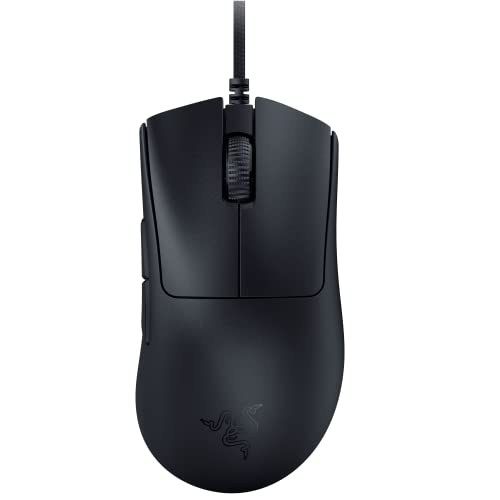
Razer DeathAdder V3 — 59g right-handed ergonomic gaming mouse, Focus Pro 30K optical sensor, wired USB-C base model (the wireless HyperSpeed variant is a separate product at higher cost), Razer Optical Switch Gen-3 rated 90 million clicks, proven DeathAdder ergonomic shape for medium-to-large right hands, budget-priced wired base model. Available at major online retailers. wired-only at the budget base price — buyers who want wireless need the V3 HyperSpeed at higher cost; right-hand-only shape excludes all left-handed users; the 30,000 DPI maximum is marketing headroom that no competitive player configures above 3200 DPI in practice; the pronounced palm-grip-optimized hump is a poor fit for small hands or dedicated fingertip grip users.
The Razer DeathAdder V3 is the right-hand ergonomic value pick. The DeathAdder shape has 20+ years of refinement for medium-to-large right hands with palm or relaxed claw grip, and at 59g the wired base model matches the G Pro X Superlight 2 on weight while costing roughly one-third the price. The Focus Pro 30K optical sensor is top-tier and the Razer Optical Switch Gen-3 is rated for 90 million clicks. The pronounced hump behind the sensor area provides active wrist support during multi-hour sessions in a way the minimalist G Pro X shape does not. The honest tradeoff: the base model is wired-only — the wireless V3 HyperSpeed is a separate higher-priced product. Left-handed users are excluded by the shape, and small-hand fingertip-grip users may find the hump too pronounced.
Pros
- ✓59g wired body matches competitive weight benchmarks
- ✓Proven DeathAdder ergonomic shape for palm and claw grip
- ✓Focus Pro 30K sensor with 90M-click Razer Optical switches
- ✓Budget-priced — strongest price-to-performance ratio
Cons
- ✗Wired-only at the base price — wireless variant costs more
- ✗Right-hand-only shape excludes left-handed users entirely
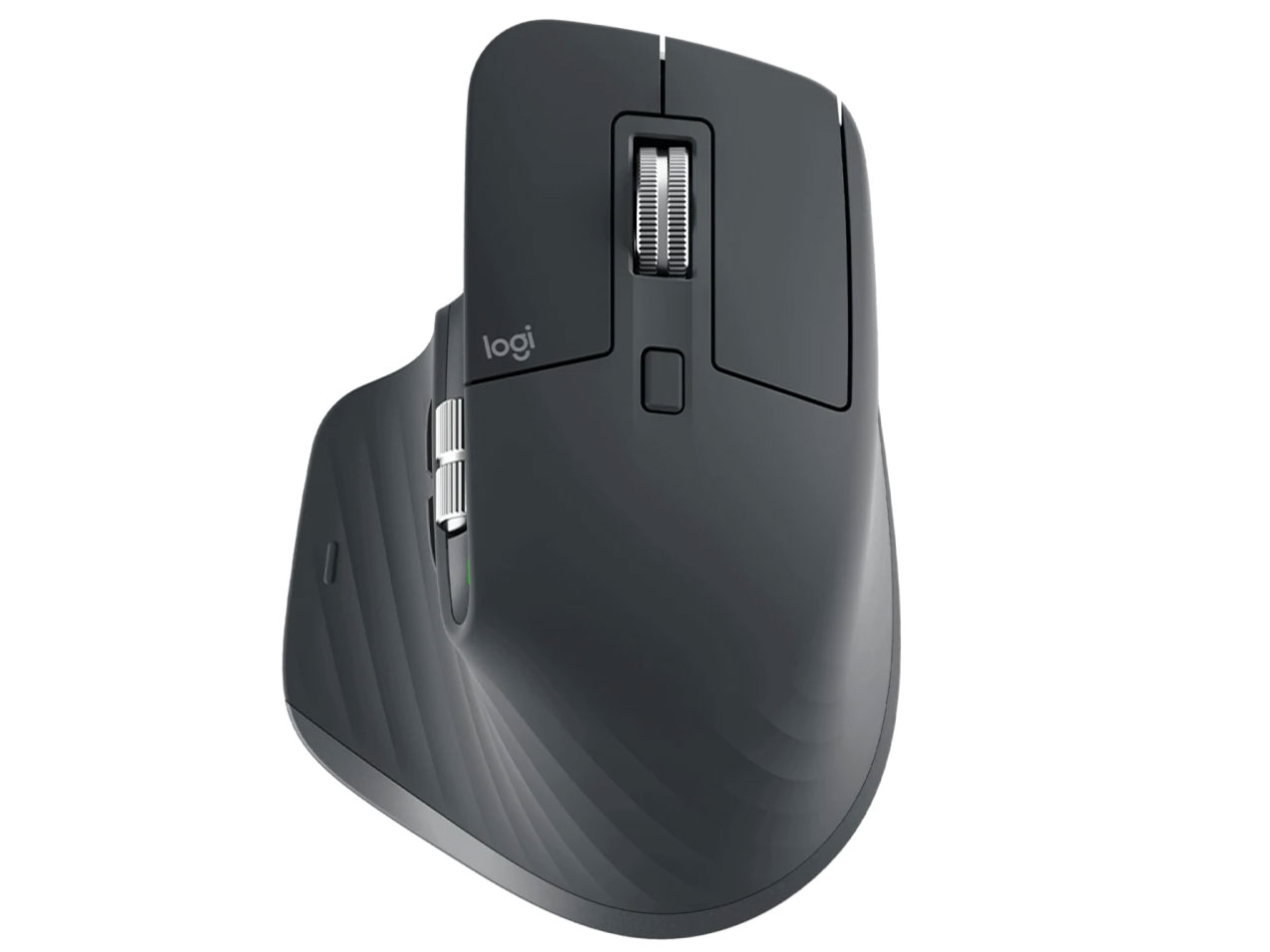
Logicool MX Master 3S — 141g productivity mouse, MagSpeed electromagnetic scroll wheel (free-spin and ratchet modes, approximately 1000 lines per second free-spin speed), 8000 DPI sensor with glass surface calibration, Logi Flow multi-device switching up to three computers, Logi Bolt 2.4GHz dongle and Bluetooth dual-mode, USB-C charging, up to 70 days battery per charge. Available at major online retailers. 141g weight makes it unsuitable for competitive gaming and fatiguing for fast-movement gaming sessions; the MagSpeed electromagnetic scroll wheel requires an adjustment period and some users never adapt to the free-spin mode feeling; Logi Options+ background software is required for full customization and runs persistently; its mid-range price is meaningful for a mouse that provides no advantage in competitive gaming contexts.
The Logicool MX Master 3S is the productivity powerhouse for users who spend more time in spreadsheets, long documents, and browser tabs than in games. The MagSpeed electromagnetic scroll wheel covers approximately 1000 lines per second in free-spin mode and ratchets cleanly for precise document navigation, while Logi Flow handles cursor movement and clipboard sharing across up to three computers. The 8000 DPI sensor includes glass-surface calibration, which is genuinely relevant for the glass-topped desks common in home offices. Up to 70 days battery life per charge and dual-mode Logi Bolt 2.4GHz plus Bluetooth complete the office package. The honest tradeoffs: 141g is more than double the competitive mice and unsuitable for fast-tracking FPS gaming, and the MagSpeed free-spin mode requires an adjustment period.
Pros
- ✓MagSpeed electromagnetic scroll wheel for document and spreadsheet work
- ✓Logi Flow multi-device switching across up to three computers
- ✓8000 DPI sensor with glass surface calibration
- ✓Up to 70-day battery life per charge
Cons
- ✗141g weight is unsuitable for competitive gaming
- ✗Logi Options+ background software required for full customization
Subscribe to our newsletter
Occasional updates and new releases — no spam.
Logitech G604 LIGHTSPEED — large wireless gaming mouse with dual LIGHTSPEED 2.4GHz and Bluetooth connectivity, HERO 25K optical sensor, 15 programmable controls (including six thumb buttons), and a single-AA battery rated for very long runtime. Suited to MMO/MOBA players and productivity-plus-gaming users who want many buttons and long battery life. Tradeoffs: larger and heavier than a dedicated FPS mouse, the single-AA design adds weight, and the shell is utilitarian rather than premium.
The Logitech G604 LIGHTSPEED is a large wireless mouse built around button count and battery life rather than minimal weight. It pairs over both LIGHTSPEED 2.4GHz and Bluetooth, carries the HERO 25K sensor shared with Logitech's flagship gaming line, and exposes 15 programmable controls including six thumb buttons — enough to bind a full MMO action bar or a deep set of productivity macros. A single AA battery powers it for very long stretches, so charging is rarely a concern. The honest tradeoffs: it is larger and heavier than a dedicated FPS mouse, the single-AA design adds a little mass, and the textured shell is utilitarian rather than premium. For twitch FPS aim you want something lighter, but for button-heavy workflows it is a strong, widely available pick.
Pros
- ✓15 programmable controls including six thumb buttons
- ✓Dual LIGHTSPEED 2.4GHz and Bluetooth wireless
- ✓HERO 25K optical sensor shared with Logitech's flagship mice
- ✓Very long battery life on a single AA cell
Cons
- ✗Larger and heavier than a dedicated FPS mouse
- ✗Single-AA design adds weight versus a built-in battery
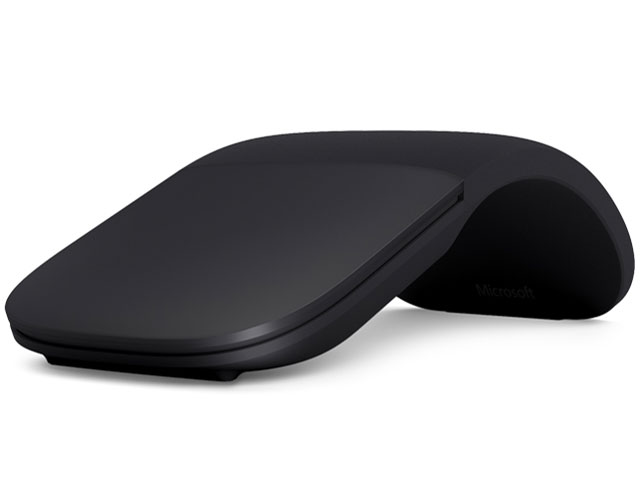
Microsoft Arc Mouse — ultra-thin foldable Bluetooth travel mouse, capacitive touch scroll strip (no physical scroll wheel), Bluetooth 5.0, approximately one-year battery life on two AAA batteries, folds flat to approximately 7mm thickness for bag carry, works on most surfaces, instant pairing with Surface and Windows devices. Available at major online retailers. Bluetooth-only with no 2.4GHz dongle option — susceptible to interference in RF-crowded environments and higher latency than dongle wireless; the capacitive touch scroll strip provides no tactile feedback and requires intentional gesture rather than passive scroll, which some users never adapt to; not suitable for gaming of any kind — the click mechanism has limited tactile feedback and the shape is not optimized for rapid pointer movement; the fold hinge mechanism has documented wear failure at 2–3 years of frequent travel use; the asymmetric arc shape is a size fit issue for users with larger hands.
The Microsoft Arc Mouse solves a specific portability problem that no other mouse in this comparison addresses — folding flat to approximately 7mm thickness so it disappears into a bag without pressing against laptops, notebooks, or chargers. The capacitive touch scroll strip replaces a physical scroll wheel and works reliably for browser navigation and document scrolling once you adapt to the gesture rather than passive scroll. Bluetooth 5.0 pairs instantly with Surface and Windows devices, and two AA batteries deliver approximately one year of typical use without recharging. It is a budget-priced travel mouse. The honest tradeoffs: Bluetooth-only means higher latency than 2.4GHz dongle wireless and worse RF performance in crowded environments, the touch scroll strip has no tactile feedback so some users never adapt, and the fold hinge has documented wear issues at the 2-3 year mark with frequent travel.
Pros
- ✓Folds flat to approximately 7mm thickness for bag carry
- ✓Bluetooth 5.0 instant pairing with Surface and Windows devices
- ✓About one year battery life on two AA batteries
- ✓Capacitive touch scroll strip for browser and document navigation
Cons
- ✗Bluetooth-only — higher latency than 2.4GHz dongle wireless
- ✗Fold hinge mechanism has documented wear at 2-3 years of frequent use
Which one is right for you?
For competitive FPS and pro esports aspirations
Logicool G Pro X Superlight 2
60g HERO 25K body with 2000Hz LIGHTSPEED matches the most complete competitive specification used by tournament pros.
For right-hand ergonomic gaming on a tight budget
Razer DeathAdder V3
Proven DeathAdder palm-grip shape at 59g and a budget price offers the strongest price-to-performance ratio for medium-to-large hands.
For spreadsheet-heavy office and multi-device work
Logicool MX Master 3S
MagSpeed scroll wheel and Logi Flow multi-device switching make long documents and three-computer workflows genuinely faster.
For MMO/MOBA and productivity users who want many buttons
Logitech G604 LIGHTSPEED
Fifteen programmable controls, dual wireless, and long single-AA battery life suit button-heavy gaming and work.
For frequent business travel and bag-carry minimalism
Microsoft Arc Mouse
Fold-flat 7mm thickness and one-year AA battery life make it the only mouse that disappears into a travel bag.
How we compared
We did not run independent sensor tracking accuracy tests under controlled conditions. We did not measure click latency with high-speed capture equipment. We did not conduct switch endurance testing to rated click cycle counts — Razer and Logicool publish rated lifetimes, but verification requires dedicated testing rigs unavailable here. Meaningful mouse testing for competitive use requires a standardized aim trainer setup, consistent surface, controlled lighting, and multiple testers with different grip styles — none of which are available here.
Instead, we relied on manufacturer specifications and published sensor datasheets — specifically PixArt's published specifications for the PMW3395 and similar sensors underlying the HERO 25K and Focus Pro 30K implementations, Logicool's published MagSpeed specifications for the MX Master 3S electromagnetic scroll mechanism, and Microsoft's published specifications for the Arc Mouse's capacitive scroll strip. We cross-referenced these with independent measurements and testing from peripheral review media and international sources. We aggregated long-term verified buyer reviews from major online retailers with specific attention to sensor stuttering reports, wireless dropout frequency, shape fatigue over multi-hour sessions, and scroll wheel durability complaints.
One framing point before the products: this comparison spans four meaningfully different use cases — competitive gaming (G Pro X Superlight 2), ergonomic gaming (DeathAdder V3), productivity (MX Master 3S), high-button-count wireless (Logitech G604 LIGHTSPEED), and travel (Arc Mouse). A competitive FPS player and a document-heavy office worker have almost no shared requirements in a mouse. Each product is described in terms of what it does well in its intended context and what it does poorly outside of it. There is no single best mouse here.
Sensor performance — DPI vs tracking accuracy
DPI — dots per inch — is the most visible specification in gaming mouse marketing and one of the least meaningful for actual performance decisions above approximately 3200 DPI. DPI describes how far the cursor moves on screen per inch of physical mouse movement. A 30,000 DPI maximum — like the Razer DeathAdder V3's Focus Pro 30K — does not mean the sensor tracks more accurately than a 25,600 DPI sensor. It means the marketed maximum sensitivity setting is higher, which most users will never configure above 1600–3200 DPI for desktop use or 400–1600 DPI for FPS gaming.
What matters for tracking accuracy is the sensor's ability to track consistently at the sensitivity you actually use, across different surface types, at different movement speeds, and without acceleration artifacts or prediction smoothing that alter where the cursor ends up relative to where you physically moved the mouse. The HERO 25K sensor in the G Pro X Superlight 2 and the Focus Pro 30K in the DeathAdder V3 are both top-tier optical sensors with consistent tracking performance across tested surfaces according to published data — the numerical DPI difference is a marketing differentiation, not a meaningful performance gap at typical gaming sensitivities. The MX Master 3S's 8000 DPI sensor is calibrated for productivity use — precise cursor placement across high-DPI displays at desk speeds — not the fast multi-directional movements of competitive FPS gaming.
Surface matters more than sensor tier for most users. Both the G Pro X Superlight 2 and DeathAdder V3 will track accurately on most cloth and hard gaming pads. The MX Master 3S includes surface-specific calibration and is one of the few mice that tracks reliably on glass — relevant for glass desk surfaces common in home offices. The Logitech G604 shares the same HERO 25K sensor family as Logitech's flagship gaming mice, so its tracking is well documented; the Arc Mouse's touch scroll strip handles scrolling via capacitive gesture rather than a traditional encoder, which is a meaningful design difference from every other product in this comparison.
Weight and form factor — why 60g matters
The push toward lighter gaming mice in the past four years is not marketing — it has a mechanical basis. Lighter mice require less force to accelerate and decelerate during rapid cursor movements. In practice, this means flick shots and tracking corrections can be made with less arm and wrist movement, reducing fatigue over multi-hour gaming sessions and marginally improving the consistency of fast movements for skilled players. The 60g threshold has become the de facto benchmark for 'ultra-light' in competitive gaming hardware.
The G Pro X Superlight 2 at 60g and the DeathAdder V3 at 59g both sit at this competitive threshold — but they achieve it with different design priorities. The G Pro X Superlight 2 uses a symmetrical right-hand-biased ambidextrous-adjacent shape with no side buttons, which keeps the weight down at the cost of macro functionality. The DeathAdder V3 uses Razer's proven ergonomic right-hand shape optimized for medium-to-large hands with a palm or relaxed claw grip — the familiar hump behind the sensor area provides active wrist support during extended play.
The Logicool MX Master 3S at 141g sits at the opposite end of the weight spectrum — more than double the competitive mice. For productivity use, 141g is not a problem: office mouse movements are slower and more deliberate, and the MX Master 3S's mass actually contributes to stable, precise cursor control during slow document navigation. For gaming, 141g is a significant weight that would make fast tracking movements fatiguing. The Logitech G604 is a larger, heavier wireless mouse built for palm grip and a high side-button count rather than minimal weight, which suits MMO/MOBA play and long sessions more than twitch FPS aim. The Arc Mouse is designed to be thin enough to fold flat and disappear into a bag — the travel form factor is the primary feature, not gaming performance.
Wired vs wireless — latency reality in 2026
The wireless latency gap between a high-quality 2.4GHz gaming mouse and a wired USB connection has effectively closed for all practical purposes in 2026. Current-generation 2.4GHz implementations — including Logicool's LIGHTSPEED used in the G Pro X Superlight 2 — report latencies below 1ms, which is indistinguishable from wired USB connections even in competitive gaming contexts. The performance argument for wired-only gaming mice was legitimate in 2019–2021 and has since been resolved by the current generation of wireless protocols.
The distinction that remains meaningful is between 2.4GHz and Bluetooth. Bluetooth latency — used in both the MX Master 3S (Bluetooth + Logi Bolt 2.4GHz options) and the Arc Mouse (Bluetooth only) — is typically higher than 2.4GHz dongle connections, though modern Bluetooth 5.x implementations have reduced this gap significantly for productivity and casual use. The Arc Mouse is Bluetooth-only, which makes it unsuitable for competitive gaming but perfectly adequate for document work, spreadsheets, and casual browser navigation where millisecond-level input differences have no practical consequence.
The Razer DeathAdder V3 base model is wired-only — the wireless version is the V3 HyperSpeed, a separate product at a higher price. This is an important distinction: buyers expecting a wireless option from the entry-level DeathAdder V3 need to either budget for the HyperSpeed variant or accept USB-C cable management. For desktop gaming, wired is not a disadvantage in any functional sense — cables can be routed with a bungee to eliminate drag. For users who prefer a clean desk, the wired constraint is real.
Polling rate wars — 1000Hz vs 2000Hz vs 8000Hz
Polling rate describes how frequently the mouse reports its position to the computer — 1000Hz means 1000 position reports per second (every 1ms), 2000Hz means every 0.5ms. The G Pro X Superlight 2 supports up to 2000Hz polling via a firmware update; some competing products advertise 8000Hz polling. The question of whether high polling rates produce perceptible improvements for non-professional players has a reasonably clear answer from independent testing: at 1000Hz, the interval between reports is 1ms. At 2000Hz, it is 0.5ms. The perceptual threshold for mouse response lag in human motor control research is approximately 5–15ms — well above both thresholds.
For the vast majority of users, the difference between 1000Hz and 2000Hz polling is not perceptible during actual play. The G Pro X Superlight 2's 2000Hz support and competing products' 8000Hz claims are engineering benchmarks and marketing differentiators. There is a small population of professional esports players with the refined motor control to potentially perceive differences at these margins. For home users, the relevant question is whether their PC can handle the increased CPU load of processing 2000+ position reports per second without frame rate impacts — on modern hardware, this is not a concern for most desktop configurations.
More practically: polling rate matters less than sensor consistency, surface compatibility, and your personal sensitivity and DPI settings. A player with misconfigured in-game sensitivity running a mouse at 8000Hz will not outperform a well-configured player at 1000Hz. The G Pro X Superlight 2's 2000Hz is a reasonable engineering milestone; it is not a competitive necessity for players below the top 0.1% of ranked play.
What changed in 2026
Ultra-lightweight is now the competitive baseline. The 60g threshold that the original G Pro X Superlight established as premium in 2021 is now the starting point for any mouse marketed at competitive gaming. Competitors including the DeathAdder V3 at 59g match or beat this figure while maintaining ergonomic shapes — the engineering challenge has shifted from 'can a mouse hit 60g?' to 'can it hit 50g while keeping meaningful shape and battery life?' The sub-50g category exists but remains limited in market availability and shape variety.
Hot-swappable switches have moved from enthusiast modification to mainstream product feature. Both Logicool and Razer now offer select models with user-replaceable optical switches, acknowledging that switch feel is a preference variable and that 60–80 million click rated lifetimes, while substantial, are finite over multi-year heavy gaming use. This represents a shift from 'the switch fails, replace the mouse' to 'the switch fails, replace the switch' — a practical durability improvement that reduces long-term cost of ownership for heavy users.
The wireless quality gap with wired has closed for competitive use. The argument for wired gaming mice that dominated enthusiast advice from 2016 to 2021 has largely ended — not because wired became worse but because 2.4GHz wireless implementations improved to where the latency difference is unmeasurable in practice. The used gaming peripheral market has grown substantially, creating a viable path to acquiring previous-generation competitive mice at significant discounts — the G Pro X Superlight 1 and original DeathAdder V3 are frequently available at 30–50% below new retail, which represents strong value for casual-to-intermediate players.
Where each fits
Competitive FPS and multiplayer gaming — maximum sensitivity, minimum weight, top-tier 2.4GHz wireless, 2000Hz polling, professional esports pedigree: Logicool G Pro X Superlight 2. Used by professional esports players across major tournaments, the combination of HERO 25K sensor, LIGHTSPEED wireless, and 60g weight represents the most complete competitive specification in this comparison. Available at major online retailers. It is premium pricing for a mouse — the G Pro X Superlight 1 can be found used at a lower price with virtually identical sensor performance; right-hand-only shape with no left-hand variant; zero side buttons makes macro and browser navigation functionality absent; 95-hour battery life is shorter than some competitors at similar prices; the minimal shape without pronounced ergonomic contouring can cause fatigue in players with larger hands during very long sessions.
Ergonomic right-hand gaming, medium-to-large hand palm or relaxed claw grip, budget-conscious competitive entry: Razer DeathAdder V3. The DeathAdder shape has 20+ years of refinement history for right-hand ergonomic gaming and represents the best price-to-performance ratio in this comparison for players with medium-to-large right hands. Available at major online retailers. budget-priced wired-only base model — the wireless V3 HyperSpeed costs more; right-hand-only shape excludes left-hand users entirely; the Focus Pro 30K's 30,000 DPI maximum is marketing headroom that no user configures above 3200; the DeathAdder shape, while proven for palm grip, can feel large for small-hand fingertip grip users; less prestige than the G Pro X Superlight in professional esports contexts.
Productivity, multi-device work, document navigation, glass desk surfaces, USB-C charging, Flow multi-computer workflow: Logicool MX Master 3S. For users who spend more time in spreadsheets, long documents, and browser tabs than in games, the MagSpeed electromagnetic scroll wheel and Flow cross-device switching make the MX Master 3S the most capable productivity mouse in this comparison. Available at major online retailers. 141g makes it unsuitable for competitive gaming and fatiguing for rapid extended gaming sessions; the MagSpeed scroll wheel requires an adjustment period — some users find the free-spin mode disorienting before adaptation; Logi Options+ software is required for full button customization and is not particularly lightweight as a background application; its mid-range price is meaningful spending for a mouse that is not competitive-gaming capable.
Many programmable buttons, long battery life, dual wireless, palm-grip comfort for MMO/MOBA and productivity: Logitech G604 LIGHTSPEED. It pairs over both LIGHTSPEED 2.4GHz and Bluetooth, runs on a single AA battery for very long stretches, and exposes 15 programmable controls including six thumb buttons. The honest tradeoffs: it is larger and heavier than a dedicated FPS mouse, the single-AA design adds a little weight versus a built-in cell, and the textured plastic shell is more utilitarian than premium.
Travel, business trips, clean bag carry, Surface and Windows pairing, one-year battery, minimal desk footprint: Microsoft Arc Mouse. The Arc Mouse's fold-flat mechanism solves a specific problem — carrying a mouse in a bag without it taking up meaningful space or pressing against other items — that no other product in this comparison addresses. Available at major online retailers. Bluetooth-only means no 2.4GHz reliability and higher latency than dongle wireless; the touch scroll strip lacks the tactile feedback of a physical scroll wheel and requires intentional gesture rather than passive scroll; not suitable for precision gaming of any kind; the fold hinge mechanism has reported wear issues over 2–3 years of frequent travel use — this is not a forever mouse; small hand cutout shape may not suit all palm sizes for extended desk use.
Verdict
For competitive gaming where money is not the primary constraint and you want the most complete specification — ultra-light, top sensor, 2000Hz polling, professional wireless: G Pro X Superlight 2. Accept the premium price and the zero-side-button tradeoff. If budget is the constraint, look at the previous generation G Pro X Superlight 1 on the used market first.
For competitive or enthusiast gaming with a right-hand palm grip on a budget: Razer DeathAdder V3. The shape is proven over decades for medium-to-large right hands, the Focus Pro 30K sensor is competitive-grade, and the wired constraint is a non-issue if you use a mouse bungee or don't mind cable management.
For office and productivity work with multi-device setups, long document navigation, and glass desk surfaces: Logicool MX Master 3S. The MagSpeed wheel alone justifies the price for users who scroll through long documents or large spreadsheets daily. It is not a gaming mouse and should not be evaluated as one.
For players who want many programmable buttons, dual wireless, and long battery life in a palm-grip shell — MMO/MOBA players and people who blend gaming with productivity: Logitech G604 LIGHTSPEED. It is not the choice for twitch FPS players chasing the lightest possible mouse, but for button-heavy workflows and long sessions it is a practical, widely available option.
For frequent travelers who need a mouse that disappears into a bag and works reliably with Surface and Windows devices via Bluetooth: Microsoft Arc Mouse. Set expectations correctly: it is a travel convenience accessory, not a performance peripheral. The fold mechanism is clever and the one-year battery life is genuinely practical. Use it for what it is designed for.
One note that applies across all five: grip style and hand size interact with mouse shape in ways that specs cannot convey. The right-hand-only shapes of both the G Pro X Superlight 2 and DeathAdder V3 require you to actually be right-handed, and within that, fingertip grip users and palm grip users will experience the same mouse differently. If you can try a shape in a physical store before purchasing, it is worth doing so.
Frequently asked questions
What DPI should a beginner set their gaming mouse to?▼
Is a wireless gaming mouse reliable enough for competitive play in 2026?▼
Can a gaming mouse be used for office work, or should I have separate mice for gaming and office?▼
Which grip style — palm, claw, or fingertip — should I use?▼
Is a mousepad necessary for gaming mice?▼
Is the Japanese gaming mouse market different from global markets?▼
Prices change. Check the retailer for the current price.
Comments & questions
Discussion happens on nattzy, our community forum. Sign in with Google to post — it takes a second.
Related articles

Best Gaming Monitors 2026: LG vs Samsung Odyssey vs ASUS

Best VPN 2026: 5 compared
Best LED Face Masks 2026: 3 Light Therapy Devices Compared
Best Robot Vacuums 2026: 5 Models Compared Honestly
Best Hair Dryers 2026: 5 high-end models compared honestly
Food
Best Rice Cookers 2026: 5 Top Models Compared
Best Rice Cookers 2026: 5 Top Models Compared