Best Hack Squat Machine 2026: 5 Compared
Hack squat machines are not separated by their maximum load — at home you will almost never reach it. They are separated by the carriage angle and by whether the thing actually fits in your room.
We did not run our own testing on any of these products. Doing it honestly would need an instrumented enclosure for the catios, a calibrated wet-bulb rig for the evaporative coolers, and a loaded sled with a force plate for the hack squat machines — none of which we have. What we did instead: pulled every published specification from each manufacturer's own product page and manual, cross-checked current pricing against major retailer listings, and read owner reviews at volume, filtering for reports that describe a measurable failure or a repeated complaint rather than a first-week impression. Where a number is a manufacturer claim rather than an independent measurement, we say so in the text.

Body-Solid GLPH1100
🏆 Best overall: The GLPH1100 is the pick because it solves two problems with one footprint: it is a hack squat and a leg press, and converting between them means moving the back pad and the footplate rather than rebuilding anything. The 11-gauge 2x3-inch mainframe is the other reason — it does not flex or rattle at weights well below its rated limit, which is what you actually feel.
Top picks ↓| Product | Price | Link |
|---|---|---|
| $1,300〜$1,900 | View deal → | |
| $800〜$1,200 | View deal → | |
| $1,100〜$1,600 | View deal → | |
| $600〜$950 | View deal → | |
| $1,400〜$2,200 | View deal → |
Top picks
Related articles
.png?v=1640040616)

Body-Solid GLPH1100
Body-Solid sells the GLPH1100 with and without the calf block; confirm which the listing includes.
The GLPH1100 is the pick because it solves two problems with one footprint: it is a hack squat and a leg press, and converting between them means moving the back pad and the footplate rather than rebuilding anything. The 11-gauge 2x3-inch mainframe is the other reason — it does not flex or rattle at weights well below its rated limit, which is what you actually feel. It is large and the assembly is long.
Pros
- ✓Hack squat and leg press in one footprint
- ✓11-gauge mainframe is genuinely rigid under load
- ✓Quick conversion between the two movements
Cons
- ✗Large footprint even for a combo machine
- ✗Long assembly
- ✗Heavier than one person should move alone

Titan Fitness Plate-Loaded Hack Squat
Titan revises this frame periodically — check the current listing photos rather than older reviews.
The Titan is the dedicated sled at the price where combination machines are not yet an option. Fixed carriage angle, linear bearings and multiple safety catch positions cover the fundamentals, and dropping the leg press conversion is what buys the lower price and the smaller footprint. Fit and finish is the compromise, and shipping damage is the recurring theme in owner reports — inspect the boxes on delivery.
Pros
- ✓Dedicated sled at a low price
- ✓Linear bearings, smooth travel
- ✓Multiple safety catch positions
Cons
- ✗No leg press conversion
- ✗Finish quality is inconsistent
- ✗Shipping damage reported more often than average

Powertec Compact Leg Sled
Powertec's compact and full-size sleds share naming; match the stated footprint.
The Compact Leg Sled is the answer when the room is the binding constraint. It runs both hack squat and leg press patterns in a frame designed to fit a single garage bay, which is a real engineering achievement in this category. The trade is honest and unavoidable: the carriage travel is shorter than a full-size machine, so the range of motion at the bottom is reduced.
Pros
- ✓Fits a single garage bay
- ✓Both hack squat and leg press patterns
- ✓Well-finished for the price
Cons
- ✗Shorter carriage travel limits range of motion
- ✗Not as rigid as the Body-Solid
- ✗Loading pegs are tight for wide plates
Subscribe to our newsletter
Occasional updates and new releases — no spam.
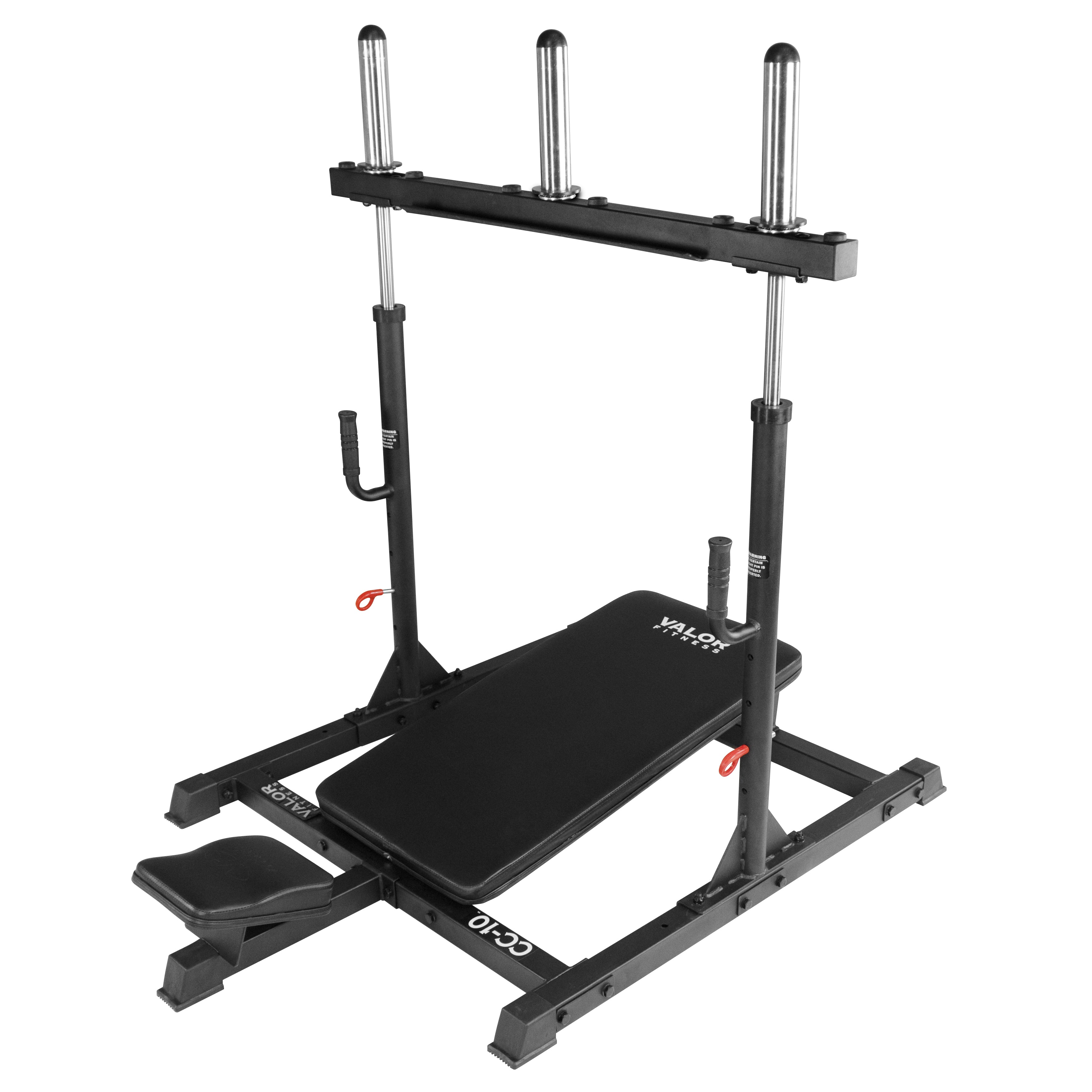
Valor Fitness CC-10
The CC-10 ships in multiple boxes that can arrive separately; confirm all boxes before assembly.
The CC-10's distinguishing feature is that the carriage runs outside the uprights, so the bar path clears the body and the same frame handles deadlift and shrug patterns as well as hack squats. That versatility is the reason to choose it. The steel is lighter gauge than the Body-Solid and you can feel it — there is more flex and more noise at the top of a heavy set.
Pros
- ✓Hack squat, deadlift and shrug on one frame
- ✓Carriage outside the uprights clears the body
- ✓Lower price than the combo machines
Cons
- ✗Lighter-gauge steel flexes noticeably
- ✗Noisier under load
- ✗Shoulder pads are thin
TDS Premier Hack Squat
Freight delivery is typically kerbside — arrange help for moving it inside.
The TDS is built to gym-floor standards — heavy-gauge uprights, a wide deeply knurled footplate, and the solidity that follows from both. If you train heavy and want the machine to feel like the one at a commercial gym, this is it. The corollary is dimensional: it is sized for a gym floor, so check ceiling height and door width before ordering rather than after.
Pros
- ✓Commercial-grade rigidity
- ✓Wide, deeply knurled footplate
- ✓Feels like a gym-floor machine
Cons
- ✗Sized for a gym, not a spare room
- ✗Expensive
- ✗Hack squat only — no leg press conversion
Measure the room before you compare the machines
This is the step most buyers skip and the one that most often ends in a return. A full-size hack squat sled is long, and the length that matters is not the frame length but the length plus the space a person needs to load plates at the back and step clear at the front. Add roughly two feet at each end to the stated footprint.
Ceiling height matters less than on a Smith machine but is not free — the carriage sits at an angle and the top of the shoulder pads at full extension is higher than the frame's static height. A basement with ducts at seven feet will rule out the taller commercial frames.
The last dimension is the doorway. These machines ship as heavy freight in several boxes and are assembled in place, which is fine, but the assembled frame cannot usually be moved through a standard interior door afterwards. Decide where it lives before it arrives.
Carriage angle and footplate position decide how it feels
The angle of the carriage rails relative to the floor sets how much of the load runs through the quadriceps versus the hips. A steeper angle biases quads more; a shallower angle allows more hip involvement and generally lets a lifter use more weight. Most fixed machines are somewhere around 45 degrees, and none of the machines in this group let you change it.
Footplate position is what you can change, and it does most of the work. Feet higher on the plate shifts load toward the glutes and hamstrings and reduces knee flexion; feet lower and closer together biases quads and increases knee travel. A large plate with deep knurling is worth more than an extra hundred pounds of rated capacity, because it is the adjustment you will make every session.
Combination machines that also do leg press change the effective angle when you convert, which is a genuine advantage in movement variety and the main argument for the Body-Solid over a dedicated sled.
Plate-loaded vs the rated capacity number
Every machine here is plate-loaded rather than selectorised, which is normal in this category and keeps the price down. Rated capacities in the specifications run from several hundred to over a thousand pounds, and for home use this number is close to irrelevant — the practical ceiling is how many plates physically fit on the pegs, and how many plates you own.
What the steel gauge does affect is rigidity and noise. The 11-gauge 2x3-inch mainframe on the Body-Solid does not flex or rattle under load in the way lighter-gauge frames do. That difference is felt at moderate weights, well below any rated limit, and it is the honest reason to spend more.
Linear bearings versus bushings is the other build distinction. Bearings run smoother and quieter and cost more; bushings are serviceable and cheaper and develop a small amount of play over time. Neither is unsafe. The bearing machines simply feel better on the descent.
Safety catches, and what to check on delivery
The safety catch mechanism is the part to inspect carefully, because it is the part you rely on at failure. Look for multiple catch positions along the travel rather than one fixed stop, and for a rotating handle that engages positively rather than a hook that must be aligned by feel. Being able to set the catch at a height you can reach while under load, without letting go, is the point.
On delivery, before adding weight: check that the carriage runs the full travel smoothly by hand, that both catch handles engage at every position, and that the frame does not rock on the floor. Frame twist from shipping is not rare and is far easier to correct before the machine is fully torqued down.
Owner reviews across this category converge on two complaints — assembly instructions and shipping damage — rather than on the machines' behaviour in use. Budget several hours and inspect the boxes before the courier leaves.