Best Electric Shaver 2026: 5 models compared honestly
Five electric shavers — the flagship Philips Series 9000 Prestige SP9883 with SenseIQ that reads beard density 125 times per second and 360-degree contour-following heads, the Braun Series 9 Pro+ 9. The decision comes down to one or two factors — the rest is noise.
Quick answer
For multi-directional beard growth, the Philips Series 9000 Prestige SP9883 is the pick — SenseIQ reads beard density 125 times per second and its 360-degree heads follow contours foil shavers fight. Choose the Braun Series 9 Pro+ 9565cc for dense daily beards, with five shaving elements and a Clean&Charge station; the Panasonic Lamdash ES-LS9A to skip recurring cartridge costs; and the Philips Series 5000 SP5588 for the cheapest rotary entry.
We evaluated each product on ingredient transparency, dermatological track record, real-user outcome consistency, packaging quality, and value per use.

Philips Series 9000 Prestige SP9883
Best Adaptive Rotary: The Series 9000 Prestige SP9883 is Philips' premium answer to multi-directional beard growth. SenseIQ reads beard density 125 times per second and adjusts motor power in real time, the three rotating heads pivot independently with a 360-degree contour range, and the AquaTouch wet/dry certification supports foam, gel, and in-shower use.
Top picks ↓| Product | Price | Link |
|---|---|---|
| $299Price as of 2026-09-23 | ||
| — | No partner store here — this opens an Amazon search. | |
| $280Reference price | ||
| $93.99Price as of 2026-09-23 | ||
| — |
Top picks
Related articles


Philips Series 9000 Prestige SP9883
Philips' flagship rotary shaver with SenseIQ technology that reads beard density 125 times per second and adjusts motor power in real time. Three shaving heads follow contours independently with 360-degree pivot range. Wet/dry certified for foam and gel use. Universal voltage (100–240 V). A flagship-priced model and a significant investment; rotary technology generally cuts less close on flat cheek areas than foil; round heads accumulate foam residue in the head-ring gap more than foil designs; SH98 replacement heads are among the priciest per year for daily users.
The Series 9000 Prestige SP9883 is Philips' premium answer to multi-directional beard growth. SenseIQ reads beard density 125 times per second and adjusts motor power in real time, the three rotating heads pivot independently with a 360-degree contour range, and the AquaTouch wet/dry certification supports foam, gel, and in-shower use. Universal 100-240 V means it travels anywhere. Rotary geometry suits men whose neck and jaw growth changes direction in ways that foil shavers fight against. The trade-off you accept: rotary generally cuts less close on flat cheek areas than foil, the round head-and-ring gap traps foam residue that needs prompt rinsing, and the SH98 replacement heads sit at the top of the blade-cost range.
Pros
- ✓SenseIQ reads beard density 125 times per second and adjusts power in real time
- ✓Three rotating heads with 360-degree contour range suit multi-directional growth
- ✓Wet/dry certified for foam, gel, and in-shower shaving
- ✓Universal 100-240 V voltage support for international use
Cons
- ✗Rotary cuts less close on flat cheeks than foil designs
- ✗SH98 replacement heads are the highest blade cost in this comparison
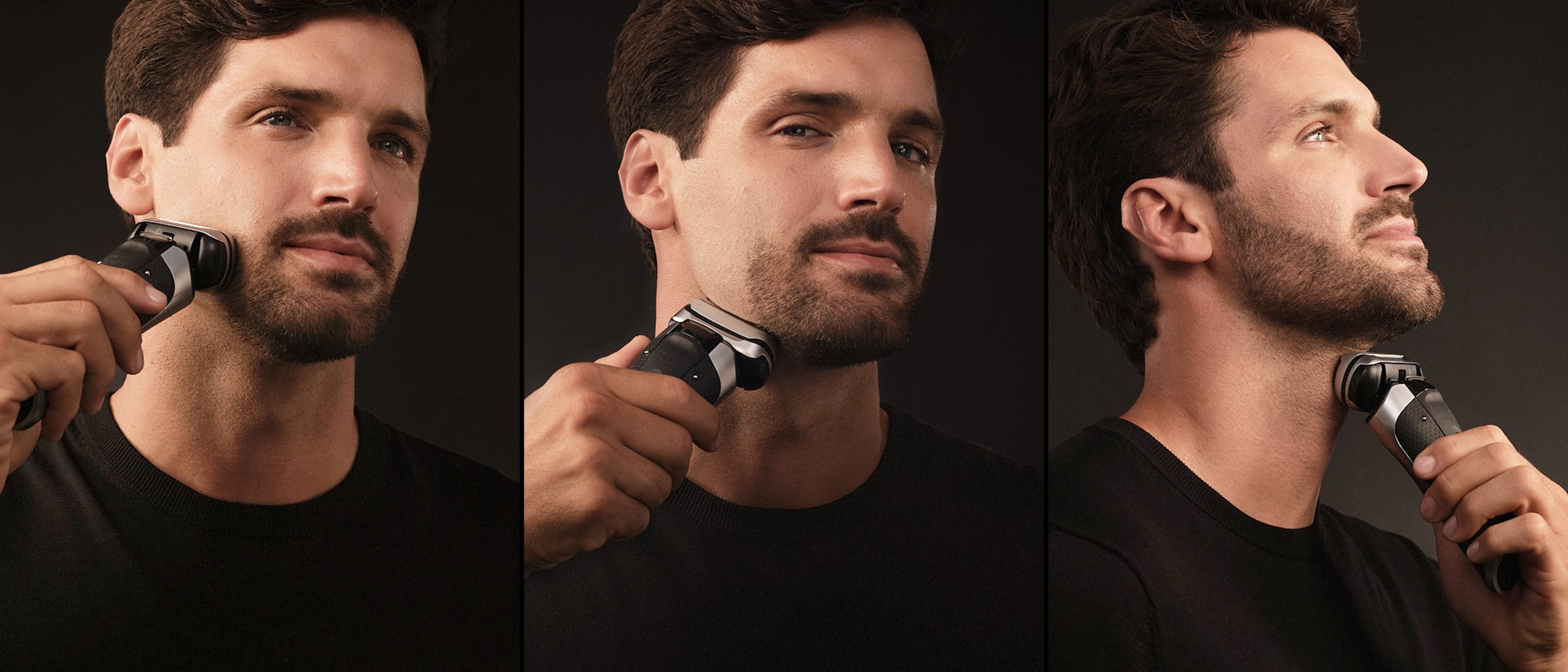
Braun Series 9 Pro+ 9565cc
Braun's most capable foil shaver with five shaving elements: three foil patterns for standard hair, the ProLift trimmer for flat-lying hairs that lie parallel to the skin and are typically missed by standard foil, and AutoSense motor that adjusts power to beard density to prevent pulling. The 9565cc includes the Clean&Charge station. A premium-priced bundle plus ongoing Clean&Charge cartridge costs; foil shavers handle reverse-grain neck growth less well than rotary; the cassette replacement is the highest blade-only cost in this comparison.
The Series 9 Pro+ 9565cc is the most capable foil shaver in this comparison and the right pick for dense or fast-growing beards. Five shaving elements — three foil patterns plus the ProLift trimmer for flat-lying hairs that other foil designs miss plus a trimmer element — combine with the AutoSense motor that reads beard density and adjusts power to prevent the pulling and tugging that defines a bad foil shave. The Clean&Charge station included in the 9565cc bundle handles cleaning, lubrication, and charging automatically with an alcohol-based fluid that prevents residue buildup. The honest trade-offs: cartridge refills add to total ownership cost, the 90B/92B replacement cassette is the highest blade-only cost here, and foil designs still fight neck growth with reverse grain in a way rotary does not.
Pros
- ✓Five shaving elements including ProLift for flat-lying hairs
- ✓AutoSense motor adjusts power to beard density to prevent pulling
- ✓Clean&Charge station included for automatic cleaning and lubrication
- ✓Strongest closeness on flat cheek areas in this comparison
Cons
- ✗Clean&Charge cartridge refills add a recurring cost to ownership
- ✗Foil design handles reverse-grain neck growth less smoothly than rotary
No partner store here — this opens an Amazon search.
Braun's Series 9 Pro foil shaver with a four-element cutting system that includes the ProLift trimmer for flat-lying hairs, full waterproofing for wet or dry shaving, and a long-lasting lithium battery. Commonly sold without the Clean&Charge station, which keeps recurring maintenance cost down. A mid-to-high-priced foil shaver with four cutting elements rather than the five on the Series 9 Pro+; foil shavers handle reverse-grain neck growth less smoothly than rotary; the bundled automatic-cleaning station of the Pro+ is not included.
The Braun Series 9 Pro is the default pick for buyers who want premium Braun foil performance without the recurring cost of the Clean&Charge cartridge cycle. The four-element cutting system includes the ProLift trimmer that catches flat-lying hairs, the body is fully waterproof for wet or dry shaving, and the lithium battery delivers a long runtime per charge. Because it commonly ships without the Clean&Charge station, total ownership cost stays below the Series 9 Pro+ and the Series 7 bundle. The trade-off you accept: four cutting elements rather than the five on the Series 9 Pro+, no bundled automatic-cleaning station, and the usual foil-shaver weakness on necks with reverse-grain growth.
Pros
- ✓Four-element cutting system with the ProLift trimmer for flat-lying hairs
- ✓Fully waterproof for wet or dry shaving
- ✓No recurring Clean&Charge cartridge cost when used without the station
- ✓Long-lasting lithium battery for extended runtime per charge
Cons
- ✗Four cutting elements rather than the five on the Series 9 Pro+
- ✗No bundled Clean&Charge station for automatic cleaning
Subscribe to our newsletter
Occasional updates and new releases — no spam.

Philips' budget AquaTouch wet-dry rotary shaver. Wet use certified for foam, gel, and shower shaving. Quick-dry design for use immediately after washing. SH52/SH53 replacement heads are the lowest blade cost in this comparison. two-head configuration is less adaptive on complex facial contours than the three-head Series 9000; no SenseIQ — fixed motor power means no adaptation to beard density; noticeably less capable on dense or fast-growing beards than the premium models; no clean-and-charge station option.
The Series 5000 SP5588 is the budget entry point to Philips rotary technology and the right pick for first-time electric shaver buyers who specifically want rotary over foil. AquaTouch wet/dry certification supports foam, gel, and in-shower use, the quick-dry design lets you reach for it immediately after washing, and the SH52/SH53 replacement head is the lowest blade cost in this comparison. The two-head configuration is less adaptive on complex contours than the three-head Series 9000, SenseIQ is absent (so motor power does not adapt to beard density), and there is no Clean&Charge option. For a buyer who wants to test whether rotary suits their beard before committing to the Series 9000 Prestige's flagship price, this is the rational first purchase.
Pros
- ✓AquaTouch wet/dry certified for foam, gel, and in-shower shaving
- ✓Quick-dry design enables use immediately after washing
- ✓Lowest replacement blade cost in this comparison
- ✓Cleanest budget entry point to Philips rotary technology
Cons
- ✗Two-head configuration less capable on complex contours than three-head Series 9000
- ✗No SenseIQ — fixed motor power means no adaptation to beard density
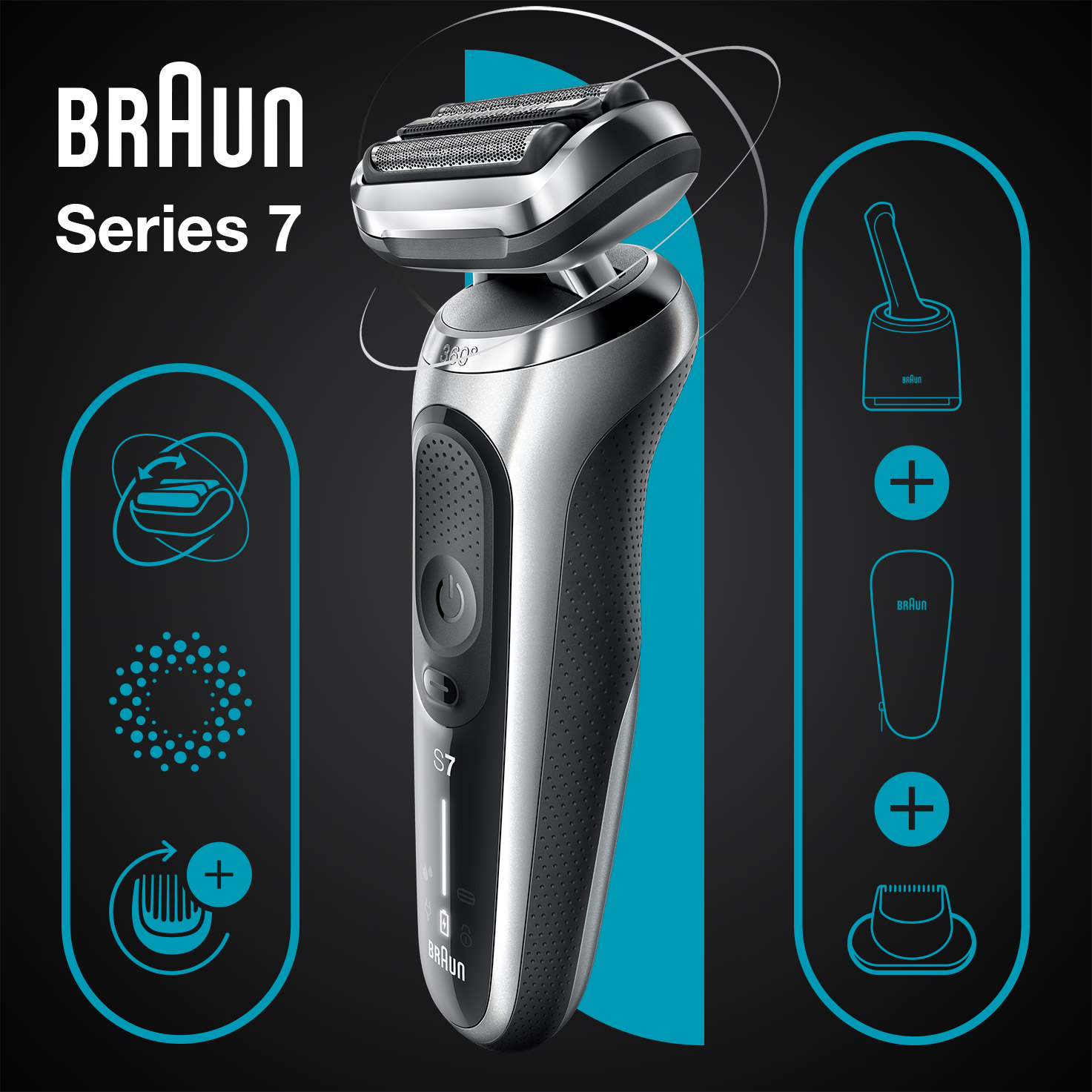
Braun's mid-range AutoSense foil shaver with the 7200cc bundle that includes a Clean&Charge station. Four shaving elements provide solid coverage for average to moderately dense beards. AutoSense reads skin and beard resistance and adjusts motor speed, which is the meaningful step-up from the Series 5 below it. four elements versus five on the Series 9 Pro+ means the ProLift for flat-lying hairs is absent; Clean&Charge cartridge costs add to total ownership cost; the 70B/70S cassette is a mid-range blade cost; the gap between Series 7 and Series 9 Pro+ performance is noticeable on dense beards.
The Series 7 71-S7200cc is Braun's mid-range AutoSense foil shaver and the right pick for buyers who want the adaptive motor intelligence and the Clean&Charge station without paying Series 9 Pro+ pricing. AutoSense reads skin and beard resistance and adjusts motor speed, which is the meaningful step-up from the Series 5 below it, and the 7200cc bundle includes the Clean&Charge station that handles cleaning, lubrication, and charging automatically. Four shaving elements provide solid coverage for average to moderately dense beards. The trade-offs: only four elements versus five on the Series 9 Pro+ means no ProLift for flat-lying hairs, Clean&Charge cartridge refills add a recurring cost, and the gap to the 9565cc on dense beards is real if your growth is heavy.
Pros
- ✓AutoSense motor reads skin and beard resistance and adjusts power
- ✓Clean&Charge station included in the 7200cc bundle
- ✓Solid four-element coverage for average to moderately dense beards
- ✓Step down from Series 9 Pro+ without losing adaptive motor intelligence
Cons
- ✗Four elements vs five — no ProLift trimmer for flat-lying hairs
- ✗Clean&Charge cartridge refills add a recurring cost to ownership
Which one is right for you?
For multi-directional beard growth and comfort over closeness
Philips Series 9000 Prestige SP9883
SenseIQ adaptive power and 360-degree pivoting rotary heads suit men whose neck and jaw growth changes direction in ways foil shavers fight against.
For dense, fast-growing beards on a daily schedule
Braun Series 9 Pro+ 9565cc
Five shaving elements including ProLift for flat-lying hairs and the included Clean&Charge station deliver the most complete foil coverage and lowest-friction maintenance in this comparison.
For buyers who want premium foil without recurring station costs
Braun Series 9 Pro
A four-element cutting system with the ProLift trimmer and full waterproofing, sold without the Clean&Charge cartridge cycle for the lowest ongoing cost in the premium tier.
For first-time electric shaver buyers on a tight budget
Philips Series 5000 SP5588
Budget AquaTouch wet/dry rotary technology with the lowest replacement blade cost in this comparison — the rational way to test rotary before committing to the Series 9000.
For mid-range buyers who want AutoSense and Clean&Charge
Braun Series 7 71-S7200cc
AutoSense adaptive motor and the included Clean&Charge station at roughly half the price of the Series 9 Pro+ for average to moderately dense beards.
How we compared
We did not measure shaving closeness with a shadow meter or profilometer, did not run a controlled skin-irritation study with dermatologist assessments across skin types, did not use an oscilloscope to verify stated motor speeds, and did not conduct the kind of split-face randomized trial that would yield statistically meaningful data on rotary versus foil for specific beard types. Genuine independent electric shaver testing at that level requires controlled conditions, a large enough sample of skin types and beard densities, and instruments most consumer publications do not have access to.
Instead, we sourced manufacturer technical specifications, cross-referenced service and replacement-blade pricing from authorized retailers internationally, reviewed shaving community forums (including Badger & Blade and Shavers.net) for long-term reliability patterns and failure modes, and read aggregated verified buyer reviews with specific attention to reports about skin irritation, missed patches, and motor longevity. The explicit weakness on every product exists because a premium shaver that is wrong for your beard density, skin type, or daily schedule is a worse purchase than a budget model that fits your actual use case.
Two questions do most of the filtering work here. First: do you have a flat beard that grows in multiple directions, or a more uniform grain? Rotary shavers (Philips) handle multi-directional growth better; foil shavers (Braun) typically cut closer on flat, consistent grain but leave more on necks where growth reverses. Second: what is your tolerance for maintenance cost? The Clean&Charge stations on the Braun 9565cc and 7200cc cost money to run — the cleaning cartridges are a recurring expense that most buyers do not calculate at the point of purchase.
Rotary vs foil — which cuts closer for you
Rotary shavers (Philips Series 9000 Prestige, Philips Series 5000) use circular cutting heads that spin independently and can tilt to follow facial contours. The three rotating heads — or four in some configurations — are designed to move in any direction across the skin, which suits beard growth that does not follow a single grain direction. Men with beard growth that changes direction significantly between the chin, neck, upper lip, and jaw are the primary beneficiaries of the rotary design's flexibility. The Philips Series 9000 Prestige's 360-degree contour following is more sophisticated than the Series 5000's, but both use the same fundamental rotary geometry.
Foil shavers (Braun Series 9 Pro+, Braun Series 9 Pro, Braun Series 7) use a perforated metal foil over oscillating cutting blades. The foil captures hairs and the blades cut them. Foil shavers generally cut closer on flat surfaces — cheeks, the upper lip area — where the blade can maintain full foil contact. The Braun Series 9 Pro+ has five shaving elements (three foils plus two trimmer elements, including the ProLift for flat-lying hairs), which addresses the historical foil weakness of missing flat-lying hairs. The Braun Series 9 Pro's four-element cutting system with the same ProLift trimmer covers both closeness and flat-lying hairs.
The honest answer on which is closer is: it depends on your face. For most men with uniform grain growing primarily downward on the cheeks, a foil shaver will typically feel closer immediately after shaving. For men with pronounced neck growth that reverses direction, rotary handles the transition better. The only way to know for certain is to try both technologies — and that is an argument for buying from a retailer with a return policy, not a reason to spend more on a premium model on the first try.
One practical Philips-specific note: the round rotary heads are more difficult to clean manually than foil shaver heads. Philips recommends rinsing under running water (all models in this comparison support this), but the gap between the rotating blades and the outer ring can accumulate shaving residue that foil shavers' flat head design does not trap the same way.
Wet shaving vs dry — does it matter for electrics
All five shavers in this comparison support dry shaving. All five also support rinsing under water for cleaning. The wet shaving question is specifically about using shaving foam, gel, or cream during the shave — not just rinsing after. The Philips Series 9000 Prestige, Series 5000, Braun Series 9 Pro+, Braun Series 7, and Braun Series 9 Pro all support wet use with shaving products.
Whether foam or gel actually improves the shave depends on skin type. For men with sensitive skin that reddens or burns after dry electric shaving, using a light foam or gel reduces friction and typically reduces post-shave irritation measurably. The foam lubricates the foil or rotary heads' contact with the skin and softens the hair shaft slightly. For men whose skin handles dry electric shaving without irritation, adding foam is an optional comfort improvement rather than a necessity — it adds time and cleanup to the routine.
The wet shaving caveat specific to rotary shavers: foam can clog the gaps between the rotary head and the outer ring faster than it does on foil shavers. Philips recommends rinsing rotary heads promptly after each wet shave. If you shave with foam in the shower and rinse immediately, this is a non-issue. If you shave with foam at a sink and do not rinse for several minutes, the residue begins to dry in the head mechanism and requires more thorough cleaning.
The Braun Clean&Charge stations (included with the 9565cc and as an option with the 7200cc) use an alcohol-based cleaning fluid that handles foam residue automatically. This is the practical argument for the Clean&Charge systems beyond convenience — they prevent the buildup that degrades blade performance over months of wet shaving.
Replacement blades cost more than you think
Replacement shaving head cartridges are the hidden cost that changes the total ownership calculation significantly. Manufacturers recommend replacing shaving heads every 12–18 months depending on daily use. Here is what that actually costs per year for each model.
Philips Series 9000 Prestige SP9883: The SH98 replacement head (compatible with Series 9000) sits among the priciest in this comparison. At the 12-month replacement cycle for daily users, that head cost recurs every year. Philips recommends replacing every 12 months for daily shavers. Third-party compatible heads exist but compatibility is inconsistent with the Series 9000 Prestige's more sensitive SenseIQ system.
Braun Series 9 Pro+ 9565cc: The 90B or 92B replacement cassette is a premium-priced part. The Clean&Charge refill cartridges add a further recurring cost per year (two cartridges at the recommended frequency). Annual maintenance for daily users is the highest in this comparison. The Clean&Charge cartridge cost is the component most buyers ignore at purchase.
Braun Series 9 Pro: The 94M or 90B replacement cassette covers the foil and cutter block as a single unit. Braun recommends replacing the cassette roughly every 18 months for daily users. Because the Series 9 Pro typically ships without a Clean&Charge station, there are no recurring cartridge costs unless you add the station separately, which keeps its annual maintenance cost below the Series 9 Pro+ and Series 7 bundles. The cassette is widely stocked at major online retailers.
Philips Series 5000 SP5588: The SH52 or SH53 replacement head is inexpensive. Lower blade cost is one of the Series 5000's practical advantages over the premium models. The same low cost recurs on a 12-month replacement cycle.
Braun Series 7 71-S7200cc: The 70B or 70S cassette is mid-priced. The model includes a Clean&Charge station; cartridge refill costs apply similarly to the Series 9 Pro+, adding a further recurring cost per year. Total annual maintenance lands in the mid-range.
Where each fits
Multi-directional beard growth, premium budget, wants the most adaptive technology available: Philips Series 9000 Prestige SP9883. The SenseIQ system reading beard density 125 times per second and adjusting power accordingly is the most sophisticated adaptive shaving technology in this comparison. The 360-degree contour following is genuinely more capable than the entry-level rotary in the Series 5000. The flagship pricing is expensive; rotary heads generally cut less close on flat cheek areas than foil, which matters if closeness is your priority over comfort; the round head geometry is difficult to clean manually compared to foil.
Dense or fast-growing beard, wants the most comprehensive foil coverage, Clean&Charge station preferred: Braun Series 9 Pro+ 9565cc. The five shaving elements — three foil patterns plus the ProLift for flat-lying hairs plus the trimmer — provide the most complete foil coverage in this comparison. AutoSense motor adaptation prevents the pulling and tugging that happens when foil shavers meet dense patches at fixed power. The premium price and ongoing Clean&Charge cartridge costs add up; foil shavers struggle more than rotary on necks with reverse grain; cleaning the 9565cc without the station requires more care than simpler designs.
Four-element foil with ProLift, no recurring station costs: Braun Series 9 Pro. A premium foil shaver with a four-element cutting system that includes the ProLift trimmer for flat-lying hairs, fully waterproof for wet or dry use, and a long-lasting lithium battery. Because it ships without the Clean&Charge cartridge cycle of the Pro+ and Series 7 bundles, its ongoing maintenance cost is lower. The pricing is mid-to-high; it has four cutting elements rather than the five on the Series 9 Pro+; foil shavers still struggle more than rotary on necks with reverse grain.
Budget-conscious first electric shaver, wet shaving capability, Philips rotary preference: Philips Series 5000 SP5588. AquaTouch wet-dry capability in a budget package is the entry point for Philips rotary technology. Quick-dry design means it can be used after washing without drying time. The two-head rotary design is less capable on complex contours than the three-head Series 9000; SenseIQ is absent — fixed motor power means no adaptation to beard density; no cleaning station option; Series 5000 replacement heads are cheaper than Series 9000 but still an annual cost.
Mid-range budget, foil preferred, Clean&Charge station useful but not premium pricing: Braun Series 7 71-S7200cc. AutoSense motor that reads skin resistance and adjusts power is the key differentiator from the Series 5 below it. The included Clean&Charge station in the 7200cc bundle handles maintenance automatically. In price, it positions between the budget Series 5 (without AutoSense) and the premium Series 9 Pro+ (with five shaving elements). The four shaving elements versus five on the Series 9 Pro+ means less foil coverage; Clean&Charge cartridge costs apply; the step-down from the 9565cc is real and noticeable on dense beards.
Brand availability and parts context
Braun is one of the dominant foil shaver brands by retail sales volume across global markets. Across major online retailers, the Series 9 family — including the Series 9 Pro+ and Series 9 Pro — appears consistently in top-ten foil shaver rankings alongside Philips rotary models. This reflects a combination of brand loyalty, part availability, price-point optimization, and product design calibrated for a range of hair textures and shaving habits.
On parts availability: Braun Series 9 cassettes — including the parts for the Series 9 Pro — are widely available at major online retailers, though replacement cassettes for top-tier models can be more expensive than budget heads. Philips rotary heads are similarly available. For a shaver you will rely on daily, parts availability and replacement cost are a real operational consideration.
On parallel-import versions of European models: Braun and Philips sell shavers in European configurations that may not include local warranty support. A parallel-import Braun Series 9 Pro+ purchased from a grey-market seller at lower cost may not be serviced by the local Braun service network. Both Braun and Philips typically offer warranty support only on models purchased through authorized channels in your region. If you buy Braun or Philips through mainstream authorized retailers, you are buying the local-market model with warranty coverage. If you buy from a foreign-listing marketplace seller, check the warranty terms carefully.
Global voltage support: All five shavers in this comparison are rated for 100–240 V, meaning they charge on any outlet worldwide with a plug adapter. This is standard for modern premium electric shavers and is not a differentiating factor within this comparison — but it is worth confirming for any travel purchase.
Our pick and honest caveats
For most men upgrading from a budget shaver or from a manual razor: the Braun Series 9 Pro is the default recommendation. It is widely available, the four-element cutting system with ProLift is competitive at its price point, and the fully waterproof body supports both wet and dry shaving. You are not getting SenseIQ's 125-times-per-second adaptation or the Braun Series 9 Pro+'s fifth shaving element and bundled Clean&Charge station, but for daily use on an average to moderately dense beard, the gap is smaller in practice than the spec sheets suggest — and you avoid the recurring cartridge cost.
For men with dense, fast-growing beards who shave daily and tolerate the maintenance cost: the Braun Series 9 Pro+ 9565cc. The five shaving elements — particularly the ProLift for flat-lying hairs that the other foil designs miss — make a real difference on dense beards. Buy it knowing the Clean&Charge cartridges are an ongoing cost and that foil shavers require more attention than rotary on necks with reverse grain.
For men who know they prefer rotary technology and want the most capable version: Philips Series 9000 Prestige SP9883. The SenseIQ adaptation is the best rotary technology available at the time of this comparison. The flagship price is a real commitment, the closeness on flat areas is less than foil, and the manual cleaning is more involved — but if multi-directional beard growth and comfort over maximum closeness is the priority, this is the right tool.
We did not run independent closeness tests or skin-irritation trials. The right shaver depends on your beard density, growth direction, skin sensitivity, daily schedule, and tolerance for ongoing maintenance costs — none of these five is the universal best pick. If you are shaving daily and would rather stop, our at-home IPL hair removal comparison covers who the technology suits and who it does not.
Maintenance reality
Electric shaver maintenance is the category where most buyer disappointment originates — not because the product failed, but because the ongoing cost and effort was higher than anticipated at purchase.
Blade replacement timing: Manufacturers recommend replacement every 12–18 months for daily shavers. The practical signal that blades need replacing is increased skin irritation or tugging rather than a specific time interval. Men with dense or coarse beards will wear through blades faster than men with fine beards. Trying to extend blade life beyond the point of good performance is a false economy — the skin irritation from degraded blades is the real cost, not the replacement price.
Clean&Charge station reality: The Braun stations (included with the 9565cc; optional with other models) are convenient — drop the shaver in, press the button, it cleans and lubricates and charges. The ongoing cost is the cleaning cartridge fluid, with Braun recommending replacement every 30 cycles. For men who shave daily, that is roughly every 1–2 months of full cleaning cycles, and a meaningful recurring annual cost if cleaning after every shave. Most daily users run a mixed schedule — full Clean&Charge cycle two to three times per week, rinse-only on other days — which reduces cartridge consumption. The station is not optional in the sense that the shaver can be used without it, but skipping cleaning accelerates blade degradation.
Manual cleaning for models without stations: Rinse under warm running water after each shave. For rotary shavers (Philips), open the head, remove the guard, and rinse each head separately every few days to prevent residue buildup in the head-ring gap. For foil shavers (Braun Series 9 Pro, or any Braun used without a station), the flat foil head rinses quickly under running water. Apply a drop of clipper oil to the foil surface weekly if shaving dry — this extends foil life noticeably. All five shavers in this comparison support full washing under running water, so there is no reason to avoid thorough cleaning.
Frequently asked questions
Rotary or foil — which is actually better for sensitive skin?▼
Can I use shaving foam or gel with all of these shavers?▼
Can I bring an electric shaver on a plane in carry-on luggage?▼
What is the approximate annual cost of replacement blades for each model?▼
Do these shavers work internationally, or do I need a voltage adapter?▼
What is the difference between the Braun Series 9 Pro and the Series 9 Pro+?▼
Prices change. Check the retailer for the current price.
Comments & questions
Discussion happens on nattzy, our community forum. Sign in with Google to post — it takes a second.