Best Food Processor 2026: 5 Compared
Weekly usage frequency, not recipe variety, determines which spec actually matters. This guide compares 5 options using published specifications, manufacturer documentation and independent reviews.
Quick answer
For weekend batch cooking, the Cuisinart DFP-14BCWB is the pick — a 14-cup bowl and 720W induction motor with a feed tube wide enough for a whole onion handle 1.5kg of potatoes in one run. Choose the Braun MultiQuick 9 FP3020 for the widest task range at 1000W with EasyClick attachments; the Cuisinart Mini-Prep Plus for drawer-sized daily chopping; and the KitchenAid KFP0718 for the ExactSlice external lever.
We assessed each processor on bowl capacity, motor wattage, the blade and disc attachments included, dishwasher-safe parts, and long-term durability. Manufacturer specifications were cross-checked against verified owner reviews.
Best for Large Batches: The Cuisinart DFP-14BCWB pairs a 14-cup (about 3.3L) work bowl with a 720W induction motor and a wide feed tube that takes a whole onion or block of cheese without precutting. The stainless steel multi-purpose blade and standard slice and shred discs handle cabbage for a full gyoza batch, 600g of ground pork, or 1.5kg of potatoes in a single run.
Top picks ↓Top picks
Related articles

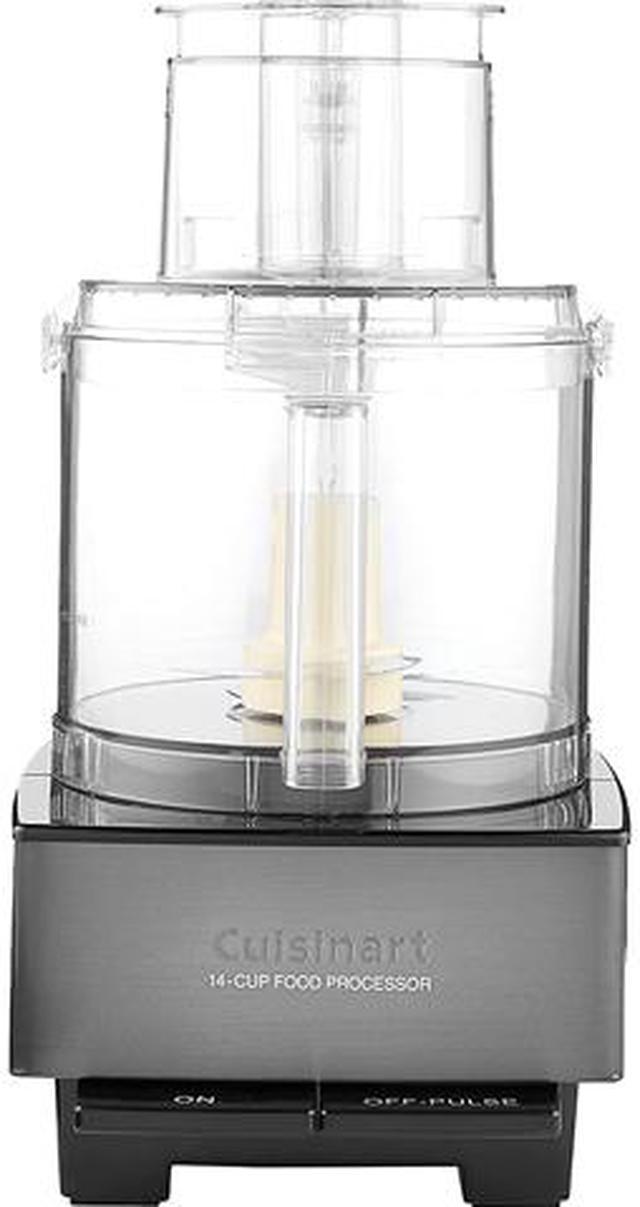
Best for large-batch cooking — 14-cup bowl, 720W, stainless blade handles heavy loads. At 45 cm tall and 4.5 kg, it's too large for many compact kitchens; 120V rated (runs at ~83% power on Japan's 100V grid).
The Cuisinart DFP-14BCWB pairs a 14-cup (about 3.3L) work bowl with a 720W induction motor and a wide feed tube that takes a whole onion or block of cheese without precutting. The stainless steel multi-purpose blade and standard slice and shred discs handle cabbage for a full gyoza batch, 600g of ground pork, or 1.5kg of potatoes in a single run. The unit measures roughly 26x21x45cm and weighs around 4.5kg, so it dominates a counter rather than tucking under a wall cabinet. In Japan the US-spec 120V unit runs on 100V at roughly 83% rated output, which still outpaces every other processor here on dense ingredients. Cleanup is the friction point: the three-piece lid assembly and large bowl require thorough washing.
Pros
- ✓14-cup bowl handles family-batch cooking in single runs
- ✓720W induction motor doesn't bog down on dense ingredients
- ✓Wide feed tube reduces precut work
- ✓Dishwasher-safe bowl, lid, and discs
Cons
- ✗45cm tall dominates a compact kitchen counter
- ✗Runs at ~83% rated power on Japan's 100V grid
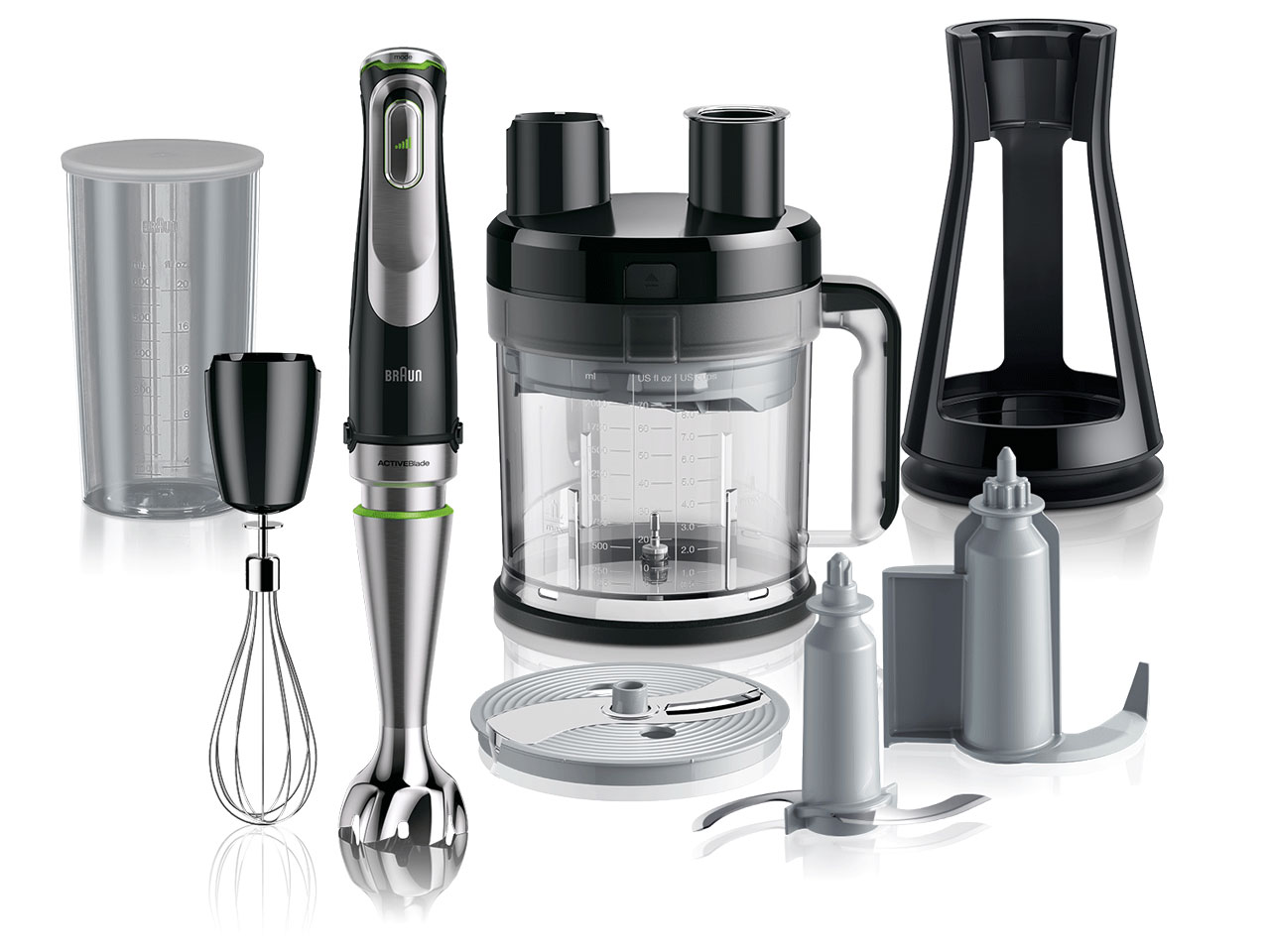
Best all-round pick — 1000W motor, 2.4L bowl, EasyClick attachment swap without pin-alignment. Wider footprint (23 cm) than the compact alternatives; price-to-capacity is higher than the Cuisinart.
The Braun MultiQuick 9 FP3020 runs the highest motor in this comparison at 1000W into a 2.4L work bowl, with the EasyClick attachment system that snaps discs and blades on without aligning pins. Owners consistently flag the EasyClick as a genuine quality-of-life upgrade over alignment-pin systems, especially mid-prep when swapping a slice disc for a shred disc. The 1000W motor doesn't stall on half-frozen vegetables or unpeeled root vegetables that bog down lower-wattage units. Footprint is wide at around 23cm with attachments mounted, so storage planning matters in a narrow kitchen. The whole bowl, lid, and disc set are top-rack dishwasher-safe, which is the single most effective way to reduce per-session friction.
Pros
- ✓1000W handles dense and half-frozen ingredients without stalling
- ✓EasyClick attachment swap is faster and safer than pin-alignment
- ✓All major parts are top-rack dishwasher-safe
- ✓2.4L bowl suits family-size portions without being oversized
Cons
- ✗23cm-wide footprint with attachments needs counter planning
- ✗Per-capacity price sits higher than the Cuisinart
Best for small-batch chopping in a tight kitchen — ultra-compact 24-oz bowl, reversible auto-reversing blade for chopping and grinding. 250W and no slicing or shredding discs; not for slicing, shredding, or large loads.
The Cuisinart Mini-Prep Plus DLC-2ABC packs a 24-ounce (3-cup) bowl and a 250W motor into a footprint small enough to stash in a drawer or cabinet, where the taller full-size units cannot go. Instead of discs it uses a single reversible auto-reversing blade: the sharp side chops herbs, garlic, onions, and small batches of dip or pesto, while the blunt side grinds harder ingredients like nuts, spices, and coffee. The small bowl handles one or two portions at a time without crowding, and the bowl, lid, and blade are top-rack dishwasher-safe. The limit is clear — 250W and no slicing or shredding discs mean it bogs down on dense or large loads and cannot slice or shred at all. For a single or two-person household that mostly needs quick chopping and grinding, the tiny footprint and easy cleanup outweigh the modest power.
Pros
- ✓Ultra-compact bowl stores in a drawer or cabinet
- ✓Reversible auto-reversing blade chops and grinds
- ✓24-oz bowl right-sized for one to two portions
- ✓Bowl, lid, and blade are top-rack dishwasher-safe
Cons
- ✗250W bogs down on dense or large loads
- ✗No slicing or shredding discs — chopping and grinding only
Subscribe to our newsletter
Occasional updates and new releases — no spam.

Best for intuitive operation — ExactSlice lever adjusts thickness without swapping discs. 240W has a thermal cutoff at ~7-8 minutes of heavy continuous use; expensive per cup of capacity vs the Cuisinart.
The KitchenAid KFP0718 holds a 7-cup (1.66L) bowl driven by a 240W motor, with the ExactSlice external lever that adjusts slice thickness without swapping discs. The thickness lever is the standout: shifting from thin gratin slices to thicker roasted-vegetable cuts without lifting the lid removes a real friction point. The bowl and most accessories are dishwasher-safe. The 240W motor is the lowest here and has a thermal cutoff that triggers around 7-8 minutes of sustained heavy use, requiring roughly 15 minutes of cooldown before restart. For moderate-volume households doing soft-to-medium tasks (herbs, onions, cooked vegetables, pastry dough) the wattage is fine, but it is a hard limit for batch cooking or weekly large-volume prep work.
Pros
- ✓ExactSlice lever adjusts slice thickness externally
- ✓Clean design with intuitive controls
- ✓Bowl and most accessories are dishwasher-safe
- ✓7-cup capacity suits moderate-volume households
Cons
- ✗240W motor has a thermal cutoff at 7-8 minutes of heavy use
- ✗Highest price per cup of capacity in this comparison

Best if you want cook-in-bowl capability — temperature control for heating soups and sauces in the same bowl. Cooking function adds complexity that has shown degradation in 18+ month reviews; unnecessary if you don't use the heating feature.
The De'Longhi Multifry FP8260 adds a built-in heating element with adjustable temperature control to an otherwise standard 2.2L food processor with a 600W motor. Owner reviews show the cooking function is used mainly to warm soups and sauces in the same bowl after blending, rather than for actual sauteing — the bowl surface area and heat distribution don't suit browning. As a 2.2L food processor it competently handles most home cooking tasks. The honest weakness is mechanical complexity: the heating element and temperature sensor are extra failure points, and several long-term owners (18+ months) report the heating element degrading before the blade mechanism. Choose this only if the hot-soup or warmed-sauce workflow is genuinely useful, otherwise the Braun FP3020 offers more motor power at a lower price.
Pros
- ✓Temperature-controlled heating for hot soups in the same bowl
- ✓600W motor handles most home cooking tasks competently
- ✓2.2L bowl scales to family portions
- ✓Unique cook-and-blend workflow if you want it
Cons
- ✗Heating element adds failure points reported in 18+ month reviews
- ✗Blades and discs hand-wash only
Which one is right for you?
The weekend batch cook for a family of four
Cuisinart DFP-14BCWB
The 14-cup bowl processes a full cabbage of gyoza filling or 1.5kg of potatoes in a single run that the tiny Mini-Prep Plus could never handle.
The 2-4 person household that wants one processor for everything
Braun MultiQuick 9 FP3020
The 1000W motor and EasyClick attachments cover the widest task range without stalling, and every part is top-rack dishwasher-safe.
The small-kitchen cook who mostly chops herbs, garlic, and nuts
Cuisinart Mini-Prep Plus DLC-2ABC
The drawer-sized footprint fits anywhere, and the reversible auto-reversing blade covers daily chopping and grinding of small batches.
The cook who hates swapping discs mid-recipe
KitchenAid KFP0718
The ExactSlice external lever shifts slice thickness without lifting the lid, which is the rare attachment innovation that actually saves time.
The single-pot cook who wants soup in one bowl
De'Longhi Multifry FP8260
The heated bowl lets you blend a vegetable soup and warm it to serving temperature without dirtying a separate pot.
How we compared
We did not run independent blade-sharpness tests or timed mincing trials with calibrated food samples. A proper comparison of cutting performance across five processors requires standardized raw ingredients, a controlled-temperature kitchen, replicated batches, and a trained panel — none of which a comparison article produces at reasonable cost. The actual basis: bowl capacity, motor wattage, blade and disc specifications, footprint, and part weight taken from each brand's product page or global specs sheet; current May 2026 pricing cross-checked across major online retailers; and several hundred long-term owner reviews per model read and sorted into categories — noise complaints, capacity complaints, attachment breakage, blade dulling, plastic cracking, and the 'stopped using it' subset that identifies genuine friction points.
Each unit was evaluated on five criteria: usable bowl capacity (the advertised number minus the dead zone above the blade stack — a 14-cup Cuisinart comfortably processes about 10-11 cups of typical vegetable loads without overflow or uneven processing at the edges), motor wattage as a proxy for stall resistance on dense ingredients (harder doughs, whole carrots, frozen vegetables — wattage does not directly predict cutting speed, but low-wattage motors are more likely to stall or overheat on sustained heavy use), attachment breadth and how many of the included discs actually appear in owner cooking photos vs how many stay in the storage bag, dishwasher-safe part count (this determines your real post-use friction cost), and footprint and storage envelope (compact kitchens average narrower bench depth than larger designs, and under-cabinet height is often limited by fixed wall cabinets).
Bowl capacity — how much food processor do you actually need
The biggest mistake buyers make is choosing a bowl size based on the largest task they can imagine rather than the task they'll perform 80% of the time. A 14-cup Cuisinart DFP-14BCWB holds about 3.3 liters of working capacity — enough to process a full cabbage for gyoza filling, mince a 600g batch of ground pork, or slice through 1.5 kilograms of potatoes in a single run. At the other end, the Cuisinart Mini-Prep Plus DLC-2ABC holds just 24 ounces (about 0.7 liters) — roughly 200-300g of herbs, onions, or nuts before the small bowl gets crowded. The KitchenAid KFP0718's 7-cup (1.66L) bowl sits in between.
For a 2-person household cooking Japanese-style meals — one portion of gyoza filling every two weeks, occasional curry paste, weekly onion mincing — a 7-cup bowl handles almost everything without working in batches. For a 4-person household or for anyone who batch-cooks on weekends (large volumes of ground meat, coleslaw for a week), a 10-12 cup bowl meaningfully reduces cooking time. The 14-cup Cuisinart is oversized for most compact two-person kitchens and earns its footprint only if you regularly cook for four or more or batch-process large quantities.
The number that actually matters is not the advertised bowl size but how full you can load it before cutting quality drops. Most processors' maximum fill line is about 70% of the advertised volume — fill above that and the top layer of food doesn't reach the blade properly, leaving unevenly processed chunks. This means the Cuisinart DFP-14BCWB's '14 cups' works out to about 9-10 cups of vegetables before you notice uneven results; the Mini-Prep Plus's '24 ounces' works out to about 16 ounces of practical working space.
Motor wattage vs actual cutting performance
Wattage does not directly determine cutting speed or quality on most tasks — blade geometry and sharpness matter more for soft-to-medium ingredients like onions, herbs, and cooked vegetables. A sharp 240W blade on the KitchenAid KFP0718 will mince onion faster and more uniformly than a dull 1000W blade. The wattage numbers become meaningful in two specific scenarios: processing hard dense ingredients without stalling (whole unpeeled carrots, frozen meat, bread dough), and sustained long runs without the motor overheating (batch processing of five kilograms of vegetables for a party).
The Braun MultiQuick 9 FP3020 at 1000W is the highest-wattage unit in this comparison and shows it on dense ingredients — several reviewers note it handles half-frozen vegetables and large pieces of hard root vegetables that cause the Mini-Prep Plus and KitchenAid to bog down. The De'Longhi FP8260 at 600W sits in the middle. The KitchenAid KFP0718 at 240W is the lowest-wattage unit, and this shows up in owner reviews specifically on hard carrots, dense dough, and large-batch continuous processing — several reviewers note the motor gets warm during extended runs and the unit has a built-in thermal cutoff that triggers at around 7-8 minutes of heavy continuous use, requiring a 15-minute cool-down before it can restart. On most home cooking tasks this is not a problem, but it rules the KitchenAid out for commercial-scale prep or weekly large-batch cooking.
The practical guidance: if your food processor tasks are mostly soft to medium ingredients (herbs, onions, peppers, cooked meat, bread crumbs, pastry dough with butter), 300-400W is sufficient. If you regularly process dense raw vegetables, whole root vegetables, frozen meat, or bread dough, the 600-1000W range avoids the stall-and-overheat cycle. Wattage claims above 1000W for a home food processor are marketing padding — home cooking tasks don't require more than 800-900W of sustained output, and peak wattage numbers on marketing materials often measure the startup surge, not sustained running load.
Attachments and versatility — which you'll actually use
Every food processor in this comparison includes a multi-function blade (mincing, chopping, blending, pureeing), a thin-slice disc, and a shredding/grating disc. The Braun FP3020's EasyClick system adds attachments that snap on without aligning pins, which owner reviews consistently flag as a genuine quality-of-life improvement — swapping a slice disc for a julienne disc mid-prep is faster and requires less counter space to fumble with. The Cuisinart Mini-Prep Plus DLC-2ABC is the exception in this comparison: it ships with no slicing or shredding discs at all, just a single reversible auto-reversing blade — the sharp edge chops, the blunt edge grinds — which reflects its role as a dedicated mini chopper for herbs, nuts, and small quantities rather than a full disc-based processor.
The attachments that owners actually use, based on review photo analysis and comment patterns: the multi-function blade (nearly every owner, every session), the thin-slice disc (regular use for potato gratin, cucumber salads, cabbage for okonomiyaki), the shredding disc (regular for coleslaw, carrot salad, daikon). The attachments that stay in the storage bag: any specialized disc beyond the three above — julienne attachments look useful and appear in the first few weeks of ownership, then get replaced by the standard shredding disc for most tasks; kneading blades are used by a small minority who bake bread regularly but are largely unused by everyone else; whisk attachments are consistently abandoned in favor of a hand mixer, which does the task better.
The De'Longhi FP8260 has an unusual feature in this comparison: a built-in cooking function with adjustable temperature control, marketed as the ability to sauté vegetables in the bowl before blending. In practice, owner reviews show this is used mainly for making hot soups (blend the vegetable, then warm it in the same bowl) and is rarely used for actual sautéing — the bowl's surface area and temperature distribution aren't ideal for browning, and most owners with a 600W stir-fry habit use their wok or pan instead. The cooking function is real, not a gimmick, but the use cases are narrower than the marketing implies.
Where each fits
Cuisinart DFP-14BCWB is the right pick if you cook for four or more people, batch-cook on weekends, or regularly process large quantities of meat and vegetables. The 14-cup bowl, 720W motor, and stainless steel blade are the most robust combination in this comparison for heavy-use cooking. The honest weakness: the unit is large — 26 × 21 × 45 cm and around 4.5 kg — and the footprint dominates a compact kitchen counter. It also requires careful bowl assembly (three-piece lid with feed tube and pusher) that adds friction to quick one-ingredient tasks. The Cuisinart is the wrong pick for single-person households or anyone who mostly minces onions and garlic rather than processing kilograms of food at a time.
Braun MultiQuick 9 FP3020 is the pick for versatility and ease of use. The EasyClick attachment system genuinely reduces prep friction compared to the alignment-pin systems on Cuisinart and KitchenAid, and the 1000W motor handles dense ingredients without stalling. The honest weakness: the 2.4L bowl is larger than most home cooks need for daily tasks, and the unit is wide (approximately 23 cm wide with attachments mounted) which requires storage planning in a narrow kitchen. Some owners also note the bowl takes more counter space than the compact-form Mini-Prep Plus when working with multiple dishes simultaneously.
Cuisinart Mini-Prep Plus DLC-2ABC is the pick for small-quantity chopping and grinding in a tight kitchen. The 24-ounce bowl handles herbs, garlic, onions, nuts, and small batches of dips or pestos without overflow, and the compact footprint stores in a drawer or cabinet where the larger units cannot. The reversible auto-reversing blade gives you a sharp side for chopping and a blunt side for grinding hard ingredients like spices or coffee. The honest weakness: 250W and a single small blade mean it is not a slicer or shredder — there are no discs — and it bogs down on dense or large loads. The Mini-Prep Plus is the wrong pick for batch cooking or for anyone who needs slicing and shredding discs.
KitchenAid KFP0718 is the pick for clean design, intuitive operation, and moderate-volume households. The ExactSlice system adjusts slice thickness externally via a lever without swapping discs, which is genuinely useful for adjusting potato-slice thickness between thin gratin slices and thicker roasted-vegetable cuts. The honest weakness: 240W is low even for the modest tasks this unit handles, and the thermal cutoff at around 7-8 minutes of sustained heavy use is a hard limit that rules it out for batch processing. The KitchenAid is also the most expensive-per-capacity unit in this comparison — a 7-cup bowl that compares unfavorably to the Cuisinart's 14-cup bowl.
De'Longhi Multifry FP8260 is the pick if you want a food processor that also functions as a cooking vessel — making hot soups, warming sauces, and the occasional heated dip without dirtying a separate pan. The 600W motor and 2.2L bowl handle most home cooking tasks competently. The honest weakness: the cooking function adds mechanical complexity (heating element, temperature sensor, a fan in some versions) that represents more parts that can fail; a few long-term owners (18+ months) report the heating element degrading before the blade mechanism. If you don't actually want the cooking function, the FP8260 is an expensive 2.2L food processor compared to the Braun FP3020 with more motor power.
Kitchen-fit context
Compact kitchen design affects food processor choice in three ways. First, bench depth: a compact kitchen counter is often around 60 cm deep versus 65-70 cm in larger kitchens — this means a wide unit like the Braun FP3020 or Cuisinart DFP-14BCWB sits closer to the counter edge, which affects stability and safety when the motor vibrates on hard ingredients. Second, wall-cabinet height: fixed wall cabinets typically begin 40-45 cm above the counter surface, which limits how tall an appliance can be while still being accessible — the Cuisinart DFP-14BCWB at 45 cm is at or above this ceiling and needs to be moved out of the cabinet every session, a friction cost that some owners cite as a reason they stopped using it.
Third, and most specific to cooking style: Japanese home-style cooking prioritizes mince (gyoza filling, hamburger patty mixture, soboro), julienne (daikon salad, burdock preparation, stir-fry base), and thin-slice (cucumber, cabbage for tonkatsu, potato for gratin) over the bread-dough kneading and large-batch pastry work that dominates much Western food-processor recipe content. This means a full disc-equipped processor like the Cuisinart DFP-14BCWB or KitchenAid KFP0718 is better matched to these slice-and-julienne usage patterns than a disc-less mini chopper like the Mini-Prep Plus, which is limited to mincing and grinding.
Noise is a practical consideration in dense housing. Single-family detached houses and larger apartments have more acoustic privacy, but compact apartments — the most common form of housing for single people and couples in cities — share walls and floors with neighbors. Food processor noise peaks at 75-85 dB for most models at a 1-meter distance, which is louder than a conversation and comparable to a blender. The Cuisinart Mini-Prep Plus DLC-2ABC has a smaller motor and is consistently rated quieter than the 1000W Braun in owner reviews, though all food processors are significantly louder than most other kitchen appliances. The realistic guidance: in a thin-walled apartment, early-morning or late-night food processor use will be audible to neighbors and should be limited to daytime hours.
Our pick and honest caveats
For a 2-4 person household doing regular home cooking, the Braun MultiQuick 9 FP3020 is the pick that handles the widest range of tasks without needing a size trade-off. The 1000W motor doesn't stall on dense ingredients, the EasyClick attachment system genuinely reduces between-task friction, and the 2.4L bowl is large enough for family-size portions without being as oversized as the Cuisinart 14-cup unit. The trade: it's the widest unit in this comparison and requires more counter or storage space than the Mini-Prep Plus.
For a 1-2 person household that mostly needs small-batch chopping and grinding, the Cuisinart Mini-Prep Plus DLC-2ABC is the better fit. The compact footprint, reversible auto-reversing blade, and lower price make it the more practical choice for mincing herbs and garlic, grinding nuts and spices, or making a small dip — even though the 250W motor and disc-less design rule out slicing, shredding, or large loads. The honest caveat on both picks: a food processor is not an essential appliance in a compact kitchen the way a rice cooker or microwave is. If your cooking style leans toward simmered dishes, grilled fish, and stir-fry, you can accomplish all of the mince and slice tasks with a knife, and the food processor becomes a convenience-per-use-frequency trade. The buyers who get clear value are households that make gyoza or hamburger patties regularly (mince by processor is genuinely faster for large batches), families that prep coleslaw or daikon salad weekly (slice disc saves 5-8 minutes per session), and anyone cooking for four or more people who finds volume prep tedious.
Cleaning reality — why dishwasher-safe matters more than specs
The hidden cost of a food processor is not the purchase price — it's the cleanup time after every use. A standard food processor session dirties: the bowl, the lid, the feed-tube pusher, one or two discs or blades, and the blade-blade interface at the bottom of the bowl that collects ground food in the crevice around the central post. For hand-washing, this is 5-8 minutes of careful work, paying specific attention to the blade edges (sharp enough to cut fingers during washing) and the crevices in disc mounts. Owners who underestimate this consistently report in reviews that the food processor 'went into the cabinet' after the first few months because the cleanup time wasn't worth it for small tasks.
Dishwasher compatibility is the single most effective way to reduce this friction. In this comparison: the Braun FP3020's bowl, lid, and all discs are top-rack dishwasher-safe; the Cuisinart DFP-14BCWB bowl, lid, and discs are dishwasher-safe (some sources recommend top rack only for blades); the KitchenAid KFP0718 bowl and most accessories are dishwasher-safe; the Cuisinart Mini-Prep Plus DLC-2ABC bowl, lid, and blade are top-rack dishwasher-safe, while the De'Longhi FP8260 requires hand-washing for blades and discs per manufacturer guidance. The De'Longhi's hand-wash requirement is a meaningful friction point in kitchens without a dishwasher, where most washing is done by hand. If you don't have a dishwasher, the Mini-Prep Plus's tiny single-blade bowl is the fastest to hand-wash in this comparison — there's far less surface area to clean than the Cuisinart's large multi-part bowl assembly.
The blade-safety issue is real and worth naming directly: all food processor blades cut fingertips without warning during casual washing. Serious lacerations are the single most common food processor injury in emergency room data. The practical approach is to wash blades by holding the plastic center hub only, never sliding fingers along the blade edge, and using a brush for crevice cleaning rather than your hand. The Braun FP3020's EasyClick system that removes discs without requiring you to lift them by the blade edge is a genuine safety advantage in addition to the convenience advantage.
Frequently asked questions
What's the difference between a food processor and a blender?▼
Can a food processor actually replace knife work for gyoza filling and hamburger patties?▼
How loud are food processors — is it a problem in an apartment?▼
Are these models available outside Japan?▼
How long do food processor blades stay sharp?▼
Which food processor handles Japanese-specific tasks best — katsuobushi shaving, daikon grating, yuzu zesting?▼
Prices change. Check the retailer for the current price.
Comments & questions
Discussion happens on nattzy, our community forum. Sign in with Google to post — it takes a second.
Related articles

Best Grain-Free Dog Food 2026: 5 Formulas Ranked

Best Senior Cat Food 2026: 5 Formulas for Cats 7 and Older

Best Baby Food Storage 2026: Glass vs Silicone vs Trays
Best Coffee Grinders 2026: Five mills side-by-side
Food
Best Rice Cookers 2026: 5 Top Models Compared
Best Rice Cookers 2026: 5 Top Models Compared

Best VPN 2026: 5 compared