Best Cat Food 2026: 4 Indoor Picks Compared
WriterPickly Editorial
Updated 2026-10-11
Indoor cats face a structural hydration problem — they evolved as desert hunters who get most of their water from prey, not a bowl. Four cat foods compared on the factors that matter most for indoor cats: calorie density, protein, moisture and taurine.
Quick answer
Royal Canin Indoor is the pick for most indoor cats — a moderate 325 kcal per cup and a psyllium fiber blend for weight and hairball control, the most indoor-specific formula here. Hill's Science Diet Indoor is a long-standing veterinary-clinic brand for adult indoor cats. Wellness CORE Indoor is the grain-free option at 45% protein (current label); Ziwi Peak covers moisture.
📋How we compared
Each product was evaluated on moisture percentage, protein source and quality, taurine content (essential amino acid for cats), AAFCO nutritional adequacy statement, and suitability for indoor adult cats. Long-term owner reviews were analyzed for palatability, litter box output changes, and coat condition. Manufacturer specification sheets were cross-referenced against independent lab analysis where published.
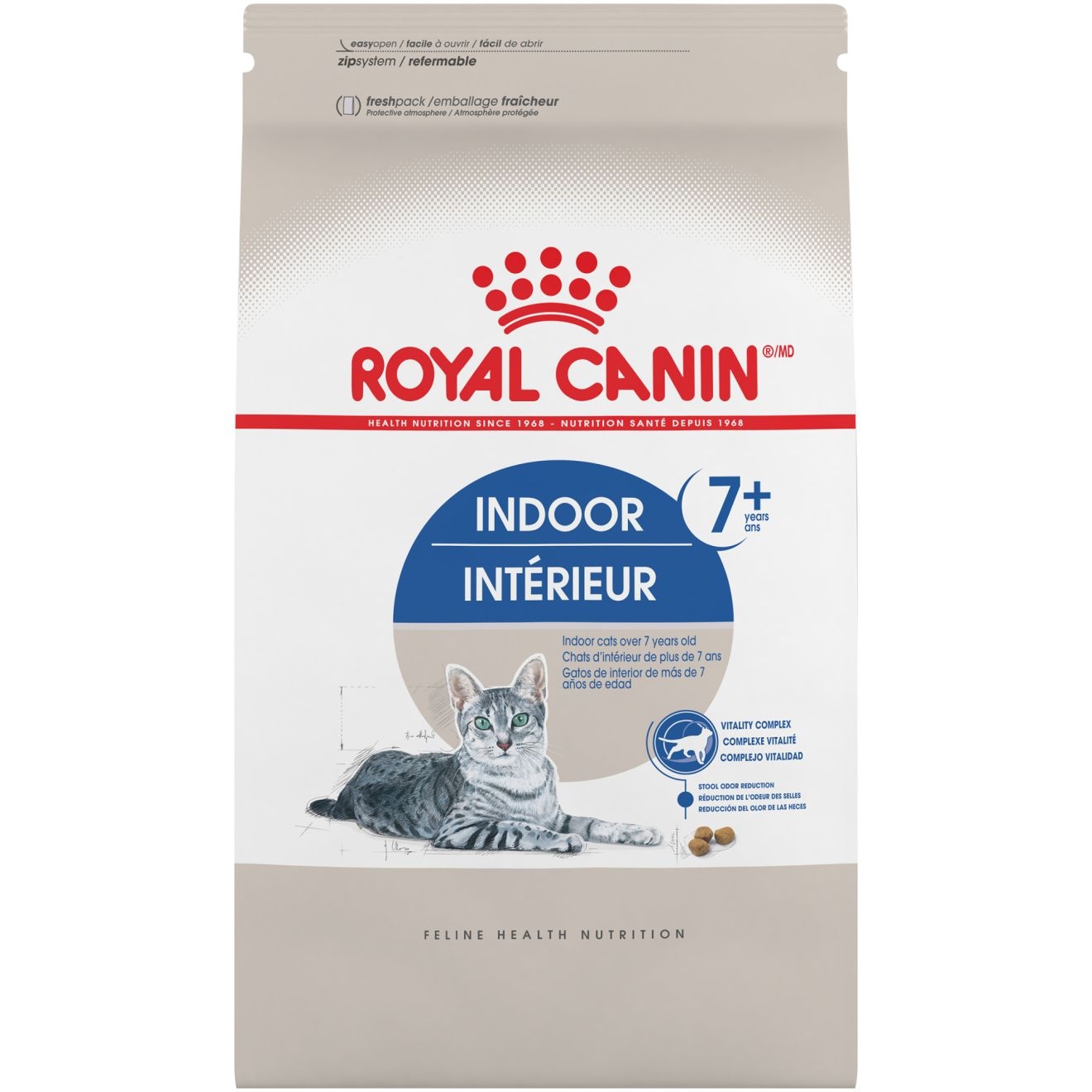
Best Indoor Specialist: Royal Canin Indoor Adult is the most precisely targeted indoor cat formula in this comparison, addressing the two main indoor-lifestyle concerns in a single product: moderate caloric density (325 kcal/cup) helps prevent the slow weight gain common in cats with reduced activity, and a psyllium-containing fiber blend helps hairballs pass. Highly digestible protein is also meant to reduce stool odor.
Top picks ↓Which one is right for you?
Related articles

1★ Best PickABest Indoor SpecialistRoyal Canin Indoor Adult Dry Cat Food
Royal Canin Indoor Adult is the most precisely targeted indoor cat formula in this comparison, addressing the two main indoor-lifestyle concerns in a single product: moderate caloric density (325 kcal/cup) helps prevent the slow weight gain common in cats with reduced activity, and a psyllium-containing fiber blend helps hairballs pass. Highly digestible protein is also meant to reduce stool odor. It is not a urinary-care formula, and Royal Canin does not publish a percentage reduction in hairballs. The honest weakness is the ingredient label: chicken meal comes first, but corn, brewers rice and corn gluten meal follow, which reads poorly to ingredient-conscious buyers. Its label says it is formulated to meet the AAFCO adult maintenance profile. Best for indoor cats prone to weight gain or hairballs.
Pros
- ✓Moderate caloric density (325 kcal/cup) addresses indoor weight gain
- ✓Psyllium-containing fiber blend helps hairballs pass
- ✓Highly digestible protein formulated to reduce stool odor
- ✓Decades of veterinary recommendation for indoor cats
Cons
- ✗Corn, brewers rice and corn gluten meal prominent — poor ingredient label optics
- ✗Dry-only format doesn't solve the indoor hydration problem directly
Score breakdown
- Moisture %
- 8% (dry)
- Protein source
- Chicken meal, corn gluten meal
- Taurine content
- 0.15% (above AAFCO minimum)
- Life stage
- Adult maintenance
- AAFCO standard
- Formulated to meet AAFCO adult profile
2ABest Vet-RecommendedHill's Science Diet Adult Indoor Dry Cat Food
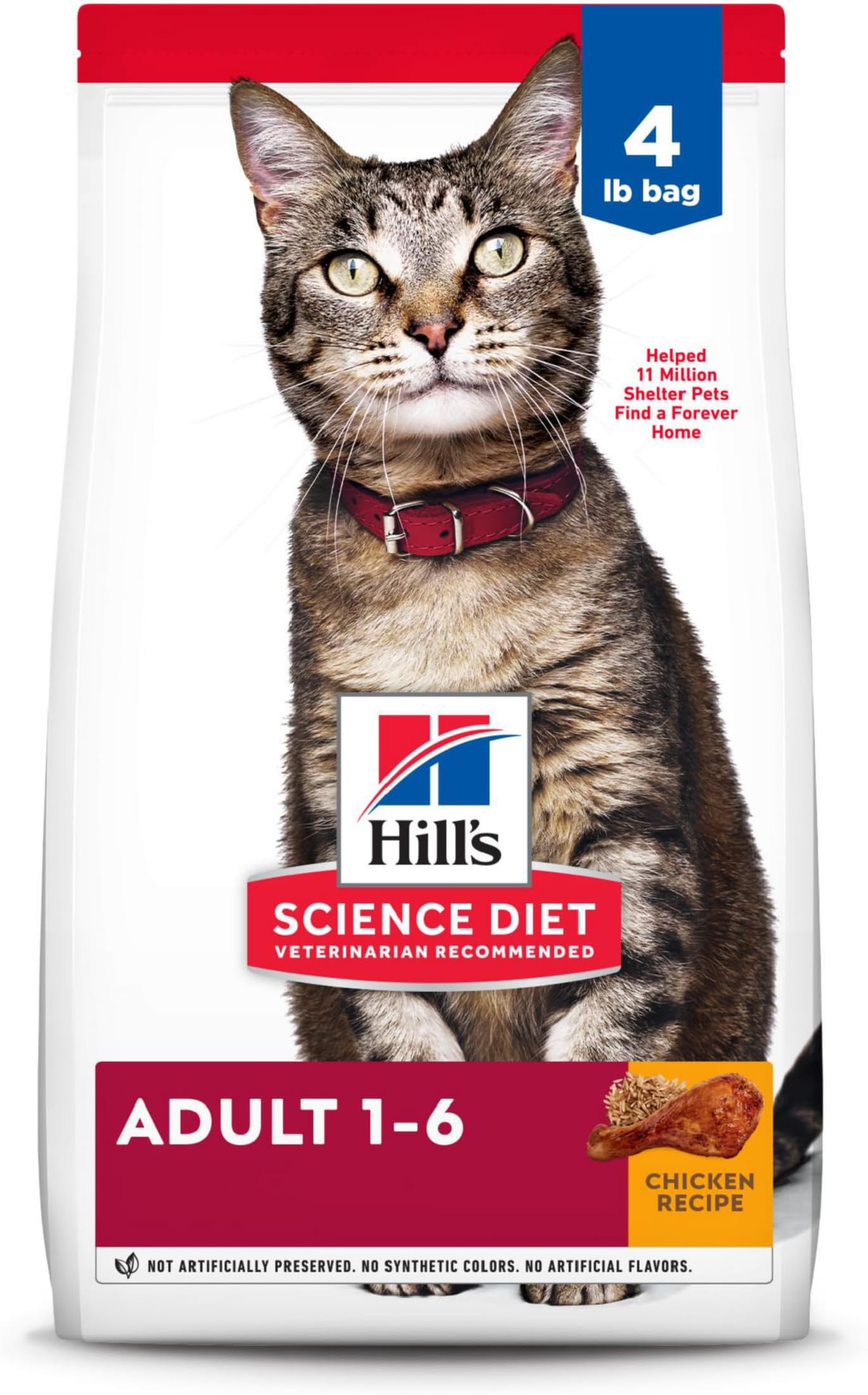
Hill's Science Diet Adult Indoor is a long-standing veterinary-clinic brand for indoor cats in the US and Japan. Chicken meal as first ingredient delivers concentrated animal protein (roughly 29% crude protein minimum on retailer labels), L-carnitine supports lean muscle maintenance, and the formula is designed for weight management in indoor cats. A feeding-trial statement could be confirmed for the Adult 7+ Indoor version but not for this Adult 1–6 formula. Palatability is moderate but consistent — cats accept it reliably, which matters in a multi-cat household where individual palate preferences vary. The honest weakness: slightly higher caloric density than Royal Canin Indoor means portion discipline is more important. Hill's 2019 vitamin D recall involved canned dog foods only, not its cat foods.
Pros
- ✓Long track record as a veterinary-clinic brand for indoor cats
- ✓Widely sold through veterinary clinics in the US and Japan
- ✓Chicken meal first — high taurine content from whole animal protein
- ✓L-carnitine for lean muscle maintenance in lower-activity indoor cats
Cons
- ✗Slightly higher caloric density than Royal Canin Indoor requires stricter portions
- ✗Feeding-trial statement confirmed only for the Adult 7+ Indoor version, not this 1–6 formula
Score breakdown
- Moisture %
- 8% (dry)
- Protein source
- Chicken Meal
- Taurine content
- 0.17% (above AAFCO minimum)
- Life stage
- Adult maintenance
- AAFCO standard
- Meets AAFCO adult profile (check bag for method)
3ABest Grain-Free IndoorWellness CORE Indoor Grain-Free Dry Cat Food

Wellness CORE Indoor is the grain-free indoor specialty kibble for owners committed to grain-free feeding. Turkey and chicken are the first two ingredients, and the current label lists 45% crude protein, 18% fat and about 445 kcal/cup, with added omega-3s for coat health; older bags were labeled 38% protein. It is formulated to meet the AAFCO adult maintenance profile. The 45% protein is well above Royal Canin Indoor (27%) and Hill's Science Diet Indoor (roughly 29%), which suits owners who want a meat-heavy kibble. The honest weakness: the calorie density is much higher than Royal Canin Indoor, so portions should be weighed carefully, and grain-free has no proven benefit for cats without a grain allergy.
Pros
- ✓Turkey and chicken as first two ingredients
- ✓45% crude protein (current label) — highest among dry foods in this comparison
- ✓Indoor formula with added omega-3 for coat health
- ✓Grain-free, formulated to meet AAFCO adult profile
Cons
- ✗Calorie-dense (about 445 kcal/cup) — portions should be weighed carefully
- ✗Grain-free has no proven benefit for cats without a grain allergy
Score breakdown
- Moisture %
- 9% (dry)
- Protein source
- Turkey, Chicken
- Taurine content
- 0.18% (above AAFCO minimum, supplemented)
- Life stage
- Adult maintenance
- AAFCO standard
- Formulated to meet AAFCO adult profile
Subscribe to our newsletter
Occasional updates and new releases — no spam.
4ABest High-Moisture Prey-ModelZiwi Peak Wet Cat Food

Ziwi Peak Wet is the premium moisture pick and the product most aligned with feline prey-model nutrition in this comparison. 78% moisture, 92% meat and organs, no grains, no plant protein concentrates. The venison can lists crude protein 10% minimum and crude fat 4% minimum as fed — roughly 45% protein and 18% fat on a dry matter basis — at about 1,200 kcal/kg. Taurine is listed among the added ingredients. For cats that drink little, or cats who refuse all other wet foods, the moisture content and ingredient quality justify the cost premium. It is not a kidney diet: for a cat with chronic kidney disease, ask your vet about a phosphorus-restricted diet. The honest weakness: Ziwi Peak is the most expensive product in this comparison per kilogram on a dry matter basis, requires refrigeration after opening, and spoils within 24-48 hours in the bowl — free-choice feeding is not possible.
Pros
- ✓78% moisture — closest to whole-prey hydration profile
- ✓92% meat and organs, no grains or plant protein fillers
- ✓About 45% protein on a dry matter basis, with taurine added
- ✓High moisture suits cats that drink little from a bowl
Cons
- ✗Most expensive product per kilogram dry matter in this comparison
- ✗Requires refrigeration, spoils within 24-48 hours — no free-choice feeding
Score breakdown
- Moisture %
- 78% (wet)
- Protein source
- Beef/Venison/Mackerel (variant dependent)
- Taurine content
- Added (listed in ingredients)
- Life stage
- Adult maintenance (all life stages)
- AAFCO standard
- Formulated to meet AAFCO profile (all life stages)
| Product | Protein source | Life stage | AAFCO standard | ||
|---|---|---|---|---|---|
| Royal Canin Indoor Adult Dry Cat Food | 8% (dry) | Chicken meal, corn gluten meal | 0.15% (above AAFCO minimum) | Adult maintenance | Formulated to meet AAFCO adult profile |
| Hill's Science Diet Adult Indoor Dry Cat Food | 8% (dry) | Chicken Meal | 0.17% (above AAFCO minimum) | Adult maintenance | Meets AAFCO adult profile (check bag for method) |
| Wellness CORE Indoor Grain-Free Dry Cat Food | 9% (dry) | Turkey, Chicken | 0.18% (above AAFCO minimum, supplemented) | Adult maintenance | Formulated to meet AAFCO adult profile |
| Ziwi Peak Wet Cat Food | 78% (wet) | Beef/Venison/Mackerel (variant dependent) | Added (listed in ingredients) | Adult maintenance (all life stages) | Formulated to meet AAFCO profile (all life stages) |
Why indoor cats have different nutritional needs than outdoor cats
Indoor cats burn fewer calories than outdoor cats — typically 20–30% less — because they lack the hunting activity and thermoregulatory demands of outdoor life. This means the caloric density of their food matters more than it does for outdoor cats; feeding an indoor cat the same portions as an outdoor cat of the same weight produces a slow but consistent weight gain. Obesity in indoor cats has cascading consequences: type 2 diabetes (cats are particularly susceptible), hepatic lipidosis (fatty liver, which can develop after only a few days without food — an overweight cat that stops eating for more than a day or two should see a vet), joint disease, and reduced lifespan. Indoor-specific formulas address this with lower caloric density per cup while maintaining nutritional completeness.
Hydration is the second structural difference. Cats evolved as desert hunters who derive most of their water from prey — a mouse is roughly 70% moisture, whole prey is 65–75% moisture. Dry kibble is 6–10% moisture. An indoor cat fed exclusively dry food must compensate by drinking more from a bowl, and many cats do not fully make up the difference — their thirst drive is calibrated for prey moisture, not standing water. The result is more concentrated urine, which is thought to raise the risk of urinary crystals and feline idiopathic cystitis (FIC) over the years. Adding wet food at even one meal per day raises total water intake and tends to make urine more dilute; no study has shown that it prevents chronic kidney disease (CKD).
Taurine: the essential amino acid cats cannot synthesize
Taurine is an amino acid that dogs can synthesize from other amino acids but cats cannot — cats must obtain it directly from diet. Taurine deficiency causes dilated cardiomyopathy (DCM), central retinal degeneration (leading to blindness), and reproductive failure in queens. The link between taurine deficiency and retinal degeneration in cats was reported in 1975 (Hayes et al.), and in 1987 Pion et al. showed in Science that it also caused feline DCM, which had been common in cats eating low-taurine commercial food. Manufacturers then raised taurine levels. All AAFCO-compliant cat foods now must meet minimum taurine levels (0.1% in dry food, 0.2% in wet food on a dry matter basis).
Taurine is concentrated in animal muscle tissue, particularly in the heart, shellfish, and fish — not in plant protein sources. A cat food deriving significant protein from plant concentrates (soy protein isolate, corn gluten meal) rather than whole animal tissue meets the minimum taurine level by adding taurine, which is a normal and accepted practice — most complete cat foods, including meat-heavy ones, list added taurine. The stronger argument for animal-protein-first cat foods is the overall amino acid profile, not the taurine source.
Wet food vs dry food vs mixed feeding — what the science says
Studies consistently show that cats fed wet food as a majority of their diet have higher urine volume and lower urine specific gravity (less concentrated urine), which is expected to reduce crystal formation and the risk of feline lower urinary tract disease (FLUTD). The study most often cited is Markwell et al. (1999, Journal of the American Veterinary Medical Association): cats with idiopathic cystitis fed a wet diet had fewer recurrences over a year (about 11%) than cats fed the dry version (about 39%). The study was not randomized and its dropouts were uneven, so the evidence is considered weak, and later work has not consistently found a difference by food format. Many veterinarians still advise that indoor cats with a urinary history get a large share of their calories from wet food.
Dry food has practical advantages: it is cheaper per calorie, stores well once sealed, can be left out for free-choice feeding without spoiling, and is easier for multi-cat households to manage. Dental health is often cited as a dry food advantage, but the evidence for kibble as a meaningful dental prophylactic is weak — cats tend to swallow kibble whole rather than chewing it. The honest recommendation for most indoor cats is mixed feeding: dry food for daytime free-choice grazing, wet food at one or two scheduled meals per day, and fresh water always available. Some cats prefer a running water fountain, though studies have found little or no average difference in how much cats drink from fountains versus bowls.
Where each fits
Royal Canin Indoor Adult is the most targeted indoor-specific formula in this comparison and earns the top slot for indoor cats not on wet food. Caloric density is 325 kcal per cup (3,534 kcal/kg) to help prevent indoor-lifestyle weight gain, a psyllium-containing fiber blend helps hairballs pass, and highly digestible protein is meant to reduce stool odor. Royal Canin does not state a percentage reduction in hairballs, and this formula is not a urinary-care diet (that is the separate Urinary Care line). The honest weakness: the ingredient list reads like a clinic formula rather than a premium food — chicken meal comes first, followed by corn, brewers rice and corn gluten meal, which frustrates ingredient-label readers. Its label states it is formulated to meet the AAFCO adult maintenance profile.
Hill's Science Diet Adult Indoor is a veterinary-clinic standard for indoor cats, sold widely in both Japan and the US. Chicken meal is the first ingredient, crude protein is roughly 29% minimum on retailer labels, and L-carnitine is added for weight maintenance. A feeding-trial statement could be confirmed for the Adult 7+ Indoor version, but not for this Adult 1–6 formula, so check the bag. The honest weakness: the caloric density is slightly higher than Royal Canin Indoor, so portion control is more necessary. Hill's 2019 vitamin D recall involved canned dog foods only; no cat foods were included.
Wellness CORE Indoor is the grain-free indoor specialty pick for owners who want a high-protein, grain-free option without feeding a wet-only diet. Turkey and chicken are the first two ingredients, and the current label lists 45% crude protein, 18% fat and about 445 kcal per cup, with added omega-3 fatty acids for coat health. It is formulated to meet the AAFCO adult maintenance profile and adds taurine, as most complete cat foods do. The honest weakness: at about 445 kcal per cup it is far more calorie-dense than Royal Canin Indoor, so portions should be weighed carefully for a low-activity indoor cat.
Ziwi Peak Wet Cat Food is the premium moisture pick and the closest commercially available product here to whole prey nutrition. 78% moisture, 92% meat and organs (beef, venison, chicken, or mackerel variants), no grains, no sugar. The venison can lists crude protein 10% minimum and crude fat 4% minimum as fed — roughly 45% protein and 18% fat on a dry matter basis — at about 1,200 kcal/kg, and taurine is listed among the added ingredients. The honest weakness is price and practicality: Ziwi Peak is the most expensive product in this comparison per kilogram on a dry matter basis, requires refrigeration after opening, and must be fed at scheduled meals rather than free-choice. For cats that drink little or refuse other wet foods, the moisture and ingredient quality justify the cost. It is not a kidney diet: cats with chronic kidney disease usually need a phosphorus-restricted diet, so ask your vet.
Frequently asked questions
How much wet food should I mix with dry food for an indoor cat?▼
Is tuna-based cat food bad for cats long term?▼
My cat only eats dry food. Is that a problem?▼
Check the details of the products in this article
- Royal Canin Indoor Adult Dry Cat Food$67.99Price as of 2026-10-19
- Hill's Science Diet Adult Indoor Dry Cat Food$63.99Price as of 2026-10-19
- Ziwi Peak Wet Cat Food$89.76Price as of 2026-10-19
Prices change. Check the retailer for the current price.
Comments & questions
Discussion happens on nattzy, our community forum. Sign in with Google to post — it takes a second.
View the discussion thread on nattzy ↗
Still deciding? Ask the community your own question — Post a question on nattzy ↗