Best Dog Dental Chews 2026: 5 for Plaque and Safety
Dental disease affects over 80% of dogs by age three, and most owners don't realize it until bad breath becomes unavoidable or a vet finds significant tartar during a routine checkup. Brushing is the gold standard, but daily brushing compliance is low. Dental chews are the practical middle ground — not as effective as brushing but meaningfully better than nothing when used consistently. These five were evaluated on whether they actually reduce plaque and tartar, not just on whether dogs enjoy eating them.
Quick answer
For most dogs, Greenies Original are the pick — VOHC accepted for both plaque and tartar reduction and widely available, which matters because dental disease affects over 80% of dogs by age three. Virbac's CET VeggieDent is also VOHC accepted and made by a veterinary pharmaceutical company, Whimzees Brushzees have the cleanest ingredient list, Arm & Hammer is the budget pick, and Pet MD's chews are enzymatic.
Dental chews were assessed on VOHC acceptance status, active ingredient mechanism, ingredient quality and safety, caloric content relative to serving, palatability reports, appropriate hardness, size range availability, and value per daily serving.

Greenies Original Dental Dog Treats
Best Overall: Greenies are the category benchmark for a reason: VOHC accepted for both plaque and tartar reduction, widely available, and consistently eaten by dogs who refuse other dental products. The texture is designed to flex rather than shatter — safe for regular use.
Top picks ↓| Product | Price | Link |
|---|---|---|
| $32.98Price as of 2026-09-20 | ||
| $38.99Price as of 2026-09-20 | ||
| $5.99Price as of 2026-09-20 | ||
| $14.48Price as of 2026-09-20 | ||
| $49.47Price as of 2026-09-20 |
Top picks
Related articles


Greenies are the category benchmark for a reason: VOHC accepted for both plaque and tartar reduction, widely available, and consistently eaten by dogs who refuse other dental products. The texture is designed to flex rather than shatter — safe for regular use. At $24 for 36 regular-size chews, the daily cost is manageable. The ingredient list is relatively clean with wheat as the primary carbohydrate; there's a grain-free version for dogs with wheat sensitivities. Palate acceptance is the highest of any option here — dogs who won't eat other dental chews usually eat Greenies.
Pros
- ✓VOHC accepted for both plaque AND tartar reduction
- ✓Highest palatability — dogs reliably eat them
- ✓Flexible texture — appropriate hardness for daily use
Cons
- ✗Contains wheat — not appropriate for wheat-sensitive dogs
- ✗Higher calorie content than some alternatives
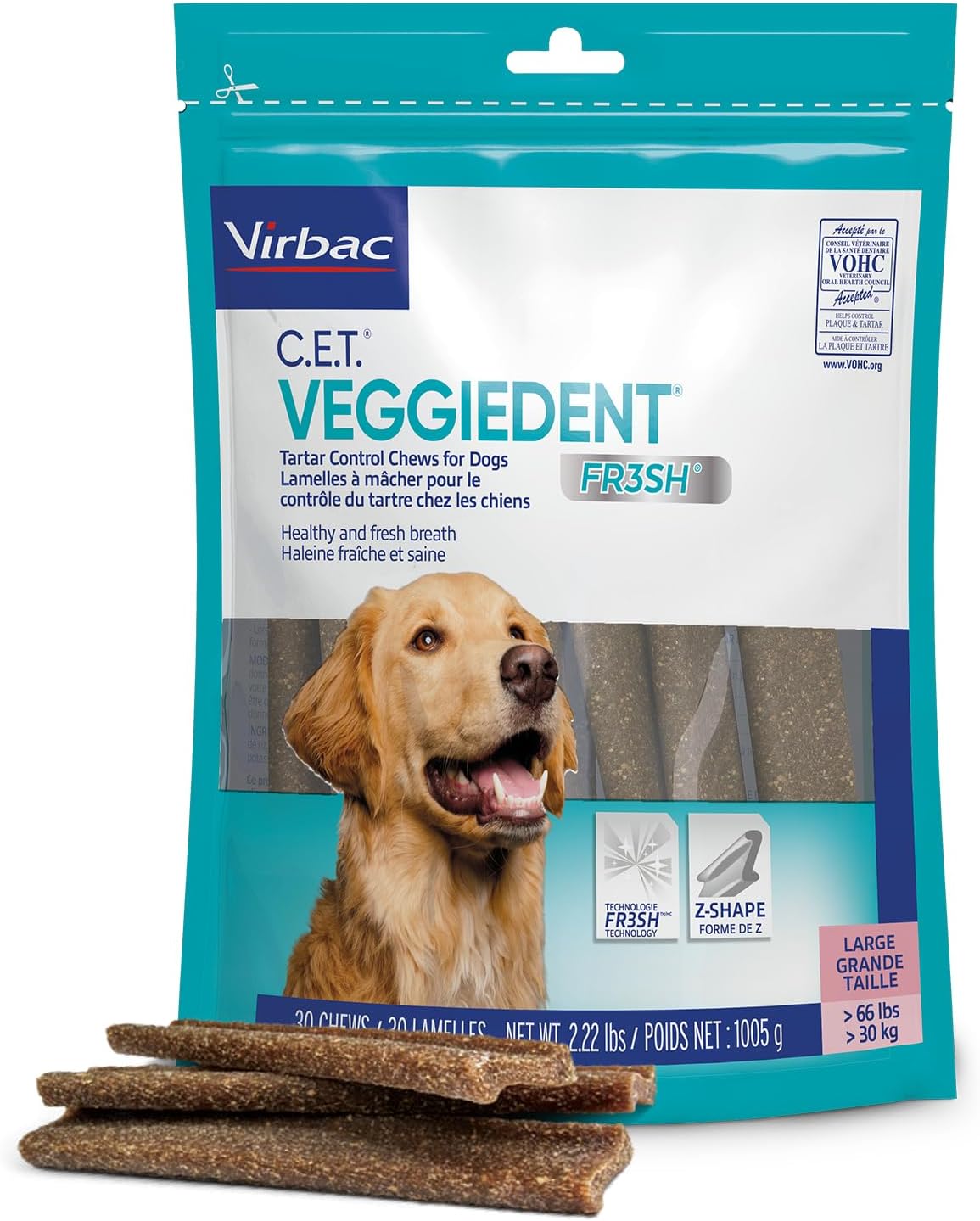
Virbac CET VeggieDent carries VOHC acceptance and is manufactured by a veterinary pharmaceutical company — the brand carries more clinical weight than consumer pet brands. The formula is grain-free (based on rice starch and potato) and uses C.E.T. Dual Enzyme technology to enzymatically target plaque bacteria. At $30 for 30 chews it's mid-range priced. The shape is specifically designed to reach the back teeth where most tartar accumulates. For dogs with grain sensitivities who need a clinically supported option, VeggieDent is the pick.
Pros
- ✓VOHC accepted — validated clinical efficacy
- ✓Grain-free formula for sensitive dogs
- ✓Veterinary brand with enzymatic antibacterial action
Cons
- ✗Lower palatability than Greenies for some dogs
- ✗Must be given at a specific rate — not as flexible

Whimzees Brushzees have the cleanest ingredient list of any VOHC-accepted dental chew: potato starch, glycerin, powdered cellulose, and natural colorings — no artificial additives, no meat by-products. VOHC accepted. The toothbrush shape is genuinely functional — the bristle-like projections create multiple cleaning surfaces. At $20 for 24 chews it's the most affordable VOHC-accepted option here. For owners who prioritize natural ingredients without compromising on dental efficacy, Whimzees is the answer.
Pros
- ✓Cleanest ingredient list of VOHC-accepted options
- ✓VOHC accepted — validated efficacy
- ✓Most affordable VOHC-accepted option at $20/24ct
Cons
- ✗Vegan formula — no animal protein, lower palatability for some dogs
- ✗Softer texture may not satisfy heavy chewers
Subscribe to our newsletter
Occasional updates and new releases — no spam.

Arm & Hammer's dental chews use baking soda (sodium bicarbonate) as the active ingredient — a mild abrasive and odor neutralizer with a track record in human dental products. Not VOHC accepted, but the mechanical abrasive action combined with baking soda provides measurable cleaning versus no dental care at all. At $14 for 28 chews, it's the most affordable option here. The texture is firmer than Greenies, which suits dogs who chew methodically. For budget-conscious owners who want some dental benefit without paying for VOHC-accepted pricing, Arm & Hammer is reasonable.
Pros
- ✓Most affordable option at $14/28ct
- ✓Baking soda provides additional abrasive cleaning
- ✓Widely available at grocery and hardware stores
Cons
- ✗Not VOHC accepted — no independent efficacy validation
- ✗Firmer texture may not suit all dogs

Pet MD's enzymatic dental chews use glucose oxidase and lactoperoxidase — the same enzymes found in veterinary enzymatic toothpastes — to break down plaque bacteria. Not VOHC accepted, but the enzymatic approach is validated in the broader veterinary dental literature. At $18 for 30 chews it's competitively priced. The chews are softer than most competitors, which makes them appropriate for senior dogs with worn teeth. The chicken flavor has high palatability. For owners who specifically want enzymatic action in a soft chew, Pet MD fills a gap not well covered by the VOHC-accepted options.
Pros
- ✓Enzymatic action validated in veterinary literature
- ✓Softer texture — appropriate for seniors and delicate teeth
- ✓High palatability for finicky dogs
Cons
- ✗Not VOHC accepted
- ✗Softer texture provides less mechanical scraping than firmer chews
How to Choose Dog Dental Chews
The Veterinary Oral Health Council (VOHC) is the independent certification body that validates dental claim products. A VOHC seal means the product has been tested in controlled studies and shown to reduce plaque or tartar by at least 10%. That's the baseline to look for — without it, you're relying on marketing claims rather than evidence.
Bottom line
Greenies are the evidence-backed default recommendation — VOHC acceptance, wide availability, and strong palatability mean most dogs will actually eat them consistently. Virbac CET VeggieDent is the pick for dogs with food sensitivities or owners who want a grain-free option backed by veterinary branding. Whimzees are the best natural ingredient option with VOHC acceptance. Arm & Hammer is the budget pick for households where cost matters more than certification.
Frequently asked questions
Do dog dental chews actually work?▼
How often should I give my dog dental chews?▼
Are dental chews safe to give without supervision?▼
Can dental chews replace brushing?▼
What other options exist for dog dental health?▼
Prices change. Check the retailer for the current price.
Comments & questions
Discussion happens on nattzy, our community forum. Sign in with Google to post — it takes a second.