Best Humidifier 2026: White Dust, Mold, and Maintenance
The biggest regret in buying a humidifier is rarely the model you picked — it's running it on straight tap water, or storing it with leftover water through the summer. CADR relative to your room size is the only spec that predicts real-world performance.
Quick answer
For most large LDK households, the Dyson Purifier Humidify+Cool Formaldehyde is the pick — HEPA H13 cleaning, UV-C water sterilization and a summer cool fan are the only combination here that earns floor space year-round. The Venta LW25 Airwasher humidifies filterlessly with zero white dust across roughly 37 m², the Boneco W200 is the design-led air washer, and the Stadler Form Oskar covers 45 m² evaporatively.
Each product is assessed on real-world durability, ease of daily use, performance against marketing claims, build quality, and long-term value. Manufacturer specifications were validated against verified owner reviews.
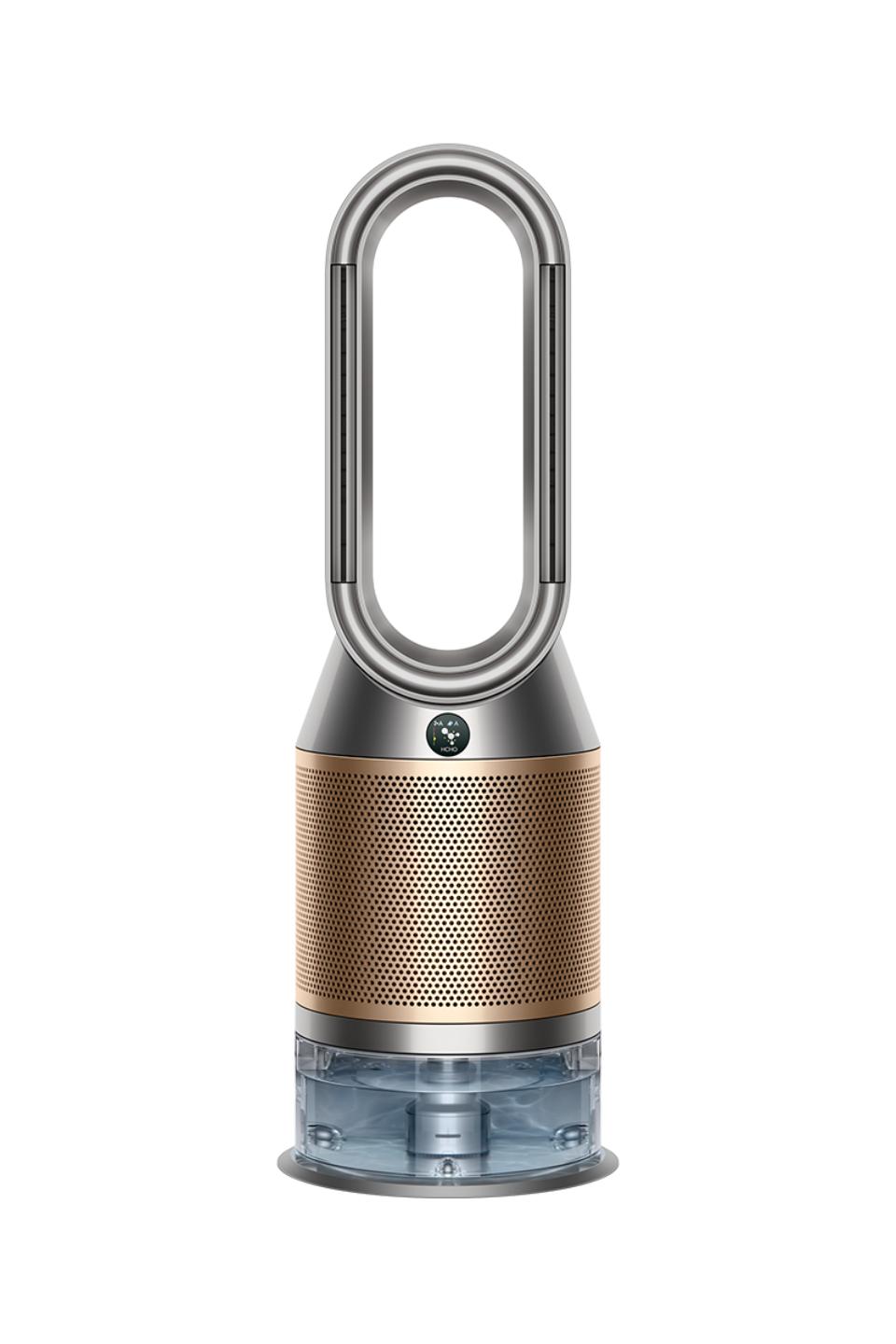
Dyson Purifier Humidify+Cool Formaldehyde
Best All-in-One Year-Round: The Dyson Purifier Humidify+Cool Formaldehyde is the only year-round pick here, stacking HEPA H13 air cleaning, UV-C water sterilization, ultrasonic humidification, a formaldehyde sensor, and a bladeless cool fan into one unit. The UV-C sterilization solves the bacterial-spray problem that dooms standard ultrasonic units without requiring distilled water, and the cool fan function means it stays useful through summer rather than going into storage in June like the other four.
Top picks ↓| Product | Price | Link |
|---|---|---|
| $802.69Price as of 2026-09-24 | ||
| $200Reference price | ||
| $220Reference price | ||
| $179.99Price as of 2026-09-24 | ||
| $79.99Price as of 2026-09-24 |
Top picks
Related articles
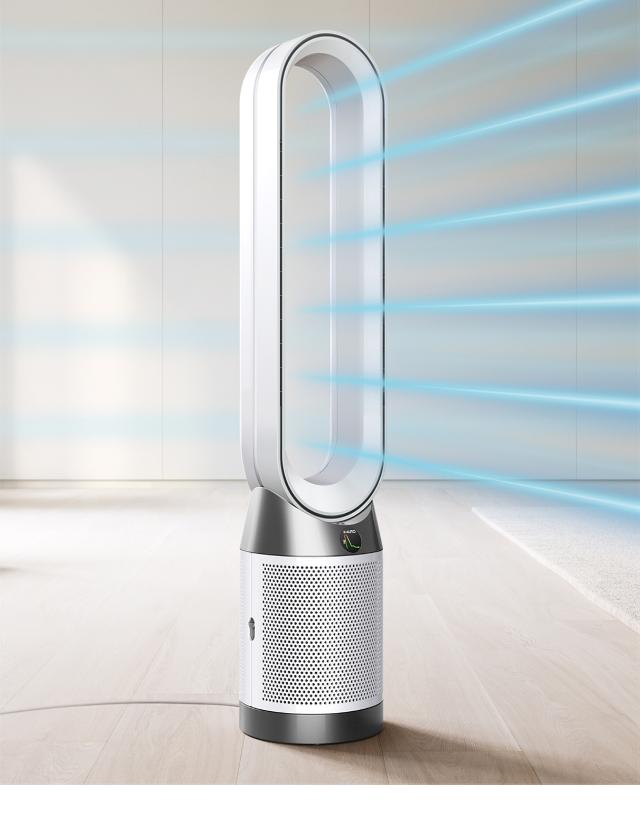
Dyson Purifier Humidify+Cool Formaldehyde
Dyson Purifier Humidify+Cool Formaldehyde (flagship tier) — the only year-round pick here, packing HEPA H13 air cleaning, UV-C water sterilization, humidification, and a bladeless fan into one unit. Budget for recurring consumables each year. Too big for rooms under 10 m².
The Dyson Purifier Humidify+Cool Formaldehyde is the only year-round pick here, stacking HEPA H13 air cleaning, UV-C water sterilization, ultrasonic humidification, a formaldehyde sensor, and a bladeless cool fan into one unit. The UV-C sterilization solves the bacterial-spray problem that dooms standard ultrasonic units without requiring distilled water, and the cool fan function means it stays useful through summer rather than going into storage in June like the other four. The cost is real: flagship-tier pricing at retail plus a monthly demineralization cartridge and a HEPA and activated carbon filter set per year. Plan for meaningful consumable costs over three years on top of the buy-in. Too big for rooms under 10m², and the cool fan moves less air than a dedicated Dyson Pure Cool.
Pros
- ✓HEPA H13 air cleaning rivals a dedicated air purifier
- ✓UV-C water sterilization solves the bacterial-spray problem without distilled water
- ✓Cool fan function keeps it useful through the humid summer
- ✓Formaldehyde sensor relevant to new builds and recently renovated apartments
Cons
- ✗Flagship-tier buy-in plus meaningful consumable costs over three years
- ✗Too large for rooms under 10m² and the cool fan is weaker than a dedicated Dyson Pure Cool
Venta LW25 Airwasher (mid-range) — filterless evaporative air washer. Rotating discs spin through a water bath, humidifying with zero white dust while the water traps dust and pollen. Covers roughly 37 m². No wick to replace, but the discs and tank need regular rinsing and descaling on hard water.
The Venta LW25 Airwasher is the filterless humidify-and-clean pick at a mid-range price — rotating plastic discs spin through a water bath, evaporating clean water vapor while the same water bath traps dust and pollen out of the air. Evaporative output means zero white dust, and there's no wick or pad to replace, which removes the per-season consumable that most evaporative units carry. Coverage runs to roughly 37 m², enough for a sizeable living room. The catch is maintenance honesty: the disc stack and water bath still need regular rinsing and, on hard water, periodic descaling, and the air-cleaning effect is gentle dust capture rather than HEPA-grade filtration — don't buy it expecting fine-particulate or PM2.5 performance.
Pros
- ✓Filterless disc design — no wick or pad to replace
- ✓Evaporative output means zero white dust regardless of tap water hardness
- ✓Water bath also traps dust and pollen as it humidifies
- ✓Covers roughly 37 m² — suits a sizeable living room
Cons
- ✗Disc stack and water bath need regular rinsing and descaling on hard water
- ✗Dust capture is gentle, not HEPA-grade fine-particulate filtration
Boneco W200 Hybrid Air Washer (premium) — minimalist Swiss filterless air washer. Rotating discs humidify with no white dust and no replaceable filter, with normal and cleaning modes and a clear water tank. The disc stack and water bath still need regular cleaning.
The premium-tier Boneco W200 Hybrid Air Washer is the design-led filterless pick — a minimalist Swiss air washer with a clear water tank that looks at home in a living room rather than clashing with the furniture the way a bulkier unit can. Like the Venta it uses rotating discs spinning through water rather than a replaceable wick, so there's no per-season filter cost, and evaporative output means zero white dust. It offers a normal and a cleaning mode. It sits at the premium end of the evaporative field, and the catch is coverage-per-cost: the Stadler Form Oskar covers up to 45 m² for a similar outlay, so the Boneco is the pick when minimalist design and the filterless format win over raw room area. The disc stack and water bath still need regular cleaning.
Pros
- ✓Minimalist Swiss design with a clear water tank fits living spaces cleanly
- ✓Filterless disc design — no replaceable wick or per-season consumable
- ✓Evaporative output means zero white dust regardless of tap water hardness
- ✓Normal and cleaning modes built in
Cons
- ✗Premium price for the coverage — Stadler Form Oskar covers more area for similar money
- ✗Disc stack and water bath still require regular cleaning
Subscribe to our newsletter
Occasional updates and new releases — no spam.
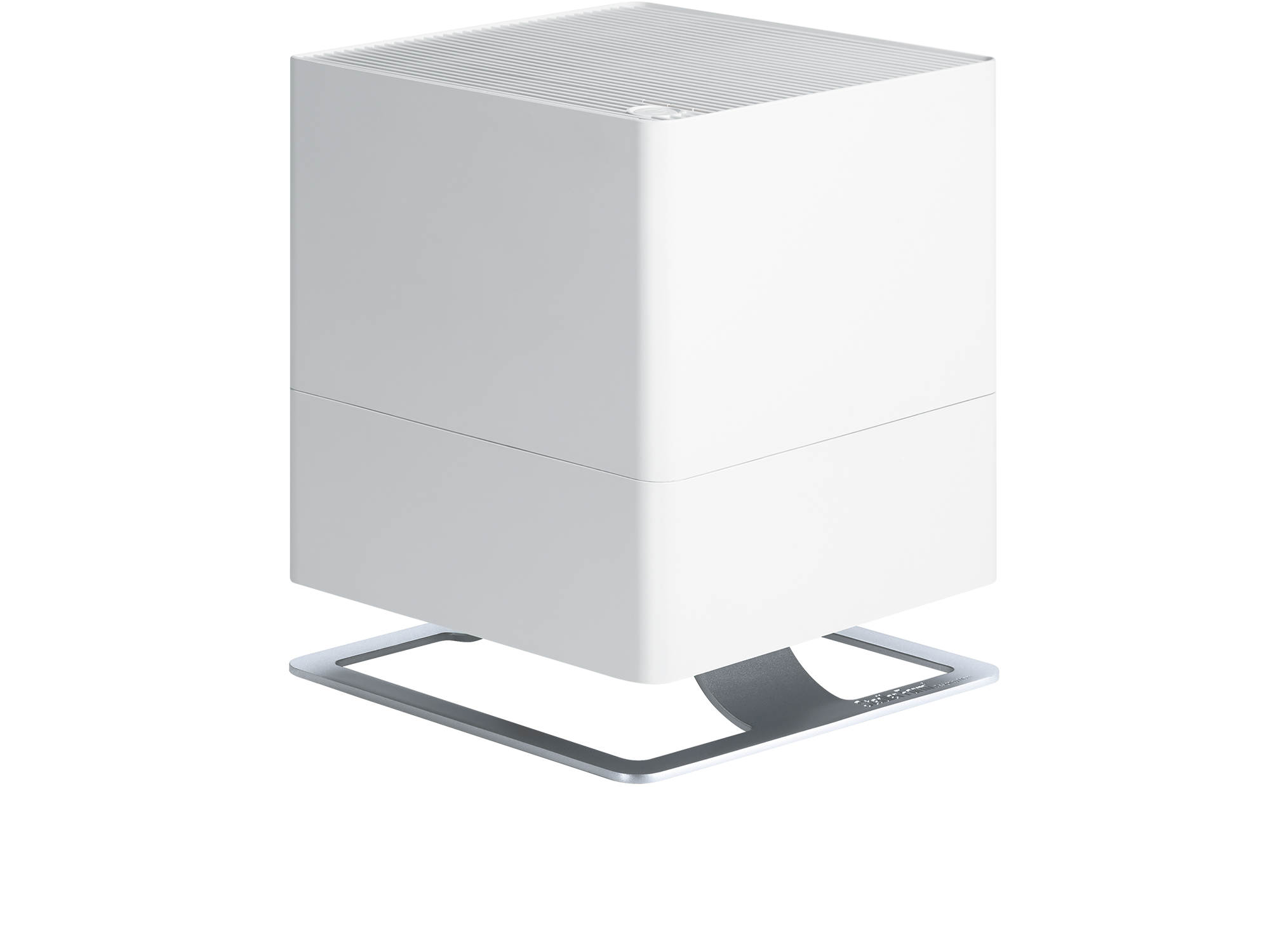
Stadler Form Oskar (mid-range) — Swiss-designed evaporative drum unit. Covers up to 45 m² and suits large living rooms. Weekly drum washing is mandatory. No smart-home integration or app — a simple dial-controlled appliance.
The mid-range Stadler Form Oskar is the large-room evaporative pick — Swiss-designed drum unit that covers up to 45m², the only option besides the Dyson that can lift a full LDK on its own without producing white dust. The drum design is the practical center: a removable drum filter that spins through the water and exposes wetted surface to airflow. The weekly drum removal and washing is mandatory because the drum's biofilm rides into the air if you skip it. No app, no smart-home integration — single dial controls output strength, which is either a feature or a limitation depending on whether you want connected appliances. The 3.5L tank shape doesn't fit easily under most kitchen faucets, so many households end up filling at the bathroom sink.
Pros
- ✓Covers up to 45m² — the only non-flagship option for a large LDK without white dust
- ✓Evaporative drum design produces no white dust regardless of water hardness
- ✓Simple dial control with no app or cloud dependency
- ✓Swiss design and build quality justify the mid-range price
Cons
- ✗Weekly drum removal and washing is mandatory to prevent biofilm spray
- ✗Tank shape doesn't fit easily under most kitchen faucets
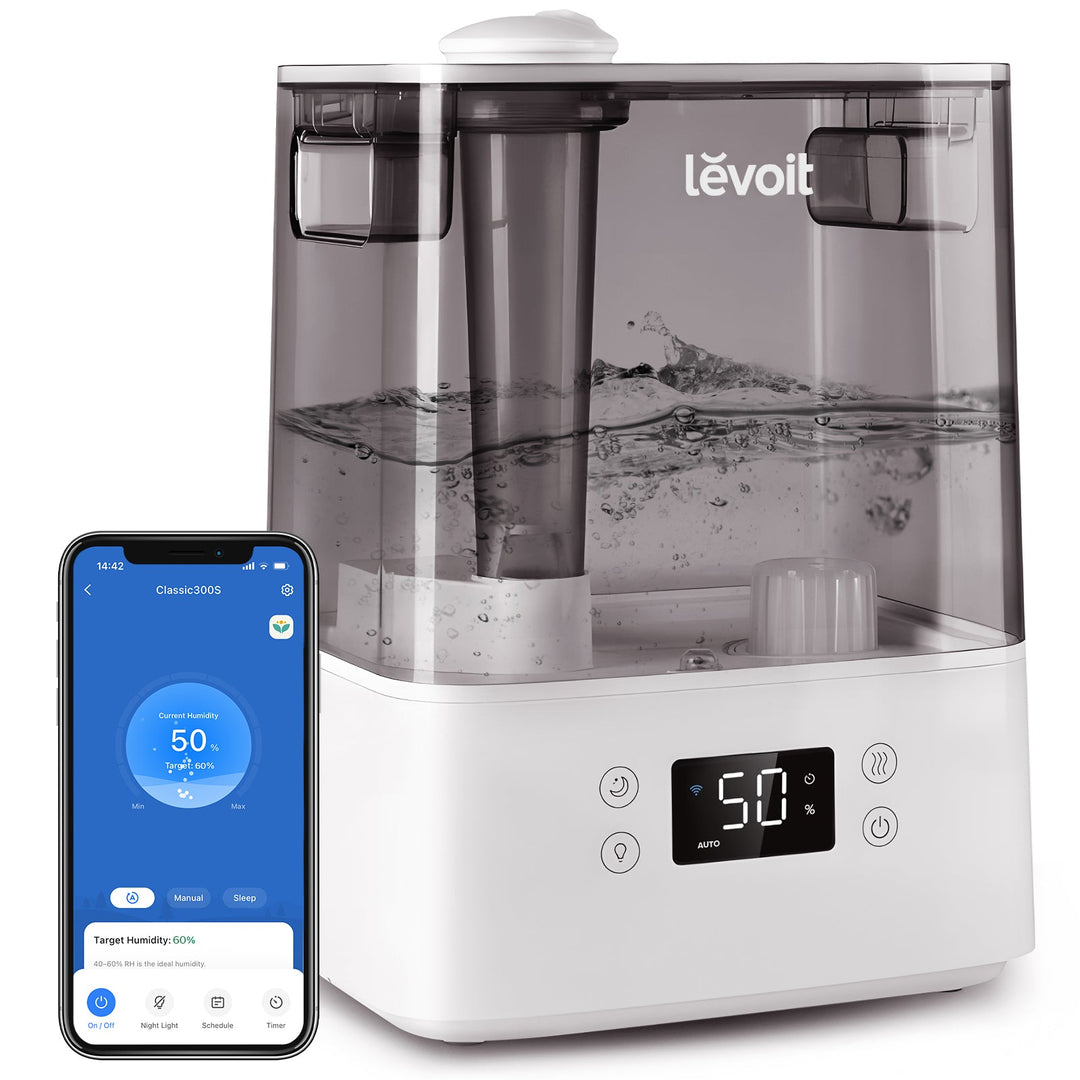
Levoit Classic 300S Ultrasonic Humidifier
Levoit Classic 300S (budget) — smart ultrasonic with app, Alexa, and Google Assistant. Best value here, but hard tap water leaves white dust on nearby furniture within weeks. Distilled water or the demineralization filter is mandatory.
The budget-priced Levoit Classic 300S is the smart-budget pick — VeSync app, Alexa and Google Assistant support, 6L tank, auto mode, and 28dB sleep mode quiet enough not to wake you. Two non-negotiable conditions: don't use straight tap water (distilled water or the demineralization filter slot is required), and don't skip the weekly tank clean. Anyone who can't commit to both will see white dust settling on nearby electronics and dark furniture within weeks on hard tap water. The on-board humidity sensor accuracy is heavily affected by placement, so keep it off walls and out of corners. At a third the price of mid-tier evaporative options, it earns the smart-home budget slot.
Pros
- ✓Lowest price in this comparison with smart-home integration
- ✓VeSync app plus Alexa and Google Assistant support
- ✓6L tank and 28dB sleep mode for overnight bedroom use
- ✓Demineralization filter slot accepts third-party filters
Cons
- ✗Distilled water or the demineralization filter is mandatory — straight tap water deposits white dust within weeks
- ✗On-board humidity sensor accuracy depends heavily on placement away from walls and corners
Which one is right for you?
For large LDK households that want one machine year-round
Dyson Purifier Humidify+Cool Formaldehyde
HEPA H13 cleaning, UV-C water sterilization, and the summer cool fan are the only combination here that justifies living on the floor through the humid season.
For filterless humidification with gentle dust capture
Venta LW25 Airwasher
Rotating discs humidify with zero white dust and no wick to replace, while the water bath traps dust and pollen, covering roughly 37 m².
For minimalist living-room design without a replaceable filter
Boneco W200 Hybrid Air Washer
A clean Swiss air-washer design with a clear water tank, filterless disc humidification, and zero white dust regardless of tap water.
For large open LDKs where no-white-dust is non-negotiable
Stadler Form Oskar
Evaporative drum design covers up to 45m² with zero white dust — the only non-flagship option for that combination.
For smart-home integration on a tight budget
Levoit Classic 300S Ultrasonic Humidifier
VeSync, Alexa, and Google support at a budget price if you can commit to distilled water and weekly tank cleaning.
How this comparison was made
No independent humidification-rate testing here. No measured water-vapor output under controlled ambient temperature, starting RH, and room volume. No smart-plug power logging across long runs. No bacterial culture sampling from tanks at different cleaning intervals. Reliable humidifier testing needs a standardized room volume, ambient humidity, and temperature — and a real home swings wildly across seasons, so lab-style comparisons without a controlled setup don't mean much.
What this comparison does instead: reads each manufacturer's spec sheet against the JEMA humidity-rating standard, confirms the 20°C / 30% RH test condition that JEMA uses for rated humidification output (the Japanese industry-standard test condition), cross-checks long-term verified buyer reviews for complaints about maintenance and real-world humidity behavior, and pulls in the optimal indoor humidity targets published by SHASE. Every product gets a weakness called out, because a humidifier that piles white dust onto your furniture in a hard-water city, or one that sprays bacteria into the air unless you wash the tank daily, or one whose rated capacity covers half the room you actually want to use it in — that humidifier's catalog spec is not telling you how it will feel to live with.
The most important upfront point: the humidification method decides the maintenance burden. Before you pick a model, you need to understand the trade-offs between ultrasonic, evaporative, and steam. Read the maintenance-reality section before deciding.
Ultrasonic vs evaporative vs steam — which one really wins
Ultrasonic humidifiers (Levoit Classic 300S here) use a vibrating piezoelectric disc to break water into a fine mist and push it into the room. They're quiet, energy-efficient, and produce visible mist, which is the part that makes most people feel the unit is 'working.' The fatal flaw: ultrasonic units neither heat nor filter the water before dispersing it. Whatever calcium and magnesium is dissolved in your tap water rides out with the vapor and lands on your furniture, electronics, and floor as white powder. With hard tap water (around 60–80 mg/L hardness), a winter's worth of white-dust accumulation is not a trivial annoyance — it's a real problem. Ultrasonic units also disperse whatever bacteria and biofilm are growing inside the tank straight into the air you breathe. That's why weekly tank cleaning and distilled or softened water aren't suggestions, they're safety requirements.
Evaporative humidifiers (the Venta LW25 Airwasher, Boneco W200 Hybrid Air Washer, and Stadler Form Oskar here) pass dry air over wetted surfaces — a wick, a drum, or rotating discs in a water bath — and let only pure water vapor evaporate off. Minerals stay behind in the water or on the wetted surface. That eliminates the white-dust problem entirely. Evaporative is also self-limiting: it physically cannot push room humidity past the equilibrium saturation point for that air temperature, so the runaway over-humidification you can get from an ultrasonic or steam unit on a timer just doesn't happen. The trade-off is that evaporative output tapers off as the room approaches your target — pulling humidity up from a very dry starting point is genuinely slower than with an ultrasonic. And because the filter or drum stays wet, it becomes a mold and bacteria farm if you don't clean it. Evaporative isn't 'low-maintenance,' it just needs a different kind of maintenance than ultrasonic.
Steam humidifiers (not in this comparison) boil the water and release steam. The output is sterile by definition — no minerals, no bacteria. The power draw is much higher than ultrasonic or evaporative (steam is in the 300W class versus 30W for evaporative), and the steam at the outlet is hot enough to be a burn risk for children and pets. The Dyson Purifier humidifier-air-cleaner sterilizes water with UV-C before the ultrasonic disperses it. This solves the bacteria-spraying problem of a standard ultrasonic without the energy cost of boiling. There's no universal winner here: ultrasonic wins on cost and quietness; evaporative wins on no-white-dust output and self-limiting humidity control; steam wins on sterile output; Dyson's hybrid approach fixes ultrasonic's main weakness at a steep price premium.
The ideal humidity range, and why over-humidifying is worse than you think
The target indoor relative humidity for human health and comfort is 40–60% RH. This range is backed by SHASE indoor-air guidance, WHO indoor air quality recommendations, and JEMA's product-labelling framework. Below 40% RH: mucous membranes dry out, susceptibility to respiratory viruses goes up, skin loses moisture, and static electricity multiplies. Above 60% RH: dust mite populations explode (mites need above 60% to reproduce), mold takes hold on walls, window frames, and fabric, and condensation forms on single-pane windows and cold exterior walls.
A lot of people over-humidify in winter. The pattern: turn the humidifier on in a cold, dry room; the unit pushes humidity up toward its target; but many cheap humidifiers don't actually have accurate humidity sensing or a reliable cut-off at the set point, so humidity blows past the set point — especially in a small, well-sealed room. Then the heater warms the room, and the problem compounds: warm air holds more moisture, so what felt like 55% RH when it was cold becomes 65% RH once the heater pushes the room to 22°C. This is how plenty of living rooms end up with winter window condensation and mold on north-facing walls despite running heat — the humidifier and the heater interact and push humidity past the safe ceiling.
The precise auto humidity sensing on the Dyson shuts off or throttles output when the target RH is hit. The Levoit Classic 300S has an auto mode with a built-in sensor, but accuracy and cut-off precision vary a lot with where you place the unit (see the placement FAQ). The Venta LW25 Airwasher, Boneco W200, and Stadler Form Oskar are evaporative and self-limiting, so they have a physical ceiling on humidity without needing electronic sensing to enforce it. In a well-sealed apartment in winter, a humidifier with reliable auto cut-off isn't a luxury — it's what stops over-humidification from causing condensation and mold.
The maintenance reality
An unmaintained humidifier is worse than no humidifier. A tank that sits between uses with water in it, filters that aren't cleaned or replaced on schedule, an ultrasonic disc caked in mineral scale — all of these become incubators for bacteria, mold, and Legionella under warm-water conditions. The humidifier then sprays them straight into the air you breathe. This isn't theoretical: NIOSH and Japan's Ministry of Health, Labour and Welfare have both documented cases of humidifier-related respiratory illness from poorly maintained household units.
Realistic maintenance obligations by method: ultrasonic (Levoit Classic 300S) — empty and wipe the tank daily if you can, a proper weekly clean with diluted white vinegar or citric acid, descale the disc every 2–4 weeks in hard-water cities, and replace the demineralization filter (if fitted) every 30–60 days. None of that is optional. An ultrasonic unit running for eight hours overnight with a biofilm-coated tank is dispersing whatever is in that tank into the air you breathe. Evaporative drum (Stadler Form Oskar) — pull the drum filter and wash it weekly (the drum surface is the primary site for bacterial growth), citric-acid sanitize the tank monthly, clean the tank monthly. Evaporative disc air washers (Venta LW25 Airwasher, Boneco W200) — rinse the disc stack and the water bath weekly, run a citric-acid or descaling cleaning cycle every couple of weeks in hard-water areas, and wipe the tank down regularly; they use no replaceable wick, but the water bath still grows biofilm if left unattended. UV-C ultrasonic-evaporative hybrid (Dyson) — UV-C sterilization knocks down the bacterial risk in the water loop, but the demineralization cartridge needs replacing every 30 days at rated use, HEPA and activated carbon filters get replaced once a year, and the water path itself still needs regular cleaning despite the UV-C.
Practical takeaway: before you buy, ask honestly whether you'll actually do the weekly maintenance. If the answer is shaky, an evaporative unit with a large, removable drum (Stadler Form Oskar) tolerates lapsed cleaning better than an ultrasonic that just sprays whatever is in the tank straight into the air. Evaporation does not aerosolize the biofilm on a drum the way ultrasonic dispersal aerosolizes what's in the tank.
Seasonal pivot: dry winter, summer mold
A seasonal humidity profile creates a problem in many climates. Winter (November to March) in cold-dry regions is cold and dry, and running heat without humidification drops indoor RH down to 20–30%. That's the season when a humidifier earns its keep — respiratory health, dry skin, static electricity, and wooden furniture shrinking are all real problems below 30% RH sustained.
From June through September the situation flips completely in humid-summer climates. During the rainy season (roughly June into July) and the muggy summer that follows, outdoor humidity regularly sits above 80% RH, and indoor humidity often runs above 70% even with the air conditioner on. Running a humidifier in this period — or even just storing one with residual water and a damp filter inside — actively cultivates mold. The humidifier itself becomes the source of indoor mold. A sensible practice: when the humid season starts, fully disassemble, clean, and dry the humidifier before storage. Don't store filters wet; replace them when the next winter season begins.
This seasonal pivot has two practical implications for what to buy. First, humidifiers that are hard to disassemble for storage (complex internal water paths, awkward tank shapes, tightly integrated air-purifier sections) tend to get stored badly and develop mold before the next winter. Second, the Dyson Purifier humidifier-air-cleaner Formaldehyde's 'cool fan' function means it stays useful through summer as an air purifier and fan, so out of the five it's the only one that justifies living on the floor year-round. The other four are best treated as winter-only and broken down, dried, and stored before the humid season hits.
What changed in 2026
Evaporative humidifiers are clawing back share after several years of ultrasonic dominance. The shift comes from rising consumer awareness of the white-dust problem — ultrasonic listings on major online retailers have accumulated a meaningful pile of negative reviews calling out white residue on electronics and dark furniture. Evaporative units, which used to feel dated and bulky, have benefited from design upgrades (Stadler Form Oskar) and the rise of filterless disc-based air washers (Venta LW25 Airwasher, Boneco W200) that humidify and capture dust in one pass. The evaporative category is no longer the unfashionable choice.
UV-C water sterilization has moved out of Dyson-only premium territory into the mid-range. By early 2026, several Japanese makers (Panasonic, Hitachi) have introduced UV-C lamps or LED sterilization in the mid-range, addressing the bacterial-spray concern of ultrasonic units without the cost of distilled water. That makes mid-range ultrasonic UV-C propositions more competitive, and narrows the gap between Dyson's approach and options at roughly a third of Dyson's price.
Combo air-purifier-plus-humidifier units have gone mainstream. In 2023 the Dyson Purifier humidifier-air-cleaner was a notable exception — most humidifiers were single-purpose. By 2026, multifunction units that pair air cleaning with humidification in one box have spread across the market. Filterless air washers like the Venta LW25 Airwasher sit in this combined category, humidifying while their water bath also traps airborne dust and pollen. The trend reflects consumer preference for multifunction appliances that cover two or three jobs in one footprint — genuinely compelling in a small apartment.
Who each one is for
For a large LDK where you want one machine year-round, get the Dyson Purifier humidifier-air-cleaner Formaldehyde. HEPA H13 air cleaning, UV-C water sterilization, a formaldehyde sensor, and a cool fan for summer — the stack of functions is just denser than anything else here. It's also a sensible pick for a new build or recently renovated home where off-gassing is a concern. But the unit itself is the flagship-priced option here, and on top of that the demineralization cartridge is monthly while the HEPA and carbon filters are replaced per seasonal set. Plan for meaningful consumable costs over three years on top of the buy-in. It's also too big for a tight corner room or anything under 10 m², and the cool fan doesn't move as much air as a dedicated Dyson Pure Cool.
For a mid-sized to large room where you want humidification and some air cleaning in one box without any white dust, the Venta LW25 Airwasher. The filterless disc design means there's no wick or pad to replace — the rotating discs spin through a water bath, evaporating clean vapor while the water traps dust and pollen out of the air. Coverage runs to roughly 37 m², so it suits a sizeable living room. Watch out: the water bath and disc stack still need regular rinsing and periodic descaling in hard-water areas, and the air-cleaning effect is gentle dust capture, not HEPA-grade filtration — don't buy it expecting fine-particulate or PM2.5 performance.
For a bedroom or living room where minimalist design matters and you want filterless evaporative humidification, the Boneco W200 Hybrid Air Washer. The Swiss design is clean and the clear water tank looks at home in a living space; like the Venta it uses rotating discs rather than a replaceable filter, so there's no per-season consumable, and evaporative output means no white dust. It offers a normal and a cleaning mode. It sits at the premium end of the evaporative field, and given that the Stadler Form Oskar covers up to 45 m² for a similar outlay, the Boneco is the pick when design and the filterless format win over raw coverage. The disc stack and water bath still need regular cleaning.
For a large living room or open LDK (up to 45 m²) where 'no white dust' is non-negotiable, the Stadler Form Oskar. The evaporative drum is the only thing in this comparison besides the Dyson that can lift this much room area on its own. There's no app or smart-home integration — it's a single-function unit with a dial for output strength. In exchange, the weekly drum removal and washing is mandatory, because without it the drum's biofilm rides into the air. The 3.5L tank is large but the shape doesn't fit easily under most kitchen faucets, so some households end up filling it at the bathroom sink.
For a budget pick with smart features and day-to-day convenience — if you're confident you'll actually do the maintenance — the Levoit Classic 300S. VeSync app, Alexa and Google support, 6L tank, auto mode, and 28dB sleep mode that won't wake you. Two conditions: don't run tap water (distilled water or a demineralization filter is required), and don't skip the weekly tank clean. Anyone who can't commit to both will see white dust settling on nearby electronics and dark furniture within weeks on hard tap water. The on-board sensor accuracy is heavily affected by placement, so don't park it against a wall or in a corner.
Bottom line
The uncomfortable conclusion across all five: which model you buy matters less than whether you'll actually maintain it. A cheap evaporative unit cleaned every week is safer indoor air than a flagship-priced combo machine left alone. With that out of the way, the tier picks: Dyson if you can stretch to the flagship tier and want a single unit handling a large LDK year-round; Venta LW25 Airwasher if you want filterless humidification with gentle dust capture and no white dust; Boneco W200 if minimalist design and the filterless format win over raw coverage; Stadler Form Oskar if you need a large room covered without white dust; Levoit Classic 300S if you want budget smart-home integration and can commit to distilled water.
Frequently asked questions
Where in the room should I place the humidifier?▼
Is it safe to leave a humidifier on overnight?▼
Should I use tap water or distilled water?▼
If I buy a humidifier-plus-air-purifier combo, do I still need a separate air purifier?▼
Realistically, how often do I have to clean it?▼
What do I do with the humidifier during a humid summer?▼
Is the Dyson Purifier humidifier-air-cleaner actually cheaper than buying separate units?▼
Prices change. Check the retailer for the current price.
Comments & questions
Discussion happens on nattzy, our community forum. Sign in with Google to post — it takes a second.
Related articles

Best Aroma Diffuser 2026: 5 Compared
Best Standing Desk 2026: 5 sit-stand desks compared honestly

Best Electric Toothbrush 2026: 5 models compared honestly

ConoHa WING review (2026): setup, speed and pricing
Best JP rental server 2026: 5 hosts ranked
Best LED Face Masks 2026: 3 Light Therapy Devices Compared