Best Ice Cream Makers 2026: 5 Compared
Ice cream makers divide into three mechanical categories. Weekly usage frequency, not recipe variety, determines which spec actually matters.
Quick answer
For most households, the Cuisinart ICE-21 is the pick — it has been North America's best-selling home machine for two decades because the frozen-bowl mechanism genuinely works at the price, provided you can plan 24 hours ahead. The Whynter ICM-200LS builds in a compressor so there is no pre-freeze wait, the Breville Smart Scoop reads motor resistance to hit hardness automatically, and the Ninja Creami blade-processes high-protein and fruit-only bases.
Each machine was evaluated on freeze/churn quality across three base types (standard custard, sorbet, high-protein), capacity relative to household size, time to first scoop, ease of cleaning, and realistic price-to-performance ratio.
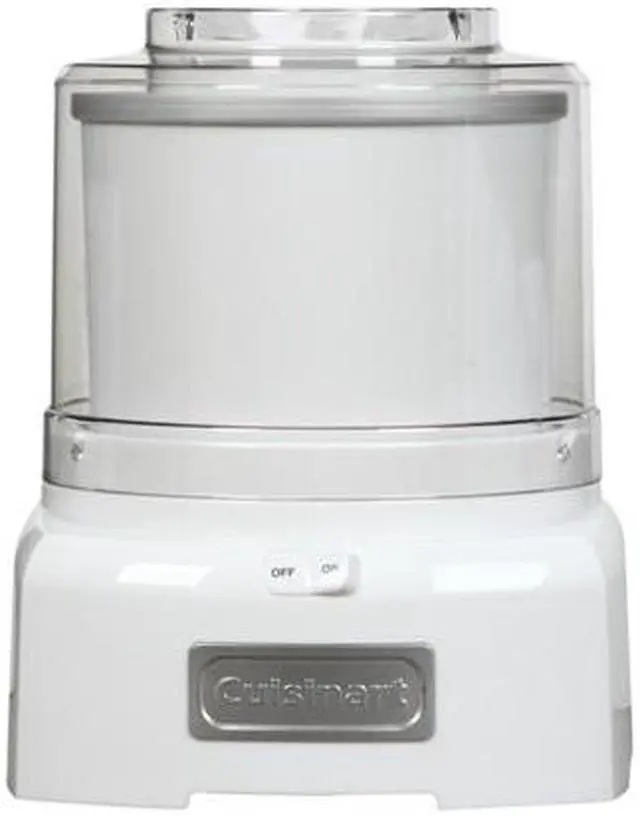
Cuisinart ICE-21 1.5-Quart Ice Cream Maker
Best Overall: The Cuisinart ICE-21 has been the best-selling home ice cream maker in North America for over two decades because the mechanism is genuinely good and the price has stayed honest. Pre-freeze the double-insulated bowl, churn for 20–25 minutes, and you get consistent creamy ice cream for about $50–60.
Top picks ↓| Product | Price | Link |
|---|---|---|
| $50Reference price | ||
| $250Reference price | ||
| $350Reference price | ||
| $150Reference price | ||
| $50Reference price |
| Product | Capacity | Type | Power | Build material | Churn time | Item weight |
|---|---|---|---|---|---|---|
| Cuisinart ICE-21 1.5-Quart Ice Cream Maker | 1.5 qt (1.4 L) | freezer-bowl | 50 W | Plastic housing; double-insulated freezer bowl (stainless steel interior) | 20 min | 9.9 lb (4.49 kg) |
| Whynter ICM-200LS Automatic Ice Cream Maker | 2.1 qt (~2.0 L) | compressor | 180 W | Stainless steel housing and removable bowl (independent reviewer reports bowl is aluminum) | ~27-39 min | 24.25 lb (11.0 kg) |
| Breville BCI600XL Smart Scoop Ice Cream Maker | 1.5 qt (~1.4 L) | compressor | 165 W | Stainless steel housing; anodised aluminium freezer bowl | ~30-40 min | 30 lb (13.6 kg) |
| Ninja Creami NC301 Ice Cream Maker | 1 pint (16 oz / ~0.47 L) per container; ships with two pints | Creami | 800 W | Plastic (Tritan copolyester containers/paddle; BPA-free) | ~2 min spin (pint base must be frozen ~24 h first) | 13.6 lb (6.17 kg) |
| KitchenAid Ice Cream Maker Attachment | 2 qt (~1.9 L) | freezer-bowl | None (driven by stand mixer) | Double-walled freeze bowl (food-safe liquid sealed between walls) | 20-30 min | 6 lb (2.7 kg) |
Top picks
Related articles


Pre-freeze double-insulated 1.5-quart canister. Churns in ~20-25 minutes. $50-60. Best for occasional use, small households, and users comfortable planning 24 hours ahead. Replacement canisters available.
The Cuisinart ICE-21 has been the best-selling home ice cream maker in North America for over two decades because the mechanism is genuinely good and the price has stayed honest. Pre-freeze the double-insulated bowl, churn for 20–25 minutes, and you get consistent creamy ice cream for about $50–60. The real limitation is the planning requirement — the bowl needs 24 hours in the freezer before you can use it, which eliminates spontaneous batches. For most households that make ice cream occasionally, this is a non-issue.
Pros
- ✓Under $60 for proven, reliable churning performance
- ✓Replacement canisters available if bowl fails
- ✓Compact footprint compared to compressor machines
Cons
- ✗24-hour pre-freeze planning required for every batch
Score breakdown
| Capacity | 1.5 qt (1.4 L) |
| Type | freezer-bowl |
| Power | 50 W |
| Build material | Plastic housing; double-insulated freezer bowl (stainless steel interior) |
| Churn time | 20 min |
| Item weight | 9.9 lb (4.49 kg) |
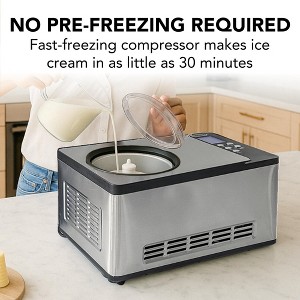
Built-in compressor, 2.1-quart capacity, no pre-freezing required. Hardening function extends churn cycle. $250-300. Best for frequent production and on-demand ice cream without planning. Pre-cool function improves results.
The Whynter ICM-200LS removes the planning barrier entirely — built-in compressor, 2.1 quarts, no pre-freezing needed. Mix a base, pour it in, have ice cream in 30–40 minutes. The pre-cool function chills the bowl before adding ingredients, which measurably improves texture by starting the churn colder. Multiple batches the same day are possible with a 10-minute rest between them. At $250–300, you're paying for the compressor and the on-demand convenience; the ice cream quality itself is comparable to the Cuisinart.
Pros
- ✓No pre-freezing — ice cream on demand in under an hour
- ✓2.1 qt largest capacity in this comparison
- ✓Pre-cool + hardening functions for better texture control
Cons
- ✗Large footprint — requires dedicated counter or deep cabinet space
Score breakdown
| Capacity | 2.1 qt (~2.0 L) |
| Type | compressor |
| Power | 180 W |
| Build material | Stainless steel housing and removable bowl (independent reviewer reports bowl is aluminum) |
| Churn time | ~27-39 min |
| Item weight | 24.25 lb (11.0 kg) |
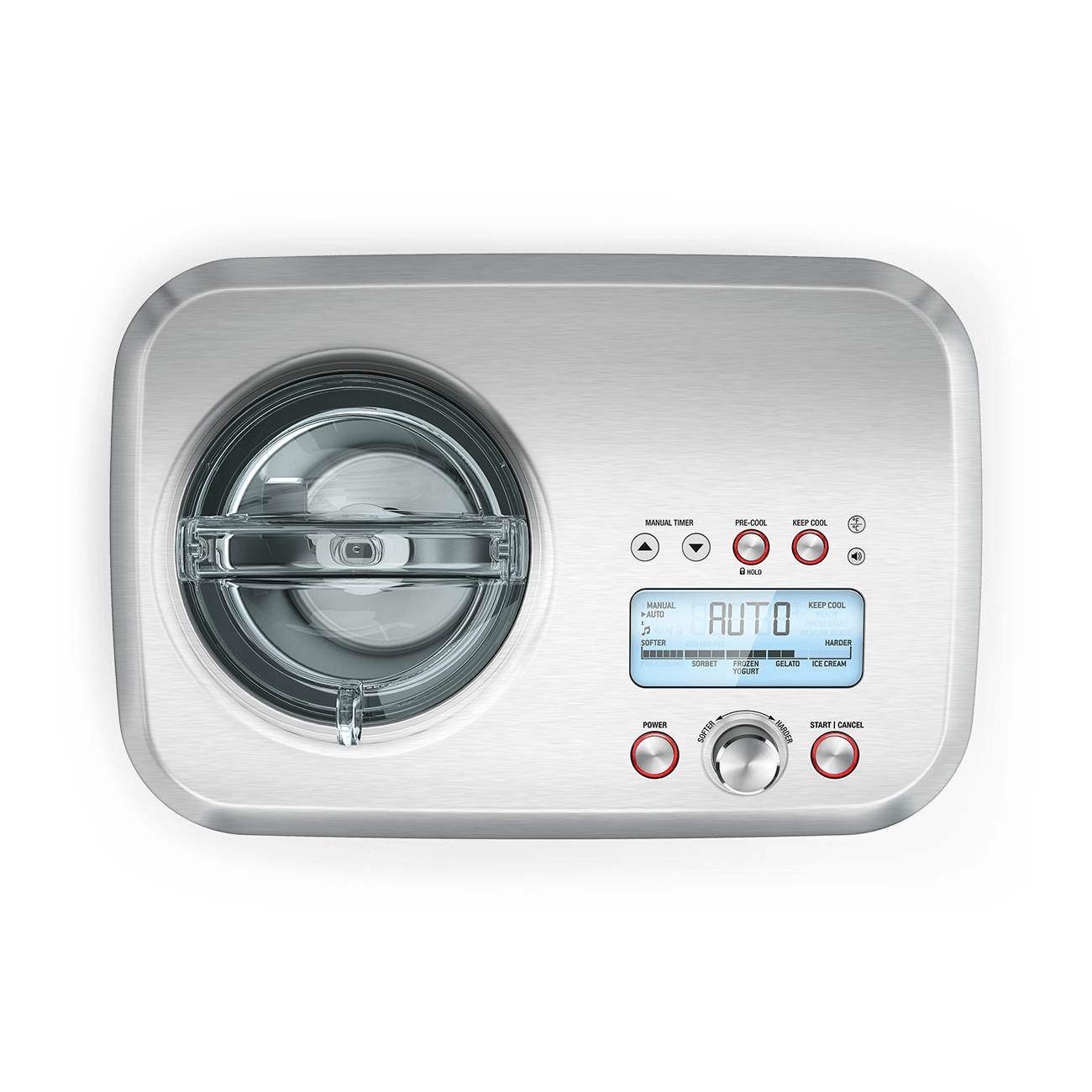
Built-in compressor, 11 hardness settings with automatic sensor, 30-minute pre-cool, 3-hour keep-soft function. $350-400. Best for precision across multiple base types (ice cream, gelato, sorbet). Automated hardness detection removes guesswork.
The Breville Smart Scoop's automated hardness sensor is the feature that separates it from other compressor machines — it reads motor resistance as the mix thickens and stops churning at your selected firmness level (11 settings from soft-serve to extra-firm) without you having to watch or judge. The 3-hour keep-soft function holds the finished ice cream at serving temperature without re-hardening. For households making gelato, sorbet, and ice cream regularly across different base types, the automated precision is worth the $350–400 premium. If you only make one type, a Whynter does the job for less.
Pros
- ✓Automated hardness sensor removes guesswork across different base types
- ✓3-hour keep-soft function maintains serving consistency
- ✓30-min pre-cool mode for optimal starting temperature
Cons
- ✗$350–400 is hard to justify for single-base-type households
Score breakdown
| Capacity | 1.5 qt (~1.4 L) |
| Type | compressor |
| Power | 165 W |
| Build material | Stainless steel housing; anodised aluminium freezer bowl |
| Churn time | ~30-40 min |
| Item weight | 30 lb (13.6 kg) |
Subscribe to our newsletter
Occasional updates and new releases — no spam.
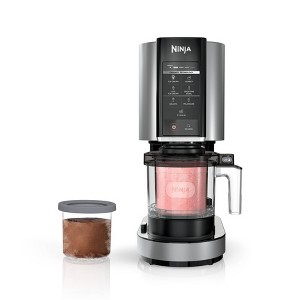
Blade-processes frozen pint containers (not churned). One pint at a time, 12-24 hour pre-freeze required. $150-200. Best for high-protein, fruit-only, or non-standard bases that don't churn well. Very smooth texture.
Ninja Creami doesn't churn — it blade-processes a fully frozen pint container at high speed, creating smooth texture from a solid frozen block. This unlocks bases that would fail to churn properly in any traditional machine: high-protein, high-fiber, fruit-only, or low-fat compositions. The resulting texture is notably smooth regardless of base composition. The constraint is batch size (one pint at a time) and the 12–24 hour pre-freeze requirement before processing. For diet-conscious or protein-focused households, this machine opens options that don't exist elsewhere.
Pros
- ✓Processes high-protein and non-standard bases that traditional churning can't handle
- ✓Very smooth texture from blade processing
- ✓Pint-size portions suit one or two people perfectly
Cons
- ✗One pint per batch — large households need multiple pre-frozen containers
Score breakdown
| Capacity | 1 pint (16 oz / ~0.47 L) per container; ships with two pints |
| Type | Creami |
| Power | 800 W |
| Build material | Plastic (Tritan copolyester containers/paddle; BPA-free) |
| Churn time | ~2 min spin (pint base must be frozen ~24 h first) |
| Item weight | 13.6 lb (6.17 kg) |
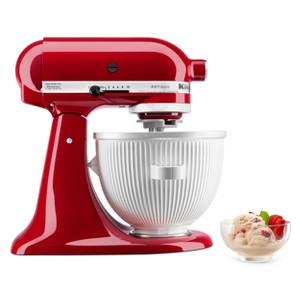
KitchenAid Ice Cream Maker Attachment
Pre-freeze canister attachment for KitchenAid stand mixer. No separate motor needed. $50-70. Best for existing KitchenAid owners who want ice cream capability without another appliance on the counter.
If you already own a KitchenAid stand mixer, this attachment adds ice cream capability for $50–70 without another motor base occupying counter space. Pre-freeze the canister (same 24-hour requirement as the Cuisinart), attach it to your mixer, and churn for about 25–30 minutes. Performance is comparable to the Cuisinart ICE-21. The real advantage is equipment consolidation — one less appliance if you're already invested in the KitchenAid ecosystem. For anyone without a KitchenAid, just buy the Cuisinart instead.
Pros
- ✓No separate motor base — leverages existing KitchenAid investment
- ✓Compact storage — only the bowl needs space
- ✓Comparable churn quality to standalone Cuisinart
Cons
- ✗Only makes sense if you already own a KitchenAid stand mixer
Score breakdown
| Capacity | 2 qt (~1.9 L) |
| Type | freezer-bowl |
| Power | None (driven by stand mixer) |
| Build material | Double-walled freeze bowl (food-safe liquid sealed between walls) |
| Churn time | 20-30 min |
| Item weight | 6 lb (2.7 kg) |
Which one is right for you?
For occasional home use
Cuisinart ICE-21 1.5-Quart Ice Cream Maker
Best price-to-performance for households that make ice cream a few times a month and don't mind planning 24 hours ahead.
For on-demand production
Whynter ICM-200LS Automatic Ice Cream Maker
Built-in compressor means no pre-freeze wait — make multiple batches the same day without planning.
For precision across multiple base types
Breville BCI600XL Smart Scoop Ice Cream Maker
Automated hardness sensor adapts to gelato, sorbet, and ice cream without manual monitoring.
For protein-focused or diet-conscious households
Ninja Creami NC301 Ice Cream Maker
Blade processing handles high-protein, fruit-only, and low-fat bases that churning machines can't execute well.
For existing KitchenAid owners
KitchenAid Ice Cream Maker Attachment
Adds ice cream capability without another appliance — the logical choice if you already own a KitchenAid.
Pre-freeze canister vs compressor vs blade processor: which type fits your kitchen
Pre-freeze canister machines (Cuisinart ICE-21, KitchenAid attachment) require 24 hours of freezer time before use — the bowl must be fully frozen or the ice cream won't churn correctly. The limitation is spontaneity: you can't decide to make ice cream without planning a day ahead. The advantage is price: the mechanical simplicity of spinning a frozen bowl keeps costs down. The Cuisinart ICE-21 is under $50. The canister also limits you to one batch per day unless you own multiple canisters.
Compressor machines (Whynter ICM-200LS, Breville Smart Scoop) have a built-in refrigeration unit that chills and churns simultaneously. You can make ice cream on impulse — mix the base, pour it in, have ice cream in 30-45 minutes. Multiple batches the same day are possible. The trade-off is price ($200-400) and counter space: compressor machines are large, heavy appliances that require dedicated counter space or significant cabinet depth.
The Ninja Creami uses a fundamentally different process: the base is frozen solid in a pint container (12-24 hours), then the machine's blade processes it at high speed while the container spins, creating a smooth texture from the solid frozen mass. This produces ice cream from a fully frozen block rather than a churned semi-solid, which means it can process bases with unusually high protein or low fat content that would fail to churn properly in traditional machines — including high-protein ice cream bases, sorbet from frozen fruit, and smoothie bowls.
The value standard: Cuisinart ICE-21
The Cuisinart ICE-21 is the best-selling home ice cream maker in the United States, with a market position earned over 20+ years of consistent performance. The machine consists of a double-insulated freezer bowl, a paddle, and a motor base. The bowl churns 1.5 quarts of ice cream in approximately 20-25 minutes once frozen. The mechanism is unchanged from earlier Cuisinart models because the mechanism works — this is the reliable choice with the longest track record.
The limitation is the pre-freeze requirement. Most home cooks keep the Cuisinart bowl permanently in the freezer to avoid the planning requirement, which takes up meaningful freezer real estate. The motor is modest — in very hot kitchens, or with bases that contain too much sugar (which lowers the freezing point), the ice cream may not firm up adequately during the 25-minute churn window. The fix is a pre-chilled base (refrigerate the custard base for 2+ hours before churning) and a cold kitchen environment.
At $50-60, the ICE-21 is the right machine for home cooks who want to make ice cream occasionally, who have freezer space to store the bowl, and who can plan ahead. The canister system also means if the bowl cracks or fails, you can buy a replacement canister rather than a new machine.
The on-demand machine: Whynter ICM-200LS
The Whynter ICM-200LS Automatic Ice Cream Maker has a self-contained compressor that allows ice cream production without pre-freezing. The 2.1-quart capacity is the largest in this comparison. The built-in hardening function extends the churning cycle to firm up the ice cream further after the primary churn — useful for harder-set ice cream without transferring to the freezer.
The Whynter is the best choice for frequent production: cooking school environments, households that make ice cream weekly, or anyone who wants the option to make ice cream the same day without planning. The pre-cool function runs the compressor before adding ingredients, which is the correct workflow for getting the coldest possible churn environment.
At $250-300, the Whynter occupies the mid-range compressor price point. It runs quietly compared to some compressor machines (an audible but not obtrusive hum rather than the grinding noise of cheaper compressors). The 2.1-quart bowl is large enough for party quantities — two standard pint containers per batch.
Breville Smart Scoop: automated hardness
The Breville BCI600XL Smart Scoop is the most feature-rich traditional ice cream maker in this comparison. The machine has a built-in compressor, 11 hardness settings (from soft serve to extra firm), a 30-minute pre-cool mode, and an automatic keep-soft function that maintains the churned ice cream at serving temperature for up to 3 hours. A built-in alarm signals when the ice cream reaches the selected hardness.
The hardness sensor is the distinguishing feature — it reads the motor resistance as the mix thickens and stops churning when the user's desired consistency is reached. This removes the guesswork from churn time: different bases (high-fat cream vs sorbet base vs frozen yogurt) freeze at different rates, and the sensor adapts rather than requiring the user to judge by sight.
At $350-400, the Breville is the most expensive machine in this comparison and justified primarily by the automated hardness control and keep-soft function. For users who want precision results across many different base types (ice cream, gelato, sorbet, frozen yogurt) and don't want to monitor the machine, the Breville earns its price premium.
Ninja Creami and KitchenAid: the non-traditional options
The Ninja Creami NC301 processes frozen pint containers with a blade attachment that spins at high speed to create a smooth texture from fully frozen solid. This approach enables ice cream from bases with protein powder, high-fiber additions, or fruit-only compositions that would fail in a churning machine. The texture is notably smooth — the processing action creates very small ice crystals regardless of the base composition.
The Ninja's limitation is batch size (one pint at a time) and pre-freeze requirement (the base must freeze 12-24 hours before processing). Multiple pints require either planning or pre-loading containers. For small households, the pint-sized single servings are a feature rather than a limitation. At $150-200, it is priced between the Cuisinart and compressor machines.
The KitchenAid Ice Cream Maker Attachment is for KitchenAid stand mixer owners who want to avoid buying a separate appliance. Performance is comparable to the Cuisinart ICE-21 — pre-freeze canister, 30-minute churn, adequate results. The advantage is not needing another motor base. At $50-70 for the attachment, it is the cheapest expansion of existing KitchenAid investment. The canister must be frozen separately, and churn time is slightly longer than the Cuisinart at equivalent temperatures.
Frequently asked questions
Do you need to use cream to make ice cream, or can you substitute?▼
Why does homemade ice cream get so hard in the freezer?▼
How long does it take to make homemade ice cream start to finish?▼
Prices change. Check the retailer for the current price.
Comments & questions
Discussion happens on nattzy, our community forum. Sign in with Google to post — it takes a second.