Best Kettlebells 2026: Competition vs Cast Iron Compared
A kettlebell is one of the simplest pieces of strength equipment you can own — and one of the easiest to get wrong. The five options in this comparison represent genuinely different tools. Weight range and build quality determine long-term value far more than feature lists.
Quick answer
For most serious training, the Kettlebell Kings Competition bell is the pick — built to the international kettlebell sport standard, so every weight from 8kg to 48kg shares the same 33mm handle and body dimensions within ±1% tolerance. The CAP cast iron bell is the cheapest real entry at $1.50-2.00 per kg, the Bowflex SelectTech 840 covers 8-24kg in one footprint, and Titan brings competition geometry near cast-iron pricing.
This comparison is desk research. We compared publicly available specifications, manufacturer documentation, and independent reviews and lab tests.

Kettlebell Kings Competition Kettlebell
Best Overall: The Kettlebell Kings Competition Kettlebell is built to the international kettlebell sport standard, which means every weight from 8 kg to 48 kg shares the same external dimensions — roughly 210 mm body diameter, 33 mm handle, and a uniform base width. The 33 mm handle is smaller than typical cast iron and lets the bell seat deeper in the palm during swings and snatches, which is meaningful for high-rep sets where callus and skin shear become the limiter.
Top picks ↓| Product | Price | Link |
|---|---|---|
| $99.00Reference price | ||
| $54.99Reference price | ||
| $149Reference price | ||
| $25〜$105Reference price | ||
| $18〜$55Reference price |
Top picks
Related articles



Best competition-grade kettlebell for consistent training across multiple weights. 33 mm handle diameter, ±1% weight tolerance, uniform body dimensions regardless of load. The right choice for kettlebell sport training, high-volume snatch work, and multi-weight sets where technique consistency is a priority. Expect to pay a premium over cast iron — it is justified for the use cases the design targets.
The Kettlebell Kings Competition Kettlebell is built to the international kettlebell sport standard, which means every weight from 8 kg to 48 kg shares the same external dimensions — roughly 210 mm body diameter, 33 mm handle, and a uniform base width. The 33 mm handle is smaller than typical cast iron and lets the bell seat deeper in the palm during swings and snatches, which is meaningful for high-rep sets where callus and skin shear become the limiter. The matte powder coat holds chalk well, and the bell is specified to ±1% of stated weight versus the typical ±3–5% on cast iron. The premium over cast iron is real but justified for sport-specific training or multi-weight sets where technique consistency matters.
Pros
- ✓Sport-standard 33 mm handle reduces palm shear on high-rep sets
- ✓Uniform body diameter across weights for consistent technique transfer
- ✓±1% weight tolerance is tighter than any cast iron in the comparison
- ✓Powder coat finish holds chalk well for snatch and swing work
Cons
- ✗Premium price over cast iron is hard to justify for single-bell fitness use
- ✗Heavier in absolute terms than equivalent cast iron at the same nominal weight
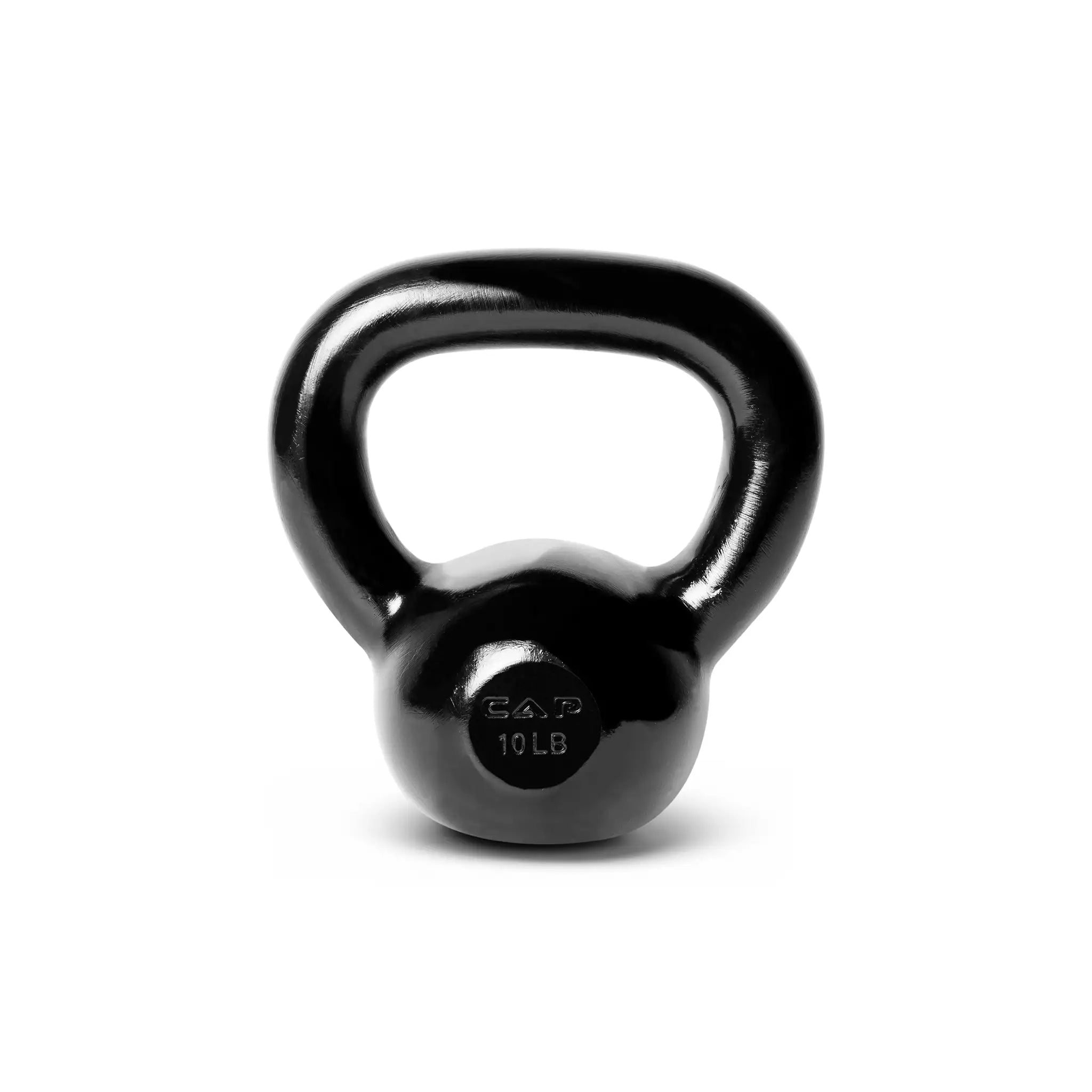
Best value cast iron kettlebell for general fitness training. Handles swings, deadlifts, presses, and carries without complication. The enamel finish and proportional handle scaling with weight are standard for the category. At $1.50–$2.00/kg, it is the most cost-efficient entry point into fixed-weight kettlebell training for home gym or garage use.
The CAP Barbell Cast Iron Kettlebell is the most cost-efficient entry into fixed-weight kettlebell training at roughly $1.50 to $2.00 per kg. The handle diameter scales with the bell weight (35–38 mm depending on size), which is standard cast iron geometry and works well for deadlift-pattern movements, presses, and goblet squats. The enamel finish is slightly less porous than the powder coat on competition bells — chalk adheres but not as aggressively, which matters mostly in humid hot-yoga-style conditions. Build quality is consistent for the price point and the bell handles swings, cleans, presses, and Turkish get-ups competently. The right pick when you want one reliable bell for fitness training and the competition standard is overkill.
Pros
- ✓Most cost-efficient entry into kettlebell training at $1.50–$2.00 per kg
- ✓Reliable for swings, deadlifts, presses, and Turkish get-ups
- ✓Enamel finish is durable and easy to wipe clean
- ✓Flat base cast into the mold supports renegade rows and storage
Cons
- ✗Handle diameter and body proportions vary across weights — not competition-spec
- ✗±3–5% weight tolerance is looser than competition kettlebells

Best adjustable kettlebell for space-constrained home gyms that need multiple weight options. Covers 8–24 kg in a single storage footprint. The larger body diameter and mechanism design are not ideal for snatches or overhead drops — best suited to swings, presses, cleans, and conditioning circuits where the bell is controlled throughout the movement.
The Bowflex SelectTech 840 adjusts from 8 to 24 kg in 2.3 kg increments using a dial selector at the top of the handle. At any setting, only the selected plates travel with the bell — the rest stay in the cradle. This converts what would be six fixed bells into a single storage footprint, which is the entire value proposition. The trade-off is physical: the bell body is larger than a competition bell at the same weight, which makes snatches less comfortable, and the plate-stack mechanism is explicitly not rated for overhead drops. It is the right pick when space is the binding constraint and your training is mostly swings, presses, cleans, and conditioning circuits where the bell stays under control.
Pros
- ✓Replaces six fixed bells in a single storage footprint
- ✓2.3 kg increments cover 8–24 kg with one piece of equipment
- ✓Dial mechanism allows quick weight changes between sets
- ✓Good fit for swings, presses, cleans, and conditioning circuits
Cons
- ✗Larger body diameter makes high-rep snatches uncomfortable
- ✗Plate-stack mechanism is not rated for overhead drops
Subscribe to our newsletter
Occasional updates and new releases — no spam.
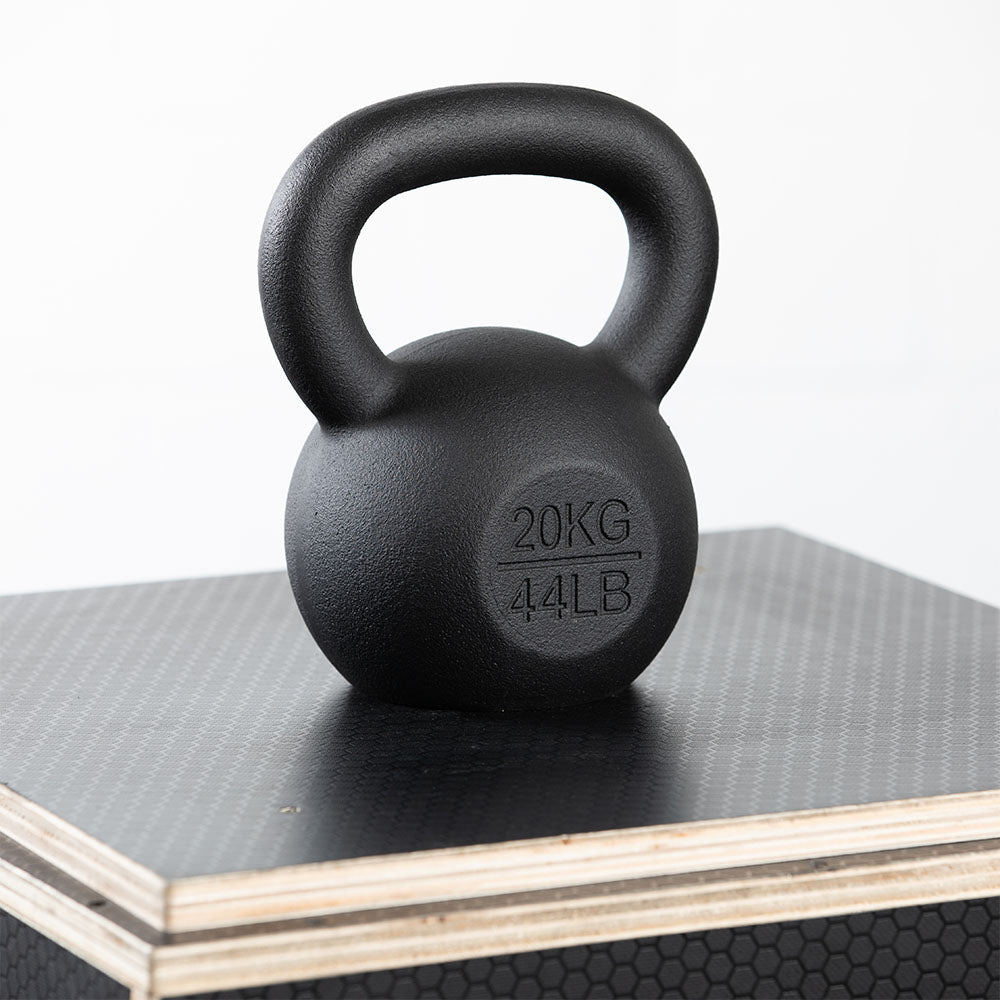
Best budget option for competition-style dimensions. Titan uses competition-spec body geometry — uniform diameter across weights — at a price closer to standard cast iron. Powder coat finish holds chalk well. A strong choice for lifters who want the dimensional consistency of a competition bell without paying Kettlebell Kings pricing.
Titan Fitness Cast Iron Kettlebells use competition-style body geometry — uniform diameter across weights — at a price point closer to standard cast iron than Kettlebell Kings. The matte powder coat finish holds chalk better than CAP's enamel, and Titan's build quality is competitive with brands at higher price points. The bell sits between CAP and Kettlebell Kings on most spec dimensions: better dimensional consistency than standard cast iron, looser weight tolerance than competition spec. A good pick if you want the storage and technique benefits of uniform body diameter across a multi-weight set without paying Kettlebell Kings pricing — and you accept that this is still cast iron, not competition steel.
Pros
- ✓Competition-style uniform body diameter at near-cast-iron pricing
- ✓Powder coat finish holds chalk better than enamel-finish cast iron
- ✓Build quality competitive with higher-priced brands
- ✓Strong choice for multi-weight sets where storage geometry matters
Cons
- ✗Still cast iron weight tolerance — not as tight as competition bells
- ✗Handle diameter is closer to cast iron than the 33 mm competition standard
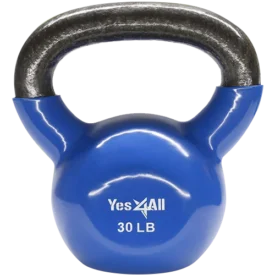
Best floor-friendly option for beginners on hard floor surfaces. The vinyl coating protects hardwood and tile from direct cast iron impact and provides a softer grip surface for new trainees. Not chalk-compatible and not ideal for high-rep ballistic work. The right first bell for someone testing kettlebell training before investing in higher-grade equipment.
The Yes4All Vinyl Coated Kettlebell exists for one specific use case: starting kettlebell training on a hard floor surface (hardwood, tile, laminate) where direct cast iron contact would damage the floor. The vinyl coating adds a few millimeters of diameter to the base, softening the contact point and reducing floor marring — the primary reason vinyl coating exists. The coating is not chalk-compatible, so grip relies entirely on the friction of the coating itself and becomes unreliable when palms get wet. Not the right tool for high-rep snatch work or heavy training, but the right first bell for someone testing kettlebell training before committing to higher-grade equipment.
Pros
- ✓Vinyl coating protects hardwood, tile, and laminate floors
- ✓Lowest price point in the comparison — minimal barrier to trying kettlebells
- ✓Flat base is functional for storage and renegade rows
- ✓Softer grip surface than bare cast iron for new trainees
Cons
- ✗Vinyl coating is not chalk-compatible and slips when wet
- ✗Not appropriate for high-rep ballistic work or progressive loading
Which one is right for you?
For sport-specific kettlebell training
Kettlebell Kings Competition Kettlebell
33 mm handle, uniform dimensions, and ±1% weight tolerance make this the reference pick for GS sport and multi-weight sets.
For one reliable fitness bell
CAP Barbell Cast Iron Kettlebell
Most cost-efficient cast iron entry at $1.50–$2.00 per kg, handles swings, cleans, and presses without complication.
For tight home gym spaces
Bowflex SelectTech 840 Kettlebell
Single bell covers 8–24 kg via dial selector, replacing six fixed bells with one storage footprint.
For multi-weight sets on a budget
Titan Fitness Cast Iron Kettlebell
Competition-style uniform body diameter at near-cast-iron pricing, with chalk-friendly powder coat.
For beginners on hardwood floors
Yes4All Vinyl Coated Kettlebell
Vinyl coating protects the floor and the bell, making it the lowest-risk way to test kettlebell training.
Cast iron vs competition steel: why the material difference is about geometry, not just quality
Standard cast iron kettlebells and competition-grade steel kettlebells are built to different manufacturing philosophies. Cast iron bells are hollow-cavity castings where the body and handle are shaped to a manufacturer's own dimensions — which means a 16 kg bell from CAP and a 16 kg bell from Titan will have slightly different handle diameters, bell body diameters, and base dimensions. This is not a defect. It is the expected outcome of a production process where manufacturers control their own mold geometry.
Competition kettlebells — like those from Kettlebell Kings — conform to the International Kettlebell Sport standard, which specifies that every weight from 8 kg to 48 kg shares the same external dimensions: the same bell body diameter (approximately 210 mm), the same handle diameter (33 mm), and the same base width. The weight difference between a 16 kg and 32 kg competition bell comes entirely from the density of the steel and filler material inside the fixed shell — the outside of the bell is the same size. This uniformity matters for sport-specific training (GS kettlebell sport) and for coaches programming at-home athletes who use different weights for different movements: your swing mechanics do not change between your 24 kg and your 32 kg if both are competition spec.
The practical implication for a non-competitive home gym lifter: if you own one bell and train with it for swings, cleans, presses, and Turkish get-ups, the handle diameter and bell proportions of a good cast iron bell like the CAP or Titan are entirely functional. The competition standard becomes relevant when you own multiple bells in different weights and want consistent technique transfer between them, or when you are training sport-specific movements (long cycle, snatch) where precise wrist positioning is important.
Steel construction also affects surface durability. Competition bells use hardened steel shells that resist chipping and cracking under rack position contact — the repeated impact of the bell's body against the forearm during cleans and jerks loads the surface differently than swings do. Cast iron is slightly more brittle at the surface than steel, which is why vinyl-coated bells exist: the coating protects both the bell and the floor but adds an imprecise layer between the palm and the handle.
Handle diameter, surface finish, and chalk compatibility
Handle diameter is the specification that most directly affects how a kettlebell feels in your hand during ballistic movements. The Kettlebell Kings Competition Kettlebell uses the sport-standard 33 mm handle diameter, which is smaller than most cast iron handles and allows the bell to seat deeper in the palm during swings and snatches, reducing the moment arm that creates callus and skin shear. For high-rep training — sets of 10+ in the snatch or 20+ in the swing — the 33 mm handle diameter is meaningful.
Cast iron kettlebells from CAP and Titan typically have handle diameters ranging from 35 to 38 mm depending on the weight. Heavier cast iron bells tend to have thicker handles because the casting process scales the whole proportional geometry with weight. This is not a performance flaw for the majority of lifters training for fitness rather than sport — handle diameters in this range work well for deadlift-pattern movements, presses, and goblet squats. The thicker handle does change the hand position during the rack and the path of the bell through the snatch.
Surface finish determines chalk compatibility and long-term grip quality. The Kettlebell Kings bell uses a matte powder coat finish that holds chalk well and resists corrosion. Titan Fitness uses a similar matte powder coat. CAP Barbell bells come with a smooth enamel finish that is slightly less porous than powder coat — chalk adheres but not as aggressively, which can matter for high-rep snatches in humid conditions. The Yes4All vinyl coating is chalk-incompatible; the vinyl surface does not absorb chalk dust, so grip relies entirely on the friction coefficient of the coating itself and becomes unreliable when wet.
Window size — the internal opening of the handle — affects two-hand grip access. Competition bells have a standardized window size that accommodates two-handed swings and goblet-position grips without the bell's body pressing into the wrist bones. Heavier cast iron bells from CAP often have larger absolute window dimensions because the handle scales with the bell body, but the proportional relationship between window width and bell body can be less refined than competition spec.
Weight accuracy: what 16 kg actually means across brands
Competition kettlebells are manufactured to tighter weight tolerances than standard cast iron. The Kettlebell Kings Competition Kettlebell is specified to ±1% of stated weight — meaning a 16 kg bell weighs between 15.84 and 16.16 kg. This tolerance matters for athletes who program in absolute loads and track progressive overload precisely, particularly in kettlebell sport where lifts are timed to the minute and the actual load directly affects power output calculations.
Cast iron kettlebells are generally manufactured to ±3–5% tolerance, which is standard for the category and acceptable for fitness training. A CAP 16 kg bell might weigh 15.2–16.8 kg. This difference is not significant for the vast majority of training contexts — if you are doing 20 swings with a 24 kg bell for conditioning, a 200–400 gram deviation from nominal weight has no practical impact on your training outcome.
The Bowflex SelectTech 840's weight accuracy depends on the dial-selection mechanism. Each increment in the selector corresponds to adding or removing cast iron plates from the stack, and the mechanism is designed to seat plates fully or not at all — partial seating, which would create a weight different from the selected setting, is a failure mode that Bowflex designs against. In practice, the SelectTech 840 delivers its stated weights with reasonable accuracy, but the total weight in the bell at any setting is a sum of the individual plate masses, which individually carry standard cast iron tolerances.
For training purposes, weight accuracy matters most in two situations: sport-specific training where exact loads affect competition preparation, and situations where you are tracking strength benchmarks across sessions. If your training is generally conditioning-focused — circuits, swings, carries, complexes — weight accuracy at the ±3% level is irrelevant to your results.
Flat-bottom stability and storage: which bells stand without a rack
Flat-bottom kettlebells stand upright on their base without tipping — this is relevant for storage, for setting up Turkish get-ups from the floor, and for renegade rows where the bell acts as a push-up handle. Not all kettlebells have flat bottoms: competition kettlebells from Kettlebell Kings have a precisely machined flat base that sits stable on hard floors. CAP Barbell cast iron bells have a flat bottom cast into the base mold — functional, though less precisely machined than a competition bell. Titan Fitness kettlebells also have flat bases.
The Bowflex SelectTech 840 has a distinctly different bottom geometry due to its adjustable mechanism: the weight-selection cradle creates a base that is wider and less conventional than a standard kettlebell. It does stand upright but does not have the clean flat bottom of a traditional bell. For renegade rows, the wider base changes hand spacing, which affects shoulder mechanics differently than a standard kettlebell base would.
Yes4All vinyl coated kettlebells have flat bottoms that are functional for storage and floor exercises. The vinyl coating adds a few millimeters of diameter to the base relative to the underlying cast iron, which softens the contact point slightly and reduces floor marring — the primary reason vinyl coating exists. For hardwood floors and home gym setups where protecting the floor surface matters, the vinyl bottom performs its intended function.
Storage considerations extend beyond the bell's ability to stand alone. Competition bells from Kettlebell Kings and Titan, having uniform body diameter regardless of weight, create more visually and physically orderly storage on a rack or shelf — you can place 16, 24, and 32 kg bells in a line and they all occupy the same footprint. Cast iron bells of different weights have proportionally different body sizes, so a heavy set of cast iron bells occupies inconsistently shaped space on a rack.
Adjustable vs fixed: when the Bowflex SelectTech 840 actually makes sense
The Bowflex SelectTech 840 adjusts from 8 to 24 kg (approximately 17.6 to 53 lbs) in 2.3 kg (5 lb) increments using a dial selector at the top of the handle. At any given setting, only the selected weight's plates travel with the bell — the remaining plates stay in the cradle. This mechanism converts what would be six separate fixed-weight bells into a single storage footprint, which is the product's primary value proposition for home gym owners with limited space.
The tradeoff is physical: the SelectTech 840 at its maximum weight is heavier and has a larger body than a competition or standard cast iron bell at the same weight. The weight distribution across the adjustable plates creates a slightly different center of mass than a solid-cast bell. For swings, goblet squats, and presses — the movements most home gym users perform — the difference is manageable and most people adapt within a few sessions.
Where the SelectTech 840 is genuinely not the right tool: ballistic movements at high repetitions, particularly snatches, where the body of the bell passes close to the forearm and the bell's larger footprint creates more contact. The mechanism also precludes the bell being dropped from overhead — the plate-stack design is not rated for impact drops, and repeated drops would eventually damage the locking mechanism. If your training includes heavy swings with significant hip drive or Olympic-style kettlebell work, a fixed-weight cast iron or competition bell takes the load more cleanly.
The economic case for the SelectTech 840 depends on how many weights you need to replicate and what the alternative costs. A set of three cast iron bells (16, 20, 24 kg) from CAP at roughly $1.50–$2.00/kg could cost $55–$100 depending on current pricing. If you regularly train with five or six different weights, the SelectTech 840's cost per effective weight becomes competitive with buying individual bells, and the space savings are real. If you train primarily with one or two weights, the adjustable mechanism is overhead you are paying for but not using.
Verdict
The Kettlebell Kings Competition Kettlebell is the reference pick for anyone training sport-specific kettlebell movements (GS sport, hardstyle at high volume) or building a multi-weight set where technique consistency across loads is a priority. The 33 mm handle diameter, ±1% weight tolerance, and standardized dimensions are genuine performance advantages over standard cast iron for these use cases. At $65–$90 per bell depending on weight, the premium over cast iron is real but justified for the training it enables.
Choose the CAP Barbell Cast Iron Kettlebell if you want a reliable, affordable fixed-weight bell for fitness training. It handles swings, deadlifts, presses, Turkish get-ups, and carries competently. The enamel finish and thicker handle are workable for most fitness-oriented programs. At $1.50–$2.00/kg, it is the most cost-efficient entry into kettlebell training.
Choose the Bowflex SelectTech 840 if space is a real constraint in your training area and you need to cover multiple weight ranges for different movements or progression. Accept the larger bell body and the restriction against dropping the bell from overhead. The adjustable mechanism works well for strength training and conditioning circuits at moderate load.
Choose the Titan Fitness Cast Iron Kettlebell if you want competition-style dimensions — specifically the uniform body diameter across weights — at a price point closer to standard cast iron than competition bells. Titan's build quality is competitive with brands at higher price points, and the powder coat finish holds up to regular training without the premium of Kettlebell Kings.
Choose the Yes4All Vinyl Coated Kettlebell if you are beginning kettlebell training on a hard floor surface (hardwood, tile, laminate) where direct cast iron contact is a floor-damage concern. The vinyl coating protects both the bell and the floor, and the price point makes it the lowest barrier to entry for beginners who want to test kettlebell training before committing to higher-grade equipment.
We did not conduct independent drop tests or metallurgical analysis. Weight specifications are drawn from manufacturer published data. Handle diameter measurements reference manufacturer specifications and third-party fitness equipment reviews. Pricing varies with weight selection and market conditions — the comparisons above reflect mid-weight options (16–24 kg range) where the price differentials between categories are most representative.
Frequently asked questions
What weight kettlebell should a beginner start with?▼
Is competition kettlebell worth the price premium for non-sport training?▼
Can I do kettlebell snatches with an adjustable kettlebell like the Bowflex SelectTech 840?▼
Do I need chalk for kettlebell training, and which bells work with it?▼
What is the difference between hardstyle and GS (kettlebell sport) training, and does it change which bell to buy?▼
Prices change. Check the retailer for the current price.
Comments & questions
Discussion happens on nattzy, our community forum. Sign in with Google to post — it takes a second.
Related articles

Best Gym Bag 2026: Wet/Dry, Backpack vs Duffel, Sizing
Best Water Bottle 2026: Stanley vs Hydro Flask vs Thermos
Best Air Purifier 2026: 5 models compared honestly

ConoHa WING review (2026): setup, speed and pricing
Best JP rental server 2026: 5 hosts ranked
Best LED Face Masks 2026: 3 Light Therapy Devices Compared