Best Plyometric Box 2026: 5 Picks for Box Jumps
The wrong plyo box doesn't just limit your training — it can rip your shins open or wobble under a depth jump landing. Weight range and build quality determine long-term value far more than feature lists.
Quick answer
The failure modes here are real: a wooden edge can open your shins, and a box that shifts under a depth-jump landing is a serious injury risk. Weight rating and build quality determine long-term value far more than feature lists. A soft foam box removes the shin-scrape risk and is the right choice for beginners and anyone training box jumps at height. A 3-in-1 wooden box gives three heights from one unit and is the better value if you can land cleanly.
Each plyo box was evaluated on platform stability under load, shin safety of the exterior material, height configuration flexibility, weight capacity, and price-to-durability ratio for home gym use.
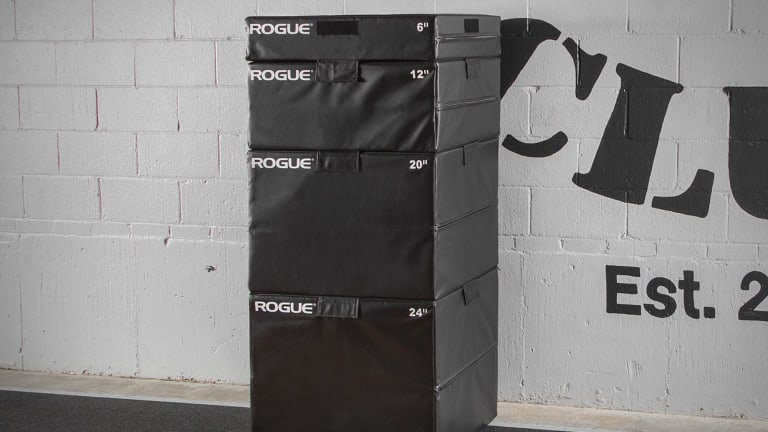
Rogue Foam Plyo Box
Best Overall: The Rogue Foam Plyo Box's high-density foam exterior compresses on contact rather than cutting skin — the single most important safety feature when training near your jump limit. The firm inner core holds position through repeated loaded landings without the surface compression that afflicts cheaper foam boxes.
Top picks ↓| Product | Price | Link |
|---|---|---|
| $155.00Reference price | ||
| $89.99Reference price | ||
| — | ||
| $90Reference price | ||
| — |
| Product | Exterior | Core | Design | Best for | Price (US) | Heights | Format | Adjustment | Surface | Price range | Material |
|---|---|---|---|---|---|---|---|---|---|---|---|
| Rogue Foam Plyo Box | High-density foam | Firm inner structure | Stackable | Athletes training near jump limit | ~$155 | — | — | — | — | — | — |
| Rep Fitness Foam Plyo Box | Foam with washable cover | — | — | — | ~$90 | 16 / 20 / 24 in (3-in-1) | Orientation-flip | — | — | — | — |
| JFIT Adjustable Plyo Box | — | — | — | — | — | — | Single unit, height-adjustable | Internal locking mechanism | Non-slip textured platform | Mid-range | — |
| Titan Fitness Wooden Plyo Box | — | — | — | — | ~$90 | 3 via orientation | — | — | Grip-textured platform | — | Solid wood construction |
| Yes4All Stackable Foam Plyo Box | Soft foam | — | Stackable, color-coded | Beginner jump progressions | Budget tier | — | — | — | — | — | — |
Top picks
Related articles

Soft foam exterior, stackable, near-zero shin-cut risk on missed jumps. Best for athletes training close to their jump limit.
The Rogue Foam Plyo Box's high-density foam exterior compresses on contact rather than cutting skin — the single most important safety feature when training near your jump limit. The firm inner core holds position through repeated loaded landings without the surface compression that afflicts cheaper foam boxes. It costs more than wood alternatives and the foam scuffs faster.
Pros
- ✓Foam exterior compresses on missed reps instead of cutting shins
- ✓Firm inner core maintains stability through loaded landings
- ✓Stackable design extends height range without buying extra boxes
Cons
- ✗Costs more than comparable wooden boxes; foam exterior shows wear faster
Score breakdown
| Exterior | High-density foam |
| Core | Firm inner structure |
| Design | Stackable |
| Best for | Athletes training near jump limit |
| Price (US) | ~$155 |

3-in-1 heights (16/20/24"), removable washable cover. Best value foam box for athletes whose training tops out at 24 inches.
Three heights (16/20/24 in) in one unit by rotating orientation — the smartest format for athletes whose training stays within 24 inches. The removable washable cover is a practical advantage in a home gym. Priced below Rogue at comparable build quality, making it the first recommendation for foam safety without the premium price.
Pros
- ✓3-in-1 heights (16/20/24 in) by repositioning without buying extra boxes
- ✓Removable washable cover keeps the surface clean
- ✓Priced below Rogue at similar build quality
Cons
- ✗24-inch ceiling means athletes progressing to 30-inch jumps will outgrow it
Score breakdown
| Heights | 16 / 20 / 24 in (3-in-1) |
| Exterior | Foam with washable cover |
| Format | Orientation-flip |
| Price (US) | ~$90 |

Adjustable height mechanism, firm edges. Best for progressive height training in a single-unit format.
The JFIT's internal locking mechanism lets you change height without moving a heavy box — ideal for structured height progressions in a single session. The edges are firmer than full-foam boxes; contact on a miss has more impact than Rogue or Rep, but softer than wood.
Pros
- ✓Internal mechanism adjusts height without repositioning the unit
- ✓Ideal for incremental height progressions within a single session
- ✓Non-slip surface texture for secure landing
Cons
- ✗Edges are firmer than full-foam competitors — not skin-soft on contact
Score breakdown
| Adjustment | Internal locking mechanism |
| Surface | Non-slip textured platform |
| Format | Single unit, height-adjustable |
| Price range | Mid-range |
Subscribe to our newsletter
Occasional updates and new releases — no spam.
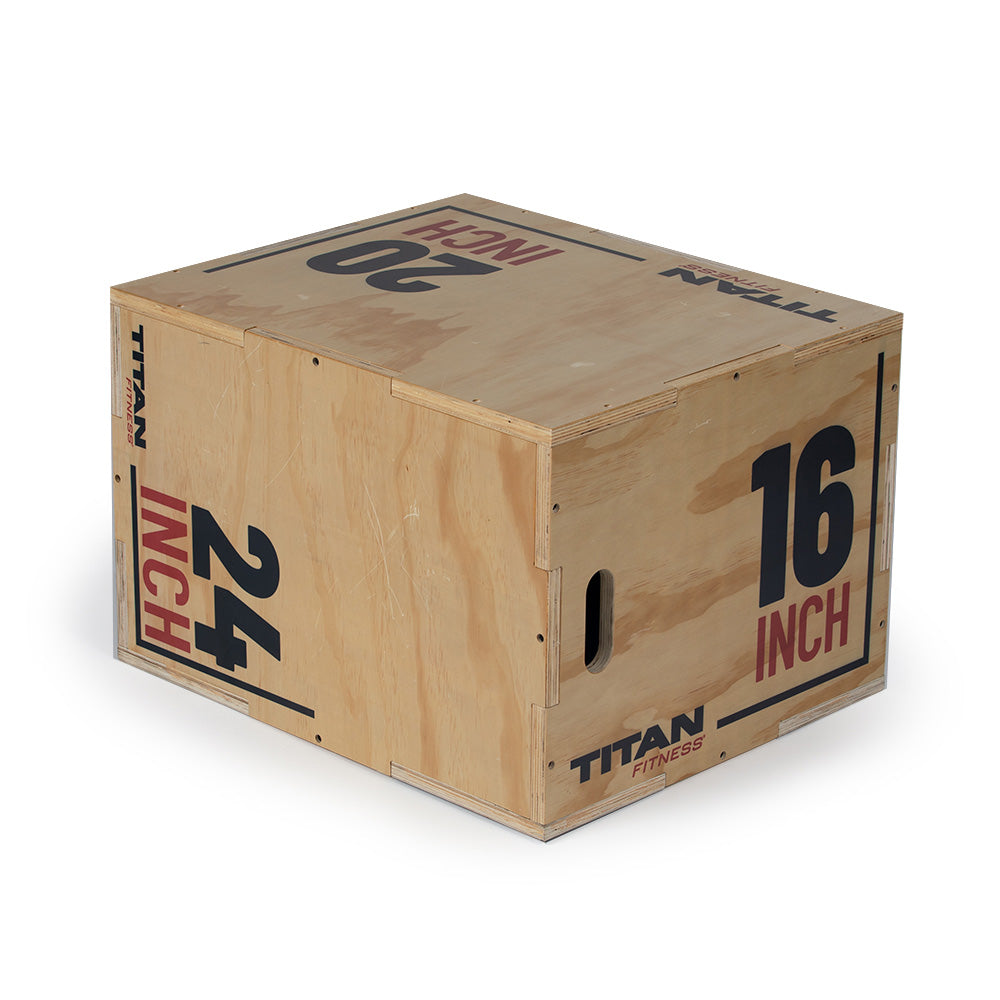
Solid wood, high weight capacity, 3 heights. Best for loaded step-ups, box squats, and athletes with clean landing mechanics.
Solid wood construction handles aggressive loaded step-ups, box squats, and depth jumps that would deform foam over time. The 3-height orientation design and grip-textured surface make it practical for serious strength training. The trade-off is unambiguous: wooden corners at shin height on a missed jump produce injury — not appropriate for athletes still developing landing mechanics.
Pros
- ✓Solid wood handles maximum loading without surface deformation
- ✓Grip-textured platform prevents feet sliding on landing
- ✓Long-term durability superior to foam for heavy use
Cons
- ✗Wooden corners at shin height produce cuts and bruising on missed jumps
Score breakdown
| Material | Solid wood construction |
| Heights | 3 via orientation |
| Surface | Grip-textured platform |
| Price (US) | ~$90 |

Color-coded heights, stackable, softest foam exterior. Best entry-price option for home cardio and beginner jump progressions.
Color-coded heights, stackable design, and soft foam exterior at the lowest entry price in the category. Best for home cardio conditioning and beginner jump progressions where shin safety matters and the jump height requirement is modest. Not designed for heavy loaded step-ups.
Pros
- ✓Lowest entry price for a skin-friendly foam jumping surface
- ✓Color-coded stackable units for easy height recognition
- ✓Soft foam exterior for home cardio and beginner jumps
Cons
- ✗Not appropriate for loaded barbell step-ups or max-effort plyometrics
Score breakdown
| Exterior | Soft foam |
| Design | Stackable, color-coded |
| Best for | Beginner jump progressions |
| Price (US) | Budget tier |
Which one is right for you?
For athletes training near their max jump height
Rogue Foam Plyo Box
Foam exterior compresses on contact instead of cutting shins — critical safety advantage when pushing jump limits.
For home gym athletes who want 3 heights in one unit
Rep Fitness Foam Plyo Box
3-in-1 orientation covers 16/20/24 in progression at below-Rogue pricing with a washable cover.
For structured progressive height training
JFIT Adjustable Plyo Box
Adjustable internal mechanism lets you change height mid-session without repositioning a heavy box.
For experienced athletes doing loaded box work
Titan Fitness Wooden Plyo Box
Solid wood handles barbell step-ups and heavy depth jumps that would deform foam surfaces over time.
For beginners and home cardio conditioning
Yes4All Stackable Foam Plyo Box
Lowest entry price with a skin-friendly foam surface — right for learning jump mechanics without injury risk.
Rogue Foam Plyo Box: Soft Exterior Built for Athletes Who Prioritize Shin Safety
Rep Fitness Foam Plyo Box: Three Heights in One Box at a Competitive Price
JFIT Adjustable Plyo Box: Height-Adjustable Platform for Progressive Training
Titan Fitness Wooden Plyo Box: Solid Wood for Heavy Loading and Long-Term Durability
Yes4All Stackable Foam Plyo Box: Color-Coded Heights at the Entry Price Point
Frequently asked questions
Is a foam plyometric box safer than a wood one?▼
What height plyometric box should I start with?▼
Can a plyo box replace a bench for exercises like Bulgarian split squats?▼
What exercises can you do with a plyometric box?▼
Prices change. Check the retailer for the current price.
Comments & questions
Discussion happens on nattzy, our community forum. Sign in with Google to post — it takes a second.