Best Kids Lunch Box 2026: 5 That Keep Food Safe and Fresh
WriterPickly Editorial
Updated 2026-06-12
The lunch box that stays home in the cabinet is the wrong lunch box. Kids interact with their lunch container multiple times a day — opening and closing compartments, fitting it into a bag, trying to clean the aftermath. The boxes that get used consistently are the ones that open with one hand, separate foods without mixing flavors, and don't grow mold in hard-to-clean crevices.
Quick answer
For most families, the PlanetBox Rover is the pick — a flat stainless interior with five fixed compartments wipes clean in seconds, and the magnetic closure lasts 5+ years, cheaper per year than annual plastic replacements. Yumbox's single-gasket seal is the most reliable containment for yogurt and wet food, Bentgo Kids delivers the core bento layout at $22, and OmieBox's insulated pod keeps hot food warm 3-4 hours.
📋How we compared
Each lunch box was assessed on food safety (insulation, leak resistance), cleaning ease (dishwasher compatibility, crevice design), child usability (opening mechanism, appropriate for age range), and long-term value considering typical replacement cycle.

Best Overall: The PlanetBox Rover makes every other lunch box seem overcomplicated in retrospect. The flat stainless steel interior with five fixed compartments wipes clean in seconds with no crevices for mold to establish.
This button opens Amazon search results, not a specific product page.
This button opens Amazon search results, not a specific product page.
Which one is right for you?
Related articles


1★ Best PickA+Best OverallPlanetBox Rover Kids Lunchbox
The PlanetBox Rover makes every other lunch box seem overcomplicated in retrospect. The flat stainless steel interior with five fixed compartments wipes clean in seconds with no crevices for mold to establish. The magnetic closure snaps shut quietly and opens with a single thumb press — preschoolers manage it on their first attempt. The entire box goes in the dishwasher top rack. Yes, $50 is a significant upfront cost, but a PlanetBox that lasts five years costs less per year than most plastic alternatives that crack or stain within 18 months. It's the best lunch box for families willing to pay once and not think about it again.
Pros
- ✓Flat stainless interior wipes clean in seconds — no mold crevices
- ✓Magnetic closure works for preschool-age hands
- ✓Fully dishwasher safe
- ✓Five-year lifespan typical with normal use
Cons
- ✗$50 upfront cost is the highest in this lineup
- ✗No insulation — requires ice pack in insulated bag for perishables
2ABest Leak-ProofYumbox Original Bento

Yumbox's single-gasket leak-proof seal is the most reliable liquid containment in this category. Yogurt, applesauce, and fruit with high water content stay in their compartments through a school commute with the box on its side — something most bento boxes cannot claim. The silicone gasket pops out for thorough washing, which prevents the gasket-mold problem that undermines cheaper leak-proof designs. The 4-compartment layout is slightly more generous per section than Bentgo, which works better for variety-resistant eaters. The base hand-washes while the tray goes in the dishwasher, which is a minor workflow inconvenience.
Pros
- ✓Single-gasket seal reliably contains liquids and wet foods
- ✓Removable gasket prevents mold buildup under seal
- ✓4-compartment layout with generous portion sizes
- ✓Silicone-free interior surface — no plastic taste transfer
Cons
- ✗Base requires hand washing — only tray is dishwasher safe
- ✗Lid requires moderate hand strength for young preschoolers
3A-Best ValueBentgo Kids Lunchbox

Bentgo Kids delivers the core bento experience at $22 — roughly half the price of PlanetBox and Yumbox. The five-compartment layout with locking side clips handles typical school lunches across age ranges, and the whole unit goes in the dishwasher top rack. The locking clips are the weak point: they're small enough to accumulate lunch residue and break under the force of the dramatic lid-opening technique that seven-year-olds favor. For families cycling through a new lunch box each school year due to growth or preference changes, the low price makes this a sensible annual replacement rather than a long-term investment.
Pros
- ✓Lowest price for a five-compartment bento box
- ✓Top-rack dishwasher safe including clips
- ✓Five compartments handle most variety lunch combinations
- ✓Available in wide range of colors and character designs
Cons
- ✗Locking clips accumulate residue and break under rough handling
- ✗Shorter lifespan than stainless steel options
Subscribe to our newsletter
Occasional updates and new releases — no spam.
4A-Best Hot + ColdOmiebox Bento Kids
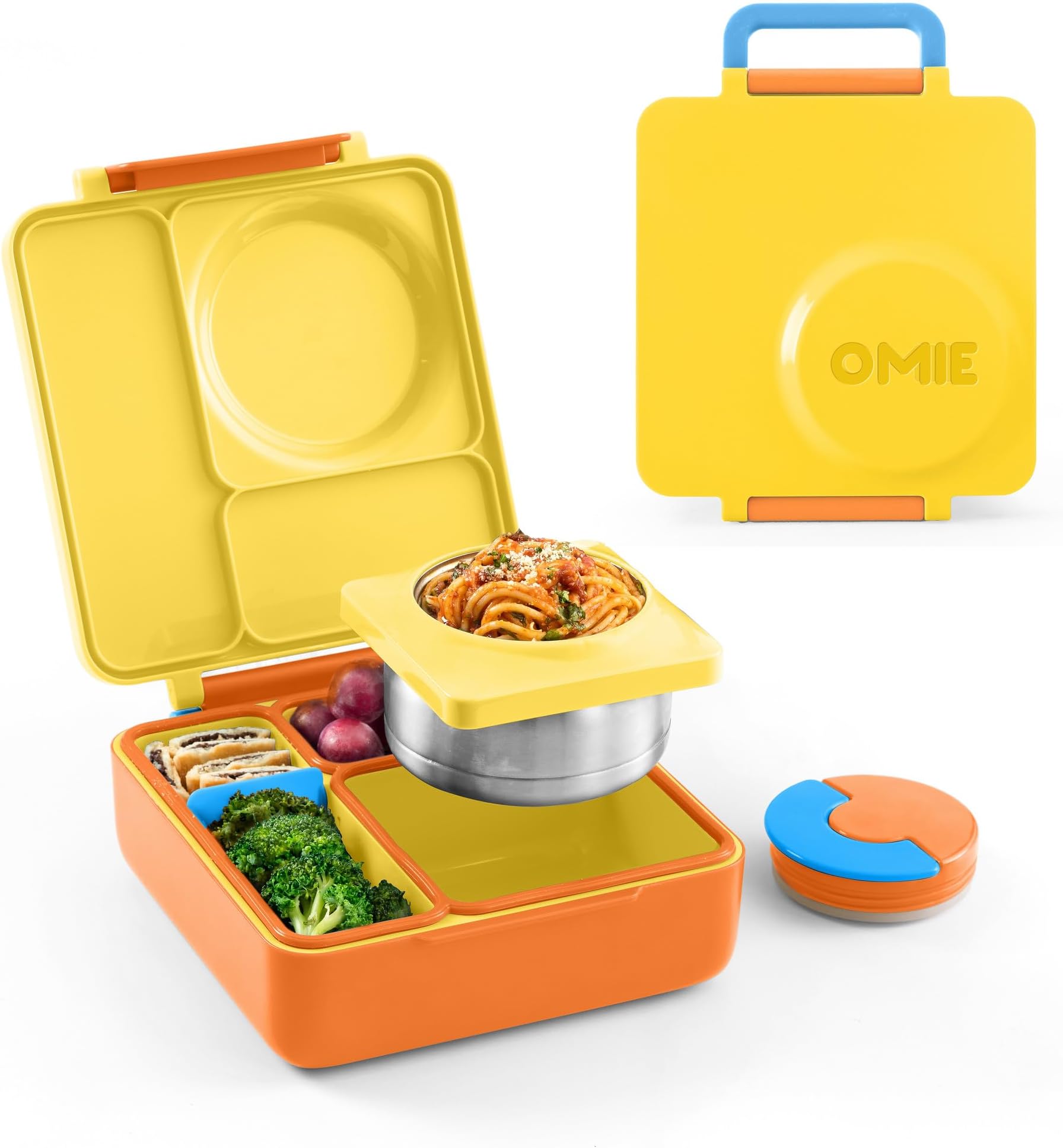
The OmieBox is the right answer to the 'hot pasta but also cold grapes' problem. An integrated insulated pod sits inside a bento-tray frame: hot food goes in the pod, cold food goes in the surrounding compartments, and nothing touches. The pod keeps hot food at safe temperatures for three to four hours, which covers a typical school lunch period. The design is more complex than a standard bento — there are more parts to wash and more pieces for a child to manage — but the hot-cold problem it solves is real and the alternatives (separate thermos plus separate box) are bulkier.
Pros
- ✓Integrated thermos pod keeps hot food warm for 3–4 hours
- ✓Bento tray surrounds the pod for cold components simultaneously
- ✓Eliminates the need to pack a separate thermos plus box
- ✓BPA-free, phthalate-free construction
Cons
- ✗More parts to wash and manage than standard bento boxes
- ✗Higher complexity for preschool-age kids to open independently
5B+Best BudgetRubbermaid Lunchblox Kids

The Rubbermaid LunchBlox solves the ice pack integration problem at the lowest price in this lineup: a flat blue ice pack snaps into the bottom of the carrier and keeps the container stacked above it, eliminating the separate ice pack rattling around an insulated bag. The modular containers snap together so the configuration changes based on what you're packing that day. At $18, it is the cheapest pick here and it shows in the plastic quality — the lids don't seal as impressively as Yumbox and the containers scratch more easily. But the snap-in ice pack is a genuinely useful feature that more expensive boxes don't offer, and it keeps food at safe temperatures without a dedicated insulated bag.
Pros
- ✓Integrated snap-in ice pack keeps food cold without a separate insulated bag
- ✓Modular containers adapt to variable lunch contents
- ✓Lowest price in this lineup
- ✓Top-rack dishwasher safe
Cons
- ✗Plastic lids don't seal as reliably as gasket-based alternatives
- ✗Containers scratch more visibly than stainless or premium plastic
Bento vs. Insulated: Choosing the Right Format
Bento-style boxes — PlanetBox, Yumbox, Bentgo, OmieBox — keep food separated in fixed compartments, which matters when a child refuses to eat food that has touched something else. The separation also makes portion sizing more intuitive: each compartment has a visual size limit that naturally prevents overpacking. The tradeoff is that bento boxes don't insulate, so hot foods stay hot only if the box goes into an insulated bag.
The OmieBox solves the hot-cold separation problem with an integrated thermos container that sits inside a bento box frame. A hot component (pasta, soup) stays in the insulated pod while cold items go in the surrounding compartments. This is the right solution when you want hot lunch without carrying a separate thermos and box.
Standard fabric lunch bags with ice packs work reliably for cold foods and are the most cost-effective approach for a single-compartment box. The challenge is that most kids forget to mention when the ice pack melts, creating food safety gaps. Stainless steel insulated boxes maintain temperature longer without ice packs but are heavier.
Cleaning: The Factor Parents Feel Every Evening
Creviced hinges and rubber seals are the primary mold generators in lunch boxes. PlanetBox uses a magnetic closure with no hinges inside the container — the entire interior surface is flat stainless steel that wipes clean in seconds. Yumbox's leak-proof seal runs around a single silicone gasket that pops out for washing. Bentgo's locking clips contain the compartment design but the clips themselves are small enough to accumulate residue.
Dishwasher compatibility dramatically affects real-world cleaning behavior. Boxes that require hand washing are theoretically simple to clean but practically end up with a backlog when evenings are busy. PlanetBox, Bentgo, and Rubbermaid LunchBlox are top-rack dishwasher safe. Yumbox's tray is dishwasher safe but the base requires hand washing.
Frequently asked questions
How long do bento lunch boxes keep food at safe temperature?▼
Are plastic bento boxes safe for kids?▼
Can kids open these lunch boxes themselves?▼
What size lunch box do I need for elementary school?▼
Is PlanetBox worth the $50 price?▼
Check the details of the products in this article
- PlanetBox Rover Kids Lunchbox$50Reference price
This button opens Amazon search results, not a specific product page.
- Yumbox Original Bento$30.59Price as of 2026-10-27
- Bentgo Kids Lunchbox$32.99Price as of 2026-10-27
- Omiebox Bento Kids$49.95Price as of 2026-10-27
- Rubbermaid Lunchblox Kids$18Reference price
Prices change. Check the retailer for the current price.
Comments & questions
Discussion happens on nattzy, our community forum. Sign in with Google to post — it takes a second.
View the discussion thread on nattzy ↗
Still deciding? Ask the community your own question — Post a question on nattzy ↗
Related articles

Best Kids Sunscreen 2026: 5 Mineral, Reef-Safe Formulas

Best Kids Toothbrush 2026: 4 Picks for Ages 1-10
Best Plyometric Box 2026: 5 Picks for Box Jumps

Best Roof Cargo Box 2026: 5 Thule and Yakima Boxes Compared
Best Snack Subscription Boxes 2026: 5 Compared

Best Insulated Lunch Bag 2026: 5 Picks for Work Compared