Best Kids Backpack 2026: 5 Bags That Survive the School Year
WriterPickly Editorial
Updated 2026-06-12
Kids' backpacks get dragged across playgrounds, stuffed beyond capacity, and thrown on classroom floors multiple times a day. The bags that last a full school year share one trait: construction that doesn't depend on fragile zippers or flimsy straps. Organization features and ergonomic padding matter more once the durability baseline is cleared.
Quick answer
For most school years, the JanSport SuperBreak is the pick — its lifetime warranty means a broken zipper gets replaced free rather than forcing a mid-year purchase. The Pottery Barn Kids Classic wins on organization density for kids who lose folders, the Herschel Survey scales the adult Heritage design down for style-conscious older kids, and the Lands' End Classmate has the widest padded straps and a sternum strap for heavy loads.
📋How we compared
Each backpack was evaluated on construction quality (zipper grade, strap attachment, material durability), organizational utility for the target age range, ergonomic design, washability, and price-to-durability value. Zipper quality was weighted most heavily as the primary failure point.

Best Durability: JanSport's lifetime warranty is the relevant differentiator for the SuperBreak — not because kids bags break constantly, but because when one does, you send it back and get a new one rather than buying another bag. The 600-denier polyester construction is genuinely resistant to the edge-scuffing and floor-dragging that destroys cheaper bags, and the single main compartment plus front utility pocket covers the organizational needs of most elementary schoolers without the complexity that confuses younger kids.
Top picks ↓This button opens Amazon search results, not a specific product page.
Which one is right for you?
Related articles


1★ Best PickA+Best DurabilityJansport Superbreak Kids
JanSport's lifetime warranty is the relevant differentiator for the SuperBreak — not because kids bags break constantly, but because when one does, you send it back and get a new one rather than buying another bag. The 600-denier polyester construction is genuinely resistant to the edge-scuffing and floor-dragging that destroys cheaper bags, and the single main compartment plus front utility pocket covers the organizational needs of most elementary schoolers without the complexity that confuses younger kids. At $35 it is not the cheapest in this lineup, but the warranty math makes it the lowest long-term cost.
Pros
- ✓Lifetime warranty — broken zipper or strap gets replaced, not argued about
- ✓600-denier polyester resists scuffing and dragging
- ✓Simple layout most kids actually use correctly
- ✓Wide color and print selection
Cons
- ✗No laptop sleeve — not suitable for tablet-carrying upper elementary students
- ✗Padded straps thin compared to ergonomic-focused competitors
2ABest OrganizationPottery Barn Kids Classic

The Pottery Barn Kids Classic earns its place through organization density: a main compartment with interior organization, front pocket, side water bottle pocket, and monogramming that makes the bag visually distinct at lost and found. The canvas construction is heavier than polyester but develops character rather than looking ratty after six months. The strap padding is adequate rather than exceptional. Where this bag consistently wins is at the start of each school day — everything has a place, kids can find it, and teachers report significantly fewer 'I lost my folder' incidents from students with organized bags versus dump-bags. Monogramming adds 5–7 business days; order in late July for September school starts.
Pros
- ✓Interior organization pocket layout reduces lost-item incidents
- ✓Monogramming makes bag identifiable in lost and found
- ✓Canvas develops character rather than looking worn
- ✓Side water bottle pocket fits most standard bottles
Cons
- ✗Canvas construction heavier than polyester alternatives
- ✗Hand-wash or spot-clean only — no machine washing
3A-Best StyleHerschel Survey Kids
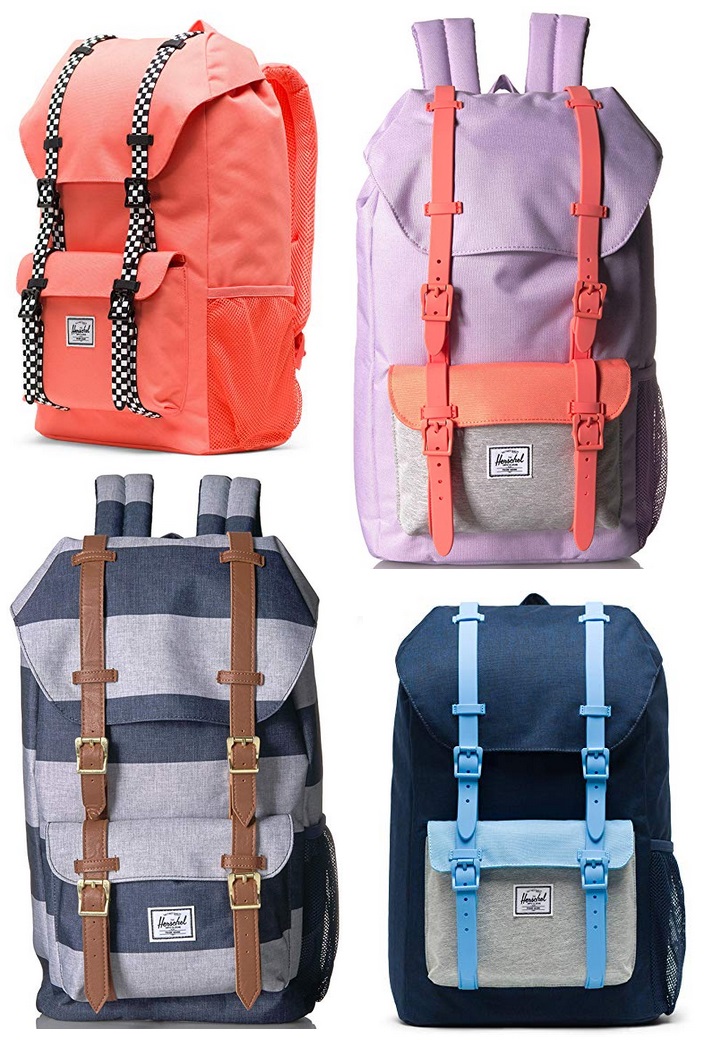
The Herschel Survey scales the adult Heritage design down to kids dimensions without sacrificing the visual appeal that makes Herschel bags desirable in the first place. The striped fabric lining inside the main compartment is a durability signal — it makes the interior easier to spot-clean than plain dark interiors and indicates attention to construction detail. A fleece-lined media pocket at the front accommodates a small tablet or iPad. The drawback is padding: the shoulder straps are narrower than ergonomic options like Lands' End, making extended carries on heavier loads less comfortable. For kids who care about how their bag looks — which kicks in harder around age eight — this is the pick that avoids the 'my bag is boring' complaint.
Pros
- ✓Scaled adult Heritage design that older kids find appealing
- ✓Striped fabric lining easy to spot-clean
- ✓Fleece-lined media pocket for tablet or iPad
- ✓High-quality YKK zippers throughout
Cons
- ✗Narrower straps less comfortable under heavy loads
- ✗Premium price for a style-forward pick
Subscribe to our newsletter
Occasional updates and new releases — no spam.
4A-Best ErgonomicsLands End Classmate
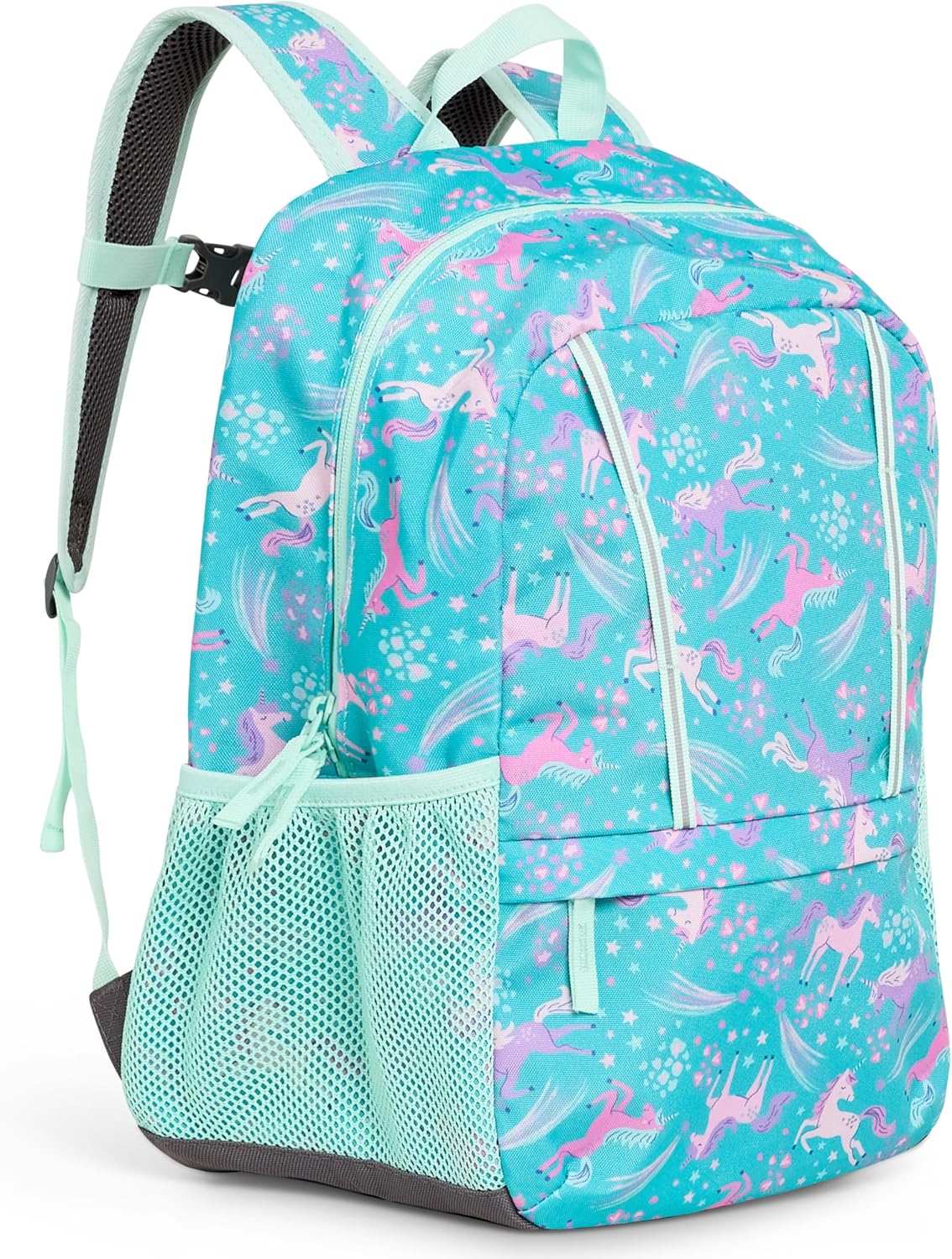
Lands' End puts more padding where it matters than any other bag in this lineup: thick padded back panel, wide padded shoulder straps with ergonomic contouring, and a sternum strap that keeps weight centered. For kids who walk longer distances to school or carry heavy loads, the physical difference is real and measurable — shoulders don't ache at the end of the day. The main compartment accommodates a 15-inch laptop, making it suitable from third grade through middle school as loads increase. The exterior is water-resistant nylon that wipes clean. The bag is machine washable, which is not something most bags at this price point can claim.
Pros
- ✓Widest, most padded straps in this lineup
- ✓Sternum strap keeps load centered and balanced
- ✓Machine washable — rare at this price
- ✓Accommodates 15-inch laptop for upper elementary/middle school
Cons
- ✗Understated styling — some kids find it boring compared to fashion-forward brands
5B+Best for PreschoolSkip Hop Zoo Backpack

The Skip Hop Zoo backpack is sized for preschool and early elementary bodies — roughly 12–14 inches tall — with a main compartment large enough for a change of clothes and a snack, but not so large that it overwhelms a three-year-old. The 3D animal hood design gives each bag a character identity (fox, unicorn, llama, and more) that toddlers find genuinely exciting, which is the primary driver of 'I want to carry my own bag' behavior at this age. Front pocket fits a water bottle or small snack. The construction quality is appropriate for the use case: light enough for small bodies, durable enough for daily daycare. Not designed for heavy loads or older children.
Pros
- ✓Sized for preschool bodies — not overwhelming on a 3-year-old
- ✓3D animal design motivates kids to carry their own bag
- ✓Front pocket and main compartment sized for daycare needs
- ✓Machine washable
Cons
- ✗Outgrown by kindergarten/first grade in most cases
- ✗Main compartment too small for full school-day supplies
Durability Signals to Look For Before You Buy
Zipper quality is the most common single point of failure in kids backpacks. YKK zippers — look for the YKK stamp on the zipper pull — are the industry benchmark and are used by every major quality manufacturer. Generic no-name zippers on budget bags frequently fail within two months of daily school use, often splitting sideways rather than separating cleanly. A broken zipper on a primary school bag typically means replacing the entire bag mid-year.
Strap attachment points are the second failure zone. The strap should attach to the bag body at reinforced bar-tack stitching, not at a single row of decorative topstitching. Pick up a fully loaded bag by one strap — if the attachment point visibly strains or pulls away from the fabric, the construction won't hold up to daily abuse from a kid who grabs one strap rather than wearing both.
Water resistance matters more than parents anticipate. Kids walk in rain, set bags on wet surfaces, and occasionally leave them near puddles. A bag with a water-resistant base and coated exterior keeps homework dry through typical exposure. Full waterproofing is overkill for school bags; basic water resistance is not.
Sizing: Matching Bag to Kid
A backpack that extends below a child's lower back shifts weight onto the hips incorrectly and causes the characteristic slouch that leads to back pain over time. The bag should fit between the shoulders and the top of the hips. Most brands offer kids sizes for elementary age (5–10) and youth sizes for middle school, with measurements in the product listing. Measure your child's torso rather than their age.
Weight distribution matters as much as total bag size. When loaded, 80% of the bag's weight should sit against the back rather than hanging away from it. This requires both a back panel with structure and padded straps that cup the shoulders rather than sitting flat. Chest straps — even basic ones — significantly reduce shoulder fatigue on longer walks to school.
Frequently asked questions
How heavy should a kids backpack be when loaded?▼
Are personalized backpacks worth the wait?▼
Can I wash a kids backpack in the washing machine?▼
What's a reasonable price for a school backpack?▼
When should I buy a backpack to get the best selection?▼
Check the details of the products in this article
- Jansport Superbreak Kids$23.99Price as of 2026-10-19
This button opens Amazon search results, not a specific product page.
- Herschel Survey Kids$90Price as of 2026-10-19
- Lands End Classmate$35.59Price as of 2026-10-19
- Skip Hop Zoo Backpack$24Price as of 2026-10-19
Prices change. Check the retailer for the current price.
Comments & questions
Discussion happens on nattzy, our community forum. Sign in with Google to post — it takes a second.
View the discussion thread on nattzy ↗
Still deciding? Ask the community your own question — Post a question on nattzy ↗
Related articles

Best Kids Toothbrush 2026: 4 Picks for Ages 1-10

Best Kids Sunscreen 2026: 5 Mineral, Reef-Safe Formulas
Best Travel Backpack 2026: 5 Compared for Carry-On Fit

Best Backpack 2026: Commuter vs Travel vs Daily Carry

Best Anti-Theft Backpack 2026: 5 for Travel

Best Leather Backpacks 2026: Fossil vs Leatherology