Best Travel Backpack 2026: 5 Compared for Carry-On Fit
Five travel backpacks from $45 to $295, covering the range from ultralight budget carry-ons to purpose-built adventure packs with suspension systems built for full-day wear. Carry-on compliance and weight distribution matter more than total capacity.
Quick answer
The Osprey Farpoint 40 is the standard pick, because its LightWire frame and padded hip belt actually transfer most of a 15 kg load off the shoulders, and the 40L clamshell opens the whole main compartment at once. The Tortuga Setout 45L adds a top lid document pocket and protected 15-inch laptop sleeve, the Nomatic Travel Pack 30L packs 16 pockets and clears budget-carrier limits at 51 x 36 x 18 cm, the Cotopaxi Allpa 35L is weatherproof, and AmazonBasics is the $45 entry.
We assessed each option on coverage breadth, real-traveler review consistency, value vs alternatives, customer service responsiveness, and limitations buried in fine print.
Best Overall: The Osprey Farpoint 40 is the standard recommendation for travelers who want a real travel pack at a reasonable price. The LightWire frame and padded hip belt actually transfer load to your hips — at 15 kg of gear that's the difference between sore shoulders by hour four and arriving fresh.
Top picks ↓| Product | Price | Link |
|---|---|---|
| — | ||
| $199Reference price | ||
| $300Reference price | ||
| $225〜$230Reference price | ||
| $29.99〜$49.99Reference price |
Top picks
Related articles


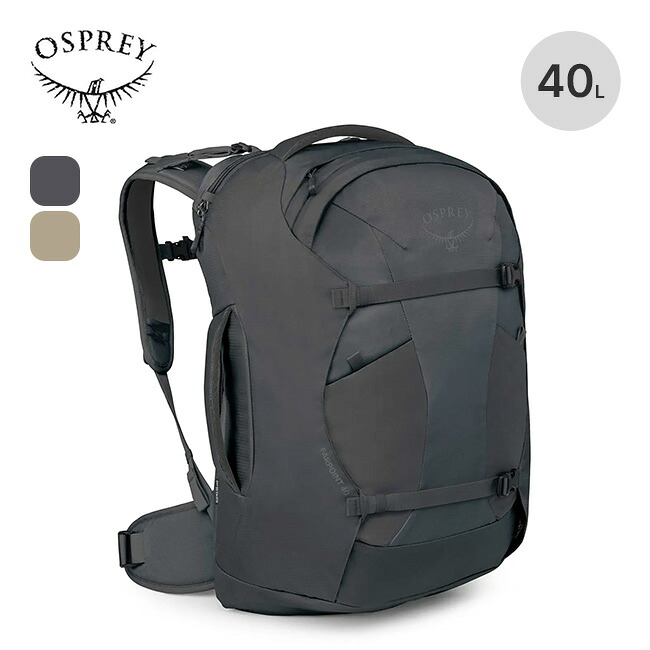
Best all-rounder at $160 — LightWire suspension, padded hip belt, clamshell main compartment. 55 × 36 × 20 cm passes most full-service carriers but not the most restrictive budget airline underseat limits. The comfort-per-dollar benchmark for this category.
The Osprey Farpoint 40 is the standard recommendation for travelers who want a real travel pack at a reasonable price. The LightWire frame and padded hip belt actually transfer load to your hips — at 15 kg of gear that's the difference between sore shoulders by hour four and arriving fresh. The 40L clamshell main compartment opens flat like a suitcase, the front zippered pocket handles documents, and the 55 × 36 × 20 cm dimensions clear most full-service carrier carry-on limits. At 1.3 kg empty it's also the lightest premium pack in this comparison. The honest limitation: it fails the most restrictive budget European underseat limits, and the external strap attachment panel reads as a hiking pack in business settings.
Pros
- ✓LightWire frame and padded hip belt transfer 70%+ of load
- ✓40L clamshell opening accesses entire main compartment at once
- ✓1.3 kg empty — lightest premium pack in this comparison
- ✓55 × 36 × 20 cm clears most full-service carry-on limits
Cons
- ✗Fails Ryanair underseat (40 × 20 × 25 cm) — gate-checks on budget routes
- ✗Hiking-pack aesthetic draws attention in business settings
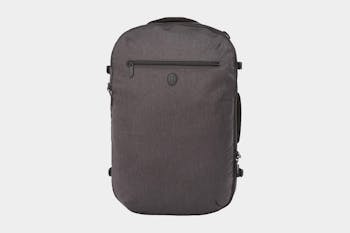
Premium frequent-flyer pick at $295 — best organization system in this comparison, padded back panel, dedicated document access. 45L is on the large end for personal-item carry-on. Worth the price for 50+ travel days per year; harder to justify for occasional travel.
The Tortuga Setout 45L is the premium pick for frequent flyers who want maximum organization built into the bag itself. A dedicated padded laptop sleeve fits 15-inch machines, a separate top lid pocket lets you reach documents and valuables without opening the main compartment, and side water bottle pockets actually work one-handed — practical details that make airport transitions noticeably smoother. The padded back panel and structured shoulder system handle full travel days comfortably, and the clamshell main compartment opens flat for suitcase-style packing. The honest limitation: at 1.8 kg empty it's heavier than the Osprey Farpoint, the 45L volume sits at the large end of personal-item carry-on, and the $295 price tag asks a real commitment from anyone not flying 50+ days per year.
Pros
- ✓Top lid document pocket accessible without opening main compartment
- ✓Dedicated padded 15-inch laptop sleeve protected on both sides
- ✓One-handed side water bottle pockets work in motion
- ✓Clamshell opens flat for suitcase-style packing
Cons
- ✗1.8 kg empty — heavier than the Osprey Farpoint 40
- ✗45L sits at the large end of personal-item carry-on tolerance

Specialist pick for tech-heavy minimalist travelers at $230 — 16 pockets, cable management, TSA-optimized laptop access, 51 × 36 × 18 cm fits European budget airline limits. 30L is genuinely limiting for trips beyond 4-5 days. Right pick only if you pack light consistently.
The Nomatic Travel Pack 30L is the specialist pick for tech-heavy minimalist travelers and anyone flying European budget routes. 16 discrete pockets include a dedicated cable management system, a TSA-approved laptop sleeve positioned for quick screening removal, a wet/dry compartment for damp clothes or toiletries, and a key clip. The 51 × 36 × 18 cm dimensions clear European budget airline limits that 40L+ bags routinely miss. The exterior uses ballistic nylon with DWR coating, durable enough for daily commuting between trips. The honest limitation: 30L is genuinely restrictive past 4-5 days of packing, the harness is adequate but not load-bearing in the Osprey sense, and the $230 price is premium for organization rather than comfort.
Pros
- ✓16 pockets including cable management and wet/dry compartment
- ✓TSA-optimized laptop sleeve speeds airport security screening
- ✓51 × 36 × 18 cm clears European budget airline limits
- ✓Ballistic nylon with DWR coating doubles as a commuter bag
Cons
- ✗30L is restrictive for trips beyond 4-5 days of packing
- ✗Harness is padded but not load-bearing like the Osprey
Subscribe to our newsletter
Occasional updates and new releases — no spam.

Adventure travel pick at $180 — weatherproof tarpaulin, YKK RC zippers, clamshell design. The only bag here with meaningful rain resistance for extended outdoor exposure. Stiffer and heavier than nylon alternatives; simpler organization than Tortuga or Nomatic.
The Cotopaxi Allpa 35L is the adventure pick — built around a weatherproof tarpaulin exterior with YKK RC zipper pulls that resist sustained rain meaningfully, not just light spray. It's the only bag here designed for outdoor markets in tropical monsoon conditions or multi-day trekking where your backpack is your only luggage. The clamshell main compartment opens flat for suitcase-style organization, and Cotopaxi's material durability reputation is genuine, with bags routinely outlasting their owners' patience. The 56 × 33 × 23 cm dimensions pass most carry-on standards. The honest limitation: the tarpaulin exterior is stiffer and heavier than nylon alternatives, the organization system is simpler than the Tortuga or Nomatic, and the rugged aesthetic draws attention in formal business travel contexts.
Pros
- ✓Weatherproof tarpaulin exterior with YKK RC zippers resists sustained rain
- ✓Clamshell main compartment opens flat for suitcase packing
- ✓35L hits a useful middle ground between minimalism and flexibility
- ✓Material durability reputation backed by long-term owner reviews
Cons
- ✗Stiffer, heavier exterior than nylon alternatives
- ✗Rugged adventure aesthetic stands out in business travel
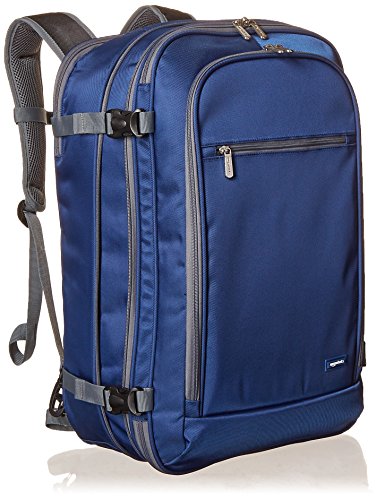
AmazonBasics Carry-On Travel Backpack
Budget baseline at $45 — 40L, padded laptop sleeve, passes full-service carrier limits. No hip belt means shoulder fatigue on long travel days. Right pick for occasional travelers testing whether they need a better bag; not the bag to buy if you travel frequently.
The AmazonBasics Carry-On Travel Backpack at around $45 covers the basics: 40L capacity, a padded laptop sleeve, padded shoulder straps, a main compartment, and a front pocket. The 44 × 30 × 18 cm carry-on dimensions clear every full-service carrier limit in this comparison. For travelers who do 2-4 trips per year and aren't ready to commit to a $160+ bag, this is the rational entry point. The honest limitation: there's no hip belt or load-transfer system, so 100% of the weight hangs from your shoulders — comfortable for two hours, painful after eight. There's no meaningful water resistance, organization is shallow, and build quality is functional rather than the 5-year durability the premium bags deliver.
Pros
- ✓Sub-$45 price is the lowest entry point in this comparison
- ✓44 × 30 × 18 cm carry-on size clears full-service carrier limits
- ✓Padded laptop sleeve and basic organization cover the essentials
- ✓Affordable to replace if it wears out mid-trip
Cons
- ✗No hip belt — full weight rests on shoulders and spine
- ✗No meaningful water resistance for outdoor exposure
Which one is right for you?
For most 5-10 day travelers
Osprey Farpoint 40 Travel Backpack
LightWire suspension and padded hip belt transfer load comfortably across full travel days at a reasonable price.
For frequent flyers who want organization
Tortuga Setout 45L Travel Backpack
Top-lid document pocket and dedicated laptop sleeve speed every airport transition meaningfully.
For tech-heavy European budget travelers
Nomatic Travel Pack 30L
51 × 36 × 18 cm clears budget airline limits while 16 pockets organize cables and electronics.
For adventure travelers in variable weather
Cotopaxi Allpa 35L Travel Pack
Weatherproof tarpaulin and YKK RC zippers handle tropical rain and multi-day outdoor exposure.
For occasional travelers on a budget
AmazonBasics Carry-On Travel Backpack
Sub-$45 with 40L and full-service carry-on dimensions covers 2-4 trips per year without overcommitting.
Carry-on compliance: what 'fits overhead' actually means
Most travel backpacks advertise carry-on compatibility, but the limits vary significantly by airline. The most permissive major carriers (Delta, United, Lufthansa) allow bags up to approximately 56 × 36 × 23 cm. The most restrictive budget carriers (Ryanair's underseat only policy at 40 × 20 × 25 cm, EasyJet's 56 × 45 × 25 cm) can catch bags that sail through everywhere else. The only reliable approach: treat the most restrictive route on your itinerary as your sizing constraint, not the most permissive. A 40L bag that fits everything you own is worthless if it's gate-checked on every Ryanair flight.
The Osprey Farpoint 40 at 55 × 36 × 20 cm is tight but legal on most full-service carriers when not overpacked. The Tortuga Setout 45L at 55 × 35 × 22 cm clears the same carriers by similar margins. The Nomatic 30L at 51 × 36 × 18 cm is the most reliably compliant in this comparison — it fits the European budget airline size windows that 40L+ bags routinely miss. The Cotopaxi Allpa 35L at 56 × 33 × 23 cm passes most standards but its clamshell opening means it packs fuller than bags with expandable bases, so the stated volume and the actual compliance volume when packed are similar. The AmazonBasics pick at 44 × 30 × 18 cm is the smallest bag here and passes every airline limit except Ryanair's underseat policy — at 44 cm length it's 4 cm over.
Harness comfort: why it matters more than capacity
Harness comfort is the spec most comparison articles skip entirely, and it's the reason the Osprey Farpoint and Tortuga Setout cost what they cost. A travel backpack differs from a hiking backpack in one specific way: you wear it through airports, on transit, and over uneven city pavement — not just on trails where the weight is distributed differently and you stop more often. At 40L and 1.5 kg of gear, a bad harness means shoulder bruising and a stiff neck by hour four. A good harness distributes the load to the hip belt and sternum strap, leaving your shoulders carrying the balance rather than the full weight.
Osprey's LightWire frame and padded hip belt on the Farpoint 40 is the reference point for this price tier — the suspension system works properly at 15 kg of pack weight, and the hip belt transfers a meaningful percentage of that load. Tortuga's padded shoulder straps and structured back panel do the same job at a slightly higher cost and with a different ergonomic geometry that some people prefer. Nomatic's harness is padded but minimal — it's designed for 15-20L of gear in a 30L pack, and it performs well at that load. Push it toward 25L and the shoulder fatigue accumulates faster than on the Osprey or Tortuga. The AmazonBasics bag has basic padded straps that are acceptable for a 6-hour day but become uncomfortable past that. No hip belt, no load-transfer system — the bag hangs from your shoulders and that is the design.
Organization systems: front-loading vs top-loading
The front-loading clamshell design — where the main compartment opens flat like a suitcase — is the single biggest organizational upgrade for travel-specific backpacks compared to hiking backpacks. With a top-loading hiking pack, finding something near the bottom means unpacking the top half first. With a clamshell like the Tortuga Setout or Cotopaxi Allpa, the entire main compartment is visible and accessible without disturbing what's above it. At a busy immigration queue or airline check-in desk, the difference is immediately practical.
The Tortuga Setout 45L has the most developed organization system in this comparison: a dedicated laptop sleeve (padded, fits 15-inch), a separate top lid pocket for documents and valuables accessible without opening the main compartment, and two side water bottle pockets that work with one hand. The Osprey Farpoint 40 takes a simpler approach — the main clamshell plus a front zippered pocket — which is faster to pack but requires more thought about what goes where. The Nomatic Travel Pack 30L is the standout here for tech-heavy travelers: 16 discrete pockets including a dedicated cable management system, TSA-approved laptop sleeve positioned for quick screening removal, a wet/dry compartment, and a key clip. The Cotopaxi Allpa 35L is the simplest system — clamshell main compartment, one front pocket, compression straps — with a focus on durability over compartmentalization.
The AmazonBasics bag has a main compartment, a front pocket, and a padded laptop sleeve. No hip belt pockets, no side water bottle pockets in most configurations, no dedicated document pocket. What it has covers the basics — you can pack for a long weekend and access your things — without any organizational depth. For travelers who use packing cubes in a simple compartment, the simplicity is not a disadvantage. For travelers who need to find their headphones without opening the whole bag, it is.
Waterproofing: what the ratings mean for real use
Travel backpacks encounter a narrower range of water exposure than hiking packs: rain while walking from a taxi to a hotel, overhead bin condensation, unexpected downpours at a market. Full waterproofing is generally overkill for this use case and adds weight, cost, and stiffness. Water-resistant coatings and covered zippers handle the realistic scenarios without the penalty.
The Cotopaxi Allpa 35L is the exception here — it's designed for adventure travel and uses a weatherproof tarpaulin exterior with YKK RC zipper pulls that provide meaningful resistance to sustained rain. If your travel involves outdoor markets in tropical monsoon conditions or multi-day trekking through variable weather with your backpack as your only bag, the Cotopaxi's water resistance is genuinely relevant. For city travel and normal transit, it's a nice-to-have that you won't test. The Osprey Farpoint 40 and Tortuga Setout 45L use DWR-treated nylon that repels light rain without being waterproof — the realistic standard for a bag that also needs to breathe and be flexible. The Nomatic Travel Pack 30L uses ballistic nylon with a DWR coating, the same approach. The AmazonBasics bag has no meaningful water resistance.
Where each fits
If you want the best all-around travel backpack that handles full-service carriers and long travel days without shoulder pain, the Osprey Farpoint 40 at around $160 is the standard recommendation for good reason. The LightWire suspension system, padded hip belt, and clamshell main compartment cover the three things that matter most in a travel pack. The 40L capacity works for 7-10 day trips with disciplined packing or weekend trips with comfortable packing. The honest limitation: 55 × 36 × 20 cm is carry-on legal on most full-service carriers but fails the most restrictive budget airline limits; the front strap attachment panel makes it look like a hiking pack in airports where trekking packs attract attention.
If you want the best carry-on-focused travel backpack for frequent flyers who want maximum organization, the Tortuga Setout 45L at around $295 is the premium pick. The organization system is more developed than any other bag in this comparison — dedicated document access, separate laptop sleeve, functional side water bottle pockets. The padded back panel and shoulder system handles a full travel day comfortably. The honest limitation: $295 is a serious investment; 45L is on the large end of what flies as a personal item on US domestic carriers without hassle; heavier empty (1.8 kg) than the Osprey Farpoint (1.3 kg).
If you want a tech-organized minimalist pack for light travelers or carry-on-only advocates on budget European routes, the Nomatic Travel Pack 30L at around $230 is the specialist pick. 16 pockets including dedicated cable management, TSA-optimized laptop removal, and a wet/dry compartment — the most thoughtfully engineered organization in this comparison. The 51 × 36 × 18 cm dimensions pass European budget airline limits that the larger bags miss. The honest limitation: 30L is genuinely restrictive for trips beyond 4-5 days; the harness is adequate but not load-bearing in the Osprey sense; premium price for a bag that is primarily about organization rather than comfort or durability.
If you want a durable adventure travel pack that handles varied environments and weather, the Cotopaxi Allpa 35L at around $180 is the adventure pick. Weatherproof tarpaulin exterior, YKK RC zippers, clamshell main compartment, and Cotopaxi's reputation for materials durability. The 35L capacity hits a practical middle ground between minimalism and flexibility. The honest limitation: the exterior material is stiffer and heavier than nylon alternatives; the organization system is simpler than the Tortuga or Nomatic; the adventure aesthetic draws attention in business travel contexts.
If you need a functional travel backpack without a premium price, the AmazonBasics Carry-On Travel Backpack at around $45 is the budget pick. 40L capacity, padded laptop sleeve, basic organization, padded shoulder straps. The carry-on dimensions pass most full-service carrier limits. The honest limitation: no hip belt or load-transfer system means shoulder fatigue on long travel days; no water resistance; organization depth is limited to main compartment plus front pocket; build quality is functional but not durable in the 3-5 year sense that the premium bags deliver.
Verdict
For most travelers doing 5-10 day trips and flying full-service carriers, the Osprey Farpoint 40 at $160 hits the right balance of capacity, comfort, and price. The suspension system alone justifies the price over a budget bag for anyone doing more than two trips per year. The Tortuga Setout 45L is the upgrade for frequent travelers who want maximum organization and can absorb the $295 price.
The Nomatic 30L is the right specialist pick for minimalist frequent flyers on European budget routes — the organization system and dimensions are purpose-built for that use case. The Cotopaxi Allpa is the right pick if your travel includes genuinely variable weather or outdoor environments. The AmazonBasics bag covers the basics at a price point that makes sense for occasional travelers who are not ready to spend $160+ on a backpack.
Frequently asked questions
What is the maximum backpack size for carry-on on most airlines?▼
Is 40L enough for a 2-week trip?▼
Why does the hip belt matter on a travel backpack?▼
Can I use a travel backpack as my only bag for business travel?▼
What should I pack first in a travel backpack?▼
Prices change. Check the retailer for the current price.
Comments & questions
Discussion happens on nattzy, our community forum. Sign in with Google to post — it takes a second.