Best Toddler Learning Toys 2026: 5 Picks for Ages 1–3
WriterPickly Editorial
Updated 2026-06-12
Toddler toys get labeled 'educational' so frequently the word has stopped meaning much. The toys that actually support development aren't necessarily the most expensive or the ones with the most buttons — they're the ones that meet a child at their current cognitive stage and introduce just enough challenge to hold attention without frustrating them. These five are selected because each develops a specific and documented set of skills, holds up under the handling patterns of 1-3 year olds, and works across the age range rather than aging out quickly.
Quick answer
Melissa & Doug's Shape Sorting Cube is the screen-free staple worth starting with: maple hardwood that survives years of handling, 12 shapes for variety, and a hinged lid so a child can reset the toy without a parent. Fisher-Price Laugh & Learn uses 75-plus songs and phrases across three SmartStages levels for language, LeapFrog's Interactive World Map stretches from age 2 to 8, VTech Sort & Discover ties electronic rewards to physical sorting, and Hape's wooden stacker stays open-ended.
📋How we compared
Toys were evaluated against developmental milestones for ages 12-36 months from the American Academy of Pediatrics, durability under toddler use conditions, safety certification (ASTM F963 or EN71), longevity of engagement across the target age range, and value at price point. Electronic and non-electronic options were included to provide options across parenting preferences.
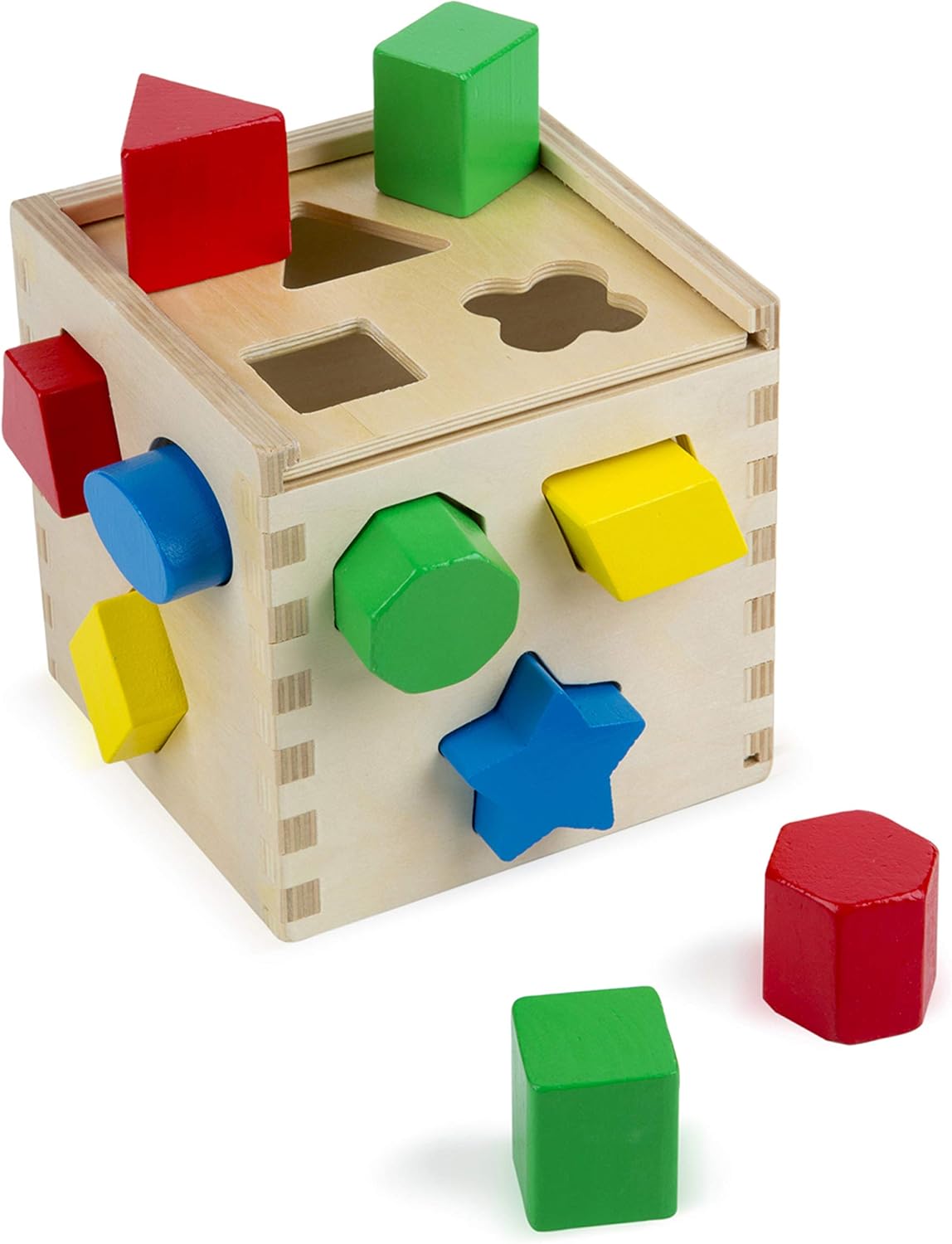
Best screen-free classic: Melissa & Doug's Shape Sorting Cube is a 30+ year product category staple for a reason: the maple hardwood construction survives years of toddler handling, the 12 colorful shapes provide sufficient variety to stay engaging, and the hinged lid lets kids retrieve the shapes themselves rather than needing parent help to reset. The hands-on, feedback-free design is specifically valued by parents and educators who want minimal electronic dependency.
Top picks ↓Related articles


1★ Best PickABest screen-free classicMelissa Doug Shape Sorting
Melissa & Doug's Shape Sorting Cube is a 30+ year product category staple for a reason: the maple hardwood construction survives years of toddler handling, the 12 colorful shapes provide sufficient variety to stay engaging, and the hinged lid lets kids retrieve the shapes themselves rather than needing parent help to reset. The hands-on, feedback-free design is specifically valued by parents and educators who want minimal electronic dependency. At $16 it's the best value in this group.
Pros
- ✓Hardwood durability lasts years
- ✓12 shapes provide lasting variety
- ✓No batteries required
Cons
- ✗No electronic feedback some kids respond well to
- ✗Best for 12-24 months specifically
- Age
- 12+ months
- Material
- Hardwood
- Shapes
- 12
- Price
- $16
2A-Best for language developmentFisher Price Laugh Learn

Fisher-Price Laugh & Learn uses 75+ songs, sounds, and phrases to reinforce letters, numbers, colors, and words through repetitive, child-initiated discovery. The toy responds to the child's actions rather than playing passively, which keeps the interaction high-quality rather than background noise. The SmartStages technology allows the toy to be switched to three difficulty levels as the child grows — extending the effective age range from 6 months to 3 years. At $28 it's strong value for the content density.
Pros
- ✓75+ songs and phrases
- ✓Three difficulty levels
- ✓Strong language development content
Cons
- ✗Electronic dependency some parents prefer to limit
- ✗Batteries require periodic replacement
- Age
- 6-36 months
- Content
- 75+ songs/phrases
- SmartStages
- Yes
- Price
- $28
3ABest longevity across agesLeapfrog World Map

LeapFrog's Interactive World Map earns its place by scaling further up the age range than any other pick here. Toddlers use it for simple country identification and animal sounds; by age 5-6 the same map teaches geography, capitals, and cultural facts. At $35 the per-year value is excellent given the 2-8 age range. The large floor format encourages movement and physical engagement alongside the learning content. Audio quality is clear and the map is durable under repeated toddler-level interaction.
Pros
- ✓Useful from ages 2-8
- ✓Encourages physical engagement
- ✓Geography, animals, and culture content
Cons
- ✗Too complex for under-24-month toddlers
- ✗Requires AA batteries
- Age
- 2-8 years
- Content
- Geography, animals, culture
- Format
- Floor map
- Price
- $35
Subscribe to our newsletter
Occasional updates and new releases — no spam.
4B+Best hands-on electronic sorterVtech Sort Discover

VTech Sort & Discover balances electronic feedback with hands-on physical sorting in a way that keeps the interaction child-driven: the electronic responses are rewards for completing the physical task correctly, not passive entertainment. The five shape pieces and sorting mechanism are appropriate for 18-month-old motor skills. A light-up face, sounds, and number/shape vocabulary reinforce the learning without overwhelming the sorting activity. At $20 it's well-priced for a developmental toy in this category.
Pros
- ✓Electronic feedback reinforces correct shape sorting
- ✓18-month-appropriate motor demands
- ✓Counts and names shapes
Cons
- ✗Smaller shape variety than Melissa & Doug
- ✗Less durable plastic than hardwood alternatives
- Age
- 12-36 months
- Shapes
- 5
- Electronic feedback
- Yes
- Price
- $20
5A-Best open-ended wooden toyHape Wooden Stacker

Hape's wooden stacking toy is the most open-ended option in this group — there's no single right way to play with it, which means it evolves with the child from 12 months (simple stacking by size) through age 3 (color sorting, counting, pattern making). The smooth painted beechwood is safe for mouthing, the rounded forms avoid sharp corners, and the quality matches Hape's reputation for premium wooden toy construction. At $30 it earns the price through longevity and the absence of any battery or electronic dependency.
Pros
- ✓Open-ended play evolves with the child
- ✓Premium beechwood construction
- ✓No batteries required
Cons
- ✗Less directed learning content than electronic alternatives
- ✗Higher price than Melissa & Doug
- Age
- 12+ months
- Material
- Beechwood
- Colors
- Multiple
- Price
- $30
| Product | Material | Content | SmartStages | Format | Electronic feedback | Colors | |||
|---|---|---|---|---|---|---|---|---|---|
| Melissa Doug Shape Sorting | 12+ months | Hardwood | 12 | $16 | — | — | — | — | — |
| Fisher Price Laugh Learn | 6-36 months | — | — | $28 | 75+ songs/phrases | Yes | — | — | — |
| Leapfrog World Map | 2-8 years | — | — | $35 | Geography, animals, culture | — | Floor map | — | — |
| Vtech Sort Discover | 12-36 months | — | 5 | $20 | — | — | — | Yes | — |
| Hape Wooden Stacker | 12+ months | Beechwood | — | $30 | — | — | — | — | Multiple |
How to Choose Toddler Learning Toys: Development Stage, Challenge Level, and Durability
The best learning toy for a toddler is the one they engage with for more than five minutes. Here's how to match toys to developmental stage and make that engagement last.
Cognitive Development Stages in Toddlers
12-18 months is primarily about cause-and-effect discovery — pushing a button causes a sound, dropping an object means it disappears (object permanence). 18-24 months expands to simple problem-solving: shape fitting, stacking, basic sorting. 2-3 years introduces more complex reasoning: which shape belongs where, how to complete a sequence, pretend play with functional objects. Toys designed for a specific stage within this range provide more sustained engagement than 'ages 1-3' catchall toys.
Open-Ended vs. Single-Purpose Toys
A shape sorter teaches shape matching by design, but a toddler will also use it as a container, a percussion instrument, and eventually a structure to stack other objects on. Toys with limited single-purpose design (press button, hear sound, nothing else) age out quickly. Open-ended toys — blocks, stackers, simple vehicles — are played with differently as the child develops, extending useful life and cognitive value.
Sound and Light Features: Help or Distraction?
Electronic features grab attention but can become a substitute for engagement rather than a driver of it. Research on infant and toddler media suggests that toys with excessive sound and light feedback can reduce the quality of parent-child interaction during play. The best electronic learning toys use sound and light to reinforce a child-initiated action (you fit the shape, it lights up) rather than to attract attention passively. Silent wooden toys develop more sustained focus for many toddlers.
Durability and Safety Standards
Toddlers chew, throw, and systematically disassemble toys. Materials matter: solid hardwood outlasts most plastics for wooden toys, and ABS plastic is more impact-resistant than cheaper alternatives. Look for ASTM F963 (US toy safety standard) or EN71 (European equivalent) certification. Avoid toys with small pieces under 1.75 inches (choking hazard threshold) for children under 3, even if the packaging says age 2+.
Bottom line
Melissa & Doug Shape Sorting Cube is the best starting point for 12-18 month olds — durable, screen-free, and genuinely engaging for shape recognition development. Fisher-Price Laugh & Learn is the best electronic learning toy for language development in the 12-24 month range. LeapFrog World Map scales with the child the longest, offering content complexity from ages 2-8. VTech Sort & Discover balances electronic feedback with hands-on sorting in a way that keeps the play child-driven. Hape Wooden Stacker is the best open-ended toy for the full 1-3 year range.
Frequently asked questions
What skills do toddler sorting toys develop?▼
How much screen time is appropriate at 18 months vs. 2-3 years?▼
Are wooden toys better than plastic for toddlers?▼
When should a child be able to complete a shape sorter?▼
Are LeapFrog and VTech toys actually educational?▼
Check the details of the products in this article
- Melissa Doug Shape Sorting$14.99Price as of 2026-10-19
- Fisher Price Laugh Learn$28Reference price
- Leapfrog World Map$35Reference price
- Vtech Sort Discover$20Reference price
- Hape Wooden Stacker$10.14Price as of 2026-10-19
Prices change. Check the retailer for the current price.
Comments & questions
Discussion happens on nattzy, our community forum. Sign in with Google to post — it takes a second.
View the discussion thread on nattzy ↗
Still deciding? Ask the community your own question — Post a question on nattzy ↗