Best Baby Laundry Detergent 2026: 5 Gentle Formulas
WriterPickly Editorial
Updated 2026-06-12
Newborn skin absorbs compounds from fabric at a higher rate than adult skin, which is why pediatric dermatologists routinely recommend fragrance-free, dye-free detergent for the first year. The detergents that earn repeat purchases are the ones that actually remove milk stains and spit-up without leaving residue that triggers eczema flare-ups. Cleaning power and gentleness don't have to be in conflict.
Quick answer
Fragrance is the leading cause of textile-related skin reactions in infants, so the best baby laundry detergent is a fragrance-free one — that single filter matters more than any brand. Dreft Stage 1 is the familiar default and plant-based ATTITUDE the cleanest ingredient list; run the cost-per-load math, since newborns generate 8-10 loads a week.
📋How we compared
Each detergent was evaluated on fragrance and dye content, optical brightener presence, third-party safety certification, cleaning performance on protein and fat-based baby stains, cost per load, and retail availability. Fragrance-free and brightener-free status were treated as baseline requirements.

Best Trusted Pick: Dreft Stage 1 is the detergent that pediatricians have recommended for decades, and that history creates a safety confidence that other detergents work harder to establish. The fragrance-free formula handles typical newborn laundry loads — milk, spit-up, formula residue — with reasonable effectiveness, though heavily soiled items sometimes need a second pass.
Top picks ↓This button opens Amazon search results, not a specific product page.
Which one is right for you?
Related articles


1★ Best PickA-Best Trusted PickDreft Stage 1 Newborn
Dreft Stage 1 is the detergent that pediatricians have recommended for decades, and that history creates a safety confidence that other detergents work harder to establish. The fragrance-free formula handles typical newborn laundry loads — milk, spit-up, formula residue — with reasonable effectiveness, though heavily soiled items sometimes need a second pass. The Stage 1 formula (versus Stage 2 for older babies) is the most minimal Dreft variant with the lowest fragrance compound burden. The cost per load ($0.40–$0.50) is the highest in this lineup, which matters when you're doing 10 loads per week. For parents who want the most-recommended name on the bottle without further research, this is the default.
Pros
- ✓Long-standing pediatrician recommendation history
- ✓Fragrance-free Stage 1 formula
- ✓Handles typical newborn laundry reliably
- ✓Available in every major retailer
Cons
- ✗Highest cost per load in this lineup ($0.40–$0.50)
- ✗Cleaning power on heavy stains not stronger than cheaper alternatives
2ABest Plant-BasedSeventh Generation Baby Detergent
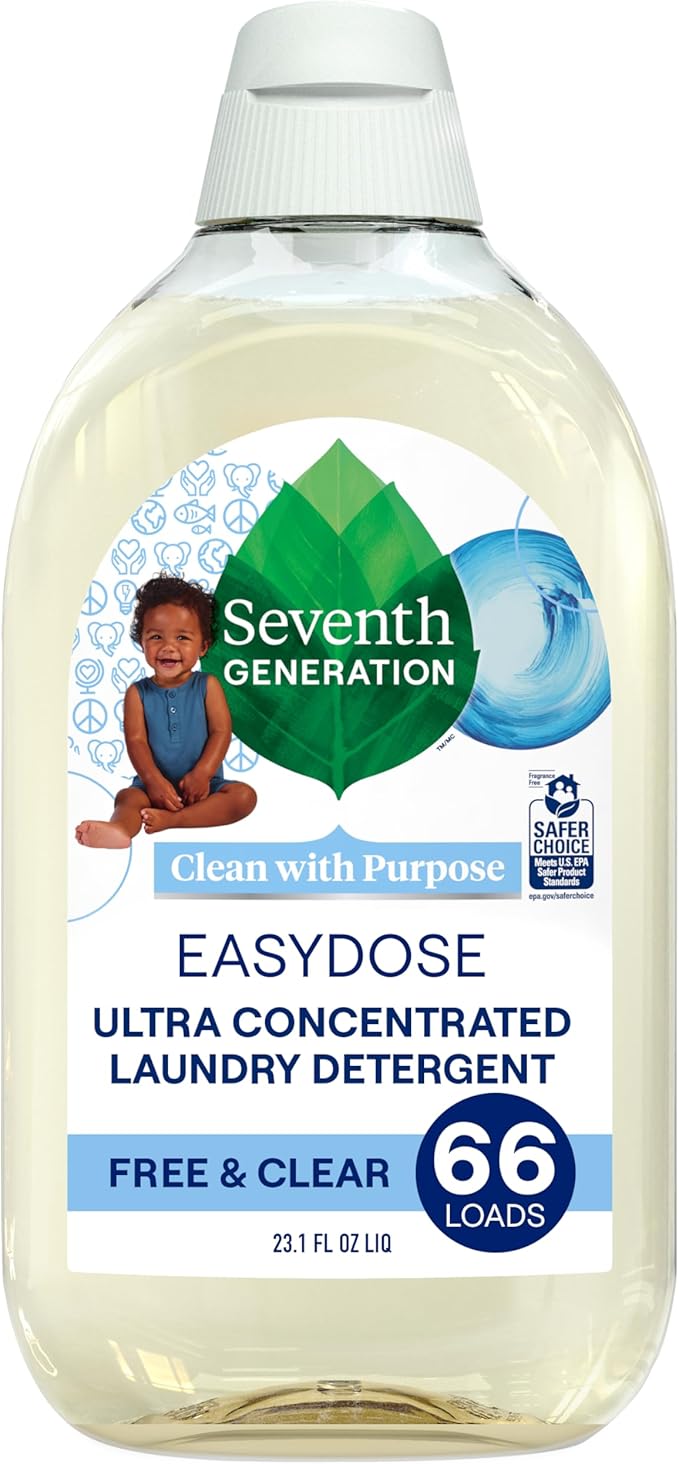
Seventh Generation's baby formula uses plant-based surfactants and enzyme blends without synthetic fragrances, dyes, or optical brighteners. The EWG verification means ingredient transparency is a core brand commitment rather than a marketing claim — the full ingredient list is disclosed publicly. Cleaning performance on protein and fat stains is comparable to Dreft at a lower cost per load ($0.25–$0.30). The formula works in both standard and HE machines. For parents specifically seeking a documented plant-based ingredient profile rather than a conventional synthetic formula, this is the clearest choice.
Pros
- ✓EWG verified — full ingredient transparency
- ✓Plant-based surfactants without synthetic fragrances
- ✓No optical brighteners
- ✓Comparable cleaning power to Dreft at lower cost
Cons
- ✗Formula can leave mild residue on dark fabrics in hard water
3ABest HypoallergenicAttitude Baby Detergent

ATTITUDE holds MADE SAFE certification — a third-party program that screens for over 6,500 potentially harmful substances — which puts it at the strict end of the ingredient verification spectrum for baby detergents. The formula is fragrance-free, dye-free, phosphate-free, and cruelty-free. At roughly $12 for 35 oz it is competitively priced against Seventh Generation. The main limitation is availability — ATTITUDE products are carried in specialty natural stores and online but less available at mainstream grocery and big-box retailers than Dreft or All Free Clear. For parents who prioritize third-party verified ingredient safety above brand recognition, this is the pick.
Pros
- ✓MADE SAFE certified — screens for 6,500+ potentially harmful substances
- ✓Fragrance-free, dye-free, phosphate-free
- ✓Cruelty-free
- ✓Competitive price against comparable ingredient-quality brands
Cons
- ✗Limited availability in mainstream retail — primarily online or specialty stores
Subscribe to our newsletter
Occasional updates and new releases — no spam.
4A-Best ValueBabyganics Laundry Detergent

Babyganics delivers the lowest effective cost per load in this lineup — roughly $0.20 per load from a 60-oz bottle at $14 — with a fragrance-free, plant-based formula that handles the full range of baby stains. The NeoNourish seed oil blend is a marketing differentiator with limited functional significance for laundry, but the core formula cleans comparably to Dreft without the price premium. Available at major retailers including Target, making it accessible for weekly grocery pickup rather than online ordering. HE-compatible. The main trade-off versus Dreft and Seventh Generation is less stringent third-party ingredient verification.
Pros
- ✓Best cost per load in this lineup at roughly $0.20
- ✓Fragrance-free, plant-based formula
- ✓Available at Target and major grocery retailers
- ✓HE-compatible
Cons
- ✗Less stringent third-party ingredient verification than ATTITUDE or Seventh Generation
5B+Best BudgetAll Free Clear Babies

All Free Clear's babies formula is the only pick in this lineup where the per-load cost drops below $0.15 at regular retail pricing ($12 for 88 oz). The formula is free of fragrance, dyes, and brighteners — the same core formulation approach as the adult All Free Clear that dermatologists recommend for sensitive skin, applied to a larger volume with baby-specific marketing. The cleaning power is solid for the price tier and the formula is widely available. The practical argument against it is less ingredient transparency than plant-based alternatives — the surfactant system is conventional synthetic. For budget-constrained families doing high laundry volume, this closes the cost gap significantly.
Pros
- ✓Lowest cost per load in this lineup
- ✓Fragrance-free, dye-free, brightener-free
- ✓Wide availability in every major retailer
- ✓Large 88-oz bottle minimizes reorder frequency
Cons
- ✗Conventional synthetic surfactants vs. plant-based alternatives
- ✗Less ingredient transparency than EWG-verified options
What to Look For in a Baby Detergent
Fragrance is the leading cause of textile-related skin reactions in infants. The American Academy of Dermatology recommends fragrance-free detergent for sensitive and newborn skin — this includes 'natural' fragrances like lavender and chamomile, which can trigger reactions in sensitized infants just as synthetic fragrances can. 'Unscented' products sometimes contain masking fragrances to neutralize detergent smell; 'fragrance-free' means no fragrance compound is present at all.
Optical brighteners — the compounds that make white fabrics appear whiter under UV light — remain on fabric after washing and have documented sensitization potential. Most baby-specific detergents avoid them; it's worth verifying on the ingredient label for any detergent you're considering for newborn laundry.
Enzyme content determines stain-removal power. Proteases break down protein stains (milk, spit-up, formula); lipases break down fat-based stains. Most mainstream baby detergents include enzymes in lower concentrations than adult formulas to reduce sensitization risk. The tradeoff is that enzyme-heavy stains — blowouts, fresh milk — sometimes require a second wash or a pre-treatment soak.
Cost Per Load: Making the Math Work
New parents do significantly more laundry than they anticipate — a newborn generates 8–10 loads per week across onesies, burp cloths, sheets, and sleep sacks. Cost per load becomes more relevant than bottle price. Dreft Stage 1 at $16 for a 40-ounce bottle delivering 32 loads costs about $0.50 per load. The Babyganics 60-ounce bottle at $14 covers more loads per dollar at roughly $0.20 per load when used as directed.
Concentrated formulas require accurate measuring to deliver the cost-per-load efficiency advertised. Using two caps of a concentrated formula instead of one doubles both cost and residue on fabric. A measuring cap that shows the fill line clearly — or a pump dispenser with a measured dose — prevents chronic overdosing that inflates running costs and increases rinse-residue buildup on newborn clothing.
Frequently asked questions
When can I switch to regular detergent?▼
Do I need to wash baby clothes before the first use?▼
Should I wash baby clothes separately?▼
Is Dreft actually worth the price?▼
Can I use baby detergent in an HE washing machine?▼
Check the details of the products in this article
- Dreft Stage 1 Newborn$24.94Price as of 2026-10-27
- Attitude Baby Detergent$18.25Price as of 2026-10-27
- Babyganics Laundry Detergent$17.97Price as of 2026-10-27
- All Free Clear Babies$12Reference price
This button opens Amazon search results, not a specific product page.
Prices change. Check the retailer for the current price.
Comments & questions
Discussion happens on nattzy, our community forum. Sign in with Google to post — it takes a second.
View the discussion thread on nattzy ↗
Still deciding? Ask the community your own question — Post a question on nattzy ↗