Best Stair Steppers 2026: 5 Compared
A stair stepper simulates stair climbing — a movement that loads the glutes, quadriceps, hamstrings, and calves through a repetitive stepping motion. Resistance feel and footprint fit matter more than maximum resistance specs.
Quick answer
The StairMaster Gauntlet Stepmill is the real thing, the only machine here with rotating 8-inch stairs demanding true step-on and step-off movement, producing the fullest hip extension arc and 400 to 500 calories an hour at level 8 to 10 of 26. The refurbished StairMaster 8-Series shares those mechanics for $1,500 to $2,500, the Bowflex Max Trainer M9 adds moving handles and the JRNY app, the NuStep T4r seats joint-limited users, and the Sunny Health mini stepper fits under a desk.
Each machine was evaluated on step mechanics (rotating stair vs pedal vs mini-pedal), resistance range and consistency, caloric output per hour at moderate pace, noise level in apartment settings, floor footprint relative to conditioning output, and joint impact level for users with knee or hip limitations.

StairMaster Gauntlet Stepmill
Best Overall: The Gauntlet Stepmill is the only machine in this comparison with genuine rotating stair mechanics — 8-inch steps that require true step-on / step-off movement producing the fullest hip extension arc and highest glute activation in the category. At level 8-10 of 26, most adults burn 400-500 cal/hour.
Top picks ↓| Product | Price | Link |
|---|---|---|
| $7299.99Price as of 2026-09-24 | ||
| $10.99Price as of 2026-09-24 | ||
| $39.99Reference price | ||
| $2,995.00Reference price | ||
| $10,199.00Reference price |
| Product | Type | Step height | Resistance levels | Console | Weight | Footprint | Price | App | Subscription | Resistance | Position | Resistance range | Engagement | Common use | Weight capacity | Availability | Motor hours | Longevity |
|---|---|---|---|---|---|---|---|---|---|---|---|---|---|---|---|---|---|---|
| StairMaster Gauntlet Stepmill | Rotating stepmill | 8 inches | 26 | Touchscreen + Bluetooth | ~440 lbs (200 kg) | Approx. 42 × 34 inches | $4,500–6,000 | — | — | — | — | — | — | — | — | — | — | — |
| Bowflex Max Trainer M9 | Step climber + moving arms | — | 20 | Touchscreen | Approx. 160 lbs | — | $1,999 | JRNY (streaming + auto-resistance) | JRNY included | — | — | — | — | — | — | — | — | — |
| Sunny Health & Fitness Mini Stair Stepper | Mini pedal stepper | 4–6 inches | — | Basic LCD | Approx. 18 lbs | Very compact | $30–60 | — | — | Hydraulic (adjustable) | — | — | — | — | — | — | — | — |
| NuStep T4r Recumbent Cross Trainer | Recumbent cross trainer | — | — | — | — | — | $2,995 | — | — | — | Seated | Near-zero to high | Full upper + lower body | Rehabilitation, seniors | 300+ lbs | — | — | — |
| StairMaster 8-Series Stepmill (Refurbished) | Rotating stepmill (commercial, previous gen) | 7–8 inches | Multiple | — | — | — | $1,500–2,500 (refurbished) | — | — | — | — | — | — | — | — | Refurbished via dealers | Under 5,000 preferred | 10–15 years home use |
Top picks
Related articles


Rotating stepmill, 8-inch steps, 26 resistance levels, touchscreen, ~440 lbs. $4,500-6,000. Commercial flagship — genuine stair climbing mechanics, highest glute engagement, industry standard. Heavy and expensive, primarily for commercial gym or well-budgeted dedicated home gym.
The Gauntlet Stepmill is the only machine in this comparison with genuine rotating stair mechanics — 8-inch steps that require true step-on / step-off movement producing the fullest hip extension arc and highest glute activation in the category. At level 8-10 of 26, most adults burn 400-500 cal/hour. Trade-off: 440 lbs and $4,500-6,000 price makes this a commercial or serious dedicated home gym purchase; floor reinforcement often required.
Pros
- ✓Genuine rotating stair mechanics — full hip extension per step
- ✓26 resistance levels with touchscreen and Bluetooth
- ✓Highest glute engagement in the category
Cons
- ✗440 lbs, $4,500–6,000 — commercial price and installation logistics
Score breakdown
| Type | Rotating stepmill |
| Step height | 8 inches |
| Resistance levels | 26 |
| Console | Touchscreen + Bluetooth |
| Weight | ~440 lbs (200 kg) |
| Footprint | Approx. 42 × 34 inches |
| Price | $4,500–6,000 |

Step climber + moving arms, 20 resistance levels, touchscreen, JRNY app. $2,200-2,800. Best connected home step climber — upper body adds calorie burn, compact footprint, mature app ecosystem. Correct for home gym athletes who want streaming fitness and space efficiency.
The Max Trainer M9 adds moving handles to the step-climbing motion, engaging the upper body pull muscles and increasing caloric burn per session compared to lower-body-only steppers. JRNY app provides streaming content and auto-resistance adjustments. At 20 resistance levels and a compact footprint, it's the most feature-complete home stepper. Trade-off: the pedal motion doesn't replicate true stair climbing — hip extension arc is smaller than a rotating stepmill, meaning lower glute activation per step.
Pros
- ✓Moving handles increase caloric burn vs lower-body-only steppers
- ✓JRNY app with streaming classes and auto-resistance
- ✓Compact footprint for a full-featured connected machine
Cons
- ✗Pedal motion has smaller hip extension arc than true stepmill — less glute activation
Score breakdown
| Type | Step climber + moving arms |
| Resistance levels | 20 |
| Console | Touchscreen |
| App | JRNY (streaming + auto-resistance) |
| Weight | Approx. 160 lbs |
| Price | $1,999 |
| Subscription | JRNY included |

Mini step climber, hydraulic resistance, 4-6 inch step range, no handles. $30-60. Budget light activity option — appropriate for desk use or rehabilitation, not serious cardiovascular training. Correct for occasional light stepping at minimal cost.
The Sunny Health mini stepper's 4-6 inch step range and hydraulic resistance make it appropriate for light daily movement, desk use, or early rehabilitation — not serious cardiovascular conditioning. At $30-60 it's a commitment-free entry point for anyone who wants to add stepping movement to a desk job without disrupting work. Trade-off: the limited resistance range and short step height produce insufficient caloric output for cardiovascular fitness goals; expect 150-200 cal/hour maximum.
Pros
- ✓Smallest footprint — fits under a desk for light stepping during work
- ✓Hydraulic resistance requires no power or setup
- ✓Under $60 for commitment-free movement addition
Cons
- ✗4-6 inch step height too small for meaningful glute engagement or cardio output
Score breakdown
| Type | Mini pedal stepper |
| Step height | 4–6 inches |
| Resistance | Hydraulic (adjustable) |
| Console | Basic LCD |
| Weight | Approx. 18 lbs |
| Footprint | Very compact |
| Price | $30–60 |
Subscribe to our newsletter
Occasional updates and new releases — no spam.
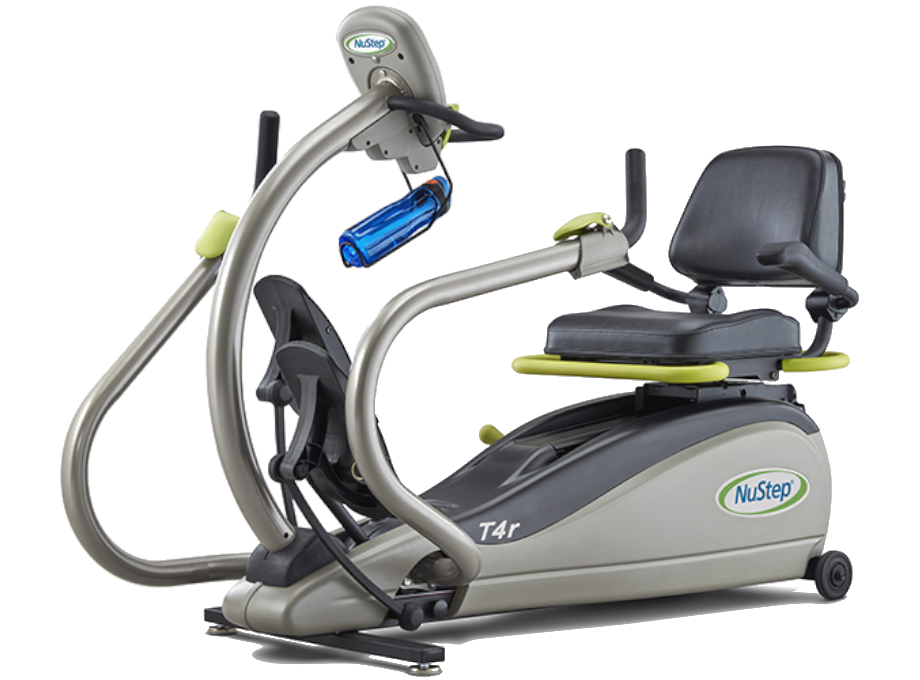
NuStep T4r Recumbent Cross Trainer
Recumbent stepping, seated position, full upper + lower body, near-zero to high resistance. $3,000-4,500. Best for joint protection — rehabilitation-grade design, seated for knee/hip limitations. Correct for users who need cardiovascular conditioning without standing impact.
The NuStep T4r's recumbent seated position eliminates the standing impact load that makes step climbing difficult for users with knee or hip limitations — you get full upper and lower body cardiovascular conditioning while seated. Resistance scales from near-zero upward, making it suitable for post-surgical rehabilitation and seniors. Trade-off: the seated design limits peak cardiovascular intensity compared to standing stepmills; healthy athletes seeking high-intensity conditioning will find the NuStep's ceiling too low.
Pros
- ✓Seated position eliminates standing impact for joint-limited users
- ✓Full upper and lower body engagement while seated
- ✓Near-zero resistance start for rehabilitation contexts
Cons
- ✗Seated design limits peak cardiovascular intensity for healthy athletes
Score breakdown
| Type | Recumbent cross trainer |
| Position | Seated |
| Resistance range | Near-zero to high |
| Engagement | Full upper + lower body |
| Common use | Rehabilitation, seniors |
| Price | $2,995 |
| Weight capacity | 300+ lbs |
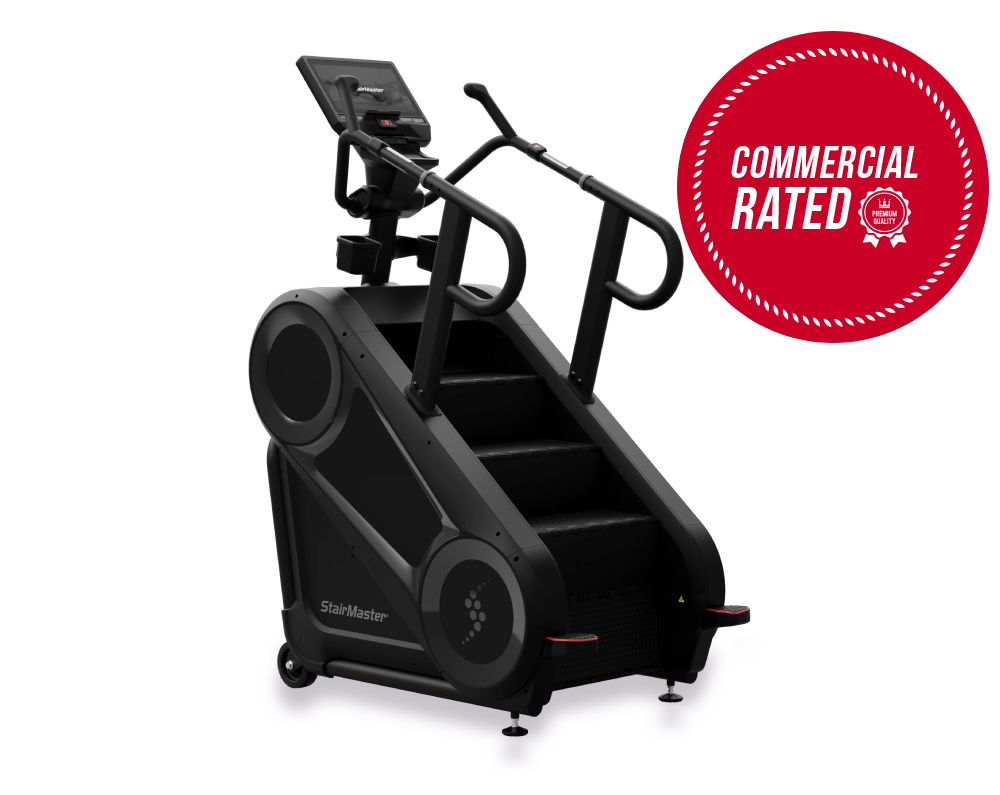
StairMaster 8-Series Stepmill (Refurbished)
Commercial stepmill (previous generation), 7-8 inch steps, available refurbished. $1,500-2,500 refurbished. Best home stepmill value — genuine stepmill mechanics at lower cost than Gauntlet when purchased refurbished. Check motor hours before purchase.
The 8-Series shares the same rotating stepmill mechanics as the Gauntlet at 7-8 inch step height, but as a previous-generation commercial unit it's available refurbished for $1,500-2,500 — half to one-third the Gauntlet's price. Commercial-grade machines in home gym environments last 10-15 years. Trade-off: purchasing requires dealing with fitness equipment dealers, verifying motor hours before buying (under 5,000 hours preferred), and managing delivery of a 300+ lb machine.
Pros
- ✓Genuine rotating stepmill mechanics at refurbished price ($1,500–2,500)
- ✓Commercial-grade longevity — 10–15 years in home use
- ✓7-8 inch steps identical in mechanics to current Gauntlet
Cons
- ✗Requires dealer sourcing, motor hour verification, and heavy delivery logistics
Score breakdown
| Type | Rotating stepmill (commercial, previous gen) |
| Step height | 7–8 inches |
| Resistance levels | Multiple |
| Availability | Refurbished via dealers |
| Price | $1,500–2,500 (refurbished) |
| Motor hours | Under 5,000 preferred |
| Longevity | 10–15 years home use |
Which one is right for you?
For commercial gym users replicating at home
StairMaster Gauntlet Stepmill
If you've trained on StairMasters in commercial gyms and want the identical experience at home, the Gauntlet is the only option — no other machine here replicates rotating-stair glute mechanics.
For connected home gym athletes
Bowflex Max Trainer M9
JRNY streaming classes, moving handles for upper body calorie burn, and a compact footprint deliver the best all-around connected stepping experience in a residential space.
For desk workers adding daily movement
Sunny Health & Fitness Mini Stair Stepper
The mini stepper slides under a standing desk, requires no power, and adds meaningful light movement to a sedentary workday at negligible cost.
For users with knee or hip limitations
NuStep T4r Recumbent Cross Trainer
The recumbent seated design provides full cardiovascular conditioning with near-zero impact load — the only option in this comparison for post-surgical rehabilitation or severe joint limitations.
For home gym builders on a budget
StairMaster 8-Series Stepmill (Refurbished)
Genuine rotating stepmill mechanics at $1,500-2,500 refurbished is the most cost-efficient path to commercial-grade stair climbing in a dedicated home gym space.
Stepmill vs step climber: the mechanical difference
Stepmill (rotating stairs): the StairMaster Gauntlet and 8-series are true stepmills — they have an actual rotating staircase with 8-inch step height. You step on each stair as it comes around, exactly simulating real stair climbing. The advantage: natural, full range of motion, each step requires hip extension through a meaningful arc. The stepmill engages the glutes more fully than a step climber because you're completing the full extension phase of each step. Calorie output is very high — stepping at moderate speed on a stepmill burns 400-600+ calories per hour for most adults. Stepmill machines are heavy (200-400 lbs), expensive ($3,000-7,000), and predominantly found in commercial gyms.
Step climber (pedal machine): the Bowflex Max Trainer and most home stair steppers use two independent pedals that compress alternately — you push down on one while the other rises. This simulates the leg push-off of climbing without the full hip extension arc of a stepmill. Step climbers also allow arm movement (the Max Trainer has moving handles like an elliptical), which increases total calorie burn. The compact footprint of step climbers (typically 50-70% less floor space than a stepmill) makes them practical for home gyms.
Mini steppers (Sunny Health and similar): compact two-pedal steppers with a small resistance mechanism and minimal footprint. Mini steppers cost $30-150 and provide a basic stepping motion but have limited resistance range, no handles, and a small step height (typically 4-6 inches). They're appropriate for light activity, desk use, or rehabilitation contexts but don't produce the caloric output or muscle stimulus of full-size stepmills or step climbers. The step range is too small for meaningful glute engagement.
StairMaster Gauntlet and 8-series: commercial standard
StairMaster Gauntlet ($4,500-6,000) is the current flagship commercial stepmill — 8-inch rotating steps, 26 resistance levels, touchscreen console, Bluetooth connectivity. The Gauntlet is the machine many people picture when they think of a StairMaster. It's found in most commercial gyms and produces genuinely demanding cardiovascular conditioning. For home use, the Gauntlet is practical only for serious athletes with dedicated gym space and commercial equipment budget. Weight is approximately 440 lbs — floor reinforcement is often needed.
StairMaster 8-Series Stepmill ($3,500-4,500) is the previous generation commercial stepmill — similar mechanics to the Gauntlet at a lower price point when purchased new or refurbished. Refurbished 8-series units are available in the $1,500-2,500 range, making this the most accessible genuine stepmill option. Build quality is commercial-grade and units last 10-15 years in home use. The 8-series step height is 7-8 inches — comparable to the Gauntlet. For home gym athletes who want the real stepmill experience, a refurbished 8-series is often the best value path.
Calorie output on a StairMaster: a moderate pace on the StairMaster (level 8-10 out of 20) produces approximately 400-500 calories per hour for a 150 lb person. Maximum effort produces 600-700 calories per hour. This makes the StairMaster one of the highest-output commercial cardio machines per unit time. The combination of non-impact movement and high output makes it particularly useful for athletes who can't run due to joint issues.
Bowflex Max Trainer M9 and home alternatives
Bowflex Max Trainer M9 ($2,200-2,800) is Bowflex's flagship step climber with moving handles — it combines stepping with upper body push/pull for total body cardio. The M9 has 20 resistance levels, JRNY app connectivity (personalized workouts and streaming), and a touchscreen. The Max Trainer's design provides more calorie burn per session than a lower-body-only step climber because the moving arms add upper body engagement (similar to the logic of an assault bike). Bowflex claims the Max Trainer produces higher calorie burn than traditional cardio in shorter sessions — the product marketing is aggressive, but the concept (more muscles engaged = more calories) is sound. The footprint is relatively compact for a connected cardio machine.
Bowflex Max Trainer M6 ($1,500-1,800) is the mid-range Max Trainer option — similar mechanics to the M9 with fewer resistance levels (16 vs 20), LCD display instead of touchscreen, and limited JRNY features. For home gym athletes who want the Max Trainer experience without the M9 premium, the M6 provides the same step climbing + upper body combination at lower cost. The difference between M6 and M9 is primarily in the digital experience rather than the fundamental exercise mechanics.
Sunny Health SF-S020 Mini Stepper ($30-60) is the budget entry point — two small pedals with hydraulic resistance, no handles, approximately 4-6 inch step range. The SF-S020 is appropriate for light daily movement (desk walking equivalent), rehabilitation, or people who want minimal investment in a stepping motion. It's not a substitute for serious cardiovascular conditioning — the resistance range is limited and the step height too small for meaningful calorie output. For the same investment ($30-60) in a resistance band or jump rope, a more effective conditioning tool is available.
Choosing between stair stepper categories for home gym
For serious cardiovascular conditioning: a refurbished StairMaster 8-series stepmill ($1,500-2,500) is the best home investment if you want genuine stepmill mechanics and have the space (approximately 4 ft × 3 ft footprint plus clearance). Commercial refurbs are typically well-maintained from gym environments and last years in home use. This requires purchasing through fitness equipment dealers — check the motor hours (under 5,000 hours is preferred) and verify the console functions before purchase.
For space-efficient home cardio: the Bowflex Max Trainer M6 or M9 provides high-output cardio in a smaller footprint than a stepmill or treadmill. If you want connected fitness features (app integration, streaming classes), the Max Trainer ecosystem is mature. The upper body component makes it more efficient for calorie burn than lower-body-only alternatives. Budget: $1,500-2,800 new.
For joint protection and seated use: the NuStep T4r recumbent stepper ($3,000-4,500) is designed for low-impact use and rehabilitation — seated position, full upper and lower body engagement, adjustable resistance from near-zero upward. It's the preferred choice for users with knee or hip limitations who need cardiovascular conditioning without standing impact. Widely used in physical therapy settings. For healthy adults seeking high-intensity conditioning, the NuStep's low-impact design means lower peak intensity.
Frequently asked questions
Is a stair stepper better than a treadmill for weight loss?▼
How long should I use a stair stepper for a good workout?▼
What's the difference between StairMaster and generic stair steppers?▼
Prices change. Check the retailer for the current price.
Comments & questions
Discussion happens on nattzy, our community forum. Sign in with Google to post — it takes a second.
Related articles

Best Gym Bag 2026: Wet/Dry, Backpack vs Duffel, Sizing
Best Water Bottle 2026: Stanley vs Hydro Flask vs Thermos
Best Air Purifier 2026: 5 models compared honestly

ConoHa WING review (2026): setup, speed and pricing
Best JP rental server 2026: 5 hosts ranked
Best LED Face Masks 2026: 3 Light Therapy Devices Compared