Best Cutting Boards 2026: 5 Compared
The cutting board debate resolves quickly once you understand what different materials actually do to knives and to bacteria. Seal integrity and stackability outlast any smart feature after six months of daily use.
Quick answer
For most home cooks, the Boos Block edge-grain maple board is the pick — hard maple at roughly 1450 Janka protects a thin Japanese edge while staying firm enough for daily prep. Teakhaus resists water without oiling thanks to teak's 2–8% natural oil, OXO's HDPE board is the only one here that survives a dishwasher sanitizing cycle for raw chicken, and Epicurean's 1/4-inch composite fits where a wood block won't.
We assessed each product on build quality and materials, how it performs in everyday kitchen use, cleaning and maintenance burden, durability over years of use, and value for the price. Manufacturer specifications were cross-checked against verified owner reviews.
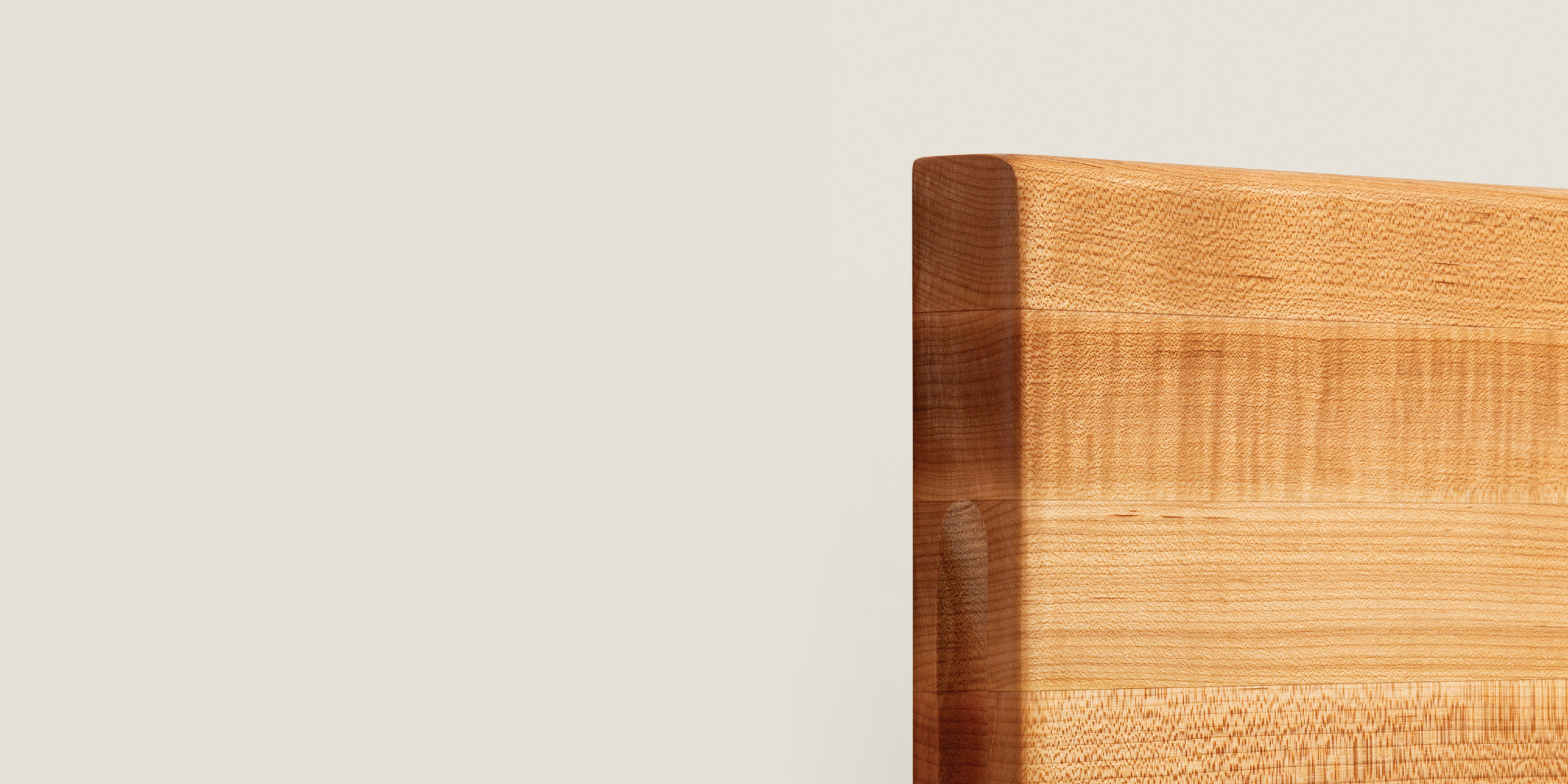
Boos Block Maple Cutting Board
Best Overall: The Boos Block edge-grain maple board is the working-kitchen standard for a reason: hard maple at roughly 1450 on the Janka scale lands in the narrow band where the wood is firm enough to resist gouging but soft enough to be kind to a knife edge. The dense closed grain reseals after each cut, which is the mechanism behind the bacterial-resistance behavior documented in UC Davis food-safety research.
Top picks ↓| Product | Price | Link |
|---|---|---|
| $100Reference price | ||
| $80Reference price | ||
| $30Reference price | ||
| $30Reference price | ||
| $239.92Price as of 2026-09-24 |
Top picks
Related articles


Hard maple edge-grain, Janka hardness ~1450, food-safe mineral oil required every 2-4 weeks. $100-250+. Best overall wood cutting board for knife edge preservation and longevity. The professional kitchen standard.
The Boos Block edge-grain maple board is the working-kitchen standard for a reason: hard maple at roughly 1450 on the Janka scale lands in the narrow band where the wood is firm enough to resist gouging but soft enough to be kind to a knife edge. The dense closed grain reseals after each cut, which is the mechanism behind the bacterial-resistance behavior documented in UC Davis food-safety research. Typical sizes run 18x12 or 20x15 inches at around 1.5-inch thickness, which gives meaningful thermal and acoustic mass during heavy chopping. Mineral-oil conditioning every two to four weeks keeps the panel from drying or warping. The trade is real maintenance, but a properly oiled board outlasts a decade of plastic replacements.
Pros
- ✓Hard maple hits the sweet spot for edge preservation
- ✓Closed grain reseals and resists bacterial retention
- ✓Substantial 1.5-inch thickness keeps the board stable during heavy prep
- ✓Lifetime build quality, repairable by sanding and re-oiling
Cons
- ✗Requires mineral-oil maintenance every two to four weeks
- ✗Premium price compared to plastic or composite alternatives

Teak edge-grain, naturally water-resistant (teak oil content), minimal maintenance required. $80-150. Best for outdoor use, near-sink placement, or users who prefer low-maintenance wood. Slightly softer on knife edges than maple.
Teakhaus uses plantation teak with natural oil content in the 2-8% range, which makes the board inherently water-resistant without the regular mineral-oil cycle that maple needs. Janka hardness around 1000 is slightly softer than maple, which is marginally easier on knife edges; the coarser grain provides usable grip during wet cuts. Edge-grain construction in the standard 20x14-inch panel is dense enough to absorb cleaver pressure without flexing. The trade is teak's silica content (1-2%), which can dull very hard Japanese knives faster than maple over time, though most home cooks will never notice. For a kitchen near a sink or for cooks who forget to oil, teak forgives neglect that maple punishes.
Pros
- ✓Natural teak oils mean minimal mineral-oil maintenance
- ✓Slightly softer than maple, marginally gentler on edges
- ✓Holds up better than maple in damp environments
- ✓Typically priced below comparable Boos boards
Cons
- ✗Silica content can accelerate wear on very hard knives (HRC 62+)
- ✗Coarser grain pattern is less refined visually than maple
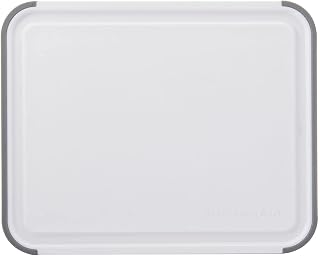
HDPE plastic, juice groove, non-slip feet, dishwasher-safe. $30-50. Best for dedicated raw meat and fish processing. The correct material for protein cutting because it can be sanitized at dishwasher temperatures. Use with a separate wood board for produce.
The OXO Good Grips board is HDPE plastic with rubber non-slip edges and a juice groove around the perimeter, sized at roughly 10.5x14.5 inches in the standard model. HDPE is the right plastic for cutting work: BPA-free, dishwasher-safe at sanitizing temperatures, and softer on edges than rigid polypropylene. The Shore D hardness around 62-65 is firmer than wood, so it will dull a knife faster than maple, but the dishwasher-safety is the load-bearing feature here. For raw chicken, fish, and other proteins where cross-contamination risk is the priority, this is the correct material because the sanitizing cycle actually works. Once the surface is heavily scored, replace it rather than try to scrub deep grooves clean.
Pros
- ✓Dishwasher-safe at sanitizing temperatures
- ✓Juice groove contains liquid during meat carving
- ✓Rubber edges keep the board stable on slick counters
- ✓Affordable enough to replace when surface scoring builds up
Cons
- ✗Harder on knife edges than wood
- ✗Scored surface becomes a bacterial reservoir over time
Subscribe to our newsletter
Occasional updates and new releases — no spam.

Epicurean Kitchen Series Composite Cutting Board
Paper composite (kraft fiber + resin), dishwasher-safe, 1/4-inch thin profile. $30-60. Best for users who want wood-look aesthetics without oil maintenance. Harder on knife edges than wood but easier to care for.
Epicurean's Kitchen Series boards are paper composite — kraft fiber compressed with food-safe resin — producing a panel roughly 1/4 inch thick that is dishwasher-safe and weighs a fraction of a comparable hardwood board. The surface is harder than maple but somewhat softer than HDPE, so edge wear sits between the two. Standard sizes around 14.5x11.25 inches store vertically in narrow gaps where a 1.5-inch wood board cannot fit. No grain means no oil maintenance and no warping concerns, which is the core appeal. The board will not develop the self-healing surface that wood does, and it lacks the visual warmth of teak or walnut, but the day-to-day friction of using and storing it is the lowest in this comparison.
Pros
- ✓Dishwasher-safe with no warping risk
- ✓Thin 1/4-inch profile fits narrow storage gaps
- ✓Lightweight enough to handle one-handed
- ✓Zero oil maintenance required
Cons
- ✗Harder on knife edges than wood boards
- ✗Composite surface lacks the self-healing behavior of end-grain wood

John Boos Walnut End-Grain Butcher Block Board
Black walnut end-grain, Janka ~1010, gentlest on knife edges of all options, maximum visual appeal. $150-400. Best for kitchen display and users who want the most attractive board. Same oil maintenance requirement as end-grain maple.
The John Boos walnut butcher block is end-grain construction in black walnut, with Janka hardness around 1010 — softer than maple, slightly softer than teak, and the gentlest wood option here on knife edges. End-grain orientation means the knife edge slides between vertical wood fibers rather than across them, which produces the characteristic self-healing surface where cut marks close visually after oiling. Typical sizes start at 18x12x1.5 inches and scale up to large butcher-block formats above 24 inches. Oil maintenance matches end-grain maple: mineral oil every two to three weeks at first, less often once fully seasoned. The premium over maple is paid almost entirely for the dark chocolate grain, which is dramatically more visually striking on an island or countertop than the lighter maple.
Pros
- ✓Softest wood option here, gentlest on knife edges
- ✓End-grain construction maximizes self-healing behavior
- ✓Visually striking dark walnut grain
- ✓Same proven Boos build quality as the maple line
Cons
- ✗Significantly more expensive than equivalent maple
- ✗End-grain requires consistent oiling to prevent cracking
Which one is right for you?
The serious home cook with Japanese knives
Boos Block Maple Cutting Board
Hard maple at Janka 1450 protects a thin Japanese edge better than any plastic or composite while still being firm enough for daily heavy prep.
The low-maintenance cook near a sink
Teakhaus Edge Grain Teak Cutting Board
Teak's natural oil content keeps the board stable through occasional damp neglect that would warp untreated maple.
The cook prepping a lot of raw chicken
OXO Good Grips Plastic Cutting Board
HDPE is the only material here that survives the dishwasher sanitizing cycle, which is what actually kills protein-borne pathogens.
The small-kitchen renter with no storage
Epicurean Kitchen Series Composite Cutting Board
The 1/4-inch composite profile slides into narrow gaps where a 1.5-inch wood block will not fit.
The cook with an open-island kitchen
John Boos Walnut End-Grain Butcher Block Board
End-grain walnut is the most visually striking surface in this comparison and the gentlest wood here on knife edges.
Wood vs plastic vs composite: what science says about bacteria and knife edges
The intuitive assumption that plastic is safer than wood for raw meat has been tested empirically and found to be wrong for established cutting boards. Dean O. Cliver's food safety research at UC Davis showed that bacteria introduced to a used plastic cutting board with grooves survived washing and could be recovered; bacteria introduced to a wood board were not recoverable after washing, apparently absorbed into the wood and unable to multiply. New, smooth plastic was harder to contaminate than wood. The implication: a new plastic board is reasonably safe, but once scored, it becomes a bacterial reservoir that is difficult to sanitize.
Knife edge preservation follows different physics. Plastic hardness (HDPE typically scores 62-65 Shore D) causes more micro-abrasion to knife edges per cut than wood (maple scores approximately 30-40 Shore D equivalent). This is observable: knives dulled on plastic cutting boards require more frequent honing. Hard materials — glass, ceramic, marble — are significantly worse than either plastic or wood and should never be used for knife work.
Composite boards (Epicurean) are made from paper composite (kraft fiber impregnated with resin), producing a surface harder than wood but typically softer than plastic. They are dishwasher-safe, thin, lightweight, and have no grain to open and close — they are impervious to water absorption, which means no warping and no oil-maintenance requirement. The trade-off is that they are harder on knife edges than wood, closer in effect to the harder end of plastic.
Boos Block Maple: the pro kitchen standard
John Boos cutting boards — specifically the Boos Block line in maple — are the most widely used professional kitchen cutting boards in North America. Restaurant prep kitchens use Boos blocks because maple is the correct hardness: hard enough to resist cutting damage, soft enough to be kind to knife edges. The dense grain of hard maple (Janka hardness ~1450) closes tightly after each cut, which is the mechanism behind the self-healing and bacterial resistance properties observed in wood boards.
Boos edge-grain maple boards (the standard Boos Block product) are made from planks oriented with the long grain showing on the surface — the same orientation as hardwood flooring. End-grain boards (the Boos Butcher Block, also available in maple) orient the cross-sections of wood upward, so the knife edge slides between the grain rather than across it. End-grain is gentler on knife edges and provides the characteristic self-healing appearance where cut marks close up, but requires more maintenance and is more prone to cracking if not oiled regularly.
At $100-250+ depending on size, Boos boards are significantly more expensive than plastic alternatives. They require food-safe mineral oil conditioning every 2-4 weeks for edge-grain, more frequently for end-grain. The investment is justified by longevity: a well-maintained Boos board will outlast any plastic board by decades.
Teakhaus edge-grain teak: the outdoor and wet-environment option
The Teakhaus by Architec Edge Grain Cutting Board uses teak rather than maple. Teak's natural oil content (2-8% by weight) makes it inherently water-resistant without mineral oil treatment — the teak board used in outdoor settings, near sinks, or by users who prefer minimal maintenance will not warp or crack as easily as unseasoned maple. The natural oils also contribute to some self-sanitation properties, though the evidence is less clear than for maple.
Teak is slightly softer than maple (Janka hardness ~1000 vs ~1450), which is marginally better for knife edges. The grain is coarser, which some users find less aesthetically pleasing but which provides more grip for cutting tasks. At $80-150 for a full-size board, Teakhaus is priced similarly to or slightly less than comparable Boos boards.
Teak's high silica content (1-2%) is sometimes cited as a concern for knife edges — silica is abrasive, and the teak grain contains more of it than maple. The practical evidence on this is mixed; most professional knife users report teak performing similarly to maple, but high-sensitivity users of very hard Japanese knives (HRC 62+) may notice slightly faster dulling on teak versus maple.
OXO Good Grips plastic and Epicurean composite: the practical daily boards
The OXO Good Grips Plastic Cutting Board is HDPE (high-density polyethylene) with rubber gripping edges on the underside. HDPE is the correct plastic for cutting boards: it is BPA-free, dishwasher-safe at standard temperatures, and has enough give to be gentler on knife edges than rigid polypropylene. The OXO design adds a juice groove around the perimeter (useful for carving meat without liquid spillage) and non-slip feet.
Plastic boards are the appropriate choice for dedicated raw meat and fish processing because they can be sanitized in a dishwasher at temperatures that kill pathogens, while wood boards should not be run through a dishwasher (the prolonged heat and moisture exposure causes warping and cracking). The two-board system — plastic for protein, wood for everything else — is the professional kitchen standard and optimal for food safety.
The Epicurean Kitchen Series Board is paper composite: kitchen paper fibers compressed under heat with a food-safe resin binder. The resulting material is dishwasher-safe, odor-resistant, and approximately 1/4 inch thick (compared to 3/4-inch for most wood boards). The thin profile makes it easy to store vertically. At $30-60, it is less expensive than wood boards of comparable size. The limitation is knife edge performance: composite is harder than wood and closer to plastic in its effect on edge retention.
John Boos walnut: the aesthetic premium
John Boos produces a walnut end-grain cutting board alongside its maple line. Black walnut (Janka hardness ~1010) is softer than maple and slightly softer than teak, making it the gentlest of the wood options on knife edges. The end-grain orientation provides the maximum self-healing behavior — knife marks close up visually after oiling, and the board maintains a pristine appearance with proper maintenance.
The visual appeal of walnut is the primary reason for its premium price ($150-400 for full-size boards): the dark chocolate grain is dramatically more attractive than maple for kitchen display purposes. Walnut end-grain boards require the same oil maintenance as maple end-grain — mineral oil every 2-3 weeks initially, less frequently once fully seasoned.
For purely functional cutting, there is no significant performance advantage to walnut over maple in the same end-grain construction. The premium is an aesthetic choice. For users who want the best-looking board on a kitchen island or butcher block counter, walnut end-grain from Boos is the correct specification.
Frequently asked questions
How do you properly oil and maintain a wood cutting board?▼
Can a cutting board transmit foodborne illness?▼
What size cutting board should you buy?▼
Prices change. Check the retailer for the current price.
Comments & questions
Discussion happens on nattzy, our community forum. Sign in with Google to post — it takes a second.
Related articles
Best Air Fryer 2026: 5 Models Compared Honestly

Best Coffee Makers 2026: Breville vs Moccamaster vs OXO

Best Air Purifier 2026: 5 models compared honestly

ConoHa WING review (2026): setup, speed and pricing
Best JP rental server 2026: 5 hosts ranked

Best LED Face Masks 2026: 3 Light Therapy Devices Compared