Best Hand Mixers 2026: KitchenAid vs Breville vs Cuisinart
Halfway through a batch of Italian buttercream, your arm gives out before the sugar syrup has fully incorporated — a stand mixer would solve that, but a good hand mixer costs $40 instead of $400 and h. Weekly usage frequency, not recipe variety, determines which spec actually matters.
Quick answer
For most home bakers, the KitchenAid KHM512ER is the pick — its DC motor holds steady RPM under load from light whipped cream through dense cookie dough, which matters more than raw wattage. The Breville BHM800SIL is the only one with a silicone scraper beater, cutting bowl scrape-downs by roughly half, the Cuisinart HM-90BCS's 9 speeds prevent overbeating at the critical aeration stages, and the Hamilton Beach 62682 covers occasional baking at $25-30.
This comparison is desk research. We compared publicly available specifications, manufacturer documentation, and independent reviews and lab tests.
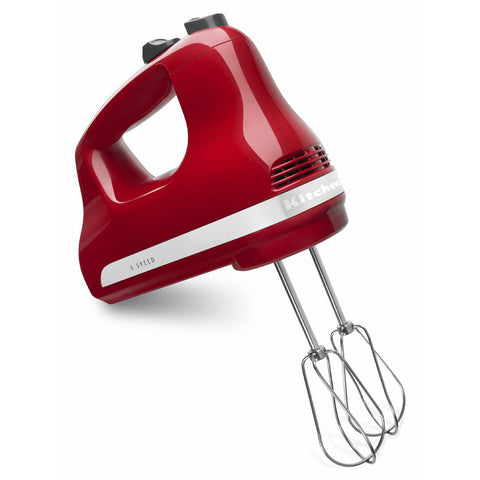
KitchenAid KHM512ER 5-Speed Ultra Power Hand Mixer
Best Overall: The KitchenAid KHM512ER wins on motor consistency, not raw wattage. Its DC motor maintains steady RPM under load — from light whipped cream through dense cookie dough — in a way that cheap AC motors don't.
Top picks ↓| Product | Price | Link |
|---|---|---|
| $59.99Reference price | ||
| $159.95Reference price | ||
| $79.95Reference price | ||
| — | ||
| $49.99Reference price |
| Product | Price | Motor | Speeds | Weight | Beaters | Dishwasher safe | Color options | Unique feature | Storage | Attachments | Bowl guide | Case | Bowl rest | Turbo boost | Low-speed control |
|---|---|---|---|---|---|---|---|---|---|---|---|---|---|---|---|
| KitchenAid KHM512ER 5-Speed Ultra Power Hand Mixer | ~$59.99 | DC 250W | 5 | 2.2 lbs | Turbo beaters | Yes | Multiple | — | — | — | — | — | — | — | — |
| Breville BHM800SIL Handy Mix Scraper Hand Mixer | ~$159.95 | 240W | 9 | 3.0 lbs | — | — | — | Scraper beater | Magnetic heel attachment | Scraper beater, regular beater, whisk | — | — | — | — | — |
| Cuisinart HM-90BCS Hand Mixer 9-Speed | ~$79.95 | 220W | 9 | 2.5 lbs | — | — | — | — | — | 5 (2 beaters, 2 dough hooks, 1 whisk) | Yes | Included | — | — | — |
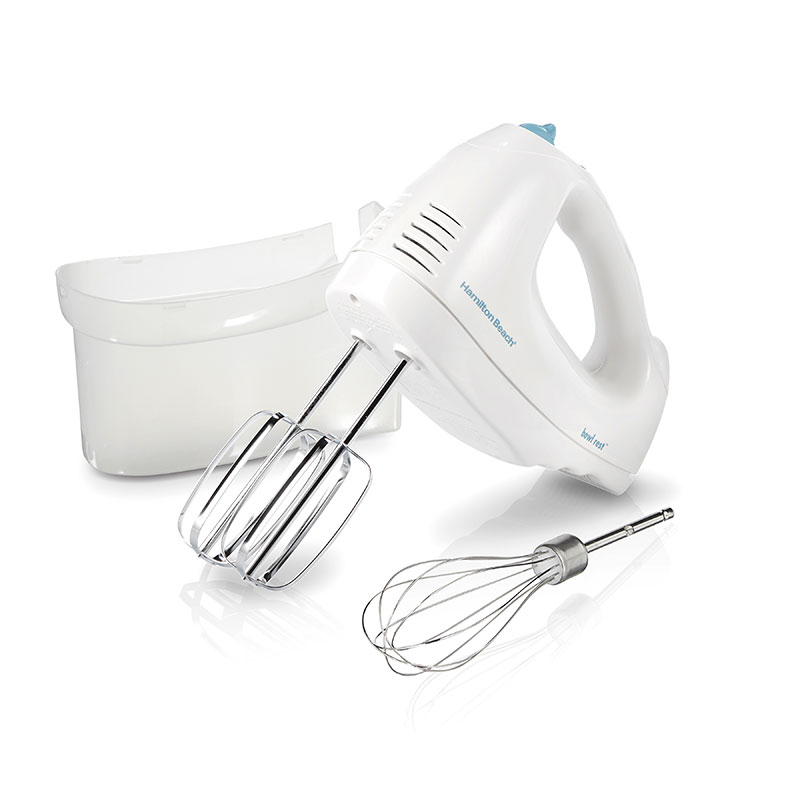
| Hamilton Beach 6-Speed Electric Hand Mixer 62682 | ~$25–30 | 290W | 6 | 2.4 lbs | — | — | — | — | Snap-on case | 2 beaters, 1 whisk | — | — | Built-in rubber foot | — | — |
| KRUPS GN9019 Hand Mixer 9-Speed | ~$49.99 | 200W | 9 | 2.1 lbs | Turbo | — | — | — | — | — | — | — | — | Yes | Exceptional |
Top picks
Related articles


KitchenAid KHM512ER 5-Speed Ultra Power Hand Mixer
DC motor maintains consistent speed under load from light whipped cream to dense cookie dough, with turbo beaters that resist staining and clean easily. The most balanced hand mixer for regular home bakers who want reliable performance without stand mixer complexity.
The KitchenAid KHM512ER wins on motor consistency, not raw wattage. Its DC motor maintains steady RPM under load — from light whipped cream through dense cookie dough — in a way that cheap AC motors don't. Turbo beaters resist staining and the 2.2 lb body reduces fatigue over long sessions. The 5-speed range is adequate for most bakers; the trade-off is less granularity than 9-speed competitors.
Pros
- ✓DC motor maintains consistent RPM under load without bogging down
- ✓Turbo beaters resist staining and self-clean during use
- ✓2.2 lb compact body reduces arm fatigue
Cons
- ✗5 speeds offers less granular control than 9-speed competitors
Score breakdown
| Price | ~$59.99 |
| Motor | DC 250W |
| Speeds | 5 |
| Weight | 2.2 lbs |
| Beaters | Turbo beaters |
| Dishwasher safe | Yes |
| Color options | Multiple |

Breville BHM800SIL Handy Mix Scraper Hand Mixer
The only hand mixer with a scraper beater — a silicone-edged attachment that wipes the bowl wall on each rotation, cutting manual scrape-downs by roughly half. Nine speeds and a 240W motor handle a full baking range, with a magnetic attachment heel that stores beaters on the body.
The Breville BHM800SIL is the only hand mixer with a scraper beater — a silicone-edged attachment that wipes the bowl wall on each rotation, cutting manual scrape-downs by roughly half. Nine speeds and 240W handle a full baking range. The magnetic attachment heel that stores beaters on the body is a practical daily convenience. At $160 it's the most expensive here.
Pros
- ✓Unique scraper beater cuts bowl scrape-downs by roughly half
- ✓9 speeds with 240W motor
- ✓Magnetic attachment heel stores beaters on mixer body
Cons
- ✗$159.95 — most expensive hand mixer in this comparison
Score breakdown
| Price | ~$159.95 |
| Motor | 240W |
| Speeds | 9 |
| Unique feature | Scraper beater |
| Storage | Magnetic heel attachment |
| Attachments | Scraper beater, regular beater, whisk |
| Weight | 3.0 lbs |

Nine speeds give the finest granular control for meringue, chiffon batter, and incorporation-sensitive mixing tasks where large speed jumps risk overbeating. Ships with dough hooks for thick batters and a whisk for rapid aeration, covering the full range of baking tasks.
The Cuisinart HM-90BCS's 9-speed range is its defining advantage — the finest granular control for meringue, chiffon batter, and incorporation-sensitive mixing. Comes with 5 attachments: two beaters, two dough hooks, and a whisk. The 220W motor is the lowest wattage on this list but handles typical baking tasks well. Best for bakers who regularly work with meringues or delicate batters.
Pros
- ✓9 speeds for finest granular control over meringue and delicate batters
- ✓Ships with 5 attachments including dough hooks
- ✓Bowl guide keeps beater path centered during long sessions
Cons
- ✗220W is the lowest wattage in this comparison
Score breakdown
| Price | ~$79.95 |
| Motor | 220W |
| Speeds | 9 |
| Attachments | 5 (2 beaters, 2 dough hooks, 1 whisk) |
| Bowl guide | Yes |
| Weight | 2.5 lbs |
| Case | Included |
Subscribe to our newsletter
Occasional updates and new releases — no spam.
The most straightforward value proposition on this list: 290W motor and 6 speeds handle everyday baking tasks at a price that requires no justification. The built-in bowl rest and snap-on storage case are useful practical touches rarely found at this price point.
At $25–30 the Hamilton Beach 62682 is the value proposition everyone understands — 290W motor, 6 speeds, built-in bowl rest, and snap-on storage case. The built-in bowl rest (a rubber foot on the back) lets you set the mixer across the bowl mid-task without dripping batter on the counter. For occasional bakers, there's nothing to justify spending more.
Pros
- ✓290W motor at the lowest price in this comparison
- ✓Built-in bowl rest for mid-task pausing
- ✓Snap-on storage case keeps beaters and whisk together
Cons
- ✗Plastic housing feels less solid than KitchenAid or Cuisinart
Score breakdown
| Price | ~$25–30 |
| Motor | 290W |
| Speeds | 6 |
| Bowl rest | Built-in rubber foot |
| Storage | Snap-on case |
| Weight | 2.4 lbs |
| Attachments | 2 beaters, 1 whisk |
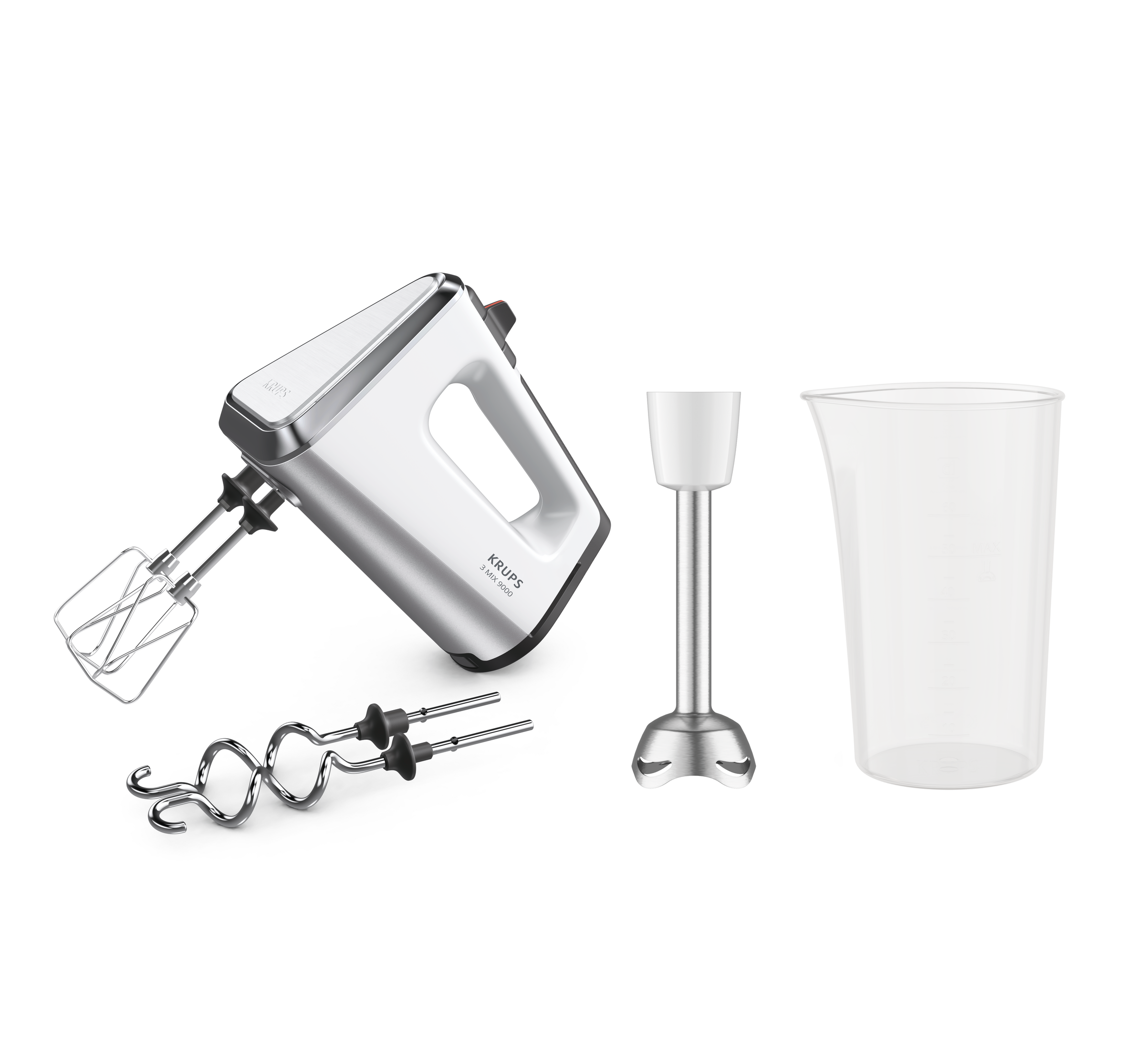
Nine speeds with a 200W motor tuned for precision at low end — the slowest speed barely stirs, which matters when you're starting a meringue or gently folding in flour. Compact and light at 2.1 lbs, with a turbo boost button for brief bursts of maximum speed.
The KRUPS GN9019's 9-speed motor is specifically tuned for precision at the low end — the slowest speed barely stirs, ideal for starting meringues before ramping up or gently folding flour without overworking gluten. At 2.1 lbs it's the lightest mixer here, and the turbo boost button adds brief maximum-speed bursts. The 200W motor is adequate for typical tasks.
Pros
- ✓Slowest speed barely stirs — ideal for meringue starts and gentle folding
- ✓2.1 lbs — lightest hand mixer in this comparison
- ✓Turbo boost button for brief maximum-speed bursts
Cons
- ✗200W is lowest wattage — may struggle with very stiff doughs
Score breakdown
| Price | ~$49.99 |
| Motor | 200W |
| Speeds | 9 |
| Weight | 2.1 lbs |
| Turbo boost | Yes |
| Low-speed control | Exceptional |
| Beaters | Turbo |
Which one is right for you?
For regular home bakers
KitchenAid KHM512ER 5-Speed Ultra Power Hand Mixer
DC motor consistency under load with low fatigue weight and easy-clean turbo beaters
For bakers who hate scraping bowls
Breville BHM800SIL Handy Mix Scraper Hand Mixer
Unique silicone scraper beater cuts manual bowl scrape-downs by roughly half
For meringues and delicate batters
Cuisinart HM-90BCS Hand Mixer 9-Speed
9-speed granular control prevents overbeating at the critical aeration stages
For occasional bakers on a budget
Hamilton Beach 6-Speed Electric Hand Mixer 62682
290W motor with bowl rest and storage case at the lowest price in this comparison
For gentle low-speed mixing tasks
KRUPS GN9019 Hand Mixer 9-Speed
Lowest-speed setting barely stirs — perfect for meringue starts and flour folding
Top pick: KitchenAid KHM512ER 5-Speed Ultra Power
The KitchenAid KHM512ER earns its top position through motor consistency rather than raw wattage. The 5-speed Ultra Power motor runs at 250W — modest on paper — but the DC motor maintains consistent RPM under load in a way that cheaper AC motors don't. When you're whipping thick cookie batter or incorporating cold butter into buttercream, the motor doesn't noticeably bog down. That consistency matters more than peak speed numbers when you're working with dense or cold ingredients.
KitchenAid ships the KHM512ER with turbo beaters rather than traditional wire beaters, which means the attachment surface area is smaller but the beaters fold into themselves to create a self-cleaning whipping action. They're dishwasher-safe and resist picking up food stains better than the chrome-plated alternatives. The mixer body itself is compact — lighter than the Breville and Cuisinart at 2.2 lbs — which reduces fatigue in longer mixing sessions. Ergonomically, the handle grip angle is matched to how most people hold a mixer, with the weight bias toward the front where the motor sits.
Where the KHM512ER shows its limitations is at 5 speeds: the Cuisinart and KRUPS both offer 9 speeds, giving more granular control for tasks like starting a meringue slowly before ramping up speed, or mixing a very light batter without overbeating. The KitchenAid's speed jumps are larger between steps. For most home bakers the 5 speeds are more than adequate, but if you bake meringues or chiffon cakes regularly, the additional speed steps in the Cuisinart justify the price difference.
Budget pick: Hamilton Beach 6-Speed 62682
The Hamilton Beach 62682 is the hand mixer you buy when you want reliable results at a price that doesn't require justification. At around $25-30, it undercuts every other mixer on this list by at least $20, and the 6-speed motor handles whipped cream, cake batter, and mashed potatoes without complaint. The 290W motor is actually more powerful than the KitchenAid's 250W, though real-world performance differences are small because motor efficiency matters as much as wattage.
The practical advantage of the Hamilton Beach is its built-in bowl rest — a small rubber foot on the back of the mixer lets you set it down mid-task across the bowl rim without laying it on the counter and potentially dripping batter. That's a small but genuinely useful feature when you're moving between adding flour and checking consistency. The mixer also comes with a snap-on storage case that keeps the beaters and whisk attachment together in one place.
The trade-off for the price is build quality. The plastic housing feels less solid than the KitchenAid or Cuisinart, and the speed dial requires slightly more deliberate turns to engage cleanly. For occasional bakers — a birthday cake here, holiday cookies there — none of this matters. The mixer works. For someone who bakes weekly and cares about the feel of the tool in their hand, the KitchenAid's $20-30 premium buys meaningfully better build quality.
Feature pick: Cuisinart HM-90BCS 9-Speed
The Cuisinart HM-90BCS targets bakers who want the most granular speed control available without buying a stand mixer. Nine speeds let you start a meringue at speed 1 — barely a stir — and work up to speed 9 for maximum aeration without jumping past the critical incorporation stages. For chiffon cake batter, meringue-based buttercreams, or angel food cake, that control pays off in texture: overbeating at a stage where air cells are still forming collapses them.
The HM-90BCS ships with five attachments: two beaters, two dough hooks, and a whisk. The dough hooks handle denser bread-adjacent batters — banana bread, muffins, scones — that a whisk can't manage. The 220W motor is the lowest wattage on this list, which seems counterintuitive for a feature-oriented mixer, but Cuisinart's motor efficiency is high and real-world performance on typical baking tasks matches the higher-wattage Hamilton Beach.
The mixer's bowl guide — a notch in the head that rests on most standard mixing bowls — helps keep the beater path centered during low-speed incorporation. It's a minor feature that matters most during long mixing sessions when arm position drifts. At around $50-60, the Cuisinart costs more than the Hamilton Beach and similar to the KitchenAid; the justification is the 9-speed range and the dough hook attachments for bakers who regularly work with thick batters.
How to choose: wattage, attachments, and storage
Wattage is a useful starting point but not a reliable proxy for performance. A 200W motor with efficient gear reduction can outperform a 300W motor with poor load management in real mixing scenarios. What actually predicts performance is how the motor handles sustained load at low speeds — this is where cheap mixers struggle. Before buying, look for reviews that specifically test thick cookie dough or cold butter incorporation rather than just whipped cream, which almost any mixer handles easily.
Attachments determine what tasks the mixer can handle: wire beaters work for cake batter, eggs, and whipped cream; turbo or flat beaters handle thicker batters and incorporate butter more efficiently; dough hooks manage banana bread and thick muffin batter (though hand mixers aren't substitutes for stand mixers on actual bread dough requiring extended kneading). A whisk attachment adds the ability to aerate liquid egg whites quickly before the beaters take over. The Breville's unique selling point is a scraper beater — one beater has a flexible silicone edge that wipes the bowl wall with each rotation, reducing the number of times you stop to scrape down by hand.
Storage is underrated: beaters and attachments need to live somewhere. The Hamilton Beach's snap-on storage case keeps everything together; the KitchenAid and Cuisinart both have cases or pouches included in some versions. If storage space is limited, buy a mixer that ships with a storage solution rather than loose attachments. Also consider cord length and whether the cord swivels — a fixed cord that drapes across your mixing arm creates a minor but persistent annoyance over long sessions.
Frequently asked questions
Hand mixer vs stand mixer: when does the upgrade make sense?▼
Does wattage matter for mixing heavy cookie dough?▼
What's the easiest way to clean hand mixer beaters?▼
Prices change. Check the retailer for the current price.
Comments & questions
Discussion happens on nattzy, our community forum. Sign in with Google to post — it takes a second.
Related articles

Best Coffee Makers 2026: Breville vs Moccamaster vs OXO
Food
Best Toaster 2026: 5 Compared
Best Toaster 2026: 5 Compared
Best Air Purifier 2026: 5 models compared honestly

ConoHa WING review (2026): setup, speed and pricing
Best JP rental server 2026: 5 hosts ranked
Best LED Face Masks 2026: 3 Light Therapy Devices Compared