Best Pasta Makers 2026: Marcato vs Imperia vs Philips
Fresh pasta is different from dried pasta in a specific way. Weekly usage frequency, not recipe variety, determines which spec actually matters.
Quick answer
Weekly usage frequency, not recipe variety, determines which specification actually matters. A hand-crank Marcato or Imperia is the correct choice for occasional weekend pasta: cheaper, effectively unbreakable, and easy to clean since neither goes in a dishwasher. An automatic extruder like the Philips earns its price only if you make pasta most weeks, since it handles mixing and extrusion in one pass. Roller width and the number of thickness settings matter less than build rigidity in a hand-crank machine.
Each pasta maker was assessed on dough sheet consistency, roller mechanism precision, included accessories, cleanup burden, and the real-world scenario it is best suited for — whether hand-rolled sheets, motor-driven consistency, or fully automatic extrusion.
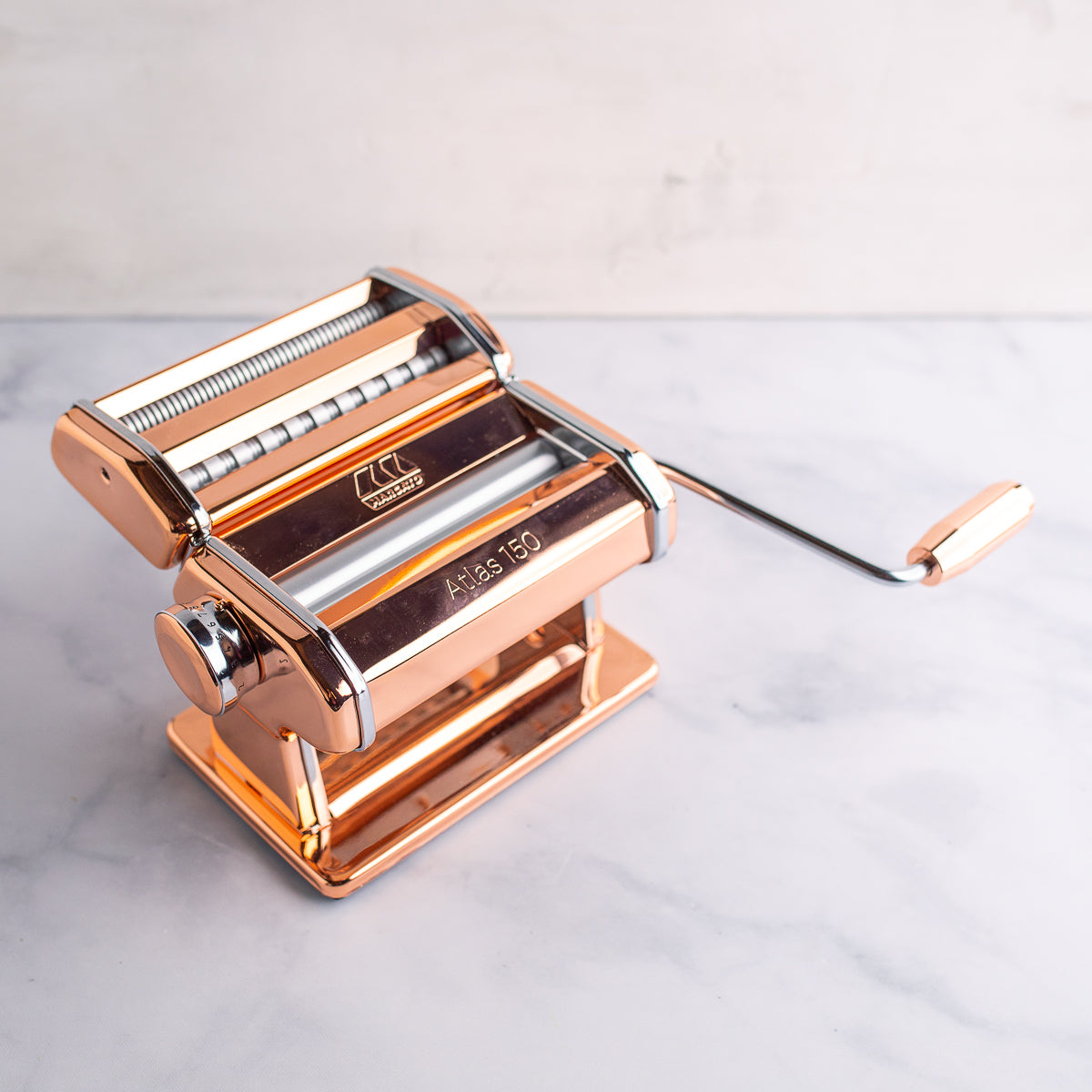
Marcato Atlas 150 Pasta Maker
Best Overall: The Marcato Atlas 150 has been the home pasta roller benchmark since the 1930s — chrome-plated steel rollers, 150mm width, nine thickness settings from 3mm to 0.6mm, and more third-party attachment support than any competitor. The crank mechanism is smooth and durable; the clamp mount is stable on any counter edge.
Top picks ↓| Product | Price | Link |
|---|---|---|
| $108.04Price as of 2026-09-24 | ||
| $60Reference price | ||
| $150Reference price | ||
| $200Reference price | ||
| $80Reference price |
| Product | Type | Roller width | Thickness settings | Material | Included cutters | Origin | Weight | Drive | Included | Compatibility | Price | Output time | Included dies | Additional dies | Cleanup | Price range | Construction | Die availability | Best use |
|---|---|---|---|---|---|---|---|---|---|---|---|---|---|---|---|---|---|---|---|
| Marcato Atlas 150 Pasta Maker | Manual roller | 150mm | 0 (3mm) to 9 (0.6mm) | Chrome-plated steel | Fettuccine + tagliolini | Italy | — | — | — | — | — | — | — | — | — | — | — | — | — |
| Imperia Pasta Machine Double Cutter | Manual roller | 150mm | — | Chrome-plated steel | Fettuccine (5mm) + spaghetti (2mm) | Italy | Slightly heavier than Atlas | — | — | — | — | — | — | — | — | — | — | — | — |
| KitchenAid Pasta Roller and Cutter Attachment Set | Stand mixer attachment (KitchenAid) | 152mm | — | — | — | — | — | Motor-driven via mixer | Roller + fettuccine + spaghetti cutter | All KitchenAid tilt-head and bowl-lift mixers | ~$150–200 (attachment only) | — | — | — | — | — | — | — | — |
| Philips Pasta Maker 7000 Automatic | Automatic extruder | — | — | — | — | — | — | — | — | — | — | ~15 minutes | Spaghetti, fettuccine, penne, lasagna | Available separately | Disassemble within 30 min | $200–300 | — | — | — |
| Ronco Pasta Maker Automatic | Budget automatic extruder | — | — | — | — | — | — | — | — | — | — | ~15–20 minutes | — | — | — | $80–120 | Plastic-heavy, simpler than Philips | Limited vs Philips | Occasional / trial use |
Top picks
Related articles


Chrome-plated steel manual roller, 150mm width, settings 0-9 (0.6-3mm), includes fettuccine and tagliolini cutters. Made in Italy since 1930. The reference standard for home pasta rollers — stable, consistent, durable, widely supported by third-party attachments.
The Marcato Atlas 150 has been the home pasta roller benchmark since the 1930s — chrome-plated steel rollers, 150mm width, nine thickness settings from 3mm to 0.6mm, and more third-party attachment support than any competitor. The crank mechanism is smooth and durable; the clamp mount is stable on any counter edge. Cleaning means wiping dry — no soap, no water, ever. The widest range of replacement parts and cutters of any home pasta maker.
Pros
- ✓Chrome steel construction with 90+ years of proven durability
- ✓Nine thickness settings down to 0.6mm — thin enough for ravioli
- ✓Widest third-party attachment and spare parts availability
Cons
- ✗Requires counter-edge clamp mount — no freestanding option; no soap cleaning
Score breakdown
| Type | Manual roller |
| Roller width | 150mm |
| Thickness settings | 0 (3mm) to 9 (0.6mm) |
| Material | Chrome-plated steel |
| Included cutters | Fettuccine + tagliolini |
| Origin | Italy |
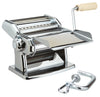
Manual roller, similar to Atlas, includes both fettuccine (5mm) and spaghetti (2mm) cutters as standard. Italian-made. Best if you want two cutter widths without buying additional attachments.
The Imperia includes both a fettuccine (5mm) and spaghetti (2mm) cutter as standard — the Atlas requires a separate purchase for the second width. Italian-made, equivalent build quality to the Atlas, slightly heavier. At thinnest settings the crank requires marginally more pressure than the Atlas; not a problem for most users. The better deal if you want two pasta widths from day one.
Pros
- ✓Includes both fettuccine (5mm) and spaghetti (2mm) cutters as standard
- ✓Italian-made chrome steel — equivalent durability to Atlas
- ✓No extra purchase needed for two common pasta widths
Cons
- ✗Slightly heavier than Atlas; marginally more crank resistance at thinnest settings
Score breakdown
| Type | Manual roller |
| Roller width | 150mm |
| Material | Chrome-plated steel |
| Included cutters | Fettuccine (5mm) + spaghetti (2mm) |
| Weight | Slightly heavier than Atlas |
| Origin | Italy |

KitchenAid Pasta Roller and Cutter Attachment Set
KitchenAid stand mixer attachment, motor-driven roller for consistent sheet speed, 152mm width, includes roller/fettuccine/spaghetti cutter. Best if you already own a KitchenAid stand mixer — most space-efficient pasta setup.
If you already own a KitchenAid stand mixer, this attachment converts it into a motor-driven pasta roller — consistent sheet speed eliminates the variable of manual crank tempo, producing more uniform sheet thickness across the full pasta length. 152mm roller width, comes with roller, fettuccine, and spaghetti cutter. Best only if you have the mixer already; buying a KitchenAid just for pasta is not cost-effective at $350–500 for the mixer.
Pros
- ✓Motor-driven roller produces more consistent sheet thickness than hand-cranking
- ✓Space-efficient — uses your existing KitchenAid investment
- ✓Steel roller quality equivalent to Marcato/Imperia
Cons
- ✗Only worthwhile if you already own a KitchenAid — $350–500 mixer + $150–200 attachment for pasta only is not cost-effective
Score breakdown
| Type | Stand mixer attachment (KitchenAid) |
| Roller width | 152mm |
| Drive | Motor-driven via mixer |
| Included | Roller + fettuccine + spaghetti cutter |
| Compatibility | All KitchenAid tilt-head and bowl-lift mixers |
| Price | ~$150–200 (attachment only) |
Subscribe to our newsletter
Occasional updates and new releases — no spam.

Automatic extruder — mix and extrude in 15 minutes, no technique required. Makes tubular and shaped pasta that rollers cannot produce. Best for users who want homemade pasta without the hand-rolling process and weeknight convenience.
The Philips is the only true set-and-forget pasta maker here — add flour and liquid, press start, fresh pasta in 15 minutes, no dough-making or rolling technique required. Makes tubular and shaped pasta (penne, rigatoni, spaghetti via die) that rollers cannot. The extruded texture is rougher than roller pasta, which actually holds sauce better. Cleanup demands disassembly within 30 minutes before dough dries; louder than manual rollers.
Pros
- ✓Fully automatic — pasta in 15 minutes with no technique
- ✓Makes tubular shapes (penne, rigatoni) impossible on a roller
- ✓Rougher extruded texture holds thick sauces better
Cons
- ✗Cleanup requires disassembly within 30 minutes; louder than manual rollers
Score breakdown
| Type | Automatic extruder |
| Output time | ~15 minutes |
| Included dies | Spaghetti, fettuccine, penne, lasagna |
| Additional dies | Available separately |
| Cleanup | Disassemble within 30 min |
| Price range | $200–300 |
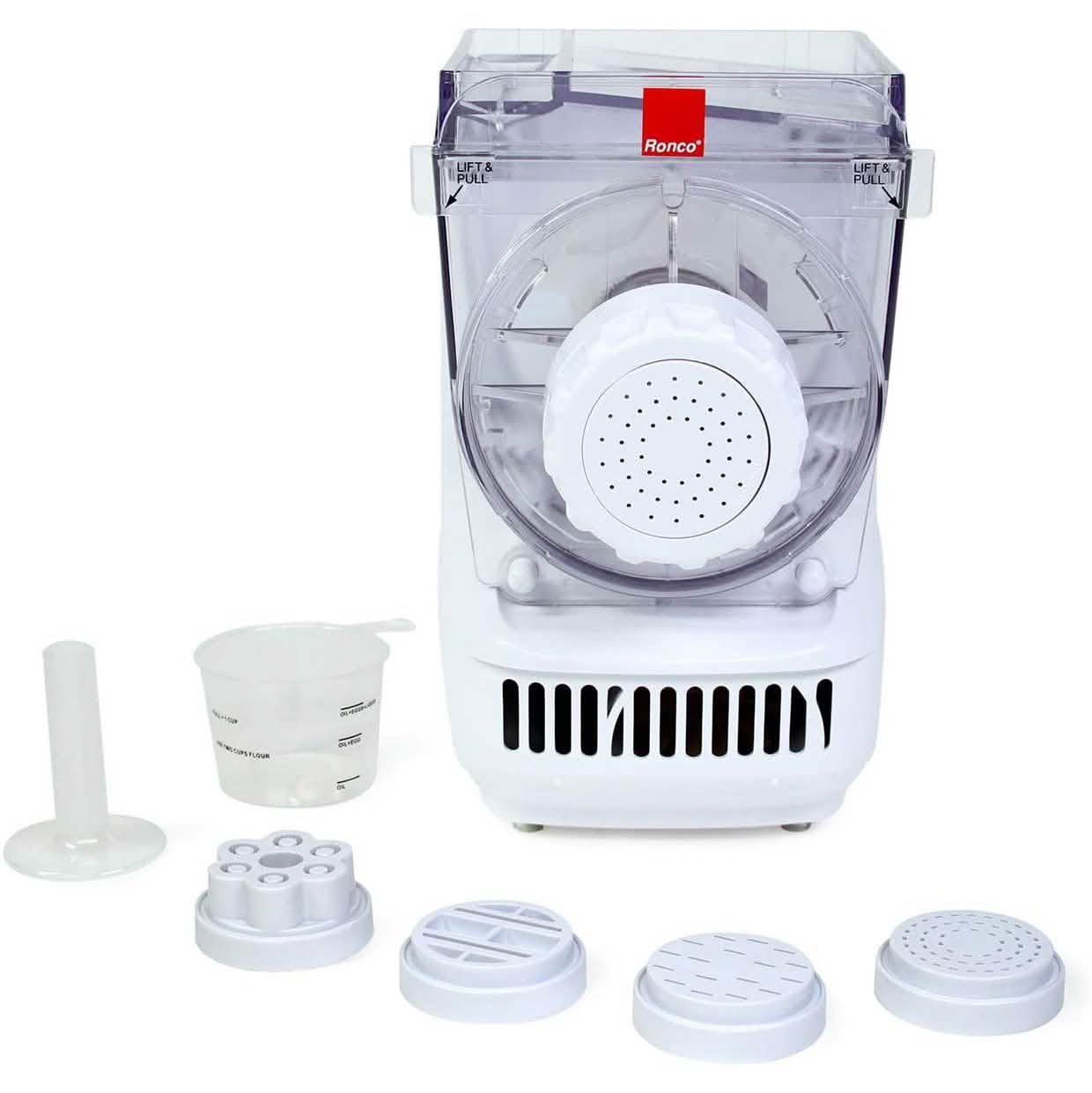
Budget automatic pasta maker — simpler than the Philips, fewer die options, lower price. Adequate for users who want to try automatic pasta making without the full Philips investment. Pasta quality and durability are lower than premium options.
The Ronco is a budget automatic extruder at $80–120 — fewer die options and lower construction quality than the Philips, but the automatic mixing and extrusion mechanism is functionally similar. Adequate for occasional use and a reasonable way to try automatic pasta making before committing to the Philips. Pasta quality and machine longevity are below the premium options.
Pros
- ✓Budget entry into automatic pasta — $80–120 vs Philips's $200–300
- ✓Automatic mixing and extrusion — no hand technique needed
- ✓Acceptable results for occasional use
Cons
- ✗Fewer die options and lower construction durability than Philips; pasta quality is noticeably lower
Score breakdown
| Type | Budget automatic extruder |
| Output time | ~15–20 minutes |
| Price range | $80–120 |
| Construction | Plastic-heavy, simpler than Philips |
| Die availability | Limited vs Philips |
| Best use | Occasional / trial use |
Which one is right for you?
For pasta enthusiasts making sheets and stuffed pasta
Marcato Atlas 150 Pasta Maker
The Atlas 150 is the benchmark for a reason — nine precision settings, durable chrome steel, and the widest third-party cutter ecosystem of any home pasta roller.
For buyers wanting two widths from day one
Imperia Pasta Machine Double Cutter
Includes both fettuccine and spaghetti cutters as standard — no separate purchase needed for the two most common pasta widths.
For KitchenAid stand mixer owners
KitchenAid Pasta Roller and Cutter Attachment Set
Motor-driven consistency and no extra appliance footprint — the best upgrade for anyone already using a KitchenAid for other tasks.
For weeknight cooks who want pasta without the process
Philips Pasta Maker 7000 Automatic
Add flour and liquid, press start, get pasta in 15 minutes — and it makes tubular shapes that rollers cannot produce.
Roller machines vs extruder machines: the fundamental split
Pasta makers fall into two categories that are not interchangeable. Roller machines (Marcato Atlas, Imperia, KitchenAid attachment) roll dough into thin sheets, which you can then cut into fettuccine, tagliatelle, lasagna sheets, or stuff for ravioli. The resulting pasta is smooth, silky, and very close to what you find at a pasta shop. The technique requires making dough first, letting it rest, then feeding it through progressively thinner settings — a 30-45 minute process.
Extruder machines (Philips Pasta Maker 7000, Ronco) push dough through shaped dies to produce hollow shapes like rigatoni, penne, and fusilli — forms that a roller cannot make. The texture is different from roller pasta: extruded pasta is slightly rougher on the surface, which actually holds sauce better but doesn't have the silky sheet texture of rolled pasta. The Philips Pasta Maker mixes and extrudes in one machine — add flour and liquid, press a button, receive pasta in 15 minutes. The trade-off is that the extruded pasta lacks the specific texture of hand-rolled or roller-machine pasta.
Choosing between the two depends on what pasta you want to make. For tagliatelle, fettuccine, pappardelle, lasagna, and stuffed pastas: a roller machine. For rigatoni, penne, spaghetti through a die, and other tubular or short shapes: an extruder. Many pasta enthusiasts own one of each. If you only own a roller and want ribbed rigatoni, you can't make it. If you only own an extruder and want silky fresh tagliatelle, the texture will be different from what you're imagining.
The Italian benchmark: Marcato Atlas 150
The Marcato Atlas 150 is the most widely used pasta maker in home kitchens globally, with a production history going back to 1930 in Campodarsego, Italy. The mechanism is entirely manual — a hand crank turns steel rollers that the dough passes through. The width setting goes from 0 (widest, 3mm gap) to 9 (thinnest, 0.6mm gap), giving precise control over pasta thickness. At setting 6-7 (about 1mm), the pasta is correct for tagliatelle and fettuccine. At setting 8-9, the pasta is thin enough for ravioli without the stuffing tearing through.
The 150mm roller width is the standard home pasta width — wide enough to produce a sheet that makes full-size lasagna sections. The Atlas 150 comes with a fettuccine and tagliolini cutter; additional cutters (spaghetti, pappardelle, ravioli) are available separately. The machine is mounted to the counter edge with a clamp — it cannot be freestanding and requires a suitable counter edge, which most kitchen islands provide. Stability under hand-crank pressure is excellent; the clamp mechanism is tight.
The build is all chrome-plated steel. It will not rust in normal kitchen conditions, but it should not be submerged in water. Cleaning is done by wiping flour residue from the rollers with a dry cloth and a wooden skewer for crevices — the rollers absorb moisture if washed, which affects the chrome plating over time. After years of use the rollers remain smooth, which matters: scratched or pitted rollers tear fresh dough.
The Italian alternative: Imperia double-cutter machine
The Imperia Pasta Machine is the other major Italian contender, also produced for decades and also fully manual. The primary functional difference from the Marcato Atlas is the dual-cutter attachment included in the base configuration — both fettuccine (5mm) and spaghetti (2mm) cutters come with the machine, rather than requiring separate purchase. For someone who wants both pasta widths without buying attachments, the Imperia is the better deal.
The roller adjustment mechanism is slightly different between the Atlas and Imperia: Atlas uses a knob with numbered settings; Imperia uses a similar knob but the feel of the roller gap is slightly different between manufacturers. Neither is objectively better — it is a matter of which mechanism you find more intuitive. Both machines produce equivalent pasta at equivalent settings.
The Imperia is slightly heavier than the Atlas — a minor consideration for storage — and has been noted in long-term user reviews to have marginally less smooth roller action at the thinnest settings, requiring slightly more cranking pressure. For most home use this is not a meaningful difference. Both machines are made for regular use and will outlast an average kitchen.
KitchenAid attachment: the stand mixer integration
The KitchenAid Pasta Roller and Cutter Attachment set converts a KitchenAid stand mixer into a pasta rolling machine. The power drive port on the stand mixer turns the rollers at a consistent motor-driven speed, which is genuinely different from hand-cranking: the pasta feeds through at a regulated pace rather than the variable speed of manual cranking, which can produce more consistent sheet thickness across the full length of the sheet.
The KitchenAid attachment set comes with a roller, fettuccine cutter, and spaghetti cutter. Additional cutters (lasagna, angel hair, linguine) are available. The attachment quality matches the Atlas/Imperia standard — steel rollers, 6-inch width (152mm). The main advantages are consistency of motor drive and the workflow of one countertop appliance rather than a separate machine. If you already own a KitchenAid, this is the most space-efficient pasta-making addition.
The main limitation is that you cannot use the pasta attachment and a bowl attachment simultaneously — the pasta roller replaces the bowl hub. And if you don't already own a KitchenAid, buying one to use the pasta attachment is not cost-effective. The stand mixer costs $350-500; the pasta attachment adds $150-200. For pasta-making alone, the Atlas or Imperia at $50-80 is a better value. The KitchenAid attachment is the right choice only if you already own the mixer.
Philips Pasta Maker 7000: the automatic extruder
The Philips Pasta Maker 7000 takes a completely different approach: add flour and liquid, select a die shape, press start. In 15 minutes you have pasta ready to cook. No dough resting, no hand-rolling, no technique required. The machine mixes, kneads, and extrudes automatically. For weeknight cooking when you want homemade pasta without the process, the Philips is the fastest path from dry ingredients to finished pasta.
The pasta shapes available depend on the die set. The Philips Pasta Maker 7000 comes with dies for spaghetti, fettuccine, penne, and lasagna. Additional die sets are available. The pasta produced by extrusion has a rougher surface texture than roller-produced pasta — this is not a defect, it is a characteristic of the extrusion method. Rough-surface pasta holds sauce better than smooth; Neapolitan tomato sauces cling to extruded pasta more effectively than to silky hand-rolled pasta.
The limitations are cleanup and noise. The extruder mechanism requires disassembly and washing after each use — the dies and mixing bowl need to be cleaned before pasta dough dries in them, which happens within 30 minutes. The machine is also louder than a hand-crank roller. At $200-300, it costs significantly more than a manual roller. The value case for the Philips is the time savings and the ability to make tubular shapes that rollers cannot produce.
Frequently asked questions
What flour do you use for fresh pasta?▼
How thick should fresh pasta be?▼
Can you make pasta without a machine?▼
Prices change. Check the retailer for the current price.
Comments & questions
Discussion happens on nattzy, our community forum. Sign in with Google to post — it takes a second.