Best Chemex 2026: 6-Cup vs 8-Cup vs Hario V60
Chemex and Hario V60 are the two dominant pour-over coffee brewers. The grind, water temp, and ratio matter far more than which brewer you choose.
Quick answer
The 6-cup Chemex Classic is the right buy for one or two people — 850 ml is exactly two servings with no excess. Households of three or more should take the 8-cup at 1.1 L to avoid brewing twice. The glass-handle Chemex is the only fully dishwasher-safe version, and a Hario V60-02 gives more pour-rate control for experienced brewers.
This comparison is desk research. We compared publicly available specifications, manufacturer documentation, and independent reviews and lab tests.
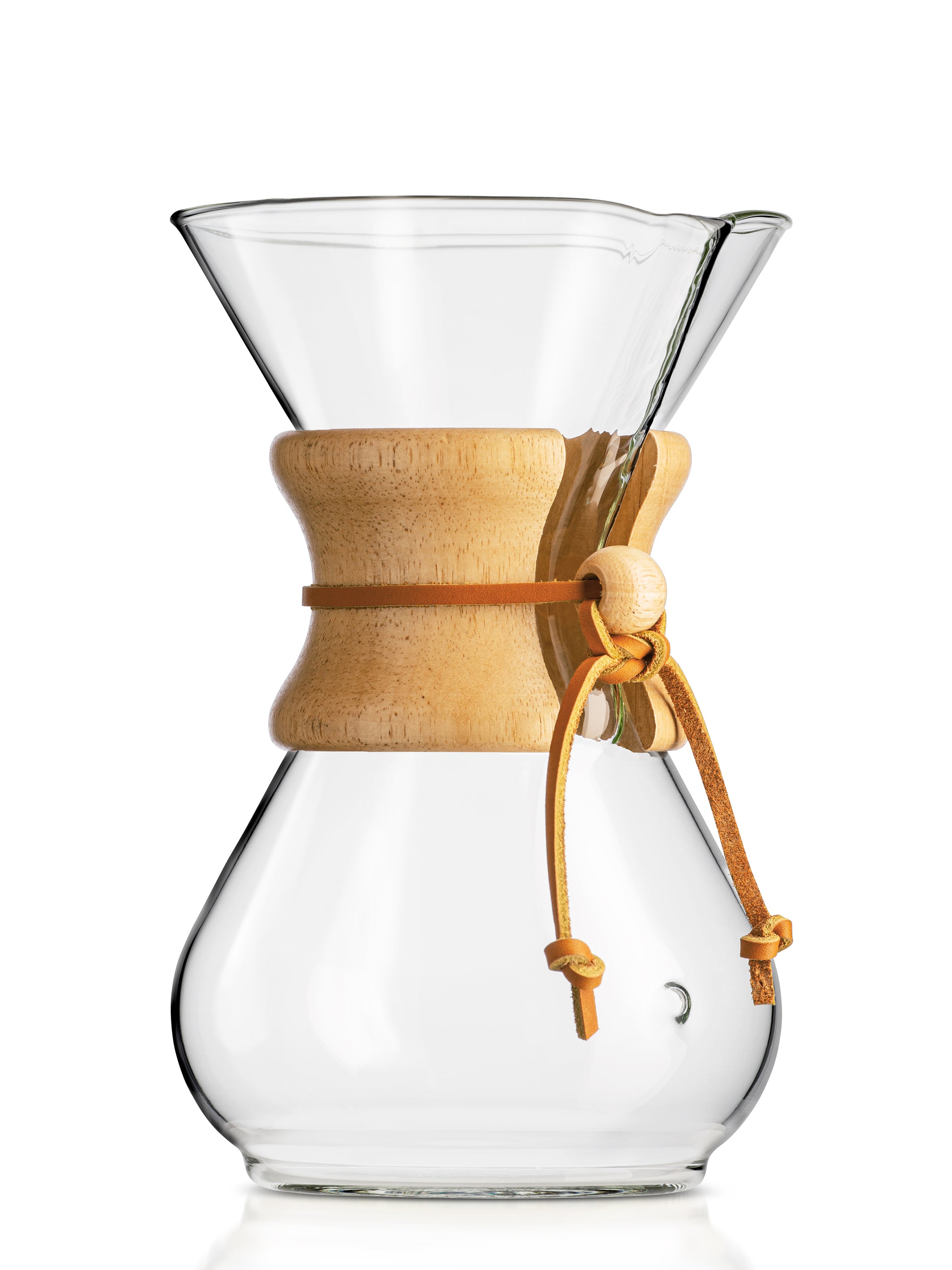
Chemex Classic 6-Cup
Best Overall: The Chemex 6-Cup Classic is the right starting point for most households — hourglass borosilicate glass with the wooden collar and leather tie, brews 850 ml (3 standard mugs), and produces a cup clarity that remains unmatched for light-roast specialty coffee. The thick proprietary filter is its defining feature and its ongoing cost.
Top picks ↓| Product | Price | Link |
|---|---|---|
| $94.50Price as of 2026-09-24 | ||
| $48.95Price as of 2026-09-24 | ||
| $55Reference price | ||
| $10Reference price | ||
| $30.25Price as of 2026-09-24 |
| Product | Capacity | Material | Filter type | Handle | Dishwasher safe | Count | Compatibility | Type | Versions | Price per filter | Cone angle | Compatible servers |
|---|---|---|---|---|---|---|---|---|---|---|---|---|
| Chemex Classic 6-Cup | 30 oz / 850 ml | Borosilicate glass | Chemex bonded (proprietary) | Wooden collar + leather tie | No (wooden collar) | — | — | — | — | — | — | — |
| Chemex Classic 8-Cup | 40 oz / 1.1 L | Borosilicate glass | Chemex bonded (proprietary) | Wooden collar + leather tie | No (wooden collar) | — | — | — | — | — | — | — |
| Chemex Glass Handle 8-Cup | 40 oz / 1.1 L | Borosilicate glass | Chemex bonded (proprietary) | Molded glass (integrated) | Yes (fully) | — | — | — | — | — | — | — |
| Chemex Bonded Filters (100-count) | — | — | — | — | — | 100 filters | All Chemex brewers | Pre-folded square or circle | White (bleached) and natural (unbleached) | ~$0.10–0.15 | — | — |
| Hario V60 02 Pour-Over | Single serve (1–2 cups) | Plastic (02 size) | V60 paper (thinner than Chemex) | — | — | — | — | — | — | — | 60° | Standard mug, Hario range server |
Top picks
Related articles

Classic hourglass design, wooden collar and leather tie, borosilicate glass. $45-55. Correct size for 1-2 person households (brews ~850 ml / 3 standard mugs). Not dishwasher-safe (wooden collar). The standard Chemex.
The Chemex 6-Cup Classic is the right starting point for most households — hourglass borosilicate glass with the wooden collar and leather tie, brews 850 ml (3 standard mugs), and produces a cup clarity that remains unmatched for light-roast specialty coffee. The thick proprietary filter is its defining feature and its ongoing cost. For 1–2 person households who want the Chemex experience without excess, this is the one.
Pros
- ✓Exceptional cup clarity — thick filter removes oils and fine sediment
- ✓Borosilicate glass handles thermal shock without cracking
- ✓850 ml capacity ideal for 1–2 person household (3 standard mugs)
Cons
- ✗Wooden collar is not dishwasher-safe — requires hand care
Score breakdown
| Capacity | 30 oz / 850 ml |
| Material | Borosilicate glass |
| Filter type | Chemex bonded (proprietary) |
| Handle | Wooden collar + leather tie |
| Dishwasher safe | No (wooden collar) |

Same Classic design, larger capacity — brews up to 1.1 L. $55-65. Best for households of 3+ people or large thermos filling. Identical brew mechanics to 6-cup; taller profile. Wooden collar — not dishwasher-safe.
The 8-Cup Classic uses identical brewing mechanics and materials as the 6-Cup but brews up to 1.1 L — enough for 4–5 standard mugs or a full thermos fill. The only meaningful difference is height; the taller carafe holds more volume below the collar without affecting extraction. If you regularly brew for 3+ people or batch-brew into a thermos, this is the correct size.
Pros
- ✓1.1 L capacity — serves 4–5 standard mugs per brew
- ✓Same borosilicate glass and brewing mechanics as the 6-Cup
- ✓Best for batch brewing into a thermos
Cons
- ✗Taller profile is slightly less stable on a crowded counter
Score breakdown
| Capacity | 40 oz / 1.1 L |
| Material | Borosilicate glass |
| Filter type | Chemex bonded (proprietary) |
| Handle | Wooden collar + leather tie |
| Dishwasher safe | No (wooden collar) |

Glass handle replaces wooden collar — fully dishwasher-safe. $55-70 (8-cup). Best if dishwasher convenience matters. Same brewing performance as Classic. Different aesthetic — more streamlined, less artisan profile.
The Glass Handle 8-Cup replaces the wooden collar with a molded glass handle — the only structural change, but a meaningful one for anyone who runs everything through the dishwasher. Brew performance is identical to the Classic; the aesthetic is more streamlined and less artisanal. If dishwasher convenience matters and you're buying the 8-Cup size anyway, the glass handle version is the practical upgrade.
Pros
- ✓Fully dishwasher-safe — no collar removal needed
- ✓Identical brewing performance to the Classic
- ✓More streamlined aesthetic — works in contemporary kitchen settings
Cons
- ✗Glass handle aesthetic is divisive — lacks the craft feel of the wooden collar
Score breakdown
| Capacity | 40 oz / 1.1 L |
| Material | Borosilicate glass |
| Filter type | Chemex bonded (proprietary) |
| Handle | Molded glass (integrated) |
| Dishwasher safe | Yes (fully) |
Subscribe to our newsletter
Occasional updates and new releases — no spam.

Proprietary thick paper filters, 100 count. $10-15. Required — not interchangeable with standard filters. Available in white (oxygen-bleached) or natural. Stock up: these are ongoing cost of Chemex ownership.
Chemex bonded filters are not interchangeable with standard basket or cone filters — the proprietary paper is 20–30% thicker, pre-folded for the Chemex neck diameter, and specifically engineered for the slower flow rate that produces Chemex's characteristic cup clarity. Buying in 100-count keeps per-filter cost manageable; available in white and natural (unbleached) — both work equally well after a proper pre-rinse.
Pros
- ✓Required for all Chemex brewers — no substitute exists
- ✓100-count pack keeps per-filter cost under $0.12
- ✓Available in white and natural unbleached versions
Cons
- ✗Ongoing cost — roughly $10–15 per 100 filters adds up with daily use
Score breakdown
| Count | 100 filters |
| Compatibility | All Chemex brewers |
| Type | Pre-folded square or circle |
| Versions | White (bleached) and natural (unbleached) |
| Price per filter | ~$0.10–0.15 |

Single-serve pour-over dripper, spiral ribs, large single hole. $25-35 (plastic). Chemex alternative with thinner filter — more body, faster flow, more technique control. Requires separate server or mug. Best for experienced brewers who prioritize extraction control.
The V60 02 is Chemex's primary alternative — a single-serve pour-over dripper with a 60° cone, spiral ribs, and a thinner filter that produces more body and faster flow than Chemex. It requires a separate server or mug (unlike Chemex's all-in-one design), and more technique-dependent pouring. For experienced brewers who want extraction control and cup body over Chemex's extreme clarity, V60 is the better choice.
Pros
- ✓More body than Chemex — thinner filter retains more oils
- ✓Faster flow rate gives more control over extraction
- ✓Plastic version at $25–35 is nearly indestructible
Cons
- ✗Requires separate server or mug — not an all-in-one vessel like Chemex
Score breakdown
| Material | Plastic (02 size) |
| Filter type | V60 paper (thinner than Chemex) |
| Cone angle | 60° |
| Capacity | Single serve (1–2 cups) |
| Compatible servers | Standard mug, Hario range server |
Which one is right for you?
For 1–2 person households
Chemex Classic 6-Cup
850 ml capacity is exactly right for two people — no excess brew, and the classic aesthetic holds up in any kitchen.
For households of 3 or more
Chemex Classic 8-Cup
1.1 L capacity covers 4–5 mugs per brew — eliminates the need to brew twice for larger groups.
For dishwasher-dependent households
Chemex Glass Handle 8-Cup
The only Chemex that's fully dishwasher-safe — no collar to remove, no hand-care routine.
For experienced pour-over brewers
Hario V60 02 Pour-Over
More technique control and cup body than Chemex — the right tool for those who want to fine-tune extraction by pour rate.
For Chemex owners stocking up
Chemex Bonded Filters (100-count)
Buy the 100-count — it's the only filter that works in a Chemex and you'll go through them faster than you expect.
How Chemex brewing works and what the thick filter actually does
Pour-over brewing: hot water is poured over ground coffee in a paper filter in a slow, controlled stream. Gravity pulls water through the grounds into a vessel below. The brew time — typically 3-4 minutes for Chemex — determines extraction level, along with grind size and water temperature. Chemex is specifically designed so the brewer and carafe are one unit: the hourglass-shaped borosilicate glass vessel is both the brewing chamber (top) and the serving carafe (bottom), separated by the wooden collar and leather tie.
The Chemex proprietary filter is the defining feature — 20-30% thicker than standard coffee filters and specifically engineered to slow water flow and remove more oils and fine sediment than V60 or AeroPress paper filters. The result is exceptional cup clarity: Chemex-brewed coffee is lighter in body, lower in bitterness, and more transparent than the same coffee brewed through a thinner filter. High-quality light-roast specialty beans with complex fruity or floral notes benefit most from Chemex filtration because clarity reveals nuance that heavier body masks.
The practical implication: Chemex requires a coarser grind and more precise pouring technique than most other pour-overs. Because the filter is thicker and flow is slower, fine grind clogs the filter and over-extracts. Medium-coarse grind (similar to French press but slightly finer) at 93-96°C, with a 30-45 second bloom pour followed by slow concentric circles, produces the characteristic Chemex cup. The brewer rewards patience and technique more than most at-home methods.
Chemex 6-cup vs 8-cup: choosing the right size
Chemex Classic 6-cup ($45-55) brews up to 30 oz (approximately 850 ml) of coffee — enough for 2-3 people depending on serving size. The 6-cup is the most common household size for 1-2 person households. The size designation ('cups') refers to 5 oz coffee cups (the standard industry convention), not 8 oz mugs — 6 Chemex cups is roughly 3 standard 10 oz mugs.
Chemex Classic 8-cup ($55-65) brews up to 40 oz (1.1 L) — enough for 3-4 people or 4-5 standard mugs. If you regularly brew for 3+ people or want the flexibility to fill a large thermos, the 8-cup is the correct size. The brew mechanics are identical; the 8-cup is simply taller with a larger carafe volume below the collar.
The Chemex with Glass Handle ($55-70, 8-cup) replaces the wooden collar and leather tie with a molded glass handle that's part of the carafe. Functionally identical to the Classic — same borosilicate glass, same filter, same brew. The glass handle is dishwasher-safe (the wooden collar is not), which matters for households that run everything through the dishwasher. Aesthetically, the glass handle has a different profile — more streamlined, less of the craft aesthetic that the wooden collar provides.
Chemex bonded filters: why you can't substitute
Chemex bonded filters ($10-15 for 100 count) are not interchangeable with standard basket coffee filters or even standard pour-over filters. The Chemex filter is pre-folded into a cone shape and sized specifically for the Chemex brewer's neck diameter. The paper is specifically engineered for the Chemex's slower flow rate — using a thinner filter in a Chemex will flow too fast and under-extract; attempting to use a basket filter will not seal properly around the neck.
Chemex offers square and circle filter variants in natural (unbleached) and white (oxygen-bleached) versions. The white filters are slightly more common and produce no additional flavor. Unbleached filters need to be pre-rinsed more thoroughly before brewing to remove papery taste. Both work equally well for brewing.
Stocking Chemex filters is an ongoing cost consideration: $10-15 per 100 filters adds up over months of daily use. AeroPress users can use reusable metal filters; Chemex users who want to reduce paper waste can purchase Able KONE or other third-party metal mesh inserts sized for Chemex, but these change the cup character significantly (more body, less clarity — approaching French press character).
Hario V60 02: Chemex's primary alternative
Hario V60 02 ($25-35 in plastic, $45-60 in ceramic or glass) is a single-serve pour-over dripper — it sits on top of a mug, carafe, or server rather than being an all-in-one brewer like Chemex. The V60's design features a large single hole at the bottom, spiral ridges inside the cone, and a 60° angle — all features that allow variable flow control, with faster flow than Chemex. V60 paper filters are thinner than Chemex filters, producing a cup with more body and slightly more oil than Chemex while still being significantly cleaner than French press.
The V60 is more technique-dependent than Chemex — the variable flow rate means pour rate and timing directly affect extraction. The same coffee brewed by two different people with different pour techniques will produce noticeably different cups. This is a feature (control) for experienced brewers and a liability (inconsistency) for beginners. V60 is the dominant format in specialty coffee cafes because skilled baristas can fine-tune extraction to a degree that Chemex's thicker filter prevents.
Chemex vs V60 decision: if you prioritize simplicity, clarity, and a single vessel that's also a serving carafe, Chemex. If you prioritize control over extraction, cup body, and brewing versatility across different roast profiles and recipes, V60. Both produce excellent specialty coffee; neither is objectively superior to the other for all use cases.
Frequently asked questions
What grind size should you use for Chemex?▼
How do you clean a Chemex?▼
What coffee works best in a Chemex?▼
Prices change. Check the retailer for the current price.
Comments & questions
Discussion happens on nattzy, our community forum. Sign in with Google to post — it takes a second.
Related articles
Food
Best Toaster 2026: 5 Compared
Best Toaster 2026: 5 Compared

Best Protein Powder 2026: 5 Compared

ConoHa WING review (2026): setup, speed and pricing
Best JP rental server 2026: 5 hosts ranked
Best LED Face Masks 2026: 3 Light Therapy Devices Compared
Best Robot Vacuums 2026: 5 Models Compared Honestly