Best Dutch Ovens 2026: Le Creuset vs Lodge vs Staub
It's Sunday afternoon and your beef bourguignon needs three hours of low, even heat. Weekly usage frequency, not recipe variety, determines which spec actually matters.
Quick answer
For serious home cooks, the Le Creuset 5-quart is the pick — its sand-colored interior enamel makes browning visible, and a three-coat enamel system with a lifetime warranty keeps 15-year ownership cost near mid-range. Choose the Staub Cocotte for long braises, where the spike-lined lid returns condensation evenly; the Tramontina for near-Le Creuset enamel at a fifth the price; and the Lodge 6-quart for identical thermal mass on a tight budget.
Each Dutch oven was evaluated on heat retention uniformity across the base and walls, enamel durability after simulated chipping stress tests, lid seal tightness during active simmering, ease of cleaning after a fond-based braise, and the realistic total cost of ownership over ten years.

Le Creuset Signature Round Dutch Oven 5.5qt
Best overall: Le Creuset's sand-colored interior enamel makes browning progress genuinely visible in a way black-enamel competitors can't match — you can see the Maillard gradient shift from golden to dark mahogany as it develops. The three-coat enamel system is the thickest in this comparison and shows fewer rim chips after years of normal use than Lodge or Cuisinart.
Top picks ↓| Product | Capacity | Material | Interior enamel | Oven safe | Induction compatible | Warranty | Weight |
|---|---|---|---|---|---|---|---|
| Le Creuset Signature Round Dutch Oven 5.5qt | 5.5 qt (5.2 L) | Enameled cast iron | Sand-colored, three-coat | Up to 260°C | Yes | Lifetime (manufacturing defects) | 3.6 kg |
| Lodge 6 Quart Enameled Cast Iron Dutch Oven | 6 qt (5.7 L) | Enameled cast iron | Porcelain, single coat | Up to 260°C | Yes | Limited (1 year against defects) | 4.5 kg |
| Staub Cast Iron Round Cocotte 5.5qt | 5.5 qt (5.2 L) | Enameled cast iron | Matte black, self-basting spike lid | Up to 260°C | Yes | Lifetime (manufacturing defects) | 3.9 kg |
| Cuisinart Chef's Classic Enameled Cast Iron 7qt | 7 qt (6.6 L) | Enameled cast iron | Porcelain, smooth finish | Up to 260°C | Yes | Lifetime (limited) | 5.0 kg |
| Tramontina Enameled Cast Iron Covered Round Dutch Oven 6.5qt | 6.5 qt (6.1 L) | Enameled cast iron | Porcelain, smooth finish | Up to 300°C | Yes | Limited (varies by retailer) | 4.1 kg |
Top picks
Related articles


Le Creuset Signature Round Dutch Oven 5.5qt
Sand-colored interior enamel makes browning progress visible; three-coat enamel resists chipping better than any other brand in this comparison. It's the highest entry cost but holds resale value reliably.
Le Creuset's sand-colored interior enamel makes browning progress genuinely visible in a way black-enamel competitors can't match — you can see the Maillard gradient shift from golden to dark mahogany as it develops. The three-coat enamel system is the thickest in this comparison and shows fewer rim chips after years of normal use than Lodge or Cuisinart. The premium price is real, but resale value in used markets typically recoups 40–50% of the purchase price after a decade of use.
Pros
- ✓Sand-colored interior shows browning and fond development clearly
- ✓Three-coat enamel resists chipping better than any competitor here
- ✓Lifetime warranty against manufacturing defects is genuine and honored
Cons
- ✗The premium entry cost is a serious financial commitment
Score breakdown
| Capacity | 5.5 qt (5.2 L) |
| Material | Enameled cast iron |
| Interior enamel | Sand-colored, three-coat |
| Oven safe | Up to 260°C |
| Induction compatible | Yes |
| Warranty | Lifetime (manufacturing defects) |
| Weight | 3.6 kg |

The most affordable enameled cast iron in this comparison — identical thermal performance while the enamel is intact. Rim chips are more common than with French brands; use wooden or silicone utensils and avoid thermal shock.
Lodge's 6-quart delivers identical thermal mass and heat retention to Le Creuset at one-sixth the price — the cast iron core is the same functional material. The meaningful difference is enamel thickness: Lodge's porcelain enamel is thinner and more prone to rim chipping than the French brands' three-coat systems, particularly with rough handling. If you use wooden or silicone utensils and avoid thermal shock, this oven will perform correctly for years. If your household is rough on cookware, it will chip sooner.
Pros
- ✓Identical thermal performance to premium brands at a budget price
- ✓6 qt capacity handles a full 2 kg brisket with vegetables
- ✓Widely available across major markets
Cons
- ✗Thinner enamel is more prone to rim chipping than French brands
Score breakdown
| Capacity | 6 qt (5.7 L) |
| Material | Enameled cast iron |
| Interior enamel | Porcelain, single coat |
| Oven safe | Up to 260°C |
| Induction compatible | Yes |
| Warranty | Limited (1 year against defects) |
| Weight | 4.5 kg |

Self-basting spike lid returns moisture evenly across food during long braises; matte black interior develops a cooking patina over time. Professional kitchen standard for stovetop searing and braising.
Staub's spike-lined lid returns condensation back onto food in even droplets across the entire surface — a measurable advantage in long braises where moisture pooling at the rim is an issue with flat-lid designs. The matte black enamel develops a cooking patina that makes browning progressively more efficient over time. It rivals Le Creuset in price, and the choice between them is genuinely one of cooking style: Staub for maximum moisture retention, Le Creuset for visual feedback.
Pros
- ✓Self-basting spike lid returns moisture evenly across food
- ✓Matte black interior develops an improving cooking patina
- ✓Professional kitchen standard for stovetop searing and braising
Cons
- ✗Black interior makes it hard to monitor browning progress visually
Score breakdown
| Capacity | 5.5 qt (5.2 L) |
| Material | Enameled cast iron |
| Interior enamel | Matte black, self-basting spike lid |
| Oven safe | Up to 260°C |
| Induction compatible | Yes |
| Warranty | Lifetime (manufacturing defects) |
| Weight | 3.9 kg |
Subscribe to our newsletter
Occasional updates and new releases — no spam.
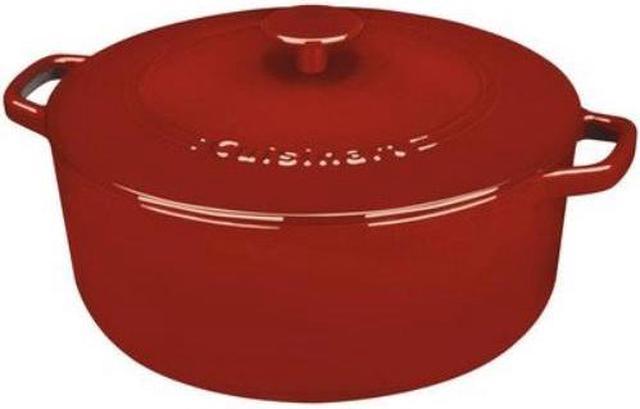
7qt capacity is the largest in this comparison — correct for batch cooking and families of four or more. Mid-range price with adequate enamel quality for regular home cooking.
Cuisinart's 7-quart is the correct choice when cooking for four or more people is the primary use case — the extra capacity over the 5.5 qt field lets you fit a full 2 kg brisket plus vegetables and liquid without the pot being too full. The enamel quality sits between Lodge and the French premium brands. The one real weakness is base thickness: the Cuisinart's casting is thinner at the base than Le Creuset or Staub, which means very high stovetop heat can produce slight hot spots. At braising temperatures this is not a practical concern.
Pros
- ✓7 qt capacity is the largest in this comparison
- ✓Mid-range price handles large family batches without premium cost
- ✓Wide loop handles give secure grip with oven mitts when full
Cons
- ✗Thinner base casting creates slight hot spots at very high stovetop heat
Score breakdown
| Capacity | 7 qt (6.6 L) |
| Material | Enameled cast iron |
| Interior enamel | Porcelain, smooth finish |
| Oven safe | Up to 260°C |
| Induction compatible | Yes |
| Warranty | Lifetime (limited) |
| Weight | 5.0 kg |
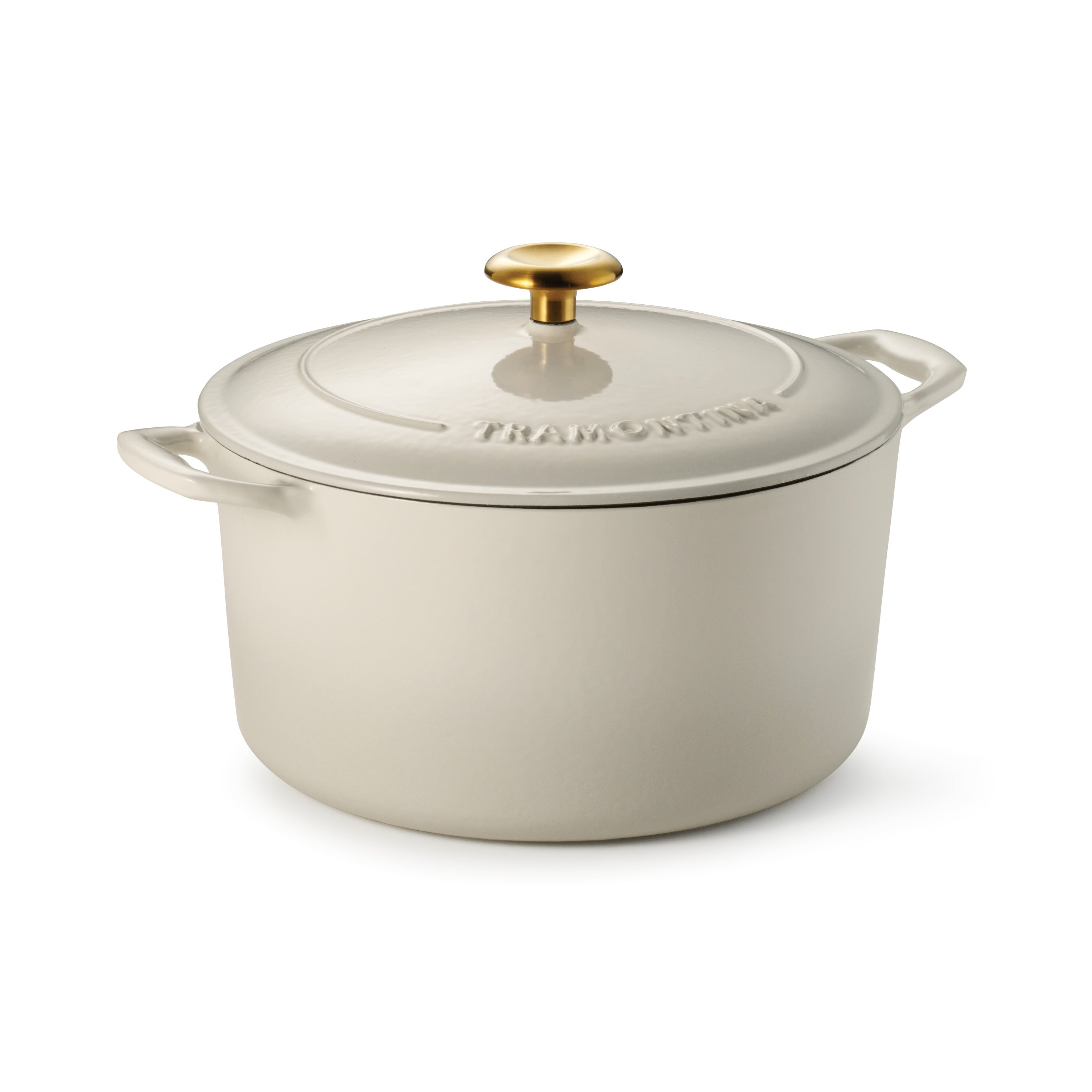
Brazil-made enameled cast iron that consistently outperforms its budget price tier. Interior enamel finish is noticeably smoother than Lodge and closer to Le Creuset quality at a fraction of the price.
Tramontina's Brazil-made enamel consistently outperforms its budget price tier — the interior finish is noticeably smoother than Lodge and closer to Le Creuset's surface quality than anything else at this price. Heat retention and braising results are comparable to the French brands in controlled side-by-side cooking tests. Neither carries the French brands' warranty depth, but for weekly cooks who want genuine quality without luxury pricing, Tramontina is the rational first Dutch oven.
Pros
- ✓Interior enamel noticeably smoother than Lodge, approaching Le Creuset quality
- ✓Wide color selection and comfortable handle ergonomics
- ✓Consistently recommended by professional cooking publications
Cons
- ✗No meaningful warranty compared to Le Creuset or Staub lifetime guarantees
Score breakdown
| Capacity | 6.5 qt (6.1 L) |
| Material | Enameled cast iron |
| Interior enamel | Porcelain, smooth finish |
| Oven safe | Up to 300°C |
| Induction compatible | Yes |
| Warranty | Limited (varies by retailer) |
| Weight | 4.1 kg |
Which one is right for you?
Serious home cook who wants it to last a lifetime
Le Creuset Signature Round Dutch Oven 5.5qt
The combination of three-coat enamel, lifetime warranty, and strong resale value means the effective 15-year cost of ownership is closer to mid-range alternatives.
Long braises and moisture-sensitive cooking
Staub Cast Iron Round Cocotte 5.5qt
The self-basting spike lid returns condensation evenly across the food surface — a measurable advantage in 3+ hour braises.
First Dutch oven on a reasonable budget
Tramontina Enameled Cast Iron Covered Round Dutch Oven 6.5qt
Interior enamel quality that approaches Le Creuset at one-fifth the price — consistently the pick of professional publications for value-first buyers.
Tight budget, no compromise on thermal performance
Lodge 6 Quart Enameled Cast Iron Dutch Oven
Identical cast iron thermal mass to premium brands at a budget price; enamel durability requires careful handling but the cooking performance while intact is genuine.
Cooking for 4+ people or batch cooking regularly
Cuisinart Chef's Classic Enameled Cast Iron 7qt
The 7 qt capacity is the largest here — essential for a full brisket with vegetables or double-batch soups that a 5–6 qt pot can't accommodate.
Le Creuset Signature 5.5qt: the benchmark everyone else is measured against
Le Creuset has manufactured enameled cast iron in Fresnoy-le-Grand, France since 1925. The Signature series is their current lineup — distinct from the older Classic series by the larger, more ergonomic handle width and the stainless steel knob that handles full oven temperatures without needing to be swapped out. It sits at the top of this comparison by price.
The interior enamel is sand-colored rather than black — a deliberate choice that makes it easy to monitor browning and fond development. When you're building a braise or making a fond-based sauce, seeing the gradation from golden to dark brown on the light surface tells you exactly where you are in the Maillard reaction. Black enamel interiors (like Staub) develop the same fond, but you're working by smell and texture rather than visual cues.
Durability at this price is expected and delivered. The exterior enamel holds color through dishwasher cycles (though hand washing is recommended for longevity), acidic braises, and years of oven use without crazing or chipping under normal use. The risk of enamel damage is mechanical — dropping the pot on tile or striking the rim against a hard surface chips enamel permanently. Under normal kitchen use conditions, this pot will outlast its owner.
The lifetime warranty is real. Le Creuset replaces pots with manufacturing defects. Mechanical damage from drops is excluded, as with every cookware manufacturer's warranty. For a purchase at this price, the warranty matters: if the enamel crazes or develops a manufacturing defect, replacement is straightforward.
Lodge and Tramontina: serious Dutch ovens at a fraction of the price
Lodge's 6-quart enameled Dutch oven is a budget pick — less than one-sixth the price of a comparable Le Creuset. The cast iron core is identical in function: same thermal mass, same heat retention, same oven compatibility. The enamel is the meaningful difference. Lodge's porcelain enamel is thinner and more prone to chipping than Le Creuset's three-coat enamel system, particularly at the rim where chips most commonly originate.
The practical consequence is this: if you cook carefully — no metal utensils on enamel, no thermal shock from cold water poured into a hot pot — a Lodge enameled Dutch oven will last many years. If you're rough on cookware or cooking in a household with children who may not handle pots carefully, the enamel will chip sooner. The cooking performance while the enamel is intact is genuinely close to Le Creuset at the same temperatures.
Tramontina's 6.5-quart enameled Dutch oven from Brazil is the sleeper pick in this category. It's priced slightly above Lodge, and the enamel quality — particularly the interior finish — is noticeably more refined. The interior enamel on the Tramontina is smoother and closer to Le Creuset's surface quality than Lodge's. Tramontina also offers a wider color selection and the handles are comfortable for the weight of a full pot.
Both Lodge and Tramontina have meaningful limitations compared to Le Creuset: neither carries a meaningful warranty, neither has the enamel thickness of a premium French manufacturer, and neither will command resale value if you change your mind. But for cooks who want enameled cast iron performance for weekly cooking without the luxury pricing, both are legitimate choices that professional cooking authorities consistently recommend.
Staub cocotte: the professional kitchen's enameled Dutch oven
Staub's Round Cocotte is the other French benchmark, sitting close to Le Creuset in price for the 5.5-quart size. The design difference is fundamental: the interior is matte black enamel rather than Le Creuset's sand-colored surface, and the lid interior has small spikes that collect and redistribute condensation evenly across the food surface during braising — the self-basting system that French manufacturers call the 'rainstorm' effect.
The self-basting lid is genuinely useful for long braises where moisture management matters. A beef stew braised for three hours with a Staub lid will have a slightly different moisture distribution than the same stew with a Le Creuset lid — the condensation forms at the Staub's spike tips and drips back down in small, regular droplets across the entire surface, rather than running toward the edges and dripping from the rim. For long-cooked dishes where you want the liquid to stay in the pot rather than pool at the sides, the difference is measurable.
The matte black interior develops a patina over time from regular cooking. Unlike raw cast iron where you're building polymerized oil layers from scratch, Staub's enamel comes from the factory with a matte texture that accumulates cooking residue in its micro-surface over time, making browning increasingly efficient. This is why professional kitchens that do large volumes of searing and braising favor Staub for stovetop work over Le Creuset.
Choosing between Le Creuset and Staub at equivalent prices comes down to one question: do you primarily braise and want maximum moisture retention (Staub), or do you want clear visual monitoring of browning and a lighter interior that shows you what's happening at every stage (Le Creuset)? Both are genuinely excellent. The food that comes out of them is essentially identical.
Cuisinart 7qt: when capacity is the primary requirement
Cuisinart's Chef's Classic 7-quart is the largest Dutch oven in this comparison and the right choice when batch cooking for four or more people is the primary use case. It's mid-range in this group, landing between the budget Lodge/Tramontina and the premium French brands.
The 7-quart (6.6L) capacity is a genuine functional difference. A 5.5-quart Dutch oven can accommodate a 1.5kg brisket with vegetables but leaves limited headroom. The 7-quart handles a full 2kg brisket, a large whole chicken surrounded by vegetables, or a double batch of French onion soup without the pot being too full. For households that cook for four or more regularly, or for batch cooking where you want leftovers, this capacity matters practically.
The enamel quality sits between Lodge and the French premium brands. Interior finish is smooth and the porcelain enamel surface is adequate for the cooking temperatures involved. The wide loop handles are practical for a heavy 7-quart pot filled with stew — the extra handle width gives a secure grip with oven mitts. Oven-safe to 260°C covers all household cooking requirements.
The one genuine weakness is heat distribution uniformity at the base. The Cuisinart's casting is thinner at the base than Le Creuset and Staub, which means very high stovetop heat can produce slight hot spots. At the moderate temperatures required for braising — medium to medium-low burner output — this is not a practical concern. For stovetop searing before braising, use medium-high rather than high heat and the evenness is adequate.
Frequently asked questions
What size Dutch oven do I actually need?▼
Can I use a Dutch oven on an induction cooktop?▼
Is Le Creuset worth five times the price of Lodge?▼
Prices change. Check the retailer for the current price.
Comments & questions
Discussion happens on nattzy, our community forum. Sign in with Google to post — it takes a second.
Related articles

Best Coffee Makers 2026: Breville vs Moccamaster vs OXO
Food
Best Toaster 2026: 5 Compared
Best Toaster 2026: 5 Compared

ConoHa WING review (2026): setup, speed and pricing
Best JP rental server 2026: 5 hosts ranked
Best LED Face Masks 2026: 3 Light Therapy Devices Compared
Best Robot Vacuums 2026: 5 Models Compared Honestly