Best Kalita Wave 2026: 185 vs 155, Steel vs Ceramic vs Glass
The Kalita Wave is a flat-bottom pour-over dripper with three small holes at the base and a proprietary wave-shaped paper filter. The grind, water temp, and ratio matter far more than which brewer you choose.
Quick answer
For most households, the Kalita Wave 185 Stainless is the pick — it will not break if dropped, retains heat better than glass, and goes in the dishwasher. The Wave 155 Ceramic is calibrated to 150-300ml so single-cup brews get a proper bed depth, the 185 Glass lets you watch bloom and channeling to diagnose technique, and the wave filters are not optional — their pleats create the air gap that makes extraction consistent.
Each dripper was evaluated on extraction consistency across varying pour techniques, material impact on heat retention, durability, ease of cleaning, and suitability for both beginner and experienced brewers.
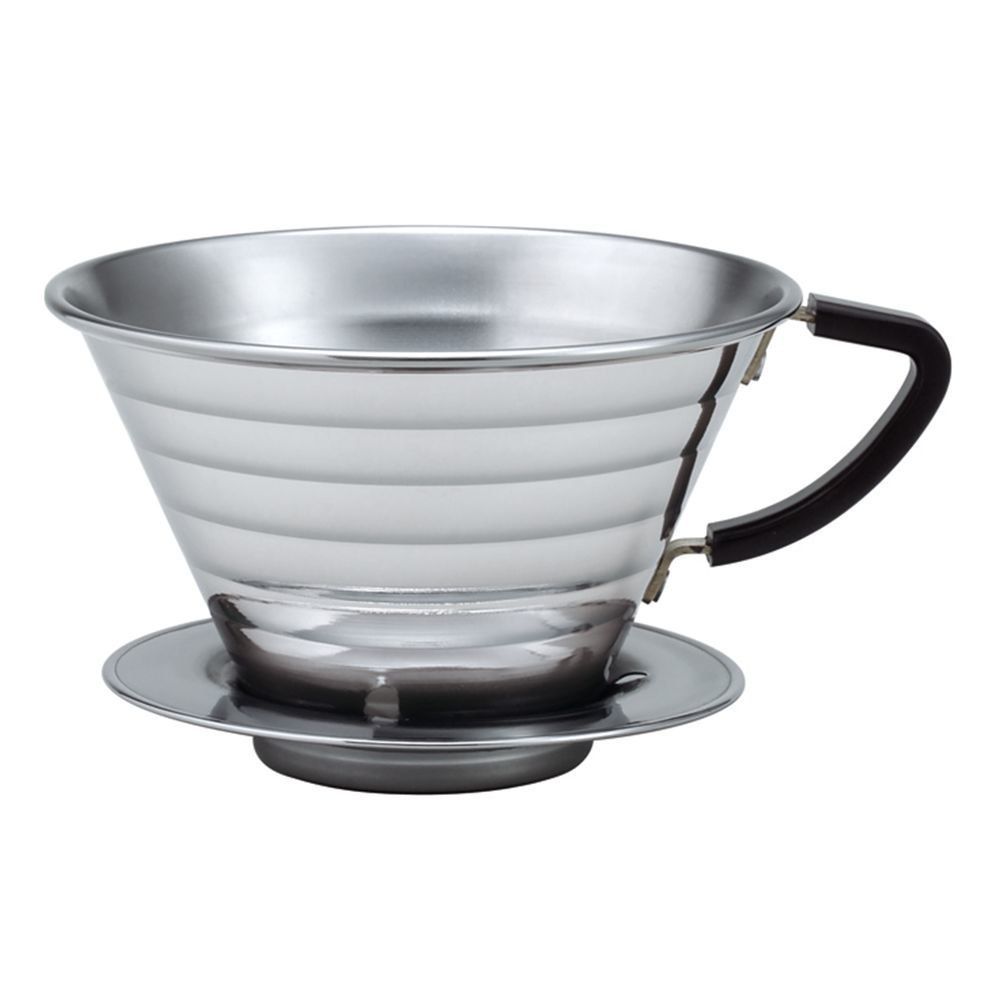
Kalita Wave 185 Stainless Dripper
Best Overall: The Wave 185 Stainless is the right Kalita for most households — stainless steel won't break if it falls, retains heat better than glass, and goes in the dishwasher. The 2–4 cup capacity covers single servings through small gatherings.
Top picks ↓| Product | Price | Link |
|---|---|---|
| $40Reference price | ||
| $35Reference price | ||
| $45Reference price | ||
| $10Reference price | ||
| $199.95Price as of 2026-09-24 |
| Product | Material | Capacity | Filter size | Dishwasher safe | Weight | Origin | Size | Count | Rinse required | Compatible | Price per filter | Temperature range | Hold duration | Spout | Display | Cord |
|---|---|---|---|---|---|---|---|---|---|---|---|---|---|---|---|---|
| Kalita Wave 185 Stainless Dripper | Stainless steel | 2–4 cups (400–700 ml) | Wave 185 | Yes | ~110 g | Japan | — | — | — | — | — | — | — | — | — | — |
| Kalita Wave 155 Ceramic | Ceramic | 1–2 cups (150–300 ml) | Wave 155 | Yes (hand wash recommended) | ~200 g | Japan | — | — | — | — | — | — | — | — | — | — |
| Kalita Wave 185 Glass | Borosilicate glass | 2–4 cups (400–700 ml) | Wave 185 | No | ~150 g | Japan | — | — | — | — | — | — | — | — | — | — |
| Kalita Wave Filters 185 | Paper | — | — | — | — | — | 185 (for Wave 185 dripper) | 100 per box | Yes (recommended) | Wave 185 only | ~$0.10–0.15 | — | — | — | — | — |
| Fellow Stagg EKG Electric Pour-Over Kettle | — | 0.9 L | — | — | — | — | — | — | — | — | — | 57–100°C | 60 min | Gooseneck | LCD temperature | 360° swivel base |
Top picks
Related articles


Stainless steel, 2-4 cup capacity, dishwasher safe. $40-55. Most durable Wave — no breakage risk, travel-friendly, good heat retention. Correct for most households. Slight metallic taste when new that fades after a few uses.
The Wave 185 Stainless is the right Kalita for most households — stainless steel won't break if it falls, retains heat better than glass, and goes in the dishwasher. The 2–4 cup capacity covers single servings through small gatherings. Some users notice a faint metallic taste with new units that disappears after a few uses; a few rinse-cycles with hot water resolves it. For daily pour-over brewing where durability and convenience matter more than visual display, this is the unambiguous recommendation.
Pros
- ✓Unbreakable stainless construction — no fragility concern
- ✓Dishwasher safe for easy cleaning
- ✓Good heat retention compared to glass
Cons
- ✗New units can impart faint metallic taste that requires a few initial uses to dissipate
Score breakdown
| Material | Stainless steel |
| Capacity | 2–4 cups (400–700 ml) |
| Filter size | Wave 185 |
| Dishwasher safe | Yes |
| Weight | ~110 g |
| Origin | Japan |
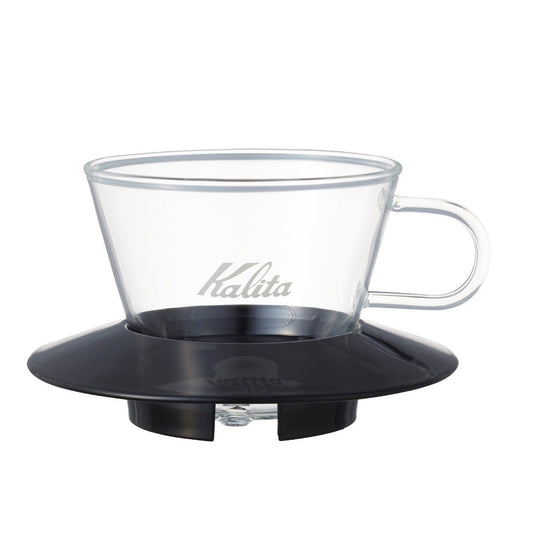
Ceramic, single-serve 1-2 cup capacity, good heat retention. $35-50. Best single-serve Wave — ceramic provides clean flavor, no metallic taste. More fragile than stainless. Travel/office single-cup use or households where 1 cup at a time is standard.
The Wave 155 Ceramic is purpose-sized for one cup — the smaller flat bed and finer three-hole drainage are calibrated to 150–300 ml volumes where the 185 would produce a thin, under-extracted bed. Ceramic provides clean flavor with no metallic transfer, and heat retention is solid for a single serve. The trade-off is fragility — ceramic will break on a hard floor, and it's heavier than you'd expect for a single-cup brewer. For a dedicated single-cup morning ritual, the 155 ceramic produces the cleanest cup in this comparison.
Pros
- ✓Optimized bed depth for 1-cup volumes — better extraction than 185 for single servings
- ✓Ceramic delivers clean flavor with zero metallic notes
- ✓Dense feel adds a satisfying tactile quality to the pour-over ritual
Cons
- ✗Fragile — will shatter if dropped on a hard surface
Score breakdown
| Material | Ceramic |
| Capacity | 1–2 cups (150–300 ml) |
| Filter size | Wave 155 |
| Dishwasher safe | Yes (hand wash recommended) |
| Weight | ~200 g |
| Origin | Japan |
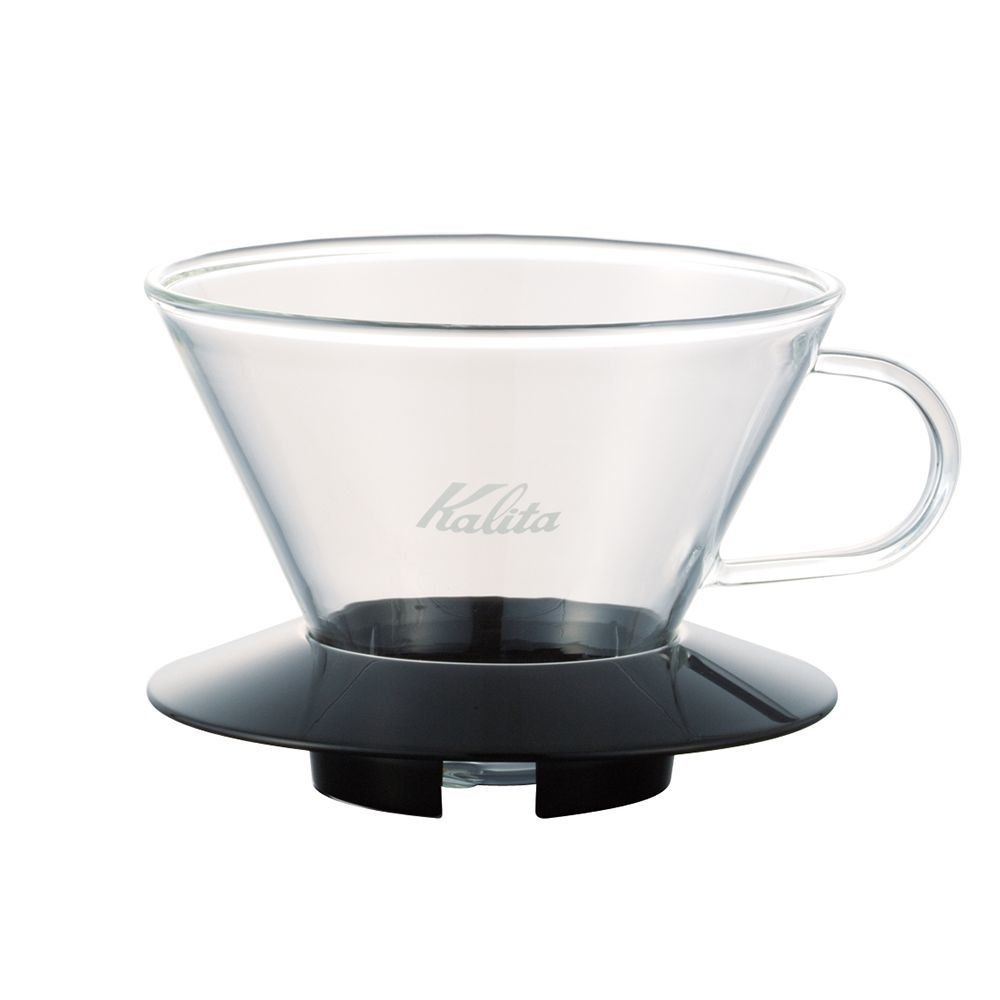
Borosilicate glass, 2-4 cup capacity, transparent. $45-60. Best for visual learners — watch bloom, observe extraction, see channeling. Less heat retention than ceramic or stainless (pre-heat the dripper). Most fragile option.
The transparent borosilicate glass lets you watch every stage of the brew — the bloom expansion, water distribution across the coffee bed, and whether channeling is occurring. For brewers who are learning pour-over technique or diagnosing extraction problems, the visual feedback is genuinely useful. Heat retention is lower than ceramic or stainless, so pre-heating the dripper with hot water before brewing matters more here than with other materials. Most fragile option in the comparison.
Pros
- ✓Transparent — observe bloom, water distribution, and channeling in real time
- ✓Borosilicate glass is heat-resistant and flavor-neutral
- ✓Unique visual experience that makes the pour-over ritual more engaging
Cons
- ✗Lower heat retention than stainless or ceramic — pre-heating is essential
- ✗Most fragile option — one drop on a hard surface ends it
Score breakdown
| Material | Borosilicate glass |
| Capacity | 2–4 cups (400–700 ml) |
| Filter size | Wave 185 |
| Dishwasher safe | No |
| Weight | ~150 g |
| Origin | Japan |
Subscribe to our newsletter
Occasional updates and new releases — no spam.
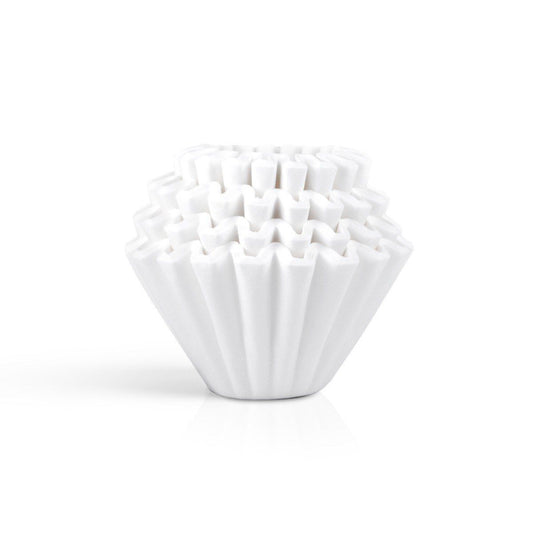
Wave-shaped pleated paper filters for Wave 185. ~$10-15 per 100 count. Required — not interchangeable with other drippers. Stock up. Creates air gap between filter and dripper walls, enabling even extraction.
Kalita Wave filters are not optional — the wave-shaped pleated design creates the air gap between filter and dripper that makes consistent extraction possible. Standard flat filters will not fit or replicate this function. At $10–15 per 100 count, the cost is modest, but the Wave 185 and Wave 155 filters are not interchangeable, so buying the correct size matters. Stock enough to avoid running out mid-week; specialty coffee retailers carry them but coverage is thinner than V60 or Chemex filters.
Pros
- ✓Wave-shaped pleats create air gap essential for even extraction
- ✓100-count boxes represent modest per-filter cost
- ✓Consistent paper quality and availability on Amazon
Cons
- ✗Not interchangeable with Wave 155 filters or any other dripper — must buy the correct size
Score breakdown
| Size | 185 (for Wave 185 dripper) |
| Count | 100 per box |
| Material | Paper |
| Rinse required | Yes (recommended) |
| Compatible | Wave 185 only |
| Price per filter | ~$0.10–0.15 |

Fellow Stagg EKG Electric Pour-Over Kettle
Gooseneck spout, variable temperature 57-100°C, hold function, 0.9 L. $150-170. Best pour-over kettle — precise flow control, exact temperature setting, 60-min hold. Correct pairing for Kalita Wave, V60, and Chemex.
The Fellow Stagg EKG is the standard recommendation for pour-over kettles because the gooseneck spout gives fine control over flow rate — from a thread-thin trickle to a wider stream by adjusting the tilt — which directly affects extraction. Variable temperature from 57°C to 100°C with a 60-minute hold means you can set 93°C for a light roast and it stays there through your entire brew session. The $150–170 price is real, and a simpler gooseneck kettle with temperature control is available for less; but the Stagg EKG's pour control and temperature precision are the best in the consumer market.
Pros
- ✓Gooseneck spout enables pour rate control that standard kettles cannot replicate
- ✓Variable temperature with 60-minute hold eliminates timing guesswork
- ✓Purpose-built for pour-over — the complete workflow solution
Cons
- ✗$150–170 is a premium price; adequate alternatives available for less
Score breakdown
| Capacity | 0.9 L |
| Temperature range | 57–100°C |
| Hold duration | 60 min |
| Spout | Gooseneck |
| Display | LCD temperature |
| Cord | 360° swivel base |
Which one is right for you?
For most households
Kalita Wave 185 Stainless Dripper
Durable, dishwasher-safe, and good heat retention — the practical default for daily pour-over brewing.
For single-cup morning brewers
Kalita Wave 155 Ceramic
The 155 size produces a proper bed depth for one-cup volumes — better extraction than using the 185 for small amounts.
For technique learners
Kalita Wave 185 Glass
Transparent glass shows bloom, water distribution, and channeling in real time — the best tool for diagnosing and improving your pour-over.
For precise temperature control
Fellow Stagg EKG Electric Pour-Over Kettle
Variable temperature with 60-minute hold and gooseneck pour control — the correct kettle pairing for any Kalita Wave.
For Wave 185 filter supply
Kalita Wave Filters 185
The proprietary wave-shaped filter is non-negotiable — stock up so you're never without the correct consumable.
How the Kalita Wave's flat bottom changes extraction
V60 pour-over: conical shape funnels all water toward a single large exit hole. Water flow rate is determined almost entirely by grind size and pour speed — small changes in either create large changes in extraction. This control is valuable for experienced brewers who want to dial in specific flavor profiles, but it makes the V60 unforgiving for inconsistent pouring technique.
Kalita Wave flat bottom: water pools slightly on the flat base before draining through three small holes. This pooling action creates a more even extraction across the entire coffee bed — water contacts all grounds equally rather than concentrating toward the center. The wave-shaped filter (with its pleated ridges) also creates a small air gap between the filter and the dripper walls, preventing the filter from collapsing onto the dripper and blocking flow. The result: more consistent extraction with less precision required in pour rate and technique.
The trade-off: the Kalita Wave is slightly less controllable than V60 for experienced brewers who want to actively manipulate flow rate for different flavor outcomes. The multi-hole system evens extraction by design, which means some of the fine-tuning that V60 allows isn't available. For most home brewers making one to four cups, the Wave's forgiving nature produces better daily results than the V60's control ceiling — you have to be very good to realize the V60's advantages, but the Wave's advantages are accessible to everyone.
Kalita Wave 185 vs 155: choosing the right size
Kalita Wave 185 is the larger dripper, designed for brewing 2-4 cups (400-700 ml). The 185 designation refers to the filter size. This is the most common household size and the correct choice for households that regularly brew for 2 or more people. The wider flat bottom provides a larger coffee bed surface area, which contributes to the even extraction the Wave is known for.
Kalita Wave 155 is the smaller dripper for single-serve brewing (1-2 cups, 150-300 ml). The filter size is 155. For household use where you're making exactly one cup each time, the 155 produces better extraction because the coffee bed thickness is more appropriate for the volume — a small amount of coffee in a 185 creates a thin, uneven bed. For travel or office single-cup use, the 155 is also more portable.
Practical recommendation: if you ever brew for two people or want the option to make a larger serve, buy the 185. If you exclusively make single cups and want a compact dripper, buy the 155. Both use different proprietary filters — they're not interchangeable.
Stainless vs ceramic vs glass: material comparison
Kalita Wave 185 Stainless ($40-55) is the most durable and travel-friendly version — stainless steel doesn't break, retains heat better than glass, and is dishwasher safe. Some reviewers report a slight metallic taste with new stainless drippers that disappears after a few uses. The stainless version is the practical choice for home use where durability and easy cleaning matter.
Kalita Wave 155 Ceramic ($35-50) is the most popular single-serve option. Ceramic has good heat retention and no flavor transfer. The ceramic material is heavier than stainless or glass and more fragile (it will break if dropped on a hard surface). The aesthetic is clean and minimal — ceramic has a particular visual appeal for the pour-over ritual.
Kalita Wave 185 Glass ($45-60) uses heat-resistant borosilicate glass for a transparent brewing window. You can watch the coffee bed bloom, observe channeling, and see water distribution as you pour — useful for learning technique and diagnosing extraction issues. The glass material absorbs less heat than ceramic, so pre-heating the dripper is important. The glass version is the least durable but the most visually interesting.
Fellow Stagg EKG: the gooseneck kettle for pour-over
Fellow Stagg EKG Electric Kettle ($150-170) is purpose-built for pour-over coffee — a precise gooseneck spout for controlled water flow, variable temperature control (from 135°F to 212°F / 57°C to 100°C), hold temperature function (maintains target temperature for up to 60 minutes), and 0.9 L capacity. The Stagg EKG is the standard kettle recommendation for Kalita Wave, V60, and Chemex brewing.
The gooseneck spout design allows pour control that a standard kettle cannot replicate. Pour-over brewing requires pouring water in a slow, circular motion at a controlled flow rate — a straight-spout kettle dumps too much water too quickly. With a gooseneck kettle, you can pour as slowly as a thin thread or as fast as a wide stream by tilting the kettle. This level of control directly affects extraction.
Variable temperature matters: different roasts extract optimally at different temperatures. Light roasts typically brew well at 93-96°C; medium roasts at 88-93°C; dark roasts at 80-88°C (to avoid harshness). A kettle that only boils and then cools requires timing to hit the right temperature window. Variable temperature kettles allow you to set and hold the exact temperature, eliminating a variable from your brew process.
Frequently asked questions
How do you brew with a Kalita Wave?▼
Do Kalita Wave filters work in other drippers?▼
Kalita Wave vs Hario V60: which is better for beginners?▼
Prices change. Check the retailer for the current price.
Comments & questions
Discussion happens on nattzy, our community forum. Sign in with Google to post — it takes a second.
Related articles
Best Air Fryer 2026: 5 Models Compared Honestly

Best Coffee Makers 2026: Breville vs Moccamaster vs OXO

ConoHa WING review (2026): setup, speed and pricing
Best JP rental server 2026: 5 hosts ranked
Best LED Face Masks 2026: 3 Light Therapy Devices Compared
Best Robot Vacuums 2026: 5 Models Compared Honestly