Best Pour-Over Coffee Kit 2026: 5 Compared
Five pour-over coffee drippers — Hario V60 Ceramic 02, Chemex Classic 6-Cup, Kalita Wave 185 Stainless, Bodum Pour Over with Permanent Filter, and Fellow Stagg [X] Set — compared on filter type, brew capacity, extraction character and how much technique each one demands. The grind, water temp, and ratio matter far more than which brewer you choose.
Quick answer
The Kalita Wave 185 Stainless is the best daily brewer for most people: its flat bottom with three small holes forgives imprecise pouring, it survives drops that would break ceramic, and it produces a rounder, more consistent cup than a cone. Choose the Hario V60 Ceramic 02 if you want the reference standard with the largest recipe library and bright, high-clarity extraction. The Chemex is the one to buy when you brew for three or four people and want the cleanest, lightest-bodied cup.
Each dripper was assessed on filter geometry and extraction character, brew capacity relative to stated serving size, skill ceiling and forgiveness of technique errors, paper filter availability and annual cost, and cleanup burden over daily use.

Hario V60 Ceramic Dripper 02
Best Overall: The Hario V60 Ceramic 02 is the global reference standard for pour-over — the tool specialty coffee uses as a baseline. Spiral ribs run the full cone height for even drainage; the large single apex opening drains fast for bright, clear extraction.
Top picks ↓| Product | Price | Link |
|---|---|---|
| $23.90Price as of 2026-09-24 | ||
| $48.95Price as of 2026-09-24 | ||
| $40Reference price | ||
| — | ||
| — |
| Product | Filter type | Dripper shape | Material | Capacity | Paper filter cost | Price | Included | Valve modes |
|---|---|---|---|---|---|---|---|---|
| Hario V60 Ceramic Dripper 02 | Hario V60 tabbed paper (tabless also compatible) | 60° cone | Ceramic | 1–4 cups (~480ml max) | Low (per 100 filters) | Budget | — | — |
| Chemex Classic Series 6-Cup | Chemex-specific bonded paper | Chimney | Borosilicate glass | Up to 900ml (6-cup model) | High (per 100 filters) | Mid-range | — | — |
| Kalita Wave 185 Stainless Dripper | Kalita Wave ripple paper (185 size) | Flat-bottom, 3-hole | Stainless steel | 2–4 cups | Moderate (per 100 filters) | Mid-range | — | — |
| Bodum Pour Over Coffee Maker with Permanent Filter | Permanent stainless mesh | Cone | Stainless steel frame + borosilicate glass carafe | 1–2 cups | None | Entry-level | — | — |
| Fellow Stagg [X] Pour-Over Set | V60 02-compatible cone paper | Steep-and-release cone with base valve | Stainless steel dripper + kettle | — | — | Premium (set) | Dripper + gooseneck kettle | Open pour-over + immersion steep-and-release |
Top picks
Related articles

Global reference-standard pour-over — budget-friendly, ceramic body holds heat well, spiral ribs ensure even drainage, produces the clearest origin-character cup in this comparison. High skill ceiling: technique errors show directly in the cup. V60 02 filters are widely available and inexpensive.
The Hario V60 Ceramic 02 is the global reference standard for pour-over — the tool specialty coffee uses as a baseline. Spiral ribs run the full cone height for even drainage; the large single apex opening drains fast for bright, clear extraction. Ceramic holds heat significantly better than plastic versions, and its budget-friendly price makes getting started low-risk. The honest trade-off: fast drainage amplifies technique errors — an inconsistent pour shows directly in the cup, which takes 1–2 weeks of practice to master.
Pros
- ✓Global reference standard — largest tutorial and recipe library of any dripper
- ✓Ceramic body holds heat significantly better than plastic
- ✓Bright, high-clarity extraction that expresses single-origin character
Cons
- ✗High skill ceiling — technique errors show directly in the cup; ceramic can chip
Score breakdown
| Filter type | Hario V60 tabbed paper (tabless also compatible) |
| Dripper shape | 60° cone |
| Material | Ceramic |
| Capacity | 1–4 cups (~480ml max) |
| Paper filter cost | Low (per 100 filters) |
| Price | Budget |

Batch pour-over and design object — mid-range, brews 3-4 full mugs in one batch, borosilicate glass brewer and server in one. Chemex's thick bonded paper filters produce the lightest, cleanest cup here. Glass carafe is not insulated; Chemex-specific filters cost more and are harder to find locally.
The Chemex brews and serves in one borosilicate glass vessel — up to 900ml per batch (3–4 full mugs). Its thick bonded paper filter produces the lightest, cleanest cup in this comparison: almost zero body, striking clarity, and high transparency on acidity and aroma. The design has been in MoMA's collection since 1943. Chemex-specific filters cost more and are harder to find locally; the glass carafe drops to below drinking temperature within 10–12 minutes if you don't pour immediately.
Pros
- ✓Brews and serves up to 900ml (3–4 mugs) in a single vessel
- ✓Thickest bonded paper filter — cleanest, lightest-bodied cup in this comparison
- ✓Iconic design doubles as a countertop object
Cons
- ✗Chemex-specific filters cost more and are less available; glass carafe not insulated
Score breakdown
| Filter type | Chemex-specific bonded paper |
| Dripper shape | Chimney |
| Material | Borosilicate glass |
| Capacity | Up to 900ml (6-cup model) |
| Paper filter cost | High (per 100 filters) |
| Price | Mid-range |
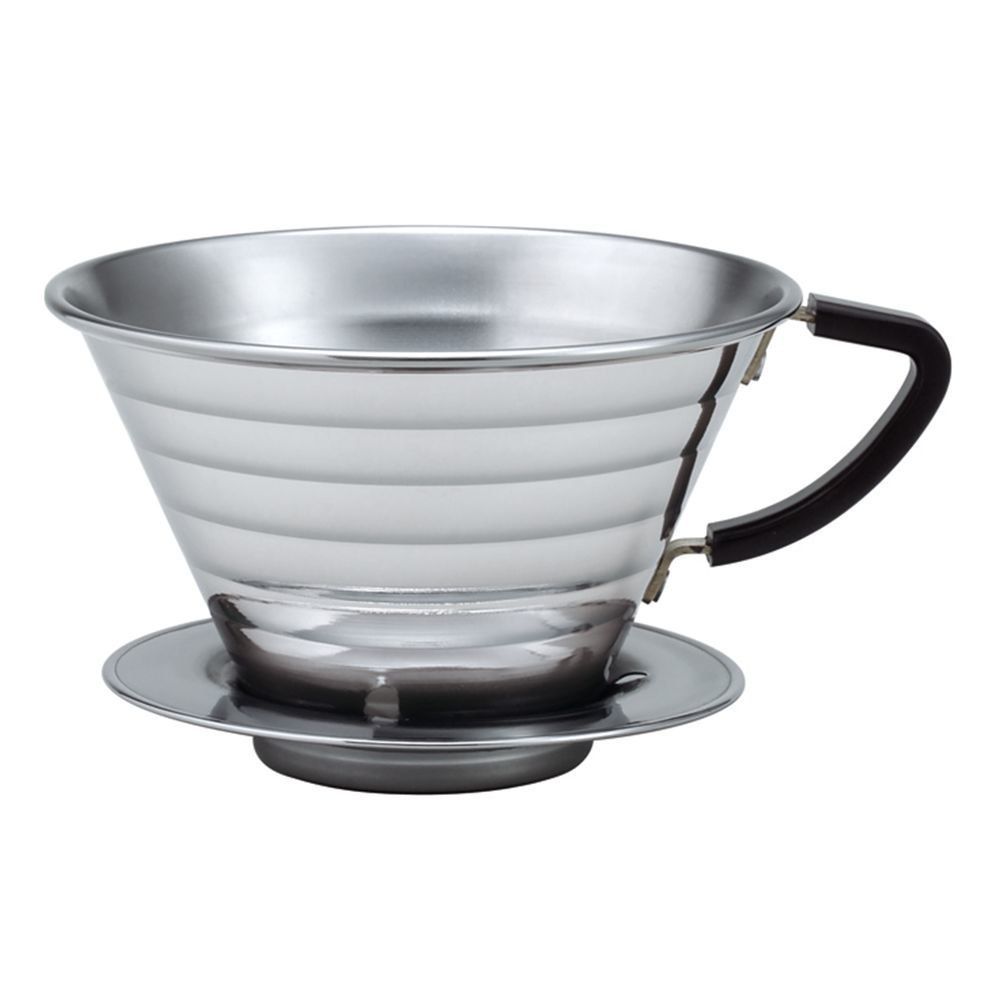
Forgiving flat-bottom daily driver — mid-range, stainless steel survives drops, three-hole drainage produces even extraction that absorbs pour inconsistencies. Fuller body than V60; Wave-specific ripple papers required; three holes need periodic cleaning to stay clear.
The Kalita Wave 185's flat-bottom with three small holes evens out flow rate and absorbs pour inconsistencies that would ruin a V60 cup. Stainless steel survives drops that would shatter ceramic or glass. The result is a fuller-bodied, rounder cup than the V60 with noticeably more cup-to-cup consistency for less exacting brewers. Wave-specific ripple papers are required; the three holes need periodic cleaning with a brush or toothpick.
Pros
- ✓Flat-bottom geometry forgives imprecise pouring — most consistent daily results
- ✓Stainless steel survives drops unlike ceramic V60 or glass Chemex
- ✓Fuller-bodied, rounder extraction than cone drippers
Cons
- ✗Wave-specific ripple papers required; three holes need periodic cleaning
Score breakdown
| Filter type | Kalita Wave ripple paper (185 size) |
| Dripper shape | Flat-bottom, 3-hole |
| Material | Stainless steel |
| Capacity | 2–4 cups |
| Paper filter cost | Moderate (per 100 filters) |
| Price | Mid-range |
Subscribe to our newsletter
Occasional updates and new releases — no spam.

Zero-paper-cost metal filter option — entry-level, stainless mesh passes coffee oils for French-press-adjacent body. No paper filter running cost. Mesh needs immediate post-brew rinse to prevent grounds drying in the holes; glass carafe will break on impact.
The Bodum's stainless mesh permanent filter passes coffee oils into the cup — richer body, French-press-adjacent mouthfeel, zero paper filter running cost. The cone frame sits on most mugs and eliminates any consumable expense. The mesh requires an immediate post-brew rinse before grounds dry into the holes, and the glass carafe will break on a hard drop. Best for drinkers who prefer heavier-bodied cups and want to eliminate paper costs.
Pros
- ✓Permanent stainless mesh filter — zero paper filter running cost
- ✓Passes coffee oils for richer, French-press-adjacent body
- ✓Low entry-level price
Cons
- ✗Mesh must be rinsed immediately after use; glass carafe breaks on impact
Score breakdown
| Filter type | Permanent stainless mesh |
| Dripper shape | Cone |
| Material | Stainless steel frame + borosilicate glass carafe |
| Capacity | 1–2 cups |
| Paper filter cost | None |
| Price | Entry-level |
![Fellow Stagg [X] Pour-Over Set](https://m.media-amazon.com/images/I/51pSk04+X0L._AC_SL1190_.jpg)
Complete pour-over starter kit with steep-and-release valve — premium-priced set including gooseneck kettle. Steep-and-release mode is the most beginner-forgiving extraction in this comparison. Price is 8-10x the Hario V60; valve adds a decision point per brew session.
The Fellow Stagg [X] set includes a cone dripper with a steep-and-release base valve and a gooseneck kettle — the most beginner-forgiving extraction method in this comparison when used in immersion (valve-closed) mode, and the most complete out-of-box setup. Compatible with standard V60 02 cone papers. The valve adds one decision point per brew; the premium-priced set costs 8–10x the Hario V60 Ceramic.
Pros
- ✓Complete set: dripper + gooseneck kettle in one purchase
- ✓Steep-and-release valve mode is the most forgiving method in this comparison
- ✓Uses standard V60 02 cone papers — widely available
Cons
- ✗The set is 8–10x the cost of the V60 ceramic alone
Score breakdown
| Filter type | V60 02-compatible cone paper |
| Dripper shape | Steep-and-release cone with base valve |
| Material | Stainless steel dripper + kettle |
| Included | Dripper + gooseneck kettle |
| Valve modes | Open pour-over + immersion steep-and-release |
| Price | Premium (set) |
Which one is right for you?
For specialty coffee enthusiasts
Hario V60 Ceramic Dripper 02
The global reference dripper — the low price makes getting started low-risk, and the skill ceiling is what separates origin character from a flat cup.
For households brewing 3–4 cups at once
Chemex Classic Series 6-Cup
Brews and serves 900ml (3–4 full mugs) in one vessel with the cleanest, lightest-bodied cup in this comparison.
For busy daily brewers who want consistent results
Kalita Wave 185 Stainless Dripper
The flat-bottom geometry forgives an imprecise pour and the stainless body survives drops — more consistency with less daily discipline.
For complete beginner setups
Fellow Stagg [X] Pour-Over Set
Includes the dripper and gooseneck kettle in one purchase; the steep-and-release mode is the most forgiving method in this comparison for new pour-over brewers.
What separates one pour-over dripper from another
Pour-over drippers look like simple pieces of ceramic, glass, or stainless, and the marketing implies that any cone or flat-bottomed shape will produce café-grade coffee if you pour slowly enough. The actual variables are more specific. Filter geometry — cone versus flat-bottom versus chimney — determines how the water flows through the coffee bed, where it channels, and whether the extraction is even or not. A cone dripper (V60, Chemex) concentrates flow toward the center point, producing faster drainage, cleaner mouthfeel, and higher sensitivity to grind size. A flat-bottom dripper (Kalita Wave) spreads the bed across a flat surface with multiple small holes, evening out flow rate and making the extraction more forgiving of grind inconsistency. The difference is not subtle for a brewer paying attention: the same coffee, same grind, same pour technique will produce a lighter, brighter cup in a V60 and a fuller, more rounded cup in a Kalita Wave.
Filter type adds another layer. Paper filters — whether Hario's tabbed V60 filters, Chemex's thick bonded paper, or Kalita's wave-shaped papers — absorb most of the coffee oils, including the diterpenes cafestol and kahweol that influence mouthfeel and, in long-term daily consumption, cholesterol levels slightly. Metal or cloth filters (Bodum's stainless mesh, cloth alternatives) pass these oils into the cup, producing a heavier, fuller-bodied brew that sits between paper pour-over and French press in mouthfeel. This is not a quality difference — it is a style preference — but it matters for buyers with dietary or flavour reasons to care.
Brew capacity is stated in cups but 'cup' means different things across brands. Hario's V60 02 is rated for 1-4 cups at roughly 120 ml each (Hario's standard 'cup' is smaller than a mug). Chemex's 6-Cup is rated for up to 900 ml using Chemex's scale where 1 cup equals 150 ml. Kalita Wave 185 is rated for 2-4 cups. In practice: Hario V60 02 produces a generous mug for one person or two small cups; Chemex 6-Cup produces 3-4 full mugs (around 200 ml each) and is the batch option in this comparison; Kalita Wave 185 is similar to V60 in real yield. Buyers expecting to brew a pot for the morning and have cups waiting should buy the Chemex. Buyers brewing one cup at a time should choose V60, Kalita, Bodum, or Fellow Stagg [X] based on flavour preference and cleanup tolerance.
How we compared
Each dripper is evaluated on five criteria. First, extraction character — the flavour profile the filter type and geometry reliably produce, based on the physics of flow rate, extraction time, and filter material. This is the most honest criterion available without a refractometer lab: the V60's thin cone filter and single large drainage spiral produce fast, high-clarity brews; the Chemex's thick bonded paper filter and chimney shape produce an ultra-clean, wine-like cup with near-zero body; the Kalita Wave's flat bed and three small holes produce even, forgiving extraction with more body than the V60; the Bodum's stainless mesh filter produces a French-press-adjacent full body; the Fellow Stagg [X]'s flow restrictor and steep-and-release mechanism add control that other drippers do not offer.
Second, paper filter cost for daily use. Hario V60 02 filters are sold in inexpensive 100-packs, so the per-year cost at one filter per day is modest. Chemex filters (Chemex-specific square-fold papers) cost noticeably more per 100, making them the most expensive consumable in this comparison. Kalita Wave 185 papers sit between the two. Bodum and Fellow Stagg [X] use reusable filters or included permanent filters, so paper cost is zero or near-zero — relevant for daily brewers tracking consumable costs. Third, cleanup friction — the number of steps and time required after each brew session. Fourth, skill ceiling — how much the dripper amplifies or forgives technique errors. Fifth, durability and failure modes — ceramic chips, glass breaks, stainless warps.
We did not blind-taste coffee from each dripper under controlled conditions. Blind tasting without controlling for water temperature, grind size, and dose weight produces noise, not signal. The flavour profiles described here are sourced from the brew chemistry of each dripper's geometry and filter material, backed by the consistent patterns in barista-community reviews. We cross-referenced long-term owner reviews as of May 2026 for usability, durability, and cleaning comments, reading several hundred comments per dripper where available.
Where each fits
If you want the global reference-standard pour-over with maximum transparency and the full skill ceiling of manual brewing, the budget-friendly Hario V60 Ceramic Dripper 02 is the starting point for almost every serious hand-pour brewer. The V60 02 uses Hario's proprietary 01-degree spiral ribs that run the full height of the cone interior, creating an air gap between the paper filter and the ceramic wall that allows even water drainage without suction. The single large opening at the apex drains fast: a typical 20 g dose / 300 ml brew will drain in 2.5-3.5 minutes with medium grind, producing a cup with clear fruit or floral notes from lighter-roast specialty beans and a clean sweetness that filter paper achieves by removing the oils responsible for heavier mouthfeel. The ceramic body holds heat well (significantly better than plastic versions), preheating with a rinse pour reduces heat loss to under 2°C for the duration of a 3-minute brew. Cleanup is one step: discard the filter with grounds, rinse the ceramic briefly. The honest weakness is structural and immediate: the V60 rewards a precise pour. The fast drainage means that an inconsistent pour — irregular flow rate, pouring directly on the edges of the filter rather than the coffee, failing to maintain a steady spiral — produces uneven extraction that shows up in the cup as a mix of over-extracted bitter notes and under-extracted sour notes from the same grounds. For specialty single-origin beans with distinct fruit character, the V60 is the best option in this comparison at any price. For a beginner who pours inconsistently or a daily drip drinker who wants a decent cup without technique, the V60's sensitivity is a daily frustration. Hario V60 Ceramic 02 is the right pick if you have or are building pour technique, you care about extraction clarity and origin character, and you buy quality whole beans.
If you want to brew 3-4 full mugs at once with a design-led piece that doubles as a countertop object, the mid-range Chemex Classic Series 6-Cup is the batch pour-over pick. Chemex's borosilicate glass carafe and wooden collar design is one of the most recognized objects in 20th-century American industrial design (it has been in MoMA's permanent collection since 1943), and it functions as a brewer and server in one piece, eliminating the need for a separate carafe. The Chemex's 6-Cup model holds up to 900 ml, enough for 3-4 generous mugs from a single brew — the most practical batch option in this comparison. The Chemex uses its own bonded square-fold paper filter, which is 20-30% thicker than standard cone filters and removes both coffee oils and fine sediment more thoroughly than any other filter in this comparison. The resulting cup is strikingly clean and light-bodied — closer to a bright, transparent tea in mouthfeel than the full-bodied French press-adjacent pour you get from Bodum — with very high clarity on acidity and aroma. The honest weakness is also structural: because Chemex filters are Chemex-specific (thicker paper, square fold, bonded edges), they cost more per filter than generic cone papers and are harder to find in supermarkets or convenience stores at the last minute. More critically, Chemex's glass carafe has no insulation — brewed coffee sitting in the Chemex drops to below comfortable drinking temperature within 10-12 minutes, which is fine if you pour immediately but awkward if you brew and then get distracted. The wooden collar is held by a leather cord that requires drying after each wash, and many owners replace the cord after a year when the leather cracks. Chemex Classic 6-Cup is the right pick if you brew for multiple people, you want one vessel that brews and serves, and you prefer a super-clean light-bodied extraction.
If you want a more forgiving flat-bottom dripper that produces consistent results even with an imprecise pour or a slightly inconsistent grind, the mid-range Kalita Wave 185 Stainless is the practical daily-driver pick. The Kalita Wave's distinctive flat-bottom design uses three small drainage holes rather than a single apex opening, spreading the flow across the bottom of the grounds bed instead of concentrating it at the center. This fundamentally changes extraction dynamics: water contacts the entire coffee bed more evenly, flow rate is slower and more consistent, and small variations in pour technique do not produce the dramatic extraction imbalance that the V60's fast-draining cone geometry amplifies. For a daily brewer who is not obsessively calibrating pour rate and grind size every morning, the Wave produces noticeably more consistent cups from session to session. The stainless steel body is also the most durable option in this comparison — it will not chip, crack, or break on contact with a hard counter, unlike ceramic V60 or glass Chemex. The Wave-specific rippled paper filter sits in the flat base without touching the dripper walls, and the ripples maintain an even air gap around the full filter circumference, which is part of the geometry that prevents channeling. Cleanup is similar to V60: discard filter with grounds, brief rinse. The honest weakness: the Wave's forgiving geometry comes with a flavour trade-off. The slower, more even extraction tends to produce rounder, fuller cups with slightly more body than the V60, which is exactly what many daily drinkers prefer — but for specialty single-origin beans where brightness and distinct acidity are the point, the Wave rounds off some of the character that a skilled V60 pour would preserve. The three small holes can also become restricted if fine grounds or oil residue build up over time, requiring periodic cleaning with a small brush or toothpick. Kalita Wave 185 Stainless is the right pick if you want consistent daily results without a demanding pour technique, you value durability over aesthetics, and you appreciate a fuller-bodied cup.
If you want a zero-paper-cost metal filter option and you prefer a heavier-bodied cup closer to French press than to traditional filtered coffee, the entry-level Bodum Pour Over Coffee Maker with Permanent Filter is the lowest-barrier entry into metal-filter pour-over. The Bodum includes a stainless steel mesh filter that sits inside a cone-shaped frame, passes the full range of coffee oils into the cup, and eliminates the need to buy paper filters altogether — the permanent filter is the only filter the machine ever needs, rinsed briefly under the tap after each brew. The cup profile is distinctly different from paper-filter pour-over: heavier body, more pronounced coffee oils in the mouthfeel, fine sediment in the last few sips if the grind was too coarse, richer and less acidic than paper-filtered V60 from the same beans. For drinkers who find V60 or Chemex cups too light or too acidic, the Bodum's oil-inclusive extraction is a feature. The honest weakness is in the mesh: a stainless steel mesh passes very fine particles that thick paper filters catch, producing a slightly muddy last sip and requiring a slightly coarser grind to avoid sediment in the cup. Cleanup is also more involved than paper: the mesh filter requires rinsing immediately after use to prevent fine coffee grounds from drying into the mesh holes, and a weekly deep rinse under running water or a soak in a small amount of white vinegar removes the oil film that accumulates. The Bodum carafe is borosilicate glass, which is heat-resistant and clean-looking but will break on impact — not as durable as the stainless Kalita Wave. Bodum Pour Over with Permanent Filter is the right pick if you want metal-filter body and oil character, you brew for 1-2 people daily, and eliminating paper filter cost matters.
If you want precise extraction control with a flow restrictor and steep-and-release mechanism, and you want a complete pour-over set in one purchase, the premium Fellow Stagg [X] Pour-Over Set is the enthusiast-kit pick. The Stagg [X] is a cone dripper (60-degree cone angle, steeper than V60's 60-degree nominal to reduce the active bed depth) with a specific feature the others lack: a valve at the base that can be closed to allow the coffee to steep before releasing for extraction, combining pour-over flow control with a brief immersion phase similar to a hybrid between Clever Dripper and V60. The included gooseneck kettle (the 'set' version) provides the controlled pour that the Stagg [X]'s design rewards. The Stagg [X] uses standard paper cone filters (Hario V60 02 filters fit), so consumable cost is equivalent to V60. The cup profile at the default open-valve pour-over mode is similar to V60 but slightly fuller-bodied due to the steeper cone angle slowing drainage marginally; with the valve closed for 30-45 seconds before opening (immersion mode), the cup gains body and sweetness at the expense of the brightness that defines traditional pour-over. The honest weakness is price. The set costs 8-10 times as much as the Hario V60 Ceramic 02. For the additional cost you get the valve mechanism (which most experienced pour-over brewers do not find necessary once they have a consistent technique), a gooseneck kettle (genuinely useful but available separately), and Fellow's premium aesthetic. If you already have a gooseneck kettle, the Stagg [X] dripper alone is much cheaper and the comparison to V60 is closer. Fellow Stagg [X] Pour-Over Set is the right pick if you want a complete do-it-all first pour-over kit, you appreciate the steep-and-release control option, and the premium price is not a constraint.
Paper filter cost and cleanup over a year
For a one-cup-per-day brewer, paper filter cost is a genuine long-term variable. Hario V60 02 filters are the cheapest of the paper options, and generic cone papers (many fit the V60 02 geometry, though Hario's own produce slightly better extraction quality) are cheaper still. Kalita Wave 185 filters sit in the middle. Chemex filters are the most expensive and least substitutable — third-party papers that fit the chimney format exist but produce a different cup than the original thick bonded paper. Bodum's permanent stainless mesh filter has no paper cost. Fellow Stagg [X] uses V60 02-compatible cone papers, so paper cost is identical to Hario. The only realistic paper-cost-saving choice is Bodum's metal filter, but Bodum's oil-inclusive cup is a flavour trade-off, not a free win.
Cleanup comparison. V60 and Kalita Wave: remove the paper filter (which wraps the grounds for zero-mess disposal), rinse the ceramic or stainless dripper under tap water for 20 seconds, done. Total: under 1 minute per session. Chemex: remove the filter (same as above), rinse the wide-mouth glass carafe — the neck is wide enough for a long bottle brush, which Chemex sells as an accessory — and the wooden collar is best air-dried rather than towel-dried to avoid mold at the knot. Total: 1.5-2 minutes. Bodum: remove the permanent metal filter, tap out grounds over the bin, rinse immediately under the tap before grounds dry into the mesh, rinse the glass carafe. If grounds dry into the mesh, soak for 5 minutes in water. Total: 2-3 minutes per session, more if the mesh dries. Fellow Stagg [X]: empty filter, rinse the dripper and the valve mechanism — the valve is the one moving part and benefits from a weekly disassembly to clear any ground residue. Total: 1-2 minutes for the dripper, slightly more for valve cleaning once per week.
Over a year of daily brewing, the cleanup difference between V60 (fastest) and Bodum (slowest) is roughly 5-10 minutes per week, or 4-8 hours per year. For most people this is not a decision-making variable, but for buyers who find even minor daily friction turns into a kit that quietly stops getting used, V60 or Kalita Wave minimise post-brew time.
Skill level required and what happens when technique is off
Hario V60 Ceramic 02 is the highest-skill-ceiling dripper in this comparison. The fast drainage and cone geometry amplify technique errors into detectable flavour outcomes. Too-fast pour: water bypasses the grounds bed by running down the filter walls, under-extracting. Too-slow pour: over-saturation of the grounds bed near the end, bitter notes in the final third. Pouring directly onto the filter edge: wet the edge instead of the grounds, uneven extraction across the bed. Grind too coarse: fast drain, sour and thin. Grind too fine: clogged drain, bitter and over-extracted. The V60 is essentially a sensor for technique and grind quality. This is why specialty coffee baristas use it — the clarity of the cup tells you exactly what your technique is doing. It is also why beginners who have never hand-poured often produce disappointing cups from the V60 for the first 2-4 weeks. The skill ceiling is real, but it is also learnable: most brewers with a scale and a 3-day practice rhythm produce reliable cups by the end of the first week.
Kalita Wave 185 is the most forgiving dripper. The flat-bottom geometry and three-hole drainage slow and even out the flow in a way that absorbs pour inconsistencies without the dramatic extraction swings the V60 produces. A brewer who pours erratically, gets distracted mid-pour, or uses a grind that is slightly off will produce a decent cup from the Wave where the same inputs into a V60 would produce a noticeably unbalanced one. The trade-off is flavour ceiling: the Wave's forgiving geometry also levels off the extraction expressiveness — you cannot extract the same brightness and clarity from the Wave that a skilled brewer coaxes from the V60, because the slower, more even extraction rounds the cup's edges.
Chemex's learning curve is moderate. The thick paper filter slows drainage substantially, requiring a consistent circular pour to avoid the water pooling on one side of the filter and creating a channeling path. The 6-Cup batch size also means that brew time runs 5-7 minutes for a full 900 ml, and maintaining consistent pour temperature and flow rate over 5 minutes requires a gooseneck kettle and a timer — without these, the back half of a Chemex brew often over-extracts as the water temperature drops and the contact time lengthens. The cup rewards technique: a well-executed Chemex produces one of the cleanest, most complex cups in this comparison. A lazy Chemex pour produces a flat, slightly bitter batch.
Bodum with permanent filter is low-skill but with a different failure mode: grind. Because the metal mesh does not restrict flow as much as paper, grind size determines the extraction rate more directly than in paper-filter drippers. Too coarse and the water rushes through, under-extracting. Too fine and the mesh clogs and the brew backs up. The Bodum is forgiving of pour technique but demands a reasonably consistent grind — which means that for brewers using a cheap blade grinder rather than a burr grinder, the Bodum's lack of filter-buffering makes grind inconsistency more visible. Fellow Stagg [X]'s valve mechanism adds control at the cost of one more decision point per brew session. In standard pour-over mode (valve open), it behaves like a steeper V60 and requires similar technique. In steep-and-release mode, the immersion phase reduces pour-technique sensitivity because the coffee is extracting evenly during the steep regardless of exact pour pattern, then drains in a burst when the valve opens. For beginners, steep-and-release mode is actually the most forgiving extraction method in this comparison — it combines the even extraction of immersion with the clarity of a paper cone filter.
Verdict
For most specialty-coffee drinkers brewing for one or two people and willing to spend 2-3 weeks learning a consistent pour, the budget-friendly Hario V60 Ceramic Dripper 02 is the default recommendation. The low price makes getting started low-risk, the ceramic holds heat well, the global user base means tutorials and grind-recipe databases are extensive (James Hoffmann's 2021 V60 video alone has millions of views and a well-tested recipe), and the cup clarity it produces with good technique and good beans is the clearest expression of origin character in this comparison. If you ever want to go further into specialty coffee, the V60 is what the community uses as a reference.
Choose Chemex Classic 6-Cup if you brew for 3-4 people, you want brewer and server in one, and you prefer the cleanest possible cup with near-zero body and high clarity. Accept the Chemex-specific filter cost and the glass fragility as the price of the design and batch capacity. Choose Kalita Wave 185 Stainless if you want consistent daily results without a demanding pour, you prefer a fuller-bodied cup than V60 produces, or you want a dripper that survives a drop without breaking. Choose Bodum Pour Over with Permanent Filter if you want metal-filter body, you dislike the running cost of paper filters, and you are comfortable with a more thorough cleanup routine. Choose the premium Fellow Stagg [X] Pour-Over Set if you want a complete starter kit that includes a gooseneck kettle, you want the steep-and-release valve option, and you do not want to source components separately.
Frequently asked questions
Does the dripper shape really change how coffee tastes, or is it mostly about the beans and grind?▼
Do I need a gooseneck kettle for pour-over, or will any kettle work?▼
Can I use V60 papers in other cone drippers, or do I need specific filters for each?▼
Prices change. Check the retailer for the current price.
Comments & questions
Discussion happens on nattzy, our community forum. Sign in with Google to post — it takes a second.