Best Salad Spinners 2026: OXO vs Zyliss vs KitchenAid
Dress a salad before the leaves are properly dry and the vinaigrette slides right off, pooling at the bowl's bottom while the greens stay bland and watery. A salad spinner fixes that in under a minute. Resistance feel and footprint fit matter more than maximum resistance specs.
Quick answer
The OXO Good Grips 5-quart remains the reference: its push-button pump plus one-handed brake stop lets you halt the basket and toss greens mid-spin, and 5 quarts swallows a whole head of romaine. The Zyliss Swift Dry uses a pull cord with fewer crevices to clean, the Chef'n SaladShot fits a drawer at 3.3 quarts, the KitchenAid KSGSS5 adds finer mesh and thicker walls, and the $27 Paderno is the durable minimal-parts option.
This comparison is desk research. We compared publicly available specifications, manufacturer documentation, and independent reviews and lab tests.
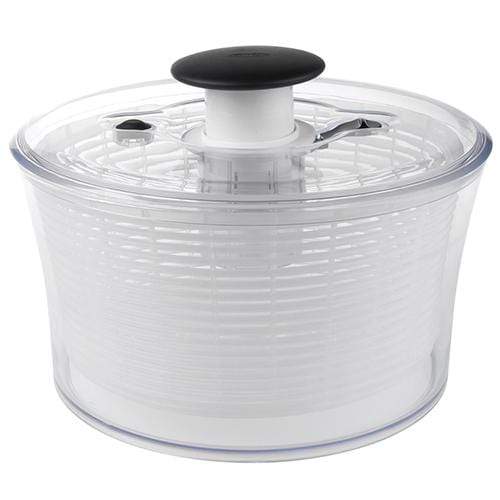
OXO Good Grips 5-Quart Salad Spinner
Best Overall: The OXO Good Grips is the reference salad spinner because its push-button pump mechanism and one-handed brake stop together make large-batch spinning comfortable and controlled — you can check and toss greens mid-spin without waiting for the basket to coast down. The 5-quart basket handles a full head of romaine without overpacking.
Top picks ↓| Product | Price | Link |
|---|---|---|
| $9.99Price as of 2026-09-24 | ||
| $44.95Reference price | ||
| $39.95Reference price | ||
| $69.99Reference price | ||
| $27.00Reference price |
| Product | Capacity | Mechanism | Brake | Basket | Base | Price | Material | Dishwasher | Footprint | Mesh | Finish | Bowl |
|---|---|---|---|---|---|---|---|---|---|---|---|---|
| OXO Good Grips 5-Quart Salad Spinner | 5 quart (4.7 L) | Push-button pump | Yes — one-handed | Colander compatible | Non-slip | $34.99 | — | — | — | — | — | — |
| Zyliss Swift Dry Salad Spinner Large | ~4.5 L (large) | Pull-cord | No | — | — | $44.95 | BPA-free plastic | Top rack (basket) | — | — | — | — |
| Chef'n SaladShot Salad Spinner | 3.3 quart (3.1 L) | Trigger pull | No | — | — | $39.95 | BPA-free plastic | — | Drawer-storable | — | — | — |
| KitchenAid Salad Spinner KSGSS5 | 5 quart (4.7 L) | Pump | Yes | — | — | $69.99 | — | — | — | Fine weave, less blowback | Stainless accent | — |
| Paderno World Cuisine A4982253 Salad Spinner | ~5 quart | Cord pull | No | — | — | $27.00 | BPA-free plastic | — | — | — | — | Opaque, functional |
Top picks
Related articles

Push-button pump with a one-handed brake stop, 5-quart basket that doubles as a colander, non-slip base, and a bowl clean enough to serve from directly. The benchmark salad spinner at a price that's justified by its daily usability for households that make salad regularly.
The OXO Good Grips is the reference salad spinner because its push-button pump mechanism and one-handed brake stop together make large-batch spinning comfortable and controlled — you can check and toss greens mid-spin without waiting for the basket to coast down. The 5-quart basket handles a full head of romaine without overpacking. The only real friction is the pump mechanism, which requires deliberate disassembly to clean properly.
Pros
- ✓Push-button pump is ergonomic for large batches
- ✓One-handed brake stop for mid-spin tossing
- ✓Bowl doubles as a colander and a serving vessel
Cons
- ✗Pump mechanism requires deliberate steps to clean thoroughly
Score breakdown
| Capacity | 5 quart (4.7 L) |
| Mechanism | Push-button pump |
| Brake | Yes — one-handed |
| Basket | Colander compatible |
| Base | Non-slip |
| Price | $34.99 |
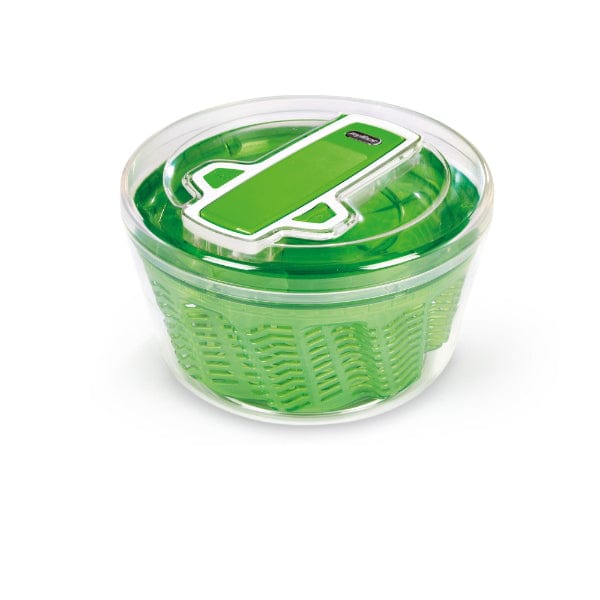
Pull-cord mechanism generates fast spin speed with a single pull and the simpler design means fewer crevices for food to collect. A solid mid-range pick for households that want effective water removal without the pump mechanism's cleaning complexity.
A single pull on the Zyliss cord generates enough initial spin speed to dry a standard load of greens — fewer moving parts means fewer crevices where food collects, which makes cleanup faster than any pump mechanism. The trade-off is no brake: you wait for the basket to coast to a stop before checking. Best for cooks who want reliable water removal without the cleaning complexity of a pump.
Pros
- ✓Pull-cord simplicity means fewer food-trap crevices
- ✓Fast initial spin speed from a single pull
- ✓Simpler to clean than pump mechanisms
Cons
- ✗No brake button — must wait for basket to coast to a stop
Score breakdown
| Capacity | ~4.5 L (large) |
| Mechanism | Pull-cord |
| Brake | No |
| Material | BPA-free plastic |
| Dishwasher | Top rack (basket) |
| Price | $44.95 |

Trigger-pull mechanism in a compact 3.3-quart body that fits in kitchen drawers where standard spinners won't. The right pick for one-to-two person households or anyone with limited cabinet space who still wants proper spin-dried greens.
The Chef'n SaladShot's trigger-pull mechanism fits in a kitchen drawer where a standard spinner won't — that compactness is the entire value proposition. It handles two to three servings per spin with adequate water removal for everyday use. For meal prep or cooking for more than two, the 3.3-quart capacity becomes a limitation quickly.
Pros
- ✓Fits in kitchen drawers — truly compact storage
- ✓Trigger-pull is intuitive for smaller portions
- ✓Right-sized for 1–2 person households
Cons
- ✗3.3-quart capacity limits batch size for groups of 3+
Score breakdown
| Capacity | 3.3 quart (3.1 L) |
| Mechanism | Trigger pull |
| Brake | No |
| Footprint | Drawer-storable |
| Material | BPA-free plastic |
| Price | $39.95 |
Subscribe to our newsletter
Occasional updates and new releases — no spam.
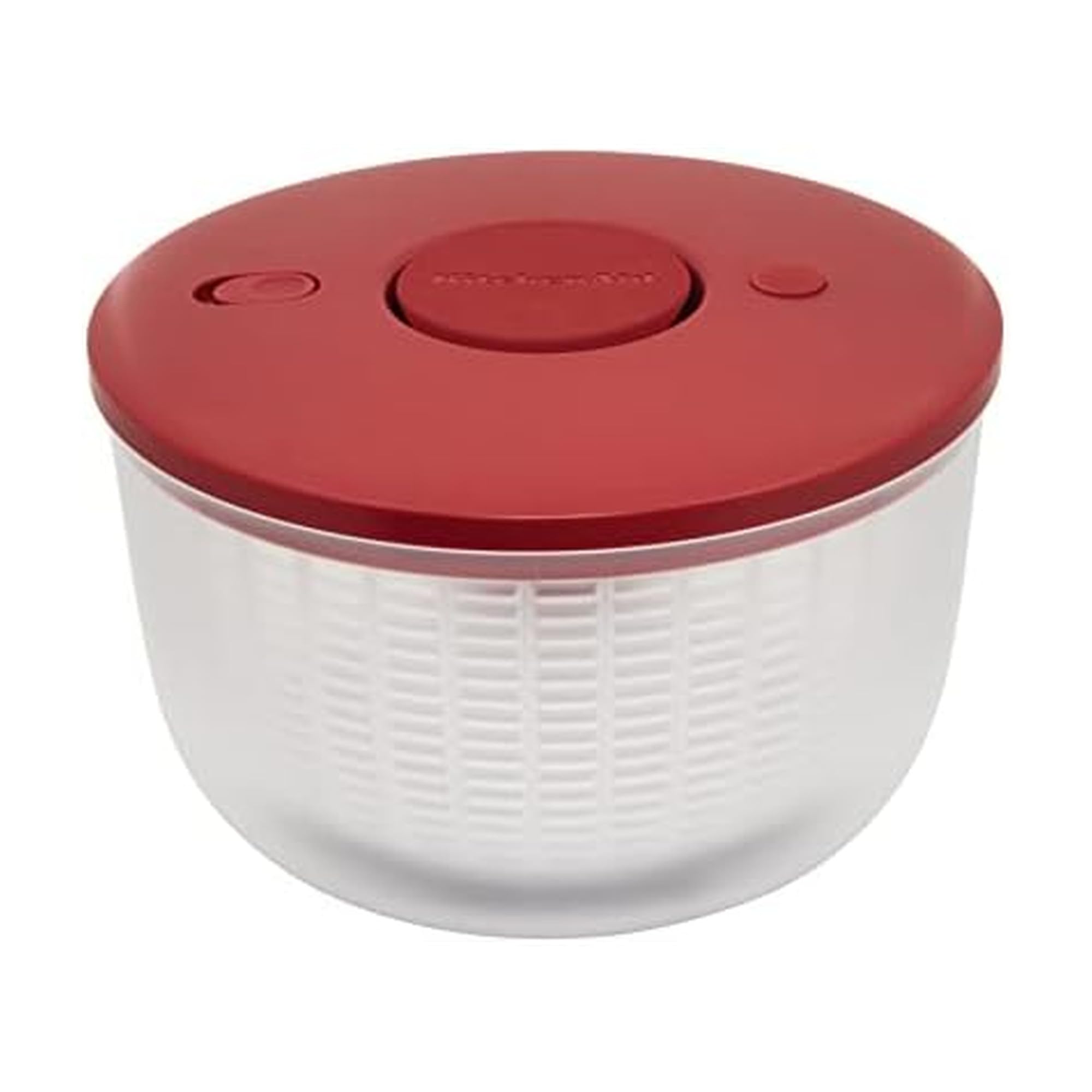
Stainless-accented finish that matches KitchenAid's broader product line, with a 5-quart capacity, finer basket mesh, and a lid that disassembles more cleanly than the OXO. The premium option for KitchenAid enthusiasts or anyone who wants the most refined mechanism available.
The KitchenAid KSGSS5 earns its premium price with thicker bowl walls, finer basket mesh (less water blowback during stops), and a lid that disassembles in fewer steps than the OXO. The stainless accents match the KitchenAid product family. For most households the OXO's performance is sufficient — this is the right pick if you own other KitchenAid appliances and value visual cohesion.
Pros
- ✓Finer mesh basket reduces water blowback at spin-stop
- ✓Lid disassembles more cleanly than OXO for washing
- ✓Stainless accents match KitchenAid product family
Cons
- ✗25–50% price premium over OXO for incremental improvements
Score breakdown
| Capacity | 5 quart (4.7 L) |
| Mechanism | Pump |
| Brake | Yes |
| Mesh | Fine weave, less blowback |
| Finish | Stainless accent |
| Price | $69.99 |
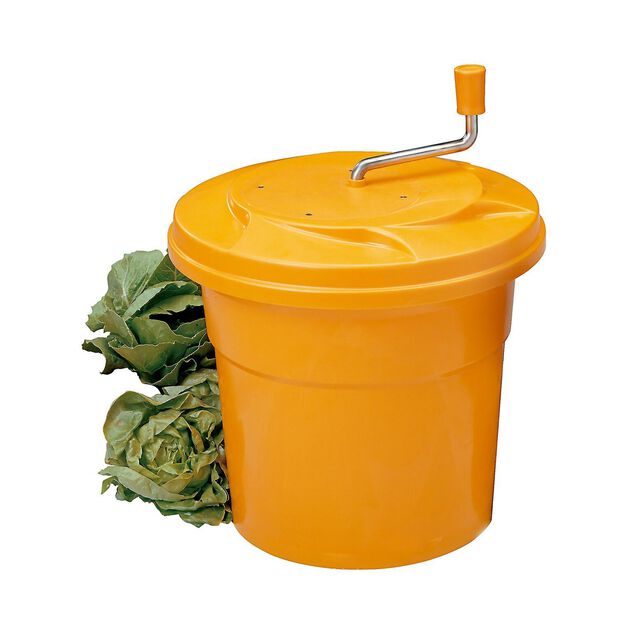
Large-capacity cord-pull spinner with a straightforward design and minimal moving parts — easy to clean and durable over years of use. A reliable workhorse for households that prioritize longevity and simplicity over feature refinements.
The Paderno's cord-pull mechanism has minimal moving parts — there is less to break, less to clean, and nothing to replace. It is the most durable spinner in this comparison over years of daily use, and at $27 it's the most affordable 5-quart option here. The bowl is functional rather than elegant, and there is no brake, but for households that want a spinner to simply work for a decade, Paderno delivers.
Pros
- ✓Minimal moving parts — longest service life in the group
- ✓Most affordable 5-quart option at $27
- ✓Easy to clean with no pump mechanism crevices
Cons
- ✗Bowl is utilitarian — not suitable for table serving
Score breakdown
| Capacity | ~5 quart |
| Mechanism | Cord pull |
| Brake | No |
| Material | BPA-free plastic |
| Bowl | Opaque, functional |
| Price | $27.00 |
Which one is right for you?
For daily salad makers
OXO Good Grips 5-Quart Salad Spinner
The pump mechanism and brake stop make high-frequency large-batch use genuinely comfortable — the spinner you'll actually reach for every day.
For low-maintenance cooks
Zyliss Swift Dry Salad Spinner Large
Pull-cord simplicity means no pump mechanism to clean after every use — rinse, dry, done.
For small kitchens and couples
Chef'n SaladShot Salad Spinner
Drawer storage and two-to-three serving capacity match the actual salad volume a 1–2 person household produces on a weeknight.
For KitchenAid households
KitchenAid Salad Spinner KSGSS5
The stainless finish and refined mechanism justify the premium when visual consistency with existing appliances matters.
For buy-once longevity
Paderno World Cuisine A4982253 Salad Spinner
Minimal moving parts at the lowest price means this spinner will outlast more complex mechanisms without anything to wear out.
Top pick: OXO Good Grips 5-Quart Salad Spinner
The OXO Good Grips 5-Quart has been the standard reference for salad spinners for over a decade, and the 2026 version still earns that position. The push-button pump mechanism requires less wrist effort than pull-cord alternatives — you press straight down rather than yanking sideways, which matters after you've washed a large batch of kale or used it five days in a row. The brake button stops the basket mid-spin so you can check and toss without waiting for it to coast to a stop on its own.
The 5-quart capacity handles a full head of romaine or an entire bunch of kale without packing the basket so tightly that the outer leaves never get spun dry. The basket itself doubles as a colander — you can rinse directly in it before spinning, skipping a separate colander step. The bowl's flat lid and non-slip base keep the spinner stable on wet countertops, which is a real issue when the mechanism is creating enough centrifugal force to actually dry greens. After spinning, the lid removes and the bowl doubles as a serving bowl — the clear walls make it presentable enough for the table.
The OXO isn't perfect: the pump mechanism requires occasional disassembly to clean thoroughly, and at $35-40 it costs twice as much as budget spinners. For households that make salad more than twice a week, the better mechanism and larger capacity make the price gap irrelevant quickly. For someone who spins greens occasionally, the Zyliss offers 80% of the functionality at a lower price.
Compact pick: Chef'n SaladShot Salad Spinner
The Chef'n SaladShot uses a trigger-pull mechanism rather than a pump or cord — you grip it like a blender handle and squeeze the trigger rapidly, which spins the basket through a gear system. The entire unit is roughly half the size of the OXO: the 3.3-quart capacity handles two to three servings, and the smaller footprint fits in kitchen drawers or tight cabinet shelves where a standard spinner won't.
The SaladShot is genuinely useful for one-to-two person households or anyone whose kitchen simply doesn't have room for a full-size spinner. The trigger mechanism is slightly more tiring for large batches than a pump, but for smaller portions the hand-grip is comfortable and natural. Water removal efficiency is slightly lower than the OXO — expect to spin a second time for very wet greens like freshly washed butter lettuce — but adequate for everyday use.
At around $20-25, the SaladShot is the best value for kitchens with space constraints. The trade-off is clear: you get a functional, compact spinner that handles everyday portions but will frustrate you if you're making salad for four or doing weekly meal prep.
Premium pick: KitchenAid Salad Spinner KSGSS5
The KitchenAid KSGSS5 targets the kitchen aesthetics market without sacrificing function. The stainless-accented lid and clear bowl match KitchenAid's broader product line, and the 5-quart capacity matches the OXO. The pump mechanism is smooth and requires slightly less downward pressure than the OXO — the gear ratio is set to generate high spin speed with fewer pumps rather than many lighter pumps.
Where the KitchenAid earns its premium price is build quality: the bowl walls are thicker, the basket mesh is finer (which means less water passes back through to the bowl during stopping), and the lid mechanism feels more solid. The lid disassembles for cleaning with fewer steps than the OXO. It also has a larger water-holding capacity in the outer bowl, so you can spin several batches of very wet greens before needing to drain.
At $50-60, the KitchenAid costs 25-50% more than the OXO for improvements that are real but incremental. The honest use case is someone who already owns KitchenAid appliances and values aesthetic cohesion, or a cooking enthusiast who wants the best available mechanism and is willing to pay for it. For most households, the OXO delivers enough performance that the premium isn't justified.
How to choose: capacity, brake mechanism, and cleaning ease
Capacity: a 5-quart basket handles a full head of romaine, roughly four to six servings. A 3.3-quart basket handles two to three servings comfortably. The critical point is that overfilling a basket defeats the spinner's purpose — leaves packed too tightly against the basket walls don't spin freely enough for the water to separate. If you regularly cook for more than two people or do weekly meal prep, the 5-quart is the right starting point regardless of which brand you choose.
Mechanism: push-button pumps (OXO, KitchenAid) require straight-down pressure and generate sustained spin with fewer strokes — easier on wrists for large batches. Pull-cord mechanisms (Zyliss Swift Dry) generate high initial speed from a single pull and work well for smaller loads. Trigger mechanisms (Chef'n) are compact but require more repetitive hand movement for equivalent spin duration. The brake button — present on OXO and KitchenAid, absent on Zyliss and Paderno — lets you stop the basket mid-spin for tossing or checking without waiting for it to coast down.
Cleaning: any salad spinner with a removable basket and smooth bowl walls is manageable. The challenge is the lid mechanism: pump and gear assemblies trap water and food particles in crevices. The OXO pump disassembles for cleaning but requires a deliberate push-click sequence to open; the KitchenAid's lid separates with a simpler twist. Paderno's simpler cord mechanism is the easiest to clean — fewer moving parts, fewer crevices. Dishwasher compatibility varies by brand; check the specific model before loading the lid, as most manufacturers recommend hand-washing the mechanism.
Frequently asked questions
Can I use the salad spinner bowl for serving?▼
Pump vs pull-cord: which spin mechanism is better?▼
How large a salad spinner do I actually need?▼
Prices change. Check the retailer for the current price.
Comments & questions
Discussion happens on nattzy, our community forum. Sign in with Google to post — it takes a second.
Related articles
Food
Best Toaster 2026: 5 Compared
Best Toaster 2026: 5 Compared

Best Protein Powder 2026: 5 Compared

ConoHa WING review (2026): setup, speed and pricing
Best JP rental server 2026: 5 hosts ranked

Best LED Face Masks 2026: 3 Light Therapy Devices Compared
Best Robot Vacuums 2026: 5 Models Compared Honestly