Fitness
Best Power Towers 2026: 5 Pull-Up Dip Stations Compared
WriterPickly Editorial
Updated 2026-11-24
A power tower puts a pull-up bar, dip handles, a padded knee-raise station and push-up grips on one freestanding frame, so the questions that decide the purchase are ceiling height, base size and how much the frame weighs — not the exercise list, which is nearly the same on every listing.
Quick answer
For most homes, the Sportsroyals Pull Up Power Tower Dip Station (450 lb, H-Frame Base) is the pick: its listing gives the widest height range here (6 settings from 64.56 to 88.18 in), so it can be set low for a basement ceiling or high for a tall user, and it states the numbers a buyer needs — a 62 lb frame, a 39.7 in H-type base on 8 anti-slip covers, 7 backrest positions and a 450 lb listed capacity. The FLYBIRD Heavy-Duty Power Tower (104.5 lb frame, 800 lb rating) suits heavier users and weighted work, the DONIUZ DZ-580A suits a flat, hard floor, the pooboo is the cheapest of the five, and the Stamina adds a plyo box but lists the lowest user limit, 250 lb.
📋How we compared
Towers were compared on what their Amazon US listings state — height range, base shape and length, unit weight, listed capacity, backrest and pad adjustments, and feet — checked against the listing and maker text on November 24, 2026. Extra weight went to a wide height range and to listings that publish the frame weight and base size. Pickly did not test these towers; where a value is not given, the table shows “Not stated”.

Sportsroyals Pull Up Power Tower Dip Station (450 lb, H-Frame Base)
Best Overall: The Sportsroyals Pull Up Power Tower Dip Station is the top pick because its listing covers the widest height range of the five — 6 settings from 64.56 to 88.18 in, for users from 4 ft 8 in to 6 ft 6 in — and publishes the figures that let you plan: a 62 lb frame in 2 mm steel, a 39.7 in H-type base on 8 anti-slip covers and a 450 lb listed capacity. The knee-raise station has 7 backrest positions and armrests tilted 10 degrees inward.
Top picks ↓- 1Sportsroyals Pull Up Power Tower Dip Station (450 lb, H-Frame Base)A+Best Overall$159.99Price as of 2026-11-27
- 3
 DONIUZ Power Tower Pull Up Bar and Dip Station (DZ-580A)B+For Hard, Flat Floors$151.99Price as of 2026-11-27
- 4
Which one is right for you?
Related articles

1★ Best PickA+Best OverallSportsroyals Pull Up Power Tower Dip Station (450 lb, H-Frame Base)
62 lb frame in 2 mm steel, 39.7 in H-type base on 8 anti-slip covers, 450 lb listed capacity, 6 height settings from 64.56 to 88.18 in, 7 backrest positions (listing figures). Suited to shared use and to rooms where the bar has to be set low.
The Sportsroyals Pull Up Power Tower Dip Station is the top pick because its listing covers the widest height range of the five — 6 settings from 64.56 to 88.18 in, for users from 4 ft 8 in to 6 ft 6 in — and publishes the figures that let you plan: a 62 lb frame in 2 mm steel, a 39.7 in H-type base on 8 anti-slip covers and a 450 lb listed capacity. The knee-raise station has 7 backrest positions and armrests tilted 10 degrees inward. On price it sits in the middle of the five. It is not a good fit for users who want to add heavy plates to dips or pull-ups and would rather have the FLYBIRD's heavier frame, or for anyone who needs adjustable dip handles, which this listing does not mention.
Pros
- ✓Widest listed height range here (64.56–88.18 in, 6 settings)
- ✓Frame weight, base length and capacity all published (62 lb, 39.7 in, 450 lb)
- ✓7 backrest positions and 8 anti-slip covers
Cons
- ✗Dip handle width and adjustment not stated
- ✗62 lb frame is lighter than the FLYBIRD's 104.5 lb
Specifications
- Listed capacity
- 450 lb
- Unit weight
- 62 lb
- Height settings
- 6 settings, 64.56–88.18 in
- Base
- H-type, 39.7 in, 8 anti-slip covers
- Knee/leg raise support
- Back cushion (7 positions) + armrests tilted 10° inward
- Other listed details
- 2 mm steel frame; users 4 ft 8 in to 6 ft 6 in
- Listed capacity
- 450 lb
- Unit weight
- 62 lb
- Height settings
- 6 settings, 64.56–88.18 in
- Base
- H-type, 39.7 in, 8 anti-slip covers
- Knee/leg raise support
- Back cushion (7 positions) + armrests tilted 10° inward
- Other listed details
- 2 mm steel frame; users 4 ft 8 in to 6 ft 6 in
2A-Heavy-Duty PickFLYBIRD Heavy-Duty Power Tower (800 lb)

104.5 lb frame rated up to 800 lb, cross-braced Π-shaped base, 9 height settings, 4 dip-handle positions and a seated leg raise station that takes plates or bands (listing figures). Suited to heavier users and weighted work; ships in two boxes.
The FLYBIRD Heavy-Duty Power Tower is the choice for heavier users and for weighted work. Its listing gives a 104.5 lb frame — about 1.7 times the Sportsroyals — on a cross-braced, outward-flaring Π-shaped base, rated up to 800 lb, with 9 height settings, 4 dip-handle positions, 12 foot-bar positions and wide, overhand and neutral pull-up grips. The seated leg raise station supports the body from below and takes plates or bands. It is the second most expensive of the five and ships in two boxes that may arrive separately. It is not a good fit for a room with a tight ceiling until the seller confirms the height, because the listing gives no height range or base size, or for anyone who wants a classic back-pad-and-forearm-pad knee raise, which the listing does not describe.
Pros
- ✓104.5 lb frame, the heaviest published weight here
- ✓800 lb listed capacity, the highest here
- ✓4 dip-handle positions and a loadable seated leg raise station
Cons
- ✗Height range and base size not stated
- ✗Second most expensive of the five; ships in two boxes
Specifications
- Listed capacity
- 800 lb
- Unit weight
- 104.5 lb
- Height settings
- 9 settings (range not stated)
- Base
- Π-shaped, cross-braced, 4 non-slip feet (size not stated)
- Knee/leg raise support
- Seated leg raise station; takes plates or bands
- Other listed details
- 4 dip-handle positions; 12 foot-bar positions; ships in 2 boxes
3B+For Hard, Flat FloorsDONIUZ Power Tower Pull Up Bar and Dip Station (DZ-580A)
32 x 41 x 65 to 87 in, 2 mm steel tubing, 660 lb (300 kg) listed capacity, backrest and elbow pads, suction-cup feet (listing figures). Suited to a flat concrete or other hard floor; the seller advises against carpet.
The DONIUZ DZ-580A lists 660 lb (300 kg), the second-highest capacity here, with 2 mm corrosion-resistant steel tubing, a backrest, elbow pads and multiple pull-up handles, at the second-lowest price of the five. The listing gives overall dimensions of 32 x 41 x 65 to 87 in and an adjustable height of 74.8 to 87 in. Its feet are suction cups, and the seller suggests a flat concrete floor rather than carpet, so the floor decides whether this tower suits you. It is not a good fit for carpeted rooms, for low ceilings (the stated adjustable range starts at 74.8 in), or for buyers who want a published frame weight.
Pros
- ✓660 lb (300 kg) listed capacity at the second-lowest price here
- ✓Overall dimensions published (32 x 41 x 65–87 in)
- ✓Backrest, elbow pads and multiple pull-up handles
Cons
- ✗Suction-cup feet: the seller advises against carpet
- ✗Unit weight and number of height settings not stated
Specifications
- Listed capacity
- 660 lb (300 kg)
- Unit weight
- Not stated
- Height settings
- 74.8–87 in (number of settings not stated)
- Base
- 32 x 41 in overall; suction-cup feet
- Knee/leg raise support
- Backrest + elbow pads
- Other listed details
- 2 mm steel tubing; tools and instructions included
- Listed capacity
- 660 lb (300 kg)
- Unit weight
- Not stated
- Height settings
- 74.8–87 in (number of settings not stated)
- Base
- 32 x 41 in overall; suction-cup feet
- Knee/leg raise support
- Backrest + elbow pads
- Other listed details
- 2 mm steel tubing; tools and instructions included
Subscribe to our newsletter
Occasional updates and new releases — no spam.
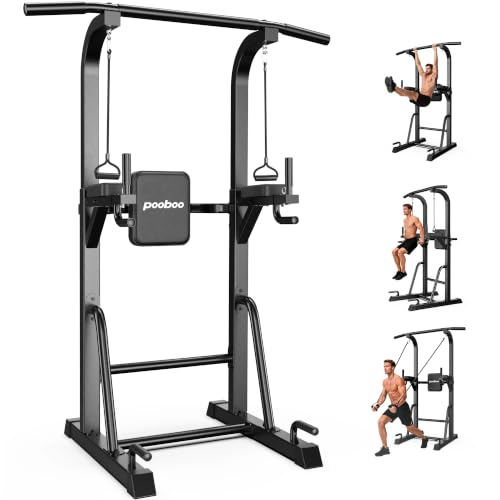
4B+Lowest Price Herepooboo Pull Up Bar Power Tower Dip Station (450 lb)
11 height levels from 71.4 to 84.9 in, 7-position backrest, 41.73 in H-shaped base, safety locknuts, 450 lb listed capacity, resistance bands included, 12-month warranty per the listing. The cheapest of the five; suited to standard-height rooms.
The pooboo is the cheapest tower in this comparison, and its listing is generous for the price: 11 height levels from 71.4 to 84.9 in, a 7-position wide backrest, a 41.73 in H-shaped base on 4 enlarged non-slip foot pads, safety locknuts, a 450 lb listed capacity, resistance bands in the box and a stated 12-month warranty. It is not the top pick because its lowest setting is almost 7 in higher than the Sportsroyals', its height span is narrower and its frame weight is not published. It is not a good fit for low ceilings or shorter users who need the bar below 71.4 in, or for buyers who want to compare frame weight before ordering.
Pros
- ✓Cheapest of the five
- ✓11 height levels and a 7-position backrest
- ✓Resistance bands included; 12-month warranty stated in the listing
Cons
- ✗Lowest setting is 71.4 in, higher than the Sportsroyals' 64.56 in
- ✗Unit weight not stated
Specifications
- Listed capacity
- 450 lb
- Unit weight
- Not stated
- Height settings
- 11 levels, 71.4–84.9 in
- Base
- H-shaped, 41.73 in, 4 non-slip foot pads, locknuts
- Knee/leg raise support
- Wide backrest (7 positions)
- Other listed details
- Resistance bands included; 12-month warranty (per the listing)
5BWith a Plyo BoxStamina Power Tower with Plyo Box

Pull-up and dip stations with a built-in plyo box adjustable from 20 to 24 in; steel frame for users up to 250 lb (listing figures). Dimensions are not stated. Suited to lighter users who want jump and step work on the same frame.
The Stamina Power Tower with Plyo Box pairs pull-up and dip stations with a built-in plyo box that adjusts from 20 to 24 in and has a textured surface for squat jumps, step-ups and calf raises, plus access to the müüv app for guided coaching. Its steel frame is listed for users up to 250 lb, the lowest limit here, and it is the most expensive of the five. The listing data gives no dimensions, height or unit weight and does not mention a back pad. It is not a good fit for users near or above 250 lb with any added load, for anyone who wants a supported knee-raise station, or for rooms where the footprint has to be known before ordering.
Pros
- ✓Built-in plyo box adjustable from 20 to 24 in
- ✓App with guided coaching and personalized workouts (per the listing)
Cons
- ✗250 lb user limit, the lowest here
- ✗Dimensions, height and unit weight not stated
- ✗Most expensive of the five
Specifications
- Listed capacity
- 250 lb (user weight)
- Unit weight
- Not stated
- Height settings
- Not stated
- Base
- Not stated
- Knee/leg raise support
- Not stated
- Other listed details
- Plyo box adjustable 20–24 in; müüv app
- Listed capacity
- 250 lb (user weight)
- Unit weight
- Not stated
- Height settings
- Not stated
- Base
- Not stated
- Knee/leg raise support
- Not stated
- Other listed details
- Plyo box adjustable 20–24 in; müüv app
Side-by-side on the same scale
| Product | Knee/leg raise support | |||||
|---|---|---|---|---|---|---|
| Sportsroyals Pull Up Power Tower Dip Station (450 lb, H-Frame Base) | 450 lb | 62 lb | 6 settings, 64.56–88.18 in | H-type, 39.7 in, 8 anti-slip covers | Back cushion (7 positions) + armrests tilted 10° inward | 2 mm steel frame; users 4 ft 8 in to 6 ft 6 in |
| FLYBIRD Heavy-Duty Power Tower (800 lb) | 800 lb | 104.5 lb | 9 settings (range not stated) | Π-shaped, cross-braced, 4 non-slip feet (size not stated) | Seated leg raise station; takes plates or bands | 4 dip-handle positions; 12 foot-bar positions; ships in 2 boxes |
| DONIUZ Power Tower Pull Up Bar and Dip Station (DZ-580A) | 660 lb (300 kg) | Not stated | 74.8–87 in (number of settings not stated) | 32 x 41 in overall; suction-cup feet | Backrest + elbow pads | 2 mm steel tubing; tools and instructions included |
| pooboo Pull Up Bar Power Tower Dip Station (450 lb) | 450 lb | Not stated | 11 levels, 71.4–84.9 in | H-shaped, 41.73 in, 4 non-slip foot pads, locknuts | Wide backrest (7 positions) | Resistance bands included; 12-month warranty (per the listing) |
| Stamina Power Tower with Plyo Box | 250 lb (user weight) | Not stated | Not stated | Not stated | Not stated | Plyo box adjustable 20–24 in; müüv app |
How to read this table: values come from each product's Amazon US listing (the maker's own feature text), checked on November 24, 2026. “Not stated” means the listing data Pickly read does not give that value — it does not mean the feature is missing. Listed capacities are the sellers' figures, and the listings do not say how they were measured. Height figures are quoted as listed; the listings do not say whether they refer to the pull-up bar or to the top of the frame, so plan your ceiling clearance from the larger number. Pickly did not test these products.
Table checked 2026-11-24
What a power tower adds over a pull-up stand or a pair of dip bars
A power tower is one freestanding frame with four stations: a pull-up bar at the top, dip handles at about waist height, a vertical knee raise station (a back pad with two forearm pads, sometimes called a captain's chair) and low grips for push-ups. A freestanding pull-up stand has the bar but usually no back pad; a pair of dip bars has the handles but no overhead bar. The tower is the format to look at when you want hanging, pressing and supported core work in one footprint and do not want to drill into a wall or a door frame.
Because every listing in this comparison names nearly the same exercises — pull-ups, dips, knee or leg raises and push-ups, with inverted rows added on the Sportsroyals and FLYBIRD listings — the exercise list does not separate the five. What separates them is physical: how high and how low the bar goes, how long the base is, how heavy the frame is, what load the seller lists, and whether the knee-raise station has an adjustable back pad.
The knee-raise station is the part a tower has that the other two formats lack. You rest your forearms on the pads, press your back against the cushion and lift your knees or straight legs. The back pad keeps the torso from swinging, which is why the distance between the pad and the handles matters: too far and you lean back to reach it, too close and it pushes you forward off the pads. Three of the five listings here state an adjustable backrest or name a backrest and elbow pads; the other two take a different route, which the sections below cover.
A tower is also a compromise. The pull-up bar sits on a frame that is not anchored to the building, so it will move more than a wall-mounted or ceiling-mounted bar, and the dip handles are fixed to the uprights rather than free to be spaced as you like. If one of those two movements is all you plan to train, a dedicated piece usually does that one job in less floor space.
Ceiling height and bar position: measure this first
Start with a tape measure, not the capacity figure. A tower has to fit under the ceiling with room for your head above the bar, because at the top of a pull-up your chin is at bar level and the rest of your head is above it. Measure floor to ceiling where the tower will stand, and check for light fittings, beams, ducts and garage door tracks in that spot.
Three listings here give a height range. The Sportsroyals lists 6 settings from 64.56 to 88.18 in (about 164 to 224 cm), a span of 23.62 in. The pooboo lists 11 levels from 71.4 to 84.9 in, a span of 13.5 in. The DONIUZ listing gives an adjustable height of 74.8 to 87 in, a span of 12.2 in, alongside overall dimensions of 32 x 41 x 65 to 87 in; the two lower figures do not match, so confirm the lowest position with the seller if a low setting matters to you. The FLYBIRD listing gives 9 height settings without the range, and the Stamina listing data gives no height at all.
Work the numbers against your room. Under a 96 in (8 ft) ceiling, the Sportsroyals at its top setting leaves under 8 in above the frame, the DONIUZ 9 in and the pooboo about 11 in — little more than a head's height at best, so most people in such a room will run the tower a setting or two below its maximum. That is fine: the top setting exists for tall users in tall rooms. What you need is a setting that leaves your head clear and still lets you hang with your arms straight.
The low end matters as much as the high end. If the bar is lower than your reach, you bend your knees to hang, which works for strict pull-ups but shortens leg raises done from the bar. A wide range gives more chances of a setting that fits both the ceiling and your reach: the Sportsroyals goes almost 7 in lower than the pooboo, and its listing names users from 4 ft 8 in to 6 ft 6 in. In a room with a ceiling well under 8 ft, that low end is what decides whether a tower can be used at all.
For the two towers without a published range, do not guess. The FLYBIRD listing says its settings suit users up to 6 ft 6 in but not how tall the frame stands; the Stamina listing data has no dimensions. Ask the seller for the maximum and minimum height before ordering if your ceiling is anything other than generous.
Base shape, depth and frame weight: what keeps a tower from rocking
A tower stays upright because its base reaches further than your body swings away from the uprights. During a pull-up your weight hangs slightly in front of the frame; during a dip or a knee raise it sits further forward still. A longer front-to-back base moves the tipping point further out. The Sportsroyals lists a 39.7 in H-type base and the pooboo a 41.73 in H-shaped base; the DONIUZ gives overall dimensions of 32 x 41 in; the FLYBIRD describes a wider, outward-flaring Π-shaped base with extra cross-bracing but gives no measurement; the Stamina listing data gives none.
An H-shaped base is two long rails joined by a crossbar, so it leaves the floor open under the pull-up bar and at the front for your feet. A Π-shaped base joins the rails at the back. Neither shape is better by name; the length of the rails, the bracing between them and the weight of steel above them are what count. Check that the base fits the depth of the space as well as the width, and leave room in front for your legs to swing during knee raises and room behind so the frame is not hard against a wall.
Frame weight is the number most listings leave out, and it is the one that tells you most about sway. A heavier frame has more mass to resist your movement. Two listings state it: the Sportsroyals at 62 lb and the FLYBIRD at 104.5 lb, about 1.7 times as much. The DONIUZ, pooboo and Stamina listing data give no unit weight, which is one reason none of them is the top pick here — a buyer cannot compare what is not published.
Feet and fasteners finish the picture. The Sportsroyals lists 8 anti-slip covers, the FLYBIRD 4 non-slip feet, the pooboo 4 enlarged non-slip foot pads plus safety locknuts meant to resist loosening, and the DONIUZ suction cups. More contact points spread the load over more floor; locknuts address the fact that bolts on a frame that is shaken every session work loose over time. Whichever tower you choose, some movement at the top of the bar is normal for a freestanding frame. A tower that rocks on its feet, though, usually has an uneven floor or loose bolts behind it.
Weight capacity: read it as body weight plus added load
The listed capacities here run from 250 lb to 800 lb: Stamina 250 lb (given as the user weight the frame supports), Sportsroyals and pooboo 450 lb, DONIUZ 660 lb (300 kg) and FLYBIRD 800 lb. None of the listings says how the figure was measured or whether it is a static load. Treat it as the seller's ceiling and stay well under it, since a body moving on a bar loads the frame harder than the same body standing still.
Add up what will be on the frame. Your body weight is the start; a weight vest, a dip belt with plates or ankle weights go on top. A 220 lb user wearing a 35 lb vest is at 255 lb, already past the Stamina's listed 250 lb. The same user has room to spare on the 450 lb towers and more on the DONIUZ and FLYBIRD. If you plan weighted dips or pull-ups, or you are a heavier user, the capacity figure becomes a real filter rather than a formality.
Capacity is not stability. A high rating says the steel and welds are meant to hold the load; it does not say the frame will stand still under it. That is why the FLYBIRD's two figures belong together — an 800 lb rating on a 104.5 lb frame with cross-bracing — and why a rating printed without a frame weight tells you less. The DONIUZ lists 660 lb and 2 mm steel tubing but no unit weight; the Sportsroyals lists a lower 450 lb but tells you the frame is 62 lb of 2 mm steel.
One more loadable point: the FLYBIRD listing describes a seated leg raise station that takes weight plates or resistance bands, with the body supported from below so the arms mainly keep your balance. That is a different way to progress core work than adding ankle weights on a captain's chair, and it is the feature that sets this tower apart for people who have outgrown bodyweight knee raises.
Back pad, elbow pads and dip handles: the stations you will feel
On a captain's-chair station, three things decide comfort: the back pad, the forearm pads and the handles. The back pad should sit where your lower back meets it with your forearms flat on the pads. People with longer or shorter upper arms need it in different places, which is why an adjustable backrest matters when several people share one tower. The Sportsroyals lists 7 backrest positions and the pooboo a 7-position wide backrest. The DONIUZ names a backrest and elbow pads without saying whether they adjust.
Forearm pads take your full body weight during a knee raise, so their angle and padding matter more than they look. The Sportsroyals listing describes cushioned armrests tilted 10 degrees inward, which it says keeps the elbows from slipping, plus a thickened back cushion. The other listings do not give a pad angle.
Dip handle width is fixed on most towers, and it changes the exercise: narrow handles keep the elbows close and put more of the work on the triceps, wide handles shift it toward the chest and ask more of the shoulders. Handles set much wider than your shoulders are a common reason people find tower dips uncomfortable. Among these five, the FLYBIRD lists 4 dip-handle positions and 12 foot-bar positions; the other four listings give no handle width or adjustment, so ask the seller for the spacing if your shoulders are narrow or broad.
Pull-up grips differ too. The FLYBIRD listing names wide, overhand and neutral grips; the DONIUZ mentions multiple handles on the pull-up frame; the pooboo names pull-ups and chin-ups. A neutral grip (palms facing each other) is the one people with sensitive wrists or elbows tend to ask for, and the FLYBIRD is the listing here that names it.
The Stamina takes a different approach altogether. Its listing describes pull-up and dip stations and a built-in plyo box that adjusts from 20 to 24 in, with a textured surface for squat jumps, step-ups and calf raises. The listing data does not mention a back pad or a knee-raise station, so buy it for the box and the two bars, not for supported core work.
The five towers, one by one
Sportsroyals Pull Up Power Tower Dip Station (450 lb, H-Frame Base): the listing gives a 2 mm steel frame weighing 62 lb, a 39.7 in H-type base on 8 anti-slip covers, a 450 lb listed capacity, 6 height settings from 64.56 to 88.18 in for users from 4 ft 8 in to 6 ft 6 in, 7 backrest positions and armrests tilted 10 degrees inward. It names five exercises: pull-ups, dips, leg raises, inverted rows and push-ups. It is the top pick because it has the widest height range of the five and publishes every figure the sections above rely on. On price it sits in the middle of the five.
FLYBIRD Heavy-Duty Power Tower (800 lb): at 104.5 lb it is the heaviest frame with a published weight here, on a Π-shaped base with extra cross-bracing and 4 non-slip feet, rated up to 800 lb. It lists 9 height settings, 4 dip-handle positions, 12 foot-bar positions and wide, overhand and neutral pull-up grips, and its seated leg raise station can be loaded with plates or bands. The listing says it ships in two boxes that may arrive separately. It gives no height range and no base size, and it is the second most expensive of the five.
DONIUZ Power Tower DZ-580A: the listing gives overall dimensions of 32 x 41 x 65 to 87 in, an adjustable height of 74.8 to 87 in, 2 mm corrosion-resistant steel tubing and a 660 lb (300 kg) listed capacity, with a backrest, elbow pads and multiple pull-up handles. Tools and instructions are included, and the seller advises retightening the screws after assembly. The feet are suction cups, and the seller suggests a flat concrete floor rather than carpet. It is the second cheapest of the five; unit weight and the number of height settings are not stated.
pooboo Pull Up Bar Power Tower Dip Station (450 lb): 11 height levels from 71.4 to 84.9 in, a 7-position wide backrest, a 41.73 in H-shaped base on 4 enlarged non-slip foot pads with safety locknuts, and a 450 lb listed capacity. Resistance bands are included, the listing puts assembly at 10 to 20 minutes, and it states a 12-month warranty. It is the cheapest of the five. Its lowest setting is almost 7 in higher than the Sportsroyals', and its unit weight is not stated.
Stamina Power Tower with Plyo Box: pull-up and dip stations plus a built-in plyo box that adjusts from 20 to 24 in, on a steel frame the listing rates for users up to 250 lb, with access to Stamina's müüv app for guided coaching and personalized workouts. The listing data gives no dimensions, height range or unit weight and does not mention a back pad. It is the most expensive of the five and has the lowest listed user limit, so it earns its place when the box is the reason you are buying.
Floor, assembly and upkeep
The floor decides more than the listing photos suggest. A tower wants a flat, hard, level surface: concrete, tile, or a firm floor under a thin, dense rubber mat. Thick carpet and soft foam tiles let the feet sink unevenly, and the frame then rocks however well it is built. The DONIUZ makes this explicit — its feet are suction cups and the seller recommends a flat concrete floor instead of carpet — so do not choose it for a carpeted bedroom.
On a wood or laminate floor, a mat protects the surface from the feet and from the concentrated load of the base rails. Choose a dense mat rather than a cushioned one, check that all feet sit fully on it, and check again after the first week because mats compress. Suction feet need a smooth, non-porous surface to grip, so a textured rubber mat can work against them.
Assembly is bolt-together on all five. The pooboo listing estimates 10 to 20 minutes with labeled parts; the DONIUZ includes tools and instructions; the FLYBIRD arrives in two boxes that can come on different days, so do not start until both are in the room; the Stamina listing points to assembly guidance in its app. Build the tower where it will stand, at the height you measured for, and with a second person for the top section if the frame is heavy.
Retighten everything after the first few sessions. Both the DONIUZ and pooboo listings tell buyers to make sure all screws are fully tightened after setup, and that advice applies to any bolted frame that is pulled and pushed several times a week. A quick check of the height pins, the base bolts and the handle bolts every few weeks is the whole maintenance routine. If a tower starts to creak or lean, stop and look for a loose fastener before the next set.
Who should not buy a power tower, and why the cheapest one is not the pick
If pull-ups are the main thing you want, a tower is more frame than you need. A doorway bar or a wall-mounted bar costs less, takes no floor space and, when fixed to solid structure, moves less than a freestanding tower. The same goes for dips alone: a pair of dip bars is smaller and lets you set the width. A tower earns its footprint when you will use at least three of its four stations.
If your ceiling is low, check before you look at anything else. With the bar set near the ceiling you cannot get your head over it; with the bar set low you hang with bent knees. The Sportsroyals goes down to 64.56 in, which helps, but in a room where even a low setting leaves no head room, a floor-based plan — dip bars, push-up handles, a low bar for rows — will serve you better than a tower on which you can use half the stations.
If you kip, swing or do muscle-ups, skip the whole category. Freestanding towers are built for strict, controlled repetitions; momentum moves the load outside the base, and none of these listings mentions kipping or anchoring the frame to the floor. People who train those movements need a bar fixed to a wall, a ceiling or a bolted-down rig.
Also think twice if your floor is thick carpet you cannot cover, if the tower would have to be moved after each session (the frames with published weights are 62 lb and 104.5 lb, and none of the listings mentions wheels or folding), or if your body weight plus any added load comes close to the listed figure of the tower you can afford.
Why not the pooboo, the cheapest of the five? Its listing is solid for the money: 11 height levels, a 7-position backrest, a 41.73 in base, bands in the box and a stated 12-month warranty. But its lowest setting is 71.4 in against the Sportsroyals' 64.56 in, its total height span is 13.5 in against 23.62 in, it lists 4 foot pads against 8 covers, and it does not publish a frame weight. The price step up to the Sportsroyals is small compared with the spread across this table, and it buys the range that decides whether a tower fits a low room or a shorter user. If your ceiling is a standard height and everyone using the tower is of average height or taller, the pooboo is a reasonable way to spend less.
Frequently asked questions
What ceiling height do I need for a power tower?▼
Is a power tower stable enough for pull-ups?▼
How much weight capacity do I need?▼
Power tower or a doorway pull-up bar: which should I buy?▼
Can I put a power tower on carpet?▼
What is the vertical knee raise station for, and do all towers have one?▼
Why is the cheapest tower not the top pick?▼
Check the details of the products in this article
- Sportsroyals Pull Up Power Tower Dip Station (450 lb, H-Frame Base)$159.99Price as of 2026-11-27
- FLYBIRD Heavy-Duty Power Tower (800 lb)$279.99Price as of 2026-11-27
- DONIUZ Power Tower Pull Up Bar and Dip Station (DZ-580A)$151.99Price as of 2026-11-27
- pooboo Pull Up Bar Power Tower Dip Station (450 lb)$142.49Price as of 2026-11-27
- Stamina Power Tower with Plyo Box$299Price as of 2026-11-27
Prices change. Check the retailer for the current price.
Comments & questions
Discussion happens on nattzy, our community forum. Sign in with Google to post — it takes a second.
Still deciding? Ask the community your own question — Post a question on nattzy ↗