Best Portable Bluetooth Speaker 2026: 5 options compared
Five Bluetooth speakers — the JBL Flip 6, Sony SRS-XB33, Ultimate Ears BOOM 3, Bose SoundLink Flex and Anker Soundcore 3 — compared on waterproof rating, battery life at realistic volumes, 360-degree versus directional sound, and outdoor audibility. Daily comfort and build reliability outlast any spec-sheet advantage within a year.
Quick answer
The JBL Flip 6 is the easiest recommendation here — IP67 protection, a 12-hour rated battery, and balanced tuning that works across genres rather than only bass-heavy tracks. Pick the Ultimate Ears BOOM 3 when the speaker sits in the middle of a group, because it is the only one with genuine 360-degree drivers. The Sony SRS-XB33 is for long days and dance music, with a rated 24-hour battery and EXTRA BASS, though LED lighting and volume cut that figure well down in practice.
Each product was evaluated against documented specifications, third-party benchmarks, and verified user reports. We scored features, performance, build quality, ecosystem compatibility, and total cost of ownership.
All-rounder: The JBL Flip 6 is the most balanced compact Bluetooth speaker in the comparison and the easiest one to recommend without conditions. IP67 dust and water protection plus a 12-hour rated battery cover the standard outdoor use cases, the dual passive radiators add audible low-end weight without resorting to heavy DSP boost, and the PartyBoost protocol lets you link it later with a JBL Charge 5 or Pulse 5 if you want to expand the system.
Top picks ↓Top picks
Related articles


JBL Flip 6 — IP67 waterproof and dustproof, 12-hour battery, PartyBoost multi-speaker linking, 360-degree passive radiator configuration. Widely available from major online retailers. 12-hour battery is on the shorter end for all-day outdoor use at real listening volumes; the passive radiator configuration is not true omnidirectional and loses level for listeners directly behind the speaker; PartyBoost only works with JBL PartyBoost-compatible speakers, not cross-brand; USB-C charging with no option for swappable batteries on extended trips.
The JBL Flip 6 is the most balanced compact Bluetooth speaker in the comparison and the easiest one to recommend without conditions. IP67 dust and water protection plus a 12-hour rated battery cover the standard outdoor use cases, the dual passive radiators add audible low-end weight without resorting to heavy DSP boost, and the PartyBoost protocol lets you link it later with a JBL Charge 5 or Pulse 5 if you want to expand the system. Tuning is bass-forward but stops short of overwhelming the vocal range, which keeps it listenable across genres rather than locked into EDM. The forward-facing primary driver is not true omnidirectional, so listeners directly behind the speaker lose some level, and 12 hours is the shorter end at outdoor volumes. At its mid-range price it has no significant weakness.
Pros
- ✓IP67 dust and water protection with consistent build quality
- ✓PartyBoost lets you scale up to other JBL speakers later
- ✓Balanced tuning works across genres rather than only bass-heavy music
Cons
- ✗12-hour battery is shorter than the Sony and Anker claims
- ✗Not true 360-degree — listeners directly behind lose some level
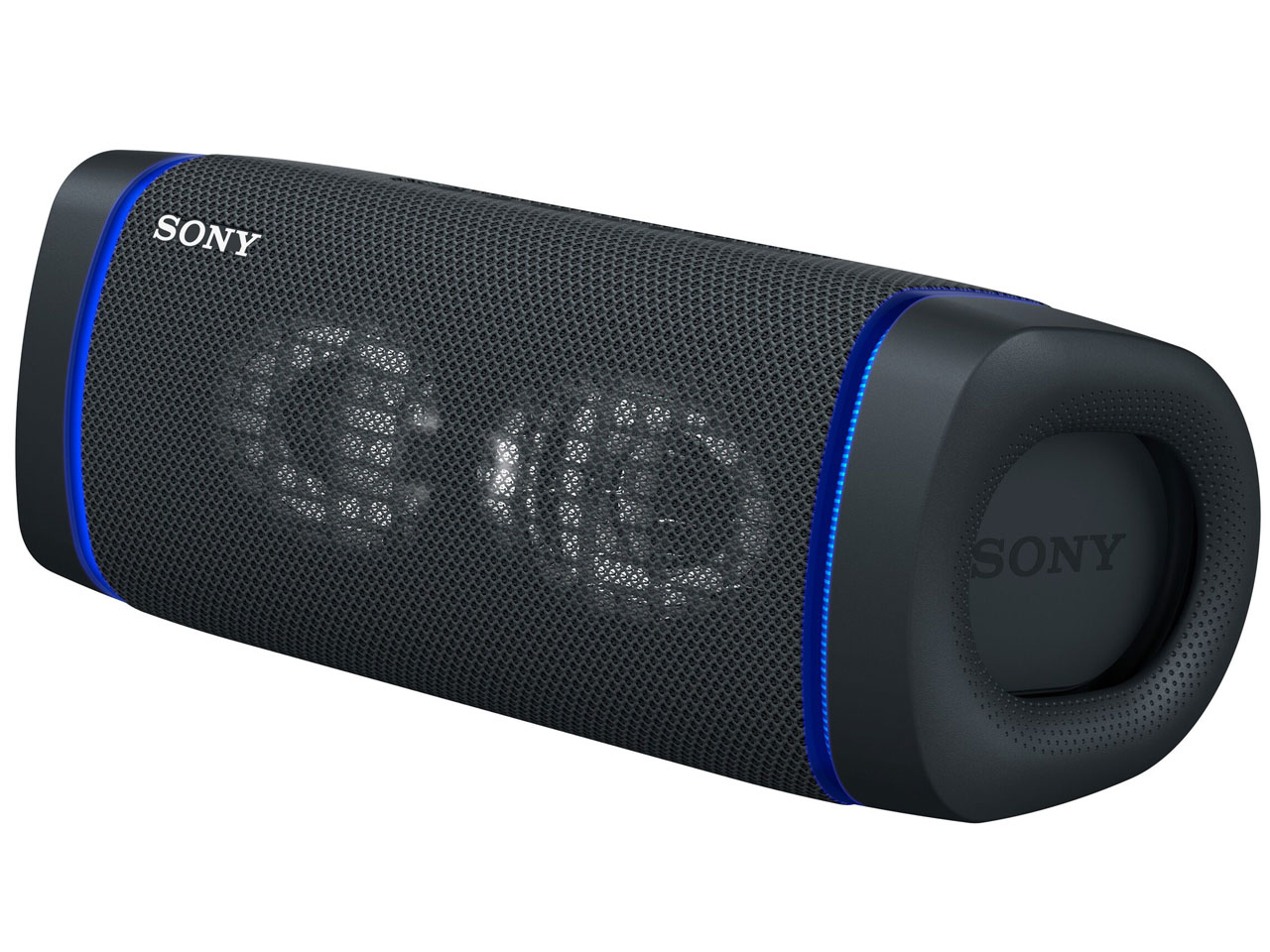
Sony SRS-XB33 — IP67, 24-hour battery at moderate volume, EXTRA BASS DSP mode, multi-color LED lighting, built-in microphone. Widely available from major online retailers. EXTRA BASS mode can produce audible distortion at high volumes, congesting midrange clarity; LED lighting is a meaningful battery drain that significantly reduces the 24-hour claim in practice; physically larger and heavier than the JBL Flip 6 and UE BOOM 3, reducing portability for hiking or backpacking; multi-speaker pairing limited to Sony-compatible speakers only.
The Sony SRS-XB33 is the choice when you want a single speaker to last the day, want EXTRA BASS for dance and hip-hop, and like the multi-color LED lighting for evening gatherings. The rated 24-hour battery is generous for the segment, though the real number drops well below that once LED lighting and high outdoor volumes enter the picture. EXTRA BASS DSP genuinely thickens the low end at moderate volumes but pushes the driver toward its excursion limit at high volume, where it can congest the midrange on vocals. IP67 dustproofing handles beach sand, the built-in mic supports speakerphone use, and Wireless Party Chain pairs with other Sony units. The XB33 is physically bigger and heavier than the Flip 6 and BOOM 3, which costs it some hiking-friendly portability.
Pros
- ✓Rated 24-hour battery for long sessions at moderate volume
- ✓EXTRA BASS DSP delivers genuinely fuller low end for dance music
- ✓Multi-color LED lighting and built-in mic for calls
Cons
- ✗EXTRA BASS at high volume can congest the midrange
- ✗Larger and heavier than the Flip 6 or BOOM 3, less hike-friendly
Ultimate Ears BOOM 3 — true 360-degree omnidirectional drivers, IP67, 15-hour battery, MagicButton one-tap custom playback shortcut, floats in water (on side). Widely available from major online retailers. cylindrical form factor rolls on uneven surfaces and is less pocketable than the Flip 6 or SoundLink Flex; bass output is adequate but not as punchy as JBL Flip 6 or as boosted as Sony EXTRA BASS; floats on its side in water rather than right-side-up like the SoundLink Flex; PartyUp multi-speaker protocol is UE-specific only.
The Ultimate Ears BOOM 3 is the only speaker in this comparison with genuine 360-degree omnidirectional drivers, which makes it the strongest choice when the speaker sits in the middle of a group at a campsite, picnic, or living room rather than facing one listener. IP67 protection and a 15-hour battery cover most outdoor sessions, and MagicButton lets you set a one-tap shortcut to a favorite playlist or streaming station without unlocking your phone. The cylindrical shape rolls on uneven surfaces and is less pocketable than the flat Flip 6 or SoundLink Flex. Bass is adequate rather than punchy, and while it floats, it floats on its side rather than right-side-up, which makes pool listening awkward. PartyUp links it to other UE speakers but stays within the UE family.
Pros
- ✓Genuine 360-degree omnidirectional drivers for table-center placement
- ✓MagicButton one-tap shortcut to a favorite playlist or station
- ✓IP67 protection plus a 15-hour battery
Cons
- ✗Cylindrical body rolls on uneven surfaces
- ✗Floats on its side rather than right-side-up
Subscribe to our newsletter
Occasional updates and new releases — no spam.
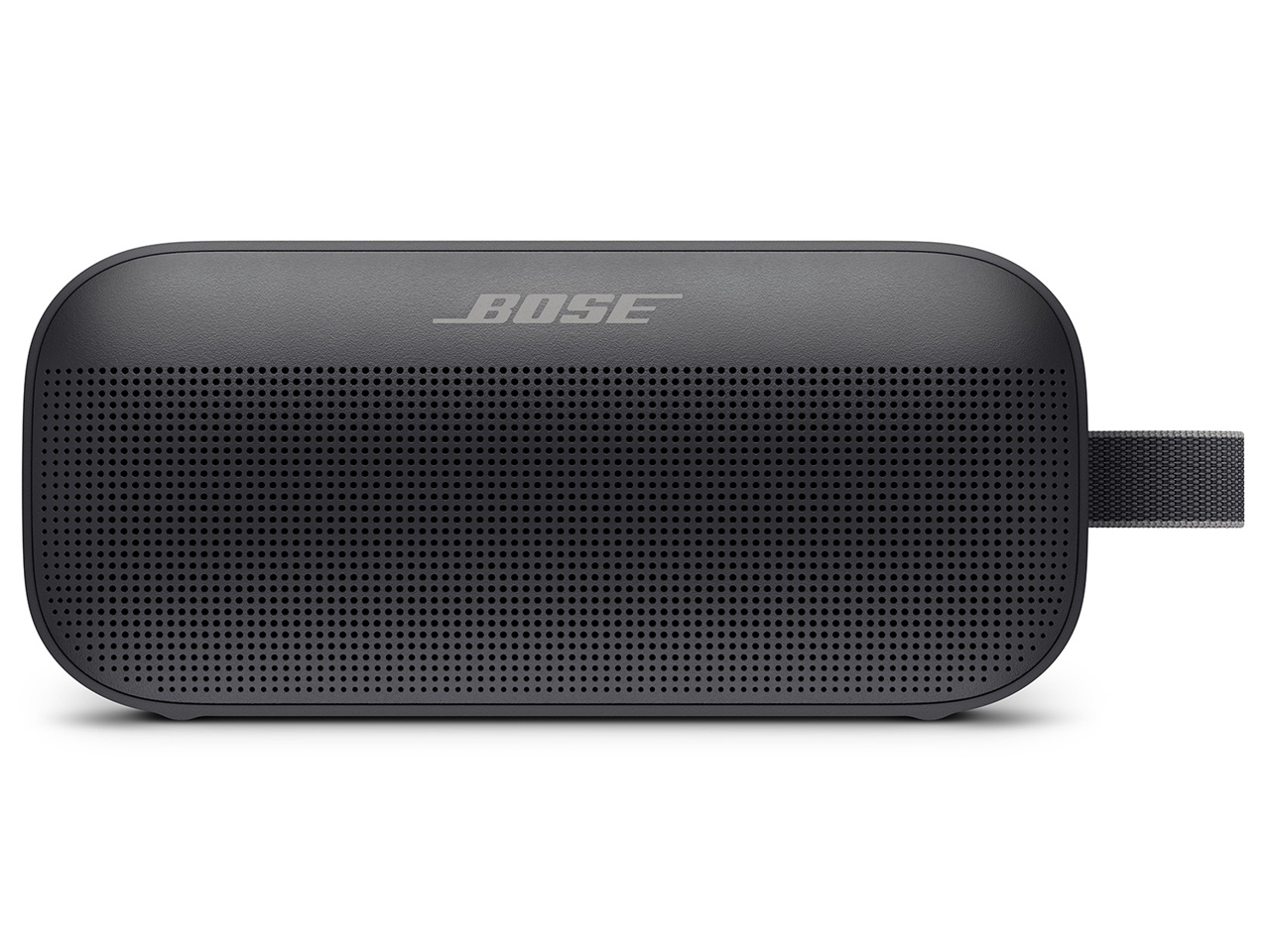
Bose SoundLink Flex — PositionIQ adaptive EQ adjusts to placement orientation, IP67, 12-hour battery, buoyant design floats right-side-up in water, outdoor acoustic tuning. Widely available from major online retailers. As the premium pick, the price is a real step up — the JBL Flip 6 gets competitive outdoor performance for less; 12-hour battery is tied for shortest in this comparison with the JBL Flip 6; stereo pairing with a second SoundLink Flex is supported but no large multi-speaker chain protocol like JBL PartyBoost; some features require the Bose Music app.
The Bose SoundLink Flex is the most performance-tuned outdoor option in this group, with PositionIQ adaptive EQ that detects whether the speaker is lying flat, standing upright, or hanging, and reshapes the soundstage accordingly. Outdoor-specific tuning makes it sound bigger than its size in open air, and the buoyant design floats right-side-up if it ends up in shallow water at the beach or pool. IP67 protection covers sand and grit. As the premium pick it is the most expensive option here, the 12-hour battery ties for shortest, and stereo pairing is limited to two SoundLink Flex units rather than a large chain like PartyBoost. Some app features depend on Bose Music. If outdoor use is the primary context, the premium is justified; if not, the Flip 6 captures most of the value for less.
Pros
- ✓PositionIQ adaptive EQ reshapes the soundstage to placement
- ✓Buoyant design floats right-side-up in water
- ✓Outdoor-tuned acoustics punch above the speaker's size
Cons
- ✗The most expensive option in this comparison
- ✗Pairs only with a second SoundLink Flex, no large chain protocol

Anker Soundcore 3 — IPX7 submersion protection, 24-hour battery at moderate volume, stereo pairing with a second unit, titanium composite drivers. Widely available from major online retailers. the audio quality gap between this budget pick and the mid-range and premium options is audible — drivers compress noticeably at high outdoor volumes compared to JBL or Bose; maximum output is lower than other speakers in this comparison, limiting outdoor use in noisy environments; IPX7 only, no certified dust protection (IP67); no multi-speaker chain beyond stereo pairing.
The Anker Soundcore 3 is the budget reference in this comparison, delivering IPX7 submersion protection, a rated 24-hour battery at moderate volume, and stereo pairing with a second unit for a true L/R setup that still costs less than a single Flip 6. The titanium composite drivers handle podcasts, background music, and bath-time playlists well, but they compress audibly at high outdoor volumes compared to the JBL or Bose, and the maximum output sits below the others, which shows in noisy or windy outdoor settings. IPX7 has no certified dust rating, so a Flip 6 or BOOM 3 is the better choice for dusty trails or fine beach sand. Multi-speaker capability tops out at stereo pairing. For casual indoor and pool-side use, it is a difficult speaker to argue against on price.
Pros
- ✓Budget price with rated 24-hour battery and IPX7 submersion
- ✓Stereo pairing with a second unit for true L/R audio
- ✓Titanium composite drivers cover podcasts and background music well
Cons
- ✗Audible driver compression at high outdoor volumes
- ✗IPX7 only — no certified dust rating for sand or grit environments
Which one is right for you?
First speaker buyers who want one good all-rounder
JBL Flip 6
IP67 protection, balanced tuning across genres, and PartyBoost future-proofing make it the easiest single-speaker recommendation without significant weakness at its price.
Solo campers and outdoor users who prioritize battery
Sony SRS-XB33
Rated 24-hour battery plus EXTRA BASS for music and LED lighting for ambience covers full-day solo outdoor sessions where charging is not convenient.
Groups who place the speaker in the middle of a gathering
Ultimate Ears BOOM 3
Genuine 360-degree omnidirectional drivers deliver consistent volume to listeners in every direction rather than concentrating it forward.
Beach, pool, and serious outdoor users
Bose SoundLink Flex
PositionIQ adaptive EQ and a right-side-up buoyant design make it the most performance-tuned outdoor option here, justifying the premium for outdoor-primary use.
Budget-first buyers and bathroom speaker users
Anker Soundcore 3
A budget price with rated 24-hour battery and IPX7 submersion is hard to argue against for casual indoor, bath, and pool-side listening.
How we compared
We did not run independent SPL measurements with a calibrated sound pressure level meter under controlled acoustic conditions. We did not perform frequency response testing using measurement microphones and analysis software in an anechoic or semi-anechoic environment. We did not conduct waterproof stress testing beyond published IP rating specifications — verifying submersion resistance to IEC 60529 standard requires controlled laboratory conditions. Rigorous portable speaker testing requires acoustic measurement equipment, a controlled listening environment, standardized test tones, and ideally outdoor field tests across representative environments — none of which are available here.
Instead, we relied on manufacturer specifications and published technical documentation — specifically JBL's published specifications for the Flip 6 passive radiator configuration and PartyBoost protocol, Sony's published EXTRA BASS processing details and IP67 certification for the SRS-XB33, Ultimate Ears' published omnidirectional driver arrangement for the BOOM 3 and MagicButton functionality, Bose's published documentation on PositionIQ adaptive EQ technology for the SoundLink Flex, and Anker's published IPX7 certification and titanium composite driver specifications for the Soundcore 3. We cross-referenced these with independent reviews from audio media and international sources including Rtings and What Hi-Fi. We aggregated long-term user reviews from major online retailers with attention to battery duration reports at various volume levels, water exposure real-world accounts, outdoor use complaints, and multi-speaker pairing reliability.
One framing note: Bluetooth speaker audio quality is substantially more subjective than almost any other product category in this comparison. EQ tuning — the manufacturer's choice of bass boost, midrange presence, and treble roll-off — shapes perceived sound quality more than raw driver specifications, and personal preference for bass-forward versus balanced tuning divides listener opinion in ways that measurements cannot fully resolve. We describe each speaker's tuning character as reported consistently across reviews, but we do not make universal sound quality rankings.
IP ratings explained — IPX7 vs IP67 vs IP68 in practice
IP ratings under IEC 60529 describe two independent protection axes: the first digit covers solid particle ingress (dust), the second covers liquid ingress. IPX7 means the solid particle rating is not specified or not tested (the X), while the 7 indicates protection against immersion in water up to 1 meter for 30 minutes. IP67 means both axes are rated: 6 is the highest dust-protection rating (completely dustproof), and 7 is the same 1-meter 30-minute submersion rating. IP68 extends the liquid protection beyond 1 meter and 30 minutes, per the manufacturer's specific test parameters.
Four of the five speakers in this comparison — JBL Flip 6, Sony SRS-XB33, Ultimate Ears BOOM 3, and Bose SoundLink Flex — carry IP67 ratings, meaning complete dustproofing plus water submersion to 1 meter for 30 minutes. The Anker Soundcore 3 carries IPX7, meaning submersion protection to 1 meter for 30 minutes without a specified dust protection rating. For most practical use cases — rain exposure, pool splashes, beach sand, bathroom condensation, accidental drops into water — the difference between IP67 and IPX7 is negligible. Dustproofing becomes relevant in genuinely dusty environments: construction sites, desert camping, fine beach sand that works into ports and grilles. In standard outdoor recreational contexts, IPX7 is adequate protection.
An important practical caveat applies to all IP-rated speakers: IP ratings are tested with sealed ports and no physical damage. A charging port that is not fully closed, a scratched or cracked housing, or any seal degradation over time can reduce actual water resistance below the rated specification. Manufacturers recommend rinsing with fresh water after saltwater exposure because salt accelerates seal degradation and can corrode internal components over time. None of the five speakers in this comparison should be treated as fully submersible for extended periods based on the IP67 or IPX7 rating alone — the ratings describe test conditions, not lifetime waterproofing guarantees.
Battery life reality — why 24 hours rarely means 24 hours
Manufacturer battery life claims for Bluetooth speakers are measured under controlled test conditions that systematically overstate real-world duration. The standard test protocol uses moderate volume (typically 50–60% of maximum output), a constant sine wave tone or pink noise signal, room temperature of approximately 25°C, and Bluetooth connected but with no adaptive features or LED lighting active. These conditions do not represent typical use.
Volume is the primary variable. Both the Sony SRS-XB33 (24-hour claim) and Anker Soundcore 3 (24-hour claim) achieve these numbers at volumes that are audible in a quiet room but significantly below outdoor-appropriate levels. At 70–80% volume in an outdoor setting — where you need to compete with ambient noise — battery life on both speakers drops to approximately 10–14 hours in practice, consistent with long-term user reports. The JBL Flip 6 (12-hour claim) and Bose SoundLink Flex (12-hour claim) are more conservative manufacturer estimates that align more closely with real-world use at moderate volumes, though outdoor high-volume use still reduces runtime.
Temperature also affects battery performance. Lithium-ion batteries lose effective capacity at temperatures below approximately 10°C — relevant for winter camping or mountain use — and degrade faster over time when stored in hot conditions, such as inside a car in summer. The Bose SoundLink Flex's outdoor-optimized design includes thermal management considerations that the other speakers do not specifically advertise. LED lighting, active on the Sony SRS-XB33 during party mode, is a meaningful battery drain. The practical recommendation for battery-critical use: turn off LED lighting on the Sony, use a speaker at its intended volume range rather than pushing it to maximum outdoor levels, and carry a USB-C power bank for extended outdoor sessions.
360-degree sound vs directional — which suits your use case
360-degree sound and directional sound describe fundamentally different driver configurations with different practical strengths. The JBL Flip 6 and Sony SRS-XB33 use a forward-facing primary driver configuration with passive radiators on the ends — the sound projects primarily in one direction, with the passive radiators adding bass and some rear diffusion but not true omnidirectional coverage. The Ultimate Ears BOOM 3 uses actual upward and outward-facing drivers arranged to project sound in all horizontal directions, which is a genuinely different acoustic configuration, not a marketing term.
For a speaker placed at the center of a group — on a table at a picnic, in the middle of a room at a party, at a campsite surrounded by multiple people — 360-degree omnidirectional output from the BOOM 3 ensures more consistent volume for listeners at all positions. For a speaker placed against a wall, facing a specific listening position, or used primarily as background music while someone sits in front of it, directional output from the Flip 6 or SRS-XB33 can concentrate audio energy toward the listener more efficiently, potentially sounding louder in the primary listening direction.
The Bose SoundLink Flex takes a different approach: PositionIQ technology detects the speaker's physical orientation and adjusts the EQ and driver output accordingly. When lying flat on its back (the stable outdoor position), the speaker adjusts the soundstage to project upward and outward. When standing upright, it delivers a more standard forward-facing soundstage. This adaptive approach means the SoundLink Flex performs competently in multiple configurations without requiring the listener to think about placement.
Where each fits
Group outdoor use, multi-speaker party chains, 360-degree listening, moderate budget: JBL Flip 6. PartyBoost compatibility allows linking multiple JBL PartyBoost-compatible speakers (Flip 6, Charge 5, Xtreme 3, and others) into a single synchronized audio system — relevant for parties, beach days, or campsites where you want to distribute sound across a space. Widely available from major online retailers. 12 hours is on the shorter end for a full day of outdoor use at reasonable volume — plan for a mid-day charge; the passive radiator configuration is not true 360-degree omnidirectional and loses some level for listeners directly behind the speaker; PartyBoost is JBL-specific and does not link with speakers from other brands; USB-C charging with no wireless option.
Extended solo outdoor use, party lighting, speakerphone calls, bass-heavy music, longest battery at moderate volumes: Sony SRS-XB33. The combination of 24-hour battery, EXTRA BASS mode, and multi-color LED lighting makes the SRS-XB33 a strong all-day companion for solo outdoor use or small gatherings where ambient lighting matters. Widely available from major online retailers. EXTRA BASS mode boosts low frequencies in a way that can overwhelm midrange clarity — vocals and acoustic instruments can sound congested when EXTRA BASS is active; the LED lighting, while fun, is a meaningful battery drain that reduces the 24-hour claim; the SRS-XB33 is physically larger and heavier than the Flip 6 and BOOM 3, making it less pocket-friendly for hiking; multi-speaker pairing is limited to two SRS-XB33 units in stereo mode.
True omnidirectional table-center placement, camping groups, outdoor social gatherings, custom shortcut button: Ultimate Ears BOOM 3. The BOOM 3's cylindrical driver array delivers consistent volume for listeners in all directions, making it the strongest choice when the speaker is in the center of a group rather than positioned toward a specific audience. MagicButton allows setting a one-tap shortcut to a specific playlist, track, or streaming station. Widely available from major online retailers. the cylindrical form factor is less pocketable than the flat Flip 6 or SoundLink Flex — it rolls if placed on an uneven surface; bass output is adequate but not as punchy as the JBL Flip 6 or as deep as the Sony EXTRA BASS mode; the BOOM 3 does not natively float right-side-up (it floats but on its side), so it is not the best choice for pool use; 15-hour battery is good but not the category leader.
Outdoor premium, PositionIQ adaptive sound, buoyant pool use, performance-focused camping: Bose SoundLink Flex. The SoundLink Flex is the highest-performing outdoor speaker in this comparison by the metrics most relevant to outdoor use: adaptive EQ that adjusts to placement, purpose-built outdoor acoustic tuning, buoyant design that floats right-side-up in water. It is the most expensive option. Widely available from major online retailers. The premium is real — the JBL Flip 6 gets 75-80% of the outdoor performance for the use cases where PositionIQ's adaptive tuning is not the differentiating factor; 12-hour battery is tied for the shortest in this comparison; the SoundLink Flex does not support multi-speaker pairing in the same way as JBL's PartyBoost — it can pair two SoundLink Flex units for stereo, but it does not link into larger speaker chains; Bose App dependency for some features.
Best budget, bath and pool use, stereo dual-speaker setup on a budget, casual outdoor background music: Anker Soundcore 3. As the budget option, the Soundcore 3 delivers IPX7 submersion protection, 24-hour battery, and stereo pairing with a second unit at a price point where the JBL Flip 6 costs three times as much. Widely available from major online retailers. the audio quality gap between the budget Soundcore 3 and the mid-range and premium options is real and audible — the Soundcore 3's titanium composite drivers produce adequate sound at moderate volumes but compress noticeably at high volumes compared to JBL or Bose; maximum output is lower than JBL Flip 6 or SoundLink Flex, which matters for outdoor use in windy or noisy environments; the Soundcore 3 lacks the outdoor acoustic optimization of the SoundLink Flex or the PartyBoost multi-speaker chain capability of the JBL; IPX7 without the dust protection of IP67.
Seasonal and use-case context
Portable Bluetooth speaker demand follows specific seasonal and cultural patterns that shape which features matter. Camping has experienced a sustained popularity surge since 2020, with solo camping in particular driving demand for compact, waterproof speakers that can accompany a single person at a remote campsite. For this use case, battery life and weather resistance take priority over maximum volume or multi-speaker chaining — the Anker Soundcore 3 or Sony SRS-XB33 serve this context well at their respective price points.
Beach use along the coast presents saltwater exposure as the primary concern. As noted in the IP section, all five speakers should be rinsed with fresh water after saltwater exposure. The Bose SoundLink Flex's buoyant design specifically addresses the common beach scenario of a speaker being knocked into shallow surf, and its IP67 certification includes the complete dustproofing that matters for fine sand environments.
Bathroom and steam-room use is a realistic use case that is rarely discussed in reviews. The humid, steam-heavy environment of a bathroom or changing room is distinct from submersion — it is continuous high-humidity exposure rather than a single splash event. IPX7 and IP67 ratings cover acute water exposure, not extended steam exposure. For bathroom use specifically, all five speakers in this comparison are regularly used in that context based on long-term review content, but none of the manufacturers explicitly warrant them for continuous high-humidity environments. In practice, the sealed designs handle bathroom use reliably according to long-term user reports, but the warranty implication is worth noting.
Major online retailers are all reliable sources for all five speakers, often running campaigns that reduce effective price. The Bose SoundLink Flex and Ultimate Ears BOOM 3 occasionally appear with promotions that bring their effective price within range of the JBL Flip 6. Anker products maintain consistent pricing with frequent deals. All five are available with manufacturer warranty and local customer support.
Our pick and honest caveats
For most users who want a single speaker for a mix of outdoor, home, and social use: JBL Flip 6. The combination of IP67 dustproofing and waterproofing, 12-hour practical battery life, PartyBoost for future speaker chain expansion, and consistently balanced audio at a mid-range price point makes it the most versatile option in this comparison. It is not the best at any single metric — the SoundLink Flex sounds better outdoors, the BOOM 3 disperses better in 360 degrees, the Sony and Anker offer longer battery life — but it has no significant weakness at its price.
For users who prioritize battery life above everything else and do not need premium audio: Anker Soundcore 3. The budget price point is genuinely hard to argue against for casual use. Buy two for a stereo pair and you still spend less than a single JBL Flip 6. The sound quality gap is real but matters less for background music than for attentive listening.
For users who take the speaker to genuinely outdoor environments — beach, mountain camping, kayaking — and want the speaker that handles those conditions best regardless of price: Bose SoundLink Flex. The PositionIQ adaptation and buoyancy are genuine outdoor-specific features, not marketing additions. The premium price is justified if outdoor use is the primary context.
One honest caveat across all five: maximum outdoor volume is a function of speaker size and driver efficiency. Compact Bluetooth speakers are not designed to fill a large outdoor space or compete with ambient noise at a crowded beach — that use case requires a larger speaker in the Charge or Xtreme class. If you regularly need to fill a large outdoor area, the five speakers in this comparison will disappoint at their volume ceiling.
Pairing and multi-speaker setups
Multi-speaker pairing capability varies significantly across these five products and is not universally compatible. JBL PartyBoost allows linking multiple JBL PartyBoost-compatible speakers into either a synchronized mono playback system (all speakers play the same audio simultaneously) or a stereo pair (two speakers, one playing left channel, one playing right). PartyBoost is available on Flip 6, Charge 5, Pulse 5, Xtreme 3, and other current JBL portable speakers. The key limitation: PartyBoost only works with PartyBoost-compatible JBL speakers and does not link with speakers from other brands.
The Sony SRS-XB33 supports Wireless Party Chain for linking multiple Sony speakers into a synchronized playback chain, similar in concept to JBL's PartyBoost. It also supports stereo pairing with a second SRS-XB33. As with JBL, Sony's multi-speaker system is Sony-specific and does not link with JBL or other brands. If you already own a Sony speaker or are building a Sony ecosystem, this matters. If you are buying a first speaker and may add a second later from any brand, the cross-brand incompatibility is worth knowing upfront.
The Ultimate Ears BOOM 3 supports PartyUp — UE's equivalent multi-speaker protocol — which links the BOOM 3, MEGABOOM 3, WONDERBOOM 3, and other UE speakers into a synchronized playback group of up to 150 speakers on the same Wi-Fi network. Like JBL and Sony, PartyUp is UE-specific. The Bose SoundLink Flex supports stereo pairing with a second SoundLink Flex but does not have a large multi-speaker chain protocol. The Anker Soundcore 3 supports stereo pairing only.
The practical implication: if multi-speaker chaining matters to your use case, buy into one ecosystem rather than mixing brands. JBL's PartyBoost ecosystem is the largest and most widely available, with the broadest range of compatible speakers at different size and price points.
Frequently asked questions
Which speaker is loudest outdoors?▼
What is the difference between a Bluetooth speaker and a smart speaker?▼
What is the actual difference between IP67 and IPX7?▼
Can I connect two different brand Bluetooth speakers together?▼
Is it safe to use a Bluetooth speaker in the bathroom?▼
Does EXTRA BASS mode on Sony actually improve bass, or is it just distortion?▼
Prices change. Check the retailer for the current price.
Comments & questions
Discussion happens on nattzy, our community forum. Sign in with Google to post — it takes a second.