Best Portable Charger 2026: 5 Power Banks Compared
Five portable chargers priced from around $22 to $100, covering the range from thin pocket-sized 10,000mAh slabs to high-wattage 24,000mAh bricks that charge a MacBook Pro at wall-charger speed. Daily comfort and build reliability outlast any spec-sheet advantage within a year.
Quick answer
For most people the Anker PowerCore Slim 10000 is the right buy: a 186g flat slab around $22 that disappears into a jacket pocket and delivers roughly two full iPhone charges. Step up to the Anker 737 PowerCore 24K only if you charge a laptop away from outlets — its 140W total output refills a 15-inch MacBook Pro at wall-charger speed while staying under the 100Wh airline limit. The Mophie Powerstation PD costs more for build quality and an 18W USB-C port rather than extra capacity.
Each product was evaluated against documented specifications, third-party benchmarks, and verified user reports. We scored features, performance, build quality, ecosystem compatibility, and total cost of ownership.

Anker PowerCore Slim 10000 Portable Charger
Best for Daily Commute: The Anker PowerCore Slim 10000 is the right pick for the most common use case — daily commute emergency phone charging at the lightest possible weight. The 186g flat slab is roughly the size and shape of two stacked iPhones, slim enough to forget it's in a jacket pocket and able to slide into a laptop bag back pocket where cylindrical banks would roll around.
Top picks ↓| Product | Price | Link |
|---|---|---|
| $25.99Reference price | ||
| $109.99Price as of 2026-09-24 | ||
| $29.99〜$49.99Reference price | ||
| $41〜$59.99Reference price | ||
| $17.99〜$29.99Reference price | ||
| $20〜$30Reference price | No partner store here — this opens an Amazon search. |
Top picks
Related articles


Anker PowerCore Slim 10000 Portable Charger
Lightest commuter pick — 186g flat slab, 10,000mAh, USB-C + USB-A at 12W. Fits in a jacket pocket. Slow 12W output won't match modern fast chargers; no percentage display, only LED dots.
The Anker PowerCore Slim 10000 is the right pick for the most common use case — daily commute emergency phone charging at the lightest possible weight. The 186g flat slab is roughly the size and shape of two stacked iPhones, slim enough to forget it's in a jacket pocket and able to slide into a laptop bag back pocket where cylindrical banks would roll around. 10,000mAh delivers approximately 2 full iPhone 15 charges or 1.5 charges of a Samsung Galaxy S24 Ultra, with USB-C and USB-A outputs at 12W each and overnight recharge in 4-5 hours via 18W USB-C input. At around 22 USD this is the value benchmark for a daily-carry charger. The honest tradeoffs: 12W USB-C output is noticeably slower than the 20W Apple charger that most modern phones expect, and the remaining-capacity indicator is LED dots only (no precise percentage display).
Pros
- ✓186g flat slab — disappears in a jacket pocket or bag pocket
- ✓10,000mAh delivers approximately 2 full iPhone 15 charges
- ✓USB-C and USB-A outputs at 12W each cover most phones
- ✓Around 22 USD — the value benchmark in this comparison
Cons
- ✗12W USB-C output is slower than modern 20W fast chargers
- ✗LED-dot capacity indicator — no precise percentage display

Anker 737 Power Bank (PowerCore 24K)
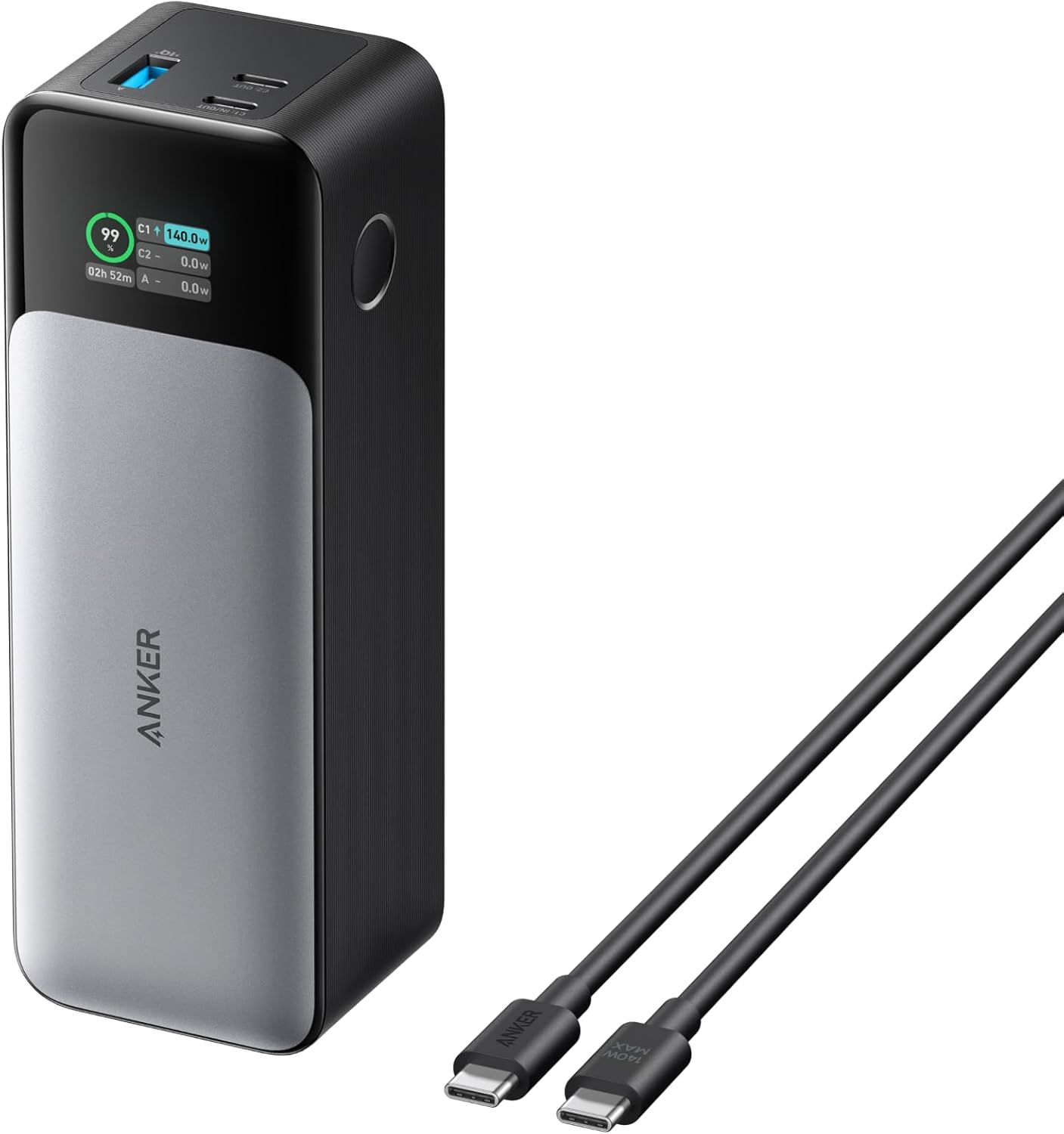
Best for laptop users — 24,000mAh at 88.8Wh (under airline limit), 140W USB-C, digital display, recharges in 2.5 hours. 443g and $100 price tag; belongs in a bag, not a pocket.
The Anker 737 Power Bank (PowerCore 24K) is the high-end pick for buyers who charge a laptop away from outlets. 24,000mAh at 88.8Wh stays under the 100Wh airline carry-on limit, dual USB-C ports each support 100W output, total 140W output charges a 15-inch MacBook Pro at approximately wall-charger speed, and the dual-port 65W input recharges the bank itself in about 2.5 hours — faster per mAh than the slim unit. The digital display shows exact battery percentage rather than LED dots, which matters when planning charge windows during a 3-hour layover. At around 100 USD this is a considered purchase. The honest tradeoffs: 443g and 86 × 62 × 33mm — this is a brick that belongs in a bag rather than a pocket, and the price is roughly five times the value picks for users whose primary need is phone charging.
Pros
- ✓140W USB-C output charges a 15-inch MacBook Pro at wall-charger speed
- ✓24,000mAh at 88.8Wh stays under the 100Wh airline carry-on limit
- ✓Digital display shows exact battery percentage
- ✓Dual-port 65W input recharges the bank in about 2.5 hours
Cons
- ✗443g is a brick that belongs in a bag, not a pocket
- ✗100 USD is roughly five times the value picks for phone-only users
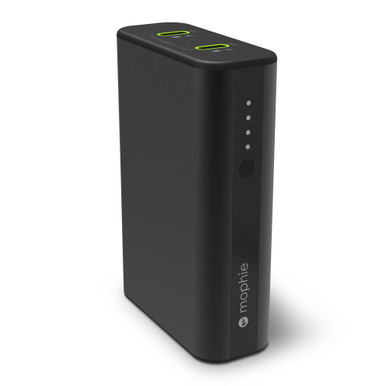
Premium build pick — Mophie's slim form with above-average long-term build quality. 10,000mAh, 18W USB-C. You're paying for aesthetics and reliability, not for charging speed or capacity density.
The Mophie Powerstation PD is the premium-build pick for buyers who care about long-term reliability and aesthetics alongside function. 10,000mAh in Mophie's signature slim form with USB-C PD output at 18W and a single USB-A port, finished in fabric or aluminum depending on variant. Mophie's build quality is consistently rated higher than budget alternatives in long-term reviews — fewer reports of rattling, port wobble, or LED failure at the 18-month mark compared to no-name brands at similar capacity. At around 50 USD this is roughly twice the price per mAh of the Anker Slim. The honest tradeoffs: you are paying for Mophie brand and premium finish rather than charging speed or capacity density, the 18W USB-C output is better than the Anker Slim's 12W but still below the 20W threshold that fully enables modern phone fast charging, and at this capacity tier there are faster-charging options at lower prices.
Pros
- ✓Mophie signature slim form with fabric or aluminum finish
- ✓Build quality rated higher than budget brands at 18+ month mark
- ✓18W USB-C PD output — faster than the Anker Slim's 12W
- ✓Premium aesthetics suit travel and lifestyle carry
Cons
- ✗Roughly twice the price per mAh of the Anker Slim
- ✗18W output still below the 20W modern phone fast-charge threshold
Subscribe to our newsletter
Occasional updates and new releases — no spam.

Value power-user pick — 20,000mAh, 65W USB-C (MacBook Air full-speed), digital percentage display, $36. Less brand track record than Anker; 2+ year quality data more mixed. Good if laptop charging matters but $100 Anker 737 is too steep.
The Baseus Adaman 65W is the value pick for buyers who need laptop-charging ability without paying Anker 737 prices. 20,000mAh with USB-C PD at 65W charges a 13-inch MacBook Air at full speed — practically identical to plugging into a wall adapter — and a small LED display shows exact battery percentage rather than LED dots. USB-A at 18W handles phone charging adequately. At around 36 USD this is roughly one-third the Anker 737 price for users whose laptop is a thin Mac or Windows ultrabook rather than a 15-inch power-hungry workstation. The honest tradeoffs: Baseus is a Chinese brand less established than Anker, replacement and support infrastructure is thinner, long-term (2+ year) quality data is more mixed than Anker flagship units, and 310g is heavier than slim designs but lighter than the Anker 737.
Pros
- ✓65W USB-C PD charges a 13-inch MacBook Air at wall-charger speed
- ✓20,000mAh capacity at around 36 USD — strong price per Wh
- ✓Digital display shows exact battery percentage
- ✓Lighter than Anker 737 at 310g for thin-laptop travelers
Cons
- ✗Baseus brand support thinner than Anker
- ✗Long-term quality data more mixed at 2+ years vs Anker flagships

INIU 10000mAh Portable Charger
Budget fast-charging pick — 10,000mAh, 20W USB-C at the same price as the Anker Slim. Faster charging than the Anker Slim; shorter brand track record. Right pick if charging speed matters more than form factor at sub-$25.
The INIU 10000mAh Portable Charger is the right pick for budget buyers who want genuine fast charging without paying for Mophie's premium finish. 10,000mAh with USB-C output at 20W — the only sub-25 USD unit in this comparison that hits 20W on USB-C — and USB-A at 22.5W handles fast-charge Android phones competently. At 20W the INIU charges an iPhone 15 to 50% in under 30 minutes, genuinely matching wall-adapter speed. LED percentage display improves on the Anker Slim's LED dots. At around 22 USD this matches the Anker Slim price while winning on USB-C wattage (20W vs 12W). The honest tradeoffs: INIU is a newer brand with less long-term quality data than Anker, the 18-month and 3-year failure patterns are not as well documented, and the durability track record is shorter even though short-term build quality reviews are solid.
Pros
- ✓20W USB-C output at sub-25 USD price — fast iPhone 15 charging
- ✓USB-A at 22.5W handles fast-charge Android phones
- ✓LED percentage display rather than dots-only indicator
- ✓10,000mAh in compact form at the Anker Slim price
Cons
- ✗Newer brand with shorter long-term quality track record
- ✗18-month and 3-year failure patterns less well documented than Anker

Budget fast-charging pick — 10,000mAh, 20W USB-C at the same price as the Anker Slim. Faster charging than the Anker Slim; shorter brand track record. Right pick if charging speed matters more than form factor at sub-$25.
The INIU 10000mAh Portable Charger is the right pick for budget buyers who want genuine fast charging without paying for Mophie's premium finish. 10,000mAh with USB-C output at 20W — the only sub-25 USD unit in this comparison that hits 20W on USB-C — and USB-A at 22.5W handles fast-charge Android phones competently. At 20W the INIU charges an iPhone 15 to 50% in under 30 minutes, genuinely matching wall-adapter speed. LED percentage display improves on the Anker Slim's LED dots. At around 22 USD this matches the Anker Slim price while winning on USB-C wattage (20W vs 12W). The honest tradeoffs: INIU is a newer brand with less long-term quality data than Anker, the 18-month and 3-year failure patterns are not as well documented, and the durability track record is shorter even though short-term build quality reviews are solid.
Pros
- ✓20W USB-C output at sub-25 USD price — fast iPhone 15 charging
- ✓USB-A at 22.5W handles fast-charge Android phones
- ✓LED percentage display rather than dots-only indicator
- ✓10,000mAh in compact form at the Anker Slim price
Cons
- ✗Newer brand with shorter long-term quality track record
- ✗18-month and 3-year failure patterns less well documented than Anker
No partner store here — this opens an Amazon search.
Which one is right for you?
For daily commute and emergency phone charging
Anker PowerCore Slim 10000 Portable Charger
186g flat slab with 10,000mAh in a 22 USD price covers daily phone-only emergency charging at the lightest possible weight.
For laptop charging away from outlets
Anker 737 Power Bank (PowerCore 24K)
140W output and 24,000mAh under the airline carry-on limit charges a 15-inch MacBook Pro at wall-charger speed for remote workers.
For travelers who value premium build and aesthetics
Mophie Powerstation PD
Mophie's slim aluminum/fabric finish with above-average long-term reliability suits lifestyle and travel carry.
For thin-laptop users who want 65W without Anker 737 pricing
Baseus Adaman 65W Power Bank
65W USB-C charges a 13-inch MacBook Air at full speed for one-third the Anker 737 price with digital percentage display.
For budget buyers who prioritize charging speed
INIU 10000mAh Portable Charger
20W USB-C output at the Anker Slim price beats it on charging speed for buyers who value wattage over brand pedigree.
mAh capacity: what the number actually means
10,000mAh is the most common portable charger capacity and the right starting point for most people. At 3.7V (the internal cell voltage), 10,000mAh stores 37Wh of energy. A typical iPhone 15 has a 3,349mAh battery at 3.86V — about 12.9Wh. In theory, a 10,000mAh bank stores 2.87 iPhone 15 charges. In practice, you get roughly 1.8 to 2.2 full charges, because DC-to-DC conversion in the bank and the cable loses 20-25% of stored energy as heat, and you rarely start charging from 0%. The honest rule of thumb: a 10,000mAh bank gives you about 2 full iPhone 15 charges, or 1.5 charges of a large Android phone (Samsung Galaxy S24 Ultra, 5,000mAh battery), or 0.3 charges of a 15-inch laptop (MacBook Pro 15-inch has a 99.6Wh battery).
20,000mAh doubles the count: roughly 4 phone charges, 3 large Android charges, 0.6 MacBook Pro charges. The Anker 737 at 24,000mAh pushes this to about 5 phone charges or 0.7 MacBook Pro charges — more meaningful laptop charging, though still not a full laptop charge from zero. Beyond 27,000mAh (roughly 100Wh at 3.7V, though manufacturers calculate differently), you cross the airline carry-on limit and the bank has to go in checked baggage or stay home. This catches travelers who buy the largest bank they can find without checking the Wh rating — IATA regulations prohibit lithium batteries above 100Wh in carry-on without airline approval, and above 160Wh outright. Both Anker units in this comparison pass at under 100Wh; always verify with your specific airline before flying.
USB-C PD wattage: why 20W is not the same as 45W
USB-C Power Delivery wattage determines how fast a device charges, and the gap between low-wattage and high-wattage banks is more significant than the mAh number for many users. At 12W output (the Anker PowerCore Slim 10000 on its USB-C port), an iPhone 15 charges to roughly 50% in an hour — usable but noticeably slower than the 20W Apple USB-C charger. At 20W output, the same iPhone 15 reaches 50% in under 30 minutes, which is what most people expect from 'fast charging.' For Android phones with 25W or 45W fast-charge support, a bank that only outputs 12-15W will feel slow even if the phone's indicator says it's charging.
For laptops, the wattage requirement jumps significantly. A 13-inch MacBook Air charges adequately at 30W but noticeably faster at 45W — the difference between arriving at a meeting with your laptop recharged versus still at 40%. A 15-inch MacBook Pro needs 67W or higher for full-speed charging; anything below that charges it but slower than it discharges under load, meaning the battery percentage goes down even while plugged into the bank. The Anker 737 at 140W output changes this math entirely: it charges the 15-inch MacBook Pro at approximately wall-charger speed, which is why it exists as a product category despite being twice the weight and price of 65W alternatives. The real-world summary: if your primary device is a phone, 20W output is sufficient. If you regularly charge a laptop from a bank, 45W output is the practical floor, and 100W+ meaningfully compresses charging time on larger laptops.
Pass-through charging, recharge time, and the overnight problem
Pass-through charging means using the power bank to charge your devices while the bank itself is simultaneously charging from a wall outlet. All five banks in this comparison support pass-through, but there are practical limits. Most manufacturers recommend against regular pass-through use — charging while discharging simultaneously generates extra heat inside the battery cells, and sustained heat is the primary factor that degrades lithium ion battery capacity over time. Occasional use (charging in a hotel room while the bank also charges your phone) is fine; using the bank as a permanent pass-through adapter on your desk for months shortens its usable lifespan.
Recharge time for the bank itself is the spec that most comparison articles skip, and it matters if you need the bank fully charged for a morning departure. The Anker PowerCore Slim 10000 recharges from zero in about 4-5 hours via USB-C at 18W input — acceptable if you plug it in the night before but inconvenient for same-day top-ups. The Anker 737 at 24,000mAh with its dual-port 65W input recharges in about 2.5 hours, which is faster per mAh than the slim unit and makes it practical to top up the bank while working during a 3-hour layover. The INIU 10000mAh with its 18W input recharges in about 4 hours. The Mophie Powerstation PD and Baseus Adaman match the 4-5 hour range. If fast bank recharge matters for your workflow, it's worth checking the input wattage in the spec sheet — banks that accept 30W+ input noticeably shrink the overnight window.
Airline carry-on rules: the 100Wh limit explained
IATA regulations (followed by most airlines worldwide) allow lithium batteries up to 100Wh in carry-on luggage without prior airline approval. Between 100Wh and 160Wh, you need airline approval and are limited to two batteries total. Above 160Wh, portable batteries are prohibited in both carry-on and checked baggage. For checked baggage: loose lithium batteries are prohibited at any capacity — they must be in carry-on. A power bank in checked baggage with no protection against accidental activation is a fire hazard under pressurized cargo conditions, which is why the rules are structured this way.
The practical translation: 10,000mAh at 3.7V = 37Wh, well under the limit. 20,000mAh at 3.7V = 74Wh, under the limit. 27,027mAh at 3.7V = exactly 100Wh — the mathematical ceiling. In practice, manufacturers round cell voltage slightly differently and their Wh ratings are authoritative; the Anker 737 is rated at 88.8Wh (24,000mAh × 3.7V = 88.8Wh), which clears the limit. Products often display capacity in mAh without the Wh rating prominently; to calculate, multiply mAh by 3.7 and divide by 1000 to get Wh. If you're unsure, carry the bank in your personal item bag and have the Wh spec accessible on your phone — some airlines ask to see it at the security checkpoint.
Form factor: slim and flat versus cylindrical
The Anker PowerCore Slim 10000 and Mophie Powerstation PD are flat slab designs — roughly the size and shape of two stacked iPhones. This form factor fits in a jacket pocket, slides into the back pocket of a laptop bag where a cylindrical bank would roll around, and feels less like carrying dedicated gear. The trade-off is typically lower wattage output (the flat pack geometry limits the heat dissipation that high-wattage circuits require) and slightly lower energy density per gram compared to cylindrical cells. The Anker 737, Baseus Adaman, and INIU use a more compact rectangular form, denser than the slim slab but not cylindrical — the Anker 737 is 86 × 62 × 33mm and 443g, which is noticeably heavier than the 186g slim unit but manageable in a bag.
The weight difference matters more on long travel days than in daily commuting. The Anker PowerCore Slim 10000 at 186g is nearly unnoticeable in a bag; the Anker 737 at 443g is present in a way you'll notice on a full travel day. For commuters who pack light and need one guaranteed phone charge, the weight-to-utility ratio of a 10,000mAh slim bank is hard to beat. For travelers managing a laptop, phone, earbuds, and a tablet through a 12-hour travel day, the 443g of the Anker 737 is the price of not hunting for outlets.
Where each fits
If you commute daily and want one emergency phone charge that fits in a coat pocket, Anker PowerCore Slim 10000 at around $22 is the pick. 10,000mAh in a 186g flat slab — thin enough to forget it's in your pocket. USB-C output at 12W and USB-A at 12W covers most phones adequately, though not at maximum fast-charge speed. Charges in 4-5 hours overnight. The honest limitation: 12W USB-C output is noticeably slower than modern fast chargers; anyone used to 20W+ charging will feel the difference on short charging windows. Also one of the few units in this comparison without a digital display — the LED dots tell you approximate remaining capacity (4 dots = roughly >80%) but not a precise percentage. Right pick for the daily commuter who wants light weight and emergency coverage.
If you charge a laptop away from outlets and need 140W output, Anker 737 Power Bank (PowerCore 24K) at around $100 is the high-end pick. 24,000mAh in an 88.8Wh package (under airline carry-on limit), dual USB-C ports each capable of 100W, one USB-A port, and a digital display showing percentage rather than LED dots. Charges the 15-inch MacBook Pro at approximately wall-charger speed. Recharges itself in about 2.5 hours via 65W input — faster per mAh than the slim unit. The honest limitation: 443g and 86 × 62 × 33mm, it's a brick that belongs in a bag rather than a pocket. At $100 it's a considered purchase, not an impulse buy. Right pick for remote workers, long-haul travelers, or anyone for whom a dead laptop is a real cost.
If you want a premium brand with clean aesthetics for travel, Mophie Powerstation PD at around $50 is the lifestyle pick. 10,000mAh in Mophie's signature slim form, USB-C PD output at 18W, single USB-A port, fabric or aluminum finish depending on variant. Mophie's build quality is consistently rated higher than budget alternatives in long-term reviews — fewer reports of rattling, port wobble, or LED failure at the 18-month mark. The honest limitation: 10,000mAh at $50 is twice the price per mAh of the Anker Slim — you're paying for the Mophie brand, the premium finish, and the build quality. Output at 18W is better than the 12W Anker Slim but still below the 20W that enables modern phone fast-charging fully. Right pick if aesthetics and build quality matter alongside function.
If you want a digital display and 65W output for under $40, Baseus Adaman 65W at around $36 is the value power-user pick. 20,000mAh, USB-C PD at 65W (enough for most thin laptops), USB-A at 18W, and a small LED display showing exact battery percentage. At 65W output, the Baseus Adaman charges a 13-inch MacBook Air at full speed — practically identical to plugging into a wall adapter. The digital display is a real-world improvement over LED dots for users who need to know whether they have 40% or 20% left before a meeting. The honest limitation: Baseus is a Chinese brand that's less established than Anker; replacement and support infrastructure is thinner, and the long-term (2+ year) quality data is more mixed than for Anker's flagship units. Also 310g, heavier than the slim designs but lighter than the Anker 737. Right pick for someone who wants laptop-charging ability without the Anker 737's price.
If you want the cheapest option that actually charges a phone quickly, INIU 10000mAh Portable Charger at around $22 is the budget pick. 10,000mAh, USB-C output at 20W (the only sub-$25 unit in this comparison to hit 20W on USB-C), USB-A at 22.5W, LED percentage display. At 20W, it charges an iPhone 15 to 50% in under 30 minutes — genuinely fast, not compromised. The honest limitation: INIU is a newer brand with less long-term quality data than Anker; the 18-month and 3-year failure patterns aren't as well documented. Build quality in short-term reviews is solid, but the durability track record is shorter. At the same price as the Anker Slim, the INIU wins on USB-C wattage (20W vs 12W) but loses on brand confidence. Right pick for budget-conscious users who prioritize charging speed over brand pedigree.
Verdict
For most people, the decision splits cleanly by use case. The Anker PowerCore Slim 10000 at $22 handles the daily commute phone-charge scenario at the lightest possible weight — if that's the use case, nothing in this comparison beats the value. The INIU 10000mAh at the same price beats it on charging speed (20W vs 12W USB-C) if fast charging matters more than form-factor slim-ness.
Step up to the Mophie Powerstation PD at $50 if build quality and aesthetics are real priorities alongside function. Step up to the Baseus Adaman at $36 if 65W laptop charging is needed at half the price of the Anker 737. Step up to the Anker 737 at $100 if 140W output and the best bank recharge speed in this comparison justify the weight and price — the case is solid for remote workers and serious travelers, weak for anyone who only needs phone charging. If you also carry a second screen, note that most portable monitors expect the laptop to send video and power over one USB-C cable; our portable monitor comparison explains that single-cable test.
Frequently asked questions
How many times will a 10,000mAh power bank charge my phone?▼
Can I take a portable charger on a plane?▼
What's the difference between 12W, 20W, and 45W USB-C output?▼
Should I leave a power bank plugged in all the time?▼
Why does my power bank feel warm while charging my phone?▼
Does a higher mAh always mean better?▼
Prices change. Check the retailer for the current price.
Comments & questions
Discussion happens on nattzy, our community forum. Sign in with Google to post — it takes a second.
Related articles

Best Portable Power Stations 2026: Jackery vs EcoFlow

Best USB-C Chargers 2026: Anker vs UGREEN vs Satechi

Best Portable Air Conditioner 2026: 5 Compared
Best Coffee Grinders 2026: Five mills side-by-side

Best Electric Toothbrush 2026: 5 models compared honestly
Best Air Purifier 2026: 5 models compared honestly