Best Window Air Conditioner 2026: 5 Compared
Window air conditioners have converged on capacity — an 8,000 BTU unit from any of these brands cools about the same room. What separates them is noise, how much of the window you lose, and how bad the install is.
Quick answer
Start with the Midea U: the U-shaped body puts the window glass between the compressor and the room and the inverter compressor removes cycling noise, so it is quieter by physical design while the sash still closes and locks. Measure your sill first. The GE Profile ClearView is the low-profile 10,000 BTU inverter that preserves the view, the LG is a cheaper conventional box with Wi-Fi, the Frigidaire is the lowest-price no-frills unit, and the Windmill sells a tool-free install with upward airflow.
We did not run our own thermal or load testing. Doing that honestly would need a calibrated psychrometric chamber for the air conditioners and an instrumented load cell rig for the Smith machines, neither of which we have. What we did instead: pulled every published specification from each manufacturer's own product page and manual, cross-checked current pricing against major retailer listings, and read owner reviews at volume — filtering for reports that describe a measurable failure or a repeated complaint rather than a first-week impression. Where a number is a manufacturer claim rather than an independent measurement, we say so in the text.
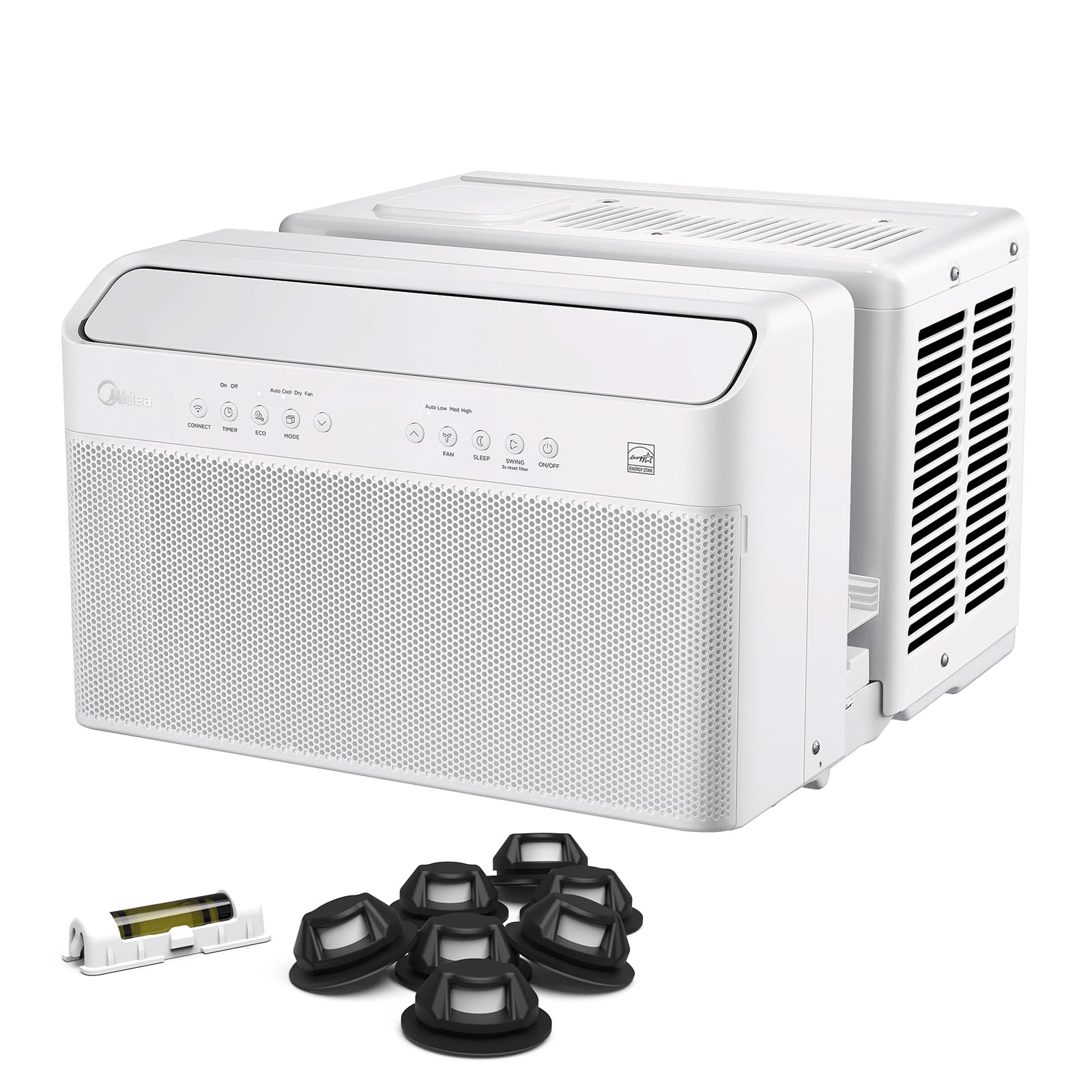
🏆 Best overall: The Midea U is the default recommendation because it wins on the axis that actually differs between window units. The U-shaped body puts glass between the compressor and the room, and the inverter compressor removes the cycling noise on top of that.
Top picks ↓| Product | Price | Link |
|---|---|---|
| $330〜$450Reference price | ||
| $319.95Price as of 2026-10-04 | ||
| $260〜$370Reference price | ||
| $230〜$330Reference price | ||
| $350〜$470Reference price |
Top picks
Related articles


Measure sash height and sill depth against the U-bracket dimensions before ordering — this is the main return reason.
The Midea U is the default recommendation because it wins on the axis that actually differs between window units. The U-shaped body puts glass between the compressor and the room, and the inverter compressor removes the cycling noise on top of that. You keep most of the window view and the sash still closes and locks. Confirm your sill and sash clear the U-bracket before ordering.
Pros
- ✓Substantially quieter by physical design, not just rating
- ✓Inverter compressor, no loud cycling
- ✓Window still opens and locks
Cons
- ✗Install constraints — not every window fits
- ✗Heavier and bulkier than a conventional box

GE Profile ClearView PHNT10CC
Sold in several capacities under the ClearView name; confirm the BTU rating on the listing.
The GE Profile ClearView is the premium conventional-mount answer: a low-profile body that sits below the normal sight line so you are not looking at a beige box. It is an inverter unit, so it is quiet at setpoint, and the 10,000 BTU rating covers a larger room than the 8,000 BTU units here. It is the most expensive of the five.
Pros
- ✓Low profile preserves the window view
- ✓Inverter compressor
- ✓Higher capacity than the 8,000 BTU units
Cons
- ✗Most expensive here
- ✗Larger and heavier to install

LG uses similar model codes across capacities — check the BTU figure rather than the suffix.
The LG is the sensible middle: a conventional box with Wi-Fi and a fixed-speed compressor. It cools an 8,000 BTU room exactly as well as the inverter units do; what you give up is the quiet at setpoint, since it cycles rather than modulates. Good choice for a room you are not sleeping in.
Pros
- ✓Meaningfully cheaper than the inverter units
- ✓Wi-Fi and scheduling
- ✓Simple, well-understood design
Cons
- ✗Fixed-speed compressor cycles audibly
- ✗Blocks the window in the conventional way
Subscribe to our newsletter
Occasional updates and new releases — no spam.
Frigidaire's window kit fits standard double-hung windows only.
The Frigidaire is the one to buy when you want cooling and nothing else. No inverter, no app dependency, a washable filter and a straightforward kit. Fewer features is fewer things to fail, and the cooling performance at 8,000 BTU is not where these units differ. It is the loudest option in the group.
Pros
- ✓Lowest price here
- ✓Nothing to fail beyond the basics
- ✓Straightforward install kit
Cons
- ✗Loudest of the five
- ✗No inverter, no app

Often sold direct as well as through retailers; compare the bundled install kit between listings.
The Windmill's argument is the parts of ownership other brands treat as an afterthought: a tool-free install, sealing components designed in rather than bagged separately, upward-facing airflow so cold air is not blowing directly at you, and a reusable filter. The compressor is fixed-speed, so it is not the quiet option — it is the pleasant-to-live-with option.
Pros
- ✓Tool-free install, sealing designed in
- ✓Upward airflow avoids a direct cold draft
- ✓Reusable filter
Cons
- ✗Fixed-speed compressor
- ✗Priced above comparable conventional units
Why the U-shape changes the noise equation
A conventional window unit is a single box straddling the sill, with the compressor inside the same enclosure as the indoor-facing grille. The window sash closes on top of the unit, so the only thing between the compressor and your ear is the unit's own casing.
The U-shaped design splits the body around the sash, so the window closes through the middle of the unit and the glass sits between the compressor half and the room. That is a physical barrier the conventional layout does not have, and it is the reason U-shaped units measure substantially quieter rather than marginally quieter.
The trade-off is install constraints. The U-shape needs a sash that can close down into the gap, which rules out some window types and most sills with an obstruction. Measure before buying — this is the most common cause of returns on this style.
Inverter or not
The same logic as portable units applies: a fixed-speed compressor cycles between full output and off, and the start of each cycle is the loud moment. An inverter modulates and settles. In this group the Midea U and the GE Profile are inverter units; the LG, Frigidaire and Windmill are fixed-speed.
The efficiency difference is real but smaller than marketing suggests for intermittent use. If the unit runs a few hours an evening, the payback on the inverter premium is long. If it runs continuously through a hot season, the payback is much shorter — and the noise difference is there either way.
What the install actually involves
All five ship with a mounting kit for standard double-hung windows: side curtains, a top rail, and a support bracket or leveling foot. The unit must tilt very slightly toward the outside so condensate drains away from the room rather than into it. Units installed dead level, or tilted the wrong way, drip indoors — this is the single most common install error.
Weight matters more than the spec sheet implies. An 8,000 BTU unit is typically in the 50–60 lb range and has to be lifted into an open window opening. This is a two-person job for most people, and a bracket that supports the outdoor half is worth fitting regardless of what the manual says is required.
The Windmill unit is designed around a tool-free install and ships the sealing components as part of the design rather than as an afterthought, which is a meaningful part of what its price premium buys.
Filters, apps, and the things that break
All five have washable filters. A clogged filter is the most common cause of a unit that has 'stopped cooling', and it is a monthly rinse during heavy use, not a seasonal one.
Wi-Fi and app control is present on the Midea U, GE Profile, LG and Windmill. Treat it as a convenience, not a reason to choose: cloud features on appliances have a track record of being discontinued, and every one of these units works fully from its own panel and remote if the app disappears.
Frequently asked questions
How many BTU do I need?▼
Is the U-shaped design worth the extra cost?▼
Can I install one myself?▼
Do these work in a casement window?▼
Prices change. Check the retailer for the current price.
Comments & questions
Discussion happens on nattzy, our community forum. Sign in with Google to post — it takes a second.
View the discussion thread on nattzy ↗
Still deciding? Ask the community your own question — Post a question on nattzy ↗