Best Electric Fireplace 2026: 5 Compared
Every plug-in electric fireplace produces the same amount of heat. The price difference buys appearance, not warmth. Once you accept that, the choice gets simple.
Quick answer
Every plug-in electric fireplace produces the same heat, so the choice is about looks and fit. The Dimplex Revillusion RBF30 is the pick for flame effect, keeping the flame three-dimensional when viewed from the side. Choose the Touchstone Sideline 50 for a recessed built-in look with the heater controllable separately from the flame; the Duraflame DFI-5010 for renters who need no installation; and the PuraFlame Western Insert for an existing masonry opening.
We did not run our own testing on any of these products. Doing it honestly would need an instrumented enclosure for the catios, a calibrated wet-bulb rig for the evaporative coolers, and a loaded sled with a force plate for the hack squat machines — none of which we have. What we did instead: pulled every published specification from each manufacturer's own product page and manual, cross-checked current pricing against major retailer listings, and read owner reviews at volume, filtering for reports that describe a measurable failure or a repeated complaint rather than a first-week impression. Where a number is a manufacturer claim rather than an independent measurement, we say so in the text.
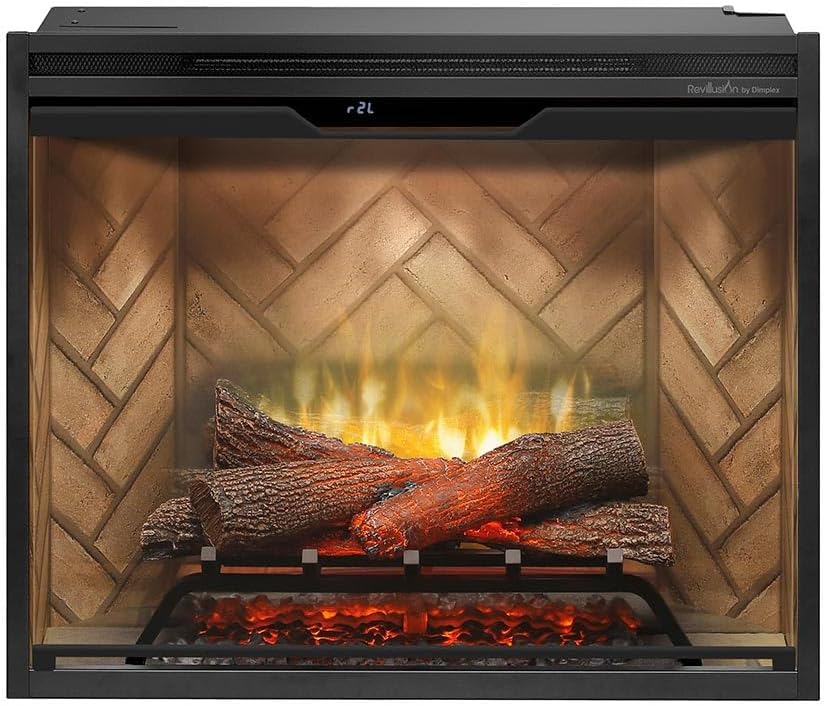
🏆 Best flame effect: The Revillusion is the one unit here where the premium buys something you can actually see. Removing the mirror from the optical path keeps the flame three-dimensional from off to the side, which matters in any room where the fireplace is not viewed strictly head-on.
Top picks ↓| Product | Price | Link |
|---|---|---|
| $1999Price as of 2026-10-03 | ||
| $599Price as of 2026-10-03 | ||
| $180〜$300Reference price | ||
| $393.99Price as of 2026-10-03 | ||
| $289.99Price as of 2026-10-03 |
Top picks
Related articles


The Revillusion line includes several widths and both firebox and insert formats — check the model suffix.
The Revillusion is the one unit here where the premium buys something you can actually see. Removing the mirror from the optical path keeps the flame three-dimensional from off to the side, which matters in any room where the fireplace is not viewed strictly head-on. It heats exactly as well as the $250 units — that is not what you are paying for — and it needs a framed opening.
Pros
- ✓Mirror-free flame holds up from an angle
- ✓Best-finished firebox here
- ✓Convincing resin log set
Cons
- ✗Most expensive by a wide margin
- ✗Requires framing and an outlet in the cavity
- ✗Same 1,500 W heat as the cheapest unit

Sideline is sold in multiple widths under the same name; the number is the width in inches.
The Sideline 50 is the linear format done properly: recessed flush into a stud wall, with the heater controllable independently of the flame so it can run as ambience in summer. Media options and flame colours are broader than they need to be, but the underlying build is solid. Budget for the framing work — the unit price is not the project price.
Pros
- ✓Flush recessed installation looks genuinely built-in
- ✓Heater runs independently of the flame
- ✓Hardwire or plug-in
Cons
- ✗Framing work required for the flush look
- ✗Mirror-based flame flattens from an angle
- ✗Colour options are more gimmick than use

Duraflame DFI-5010 Infrared Quartz Stove
Duraflame stove model codes change year to year with little functional difference; match the wattage.
The DFI-5010 is the no-installation option: it plugs in, it moves between rooms, and it leaves nothing behind. The infrared quartz element gives a different heat character from a fan coil — more radiant, less blown air. The corollary is that the metal body itself gets warm, which is worth knowing before putting it in a room with a toddler.
Pros
- ✓No installation at all
- ✓Moves between rooms
- ✓Radiant infrared heat rather than blown air
Cons
- ✗Metal housing gets warm to touch
- ✗Stove aesthetic will not suit every room
- ✗Smallest visible flame area here
Subscribe to our newsletter
Occasional updates and new releases — no spam.

PuraFlame Western Electric Fireplace Insert
Measure the masonry opening in three places — old openings are rarely square.
If there is already a masonry opening standing empty, the PuraFlame is the cheapest honest way to make it work again. The surround already exists, so the money goes entirely into the firebox rather than into carpentry. Measure the opening carefully before ordering — insert dimensions are unforgiving, and this is the most common cause of a return in this category.
Pros
- ✓Cheapest route for an existing fireplace opening
- ✓No framing or carpentry
- ✓Glass front and log set included
Cons
- ✗Opening dimensions must match closely
- ✗Mirror-based flame effect
- ✗Trim finish is basic
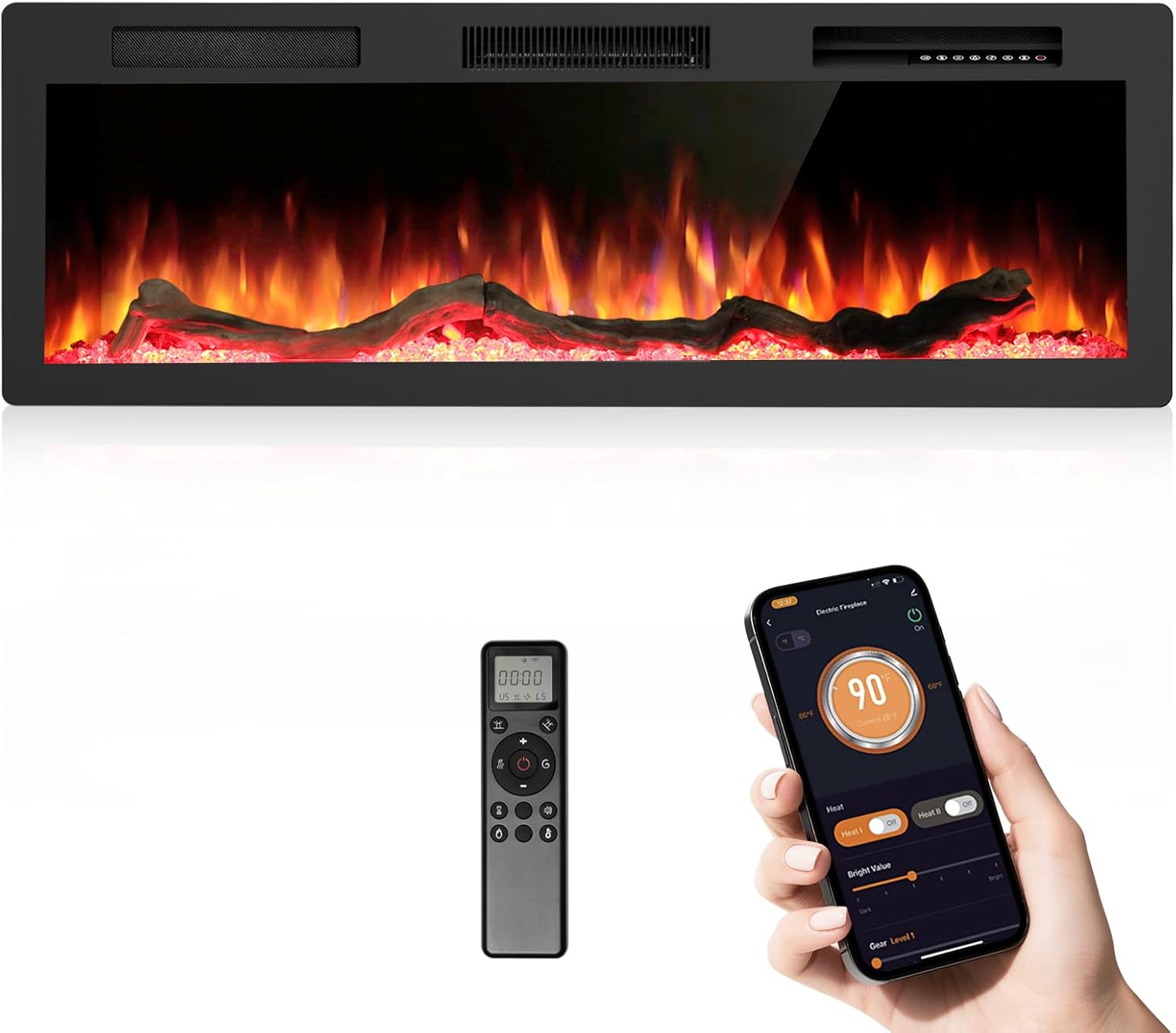
R.W.FLAME 50 inch Electric Fireplace
Listings vary between recessed-only and recessed-or-wall-mount versions of the same size.
The R.W.FLAME gets you the same 50-inch recessed linear format as the premium units for roughly half the money, and the same 1,500 W of heat, because the heat is fixed by the outlet. What you give up is trim finish and flame realism — visible from an angle, and visible up close. In a room where the fireplace is seen head-on from a sofa, that is a reasonable trade.
Pros
- ✓Same linear format at roughly half the price
- ✓Adjustable flame colour and brightness
- ✓Remote included
Cons
- ✗Flame effect is the weakest here
- ✗Trim finish is noticeably cheaper
- ✗Mixed reports on long-term remote reliability
The 1,500-watt ceiling, and what it means for sizing
A standard North American 120 V circuit caps a portable appliance at 1,500 watts, which works out to roughly 5,100 BTU per hour. Every plug-in electric fireplace on this page produces that same figure at maximum, whether it costs $250 or $1,400. There is no premium model that heats a room faster on the same outlet, because the outlet is the limit.
In practical terms 1,500 W is supplemental heat for a room of roughly 400 square feet in a mild climate — enough to take the edge off, not enough to be the primary heat source for a cold house. Hardwired 240 V units exist and do exceed this, but they need an electrician and a dedicated circuit, which changes the project from a purchase into an installation.
This is the single most useful thing to know before shopping, because it removes heat output from the comparison entirely. What is left to compare is how the flame looks, how the unit mounts, and how well it is finished.
How the flame effect is produced — and why it looks flat
Most electric fireplaces generate the flame by shining light onto a rotating rod and reflecting the result off an angled mirror behind the glass. It reads convincingly from directly in front and falls apart from an angle, because you are looking at a two-dimensional projection on a flat surface. This is why cheap units look best in the product photo, which is always shot head-on.
The Dimplex Revillusion line takes a different approach: the flame is projected without the mirror, onto a curved rear surface, which keeps the effect three-dimensional across a wider viewing angle. That is the main thing the premium price buys, and it is genuinely visible if the fireplace sits in an open room where people see it from the side.
For a unit that will be viewed head-on from a sofa, the mirror-based effect is adequate and the money is better spent elsewhere. For a unit in a room divider or an open-plan space, the viewing angle is the whole point.
Recessed, insert, freestanding: pick the installation first
A recessed linear unit like the Touchstone Sideline 50 goes into a stud wall and sits flush. It looks the most built-in and is the most work — framing, and in most cases a new outlet inside the cavity. It can also be surface-mounted if you accept it standing proud of the wall.
An insert like the PuraFlame Western is designed to drop into an existing masonry fireplace opening. If you already have a dead chimney, this is by a wide margin the cheapest route to a working heat source, because the opening and the surround already exist.
A freestanding stove like the Duraflame DFI-5010 needs nothing but an outlet, and can be moved between rooms. It is the correct choice for a rental, and the only one here that can be undone completely.
Running cost, and the one safety detail worth knowing
At full output a 1,500 W unit consumes 1.5 kWh per hour. At an electricity price of $0.16 per kWh that is about $0.24 per hour of heating, or roughly $1.90 for an eight-hour evening. Running the flame effect alone, without the heater, costs a small fraction of that — most units draw well under 100 W in flame-only mode, which is why flame-only is the mode most owners end up using year-round.
The safety detail: infrared quartz stoves like the Duraflame warm their metal housing as part of how they work, unlike fan-coil units that stay comparatively cool. That is not a defect, but it matters if there are small children or pets in the room, and it is not usually prominent in the listing.
Frequently asked questions
Can an electric fireplace heat a whole room?▼
Do they need a vent or a chimney?▼
Which one looks the most realistic?▼
Is it cheap to run?▼
Prices change. Check the retailer for the current price.
Comments & questions
Discussion happens on nattzy, our community forum. Sign in with Google to post — it takes a second.
View the discussion thread on nattzy ↗
Still deciding? Ask the community your own question — Post a question on nattzy ↗