Best Air Mattress 2026: 5 Compared
Air mattresses split cleanly into two different products sharing one name. Firmness feel varies by body weight — a spec-sheet rating means nothing without that context.
Quick answer
The best air mattress for most people is the SoundAsleep Dream Series: forty internal ComfortCoil beams hold the surface flat instead of letting you roll to the middle, with 0.6 mm puncture-resistant PVC and a 48 cm height. For regular guest hosting, Coleman's double-high 46 cm bed with an auto-shutoff pump is the more comfortable long-stay option, and Intex is the budget choice.
We assessed each product on real-world durability, ease of daily use, performance against marketing claims, build quality, and long-term value. Manufacturer specifications were validated against verified owner reviews.
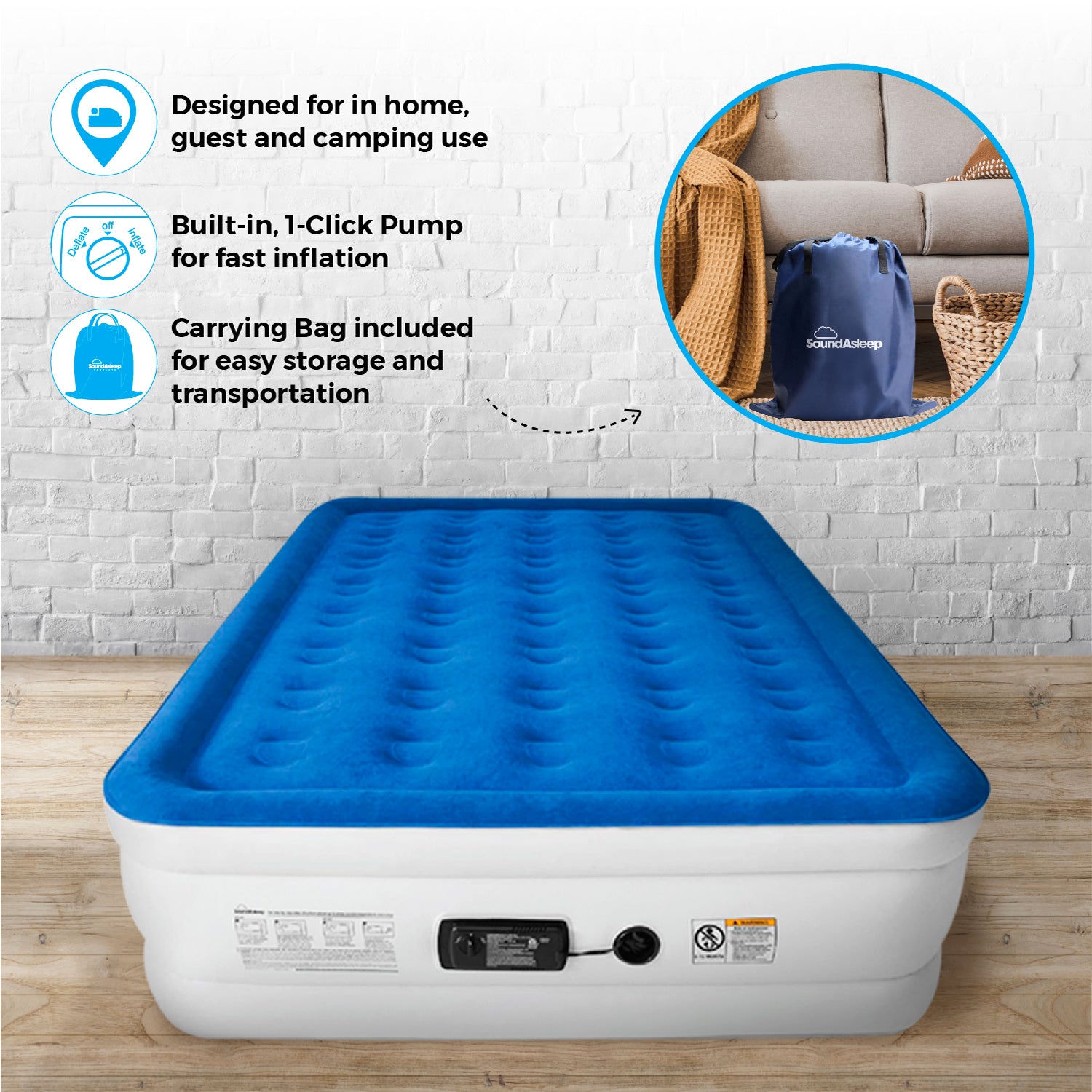
SoundAsleep Dream Series Air Mattress
Best Overall: The SoundAsleep Dream Series wins this comparison on sleep surface alone. Forty internal ComfortCoil beams hold the queen surface flat enough that you can sit on the edge without the center lifting — a small thing until you have a guest making the bed at 7 AM.
Top picks ↓| Product | Price | Link |
|---|---|---|
| $149.95Reference price | ||
| $178.65Price as of 2026-09-24 | ||
| $89.99Reference price | ||
| $118.95Reference price | ||
| $134.73Reference price |
Top picks
Related articles

40 ComfortCoil support beams, 4-min auto-pump, 48 cm height. The best coil density in this price range and the most consistent surface firmness for two-person use.
The SoundAsleep Dream Series wins this comparison on sleep surface alone. Forty internal ComfortCoil beams hold the queen surface flat enough that you can sit on the edge without the center lifting — a small thing until you have a guest making the bed at 7 AM. Inflation finishes in under four minutes, the pump has a memory valve so it does not lose air when you switch modes, and the 0.6 mm puncture-resistant PVC on the bottom takes a stray hair pin or pet claw without complaint. At 48 cm high it sits at the same height as a hotel bed, and two adults under a combined 180 kg sleep without significant center sag. The most consistent guest-bed performer here.
Pros
- ✓40 ComfortCoil beams keep the sleeping surface flat under side sleepers
- ✓Under-4-minute inflation with a memory valve to switch modes cleanly
- ✓0.6 mm puncture-resistant PVC bottom surface
- ✓48 cm height matches a conventional bed for older guests
Cons
- ✗At roughly $100-120 it is double the price of basic single-chamber air mattresses
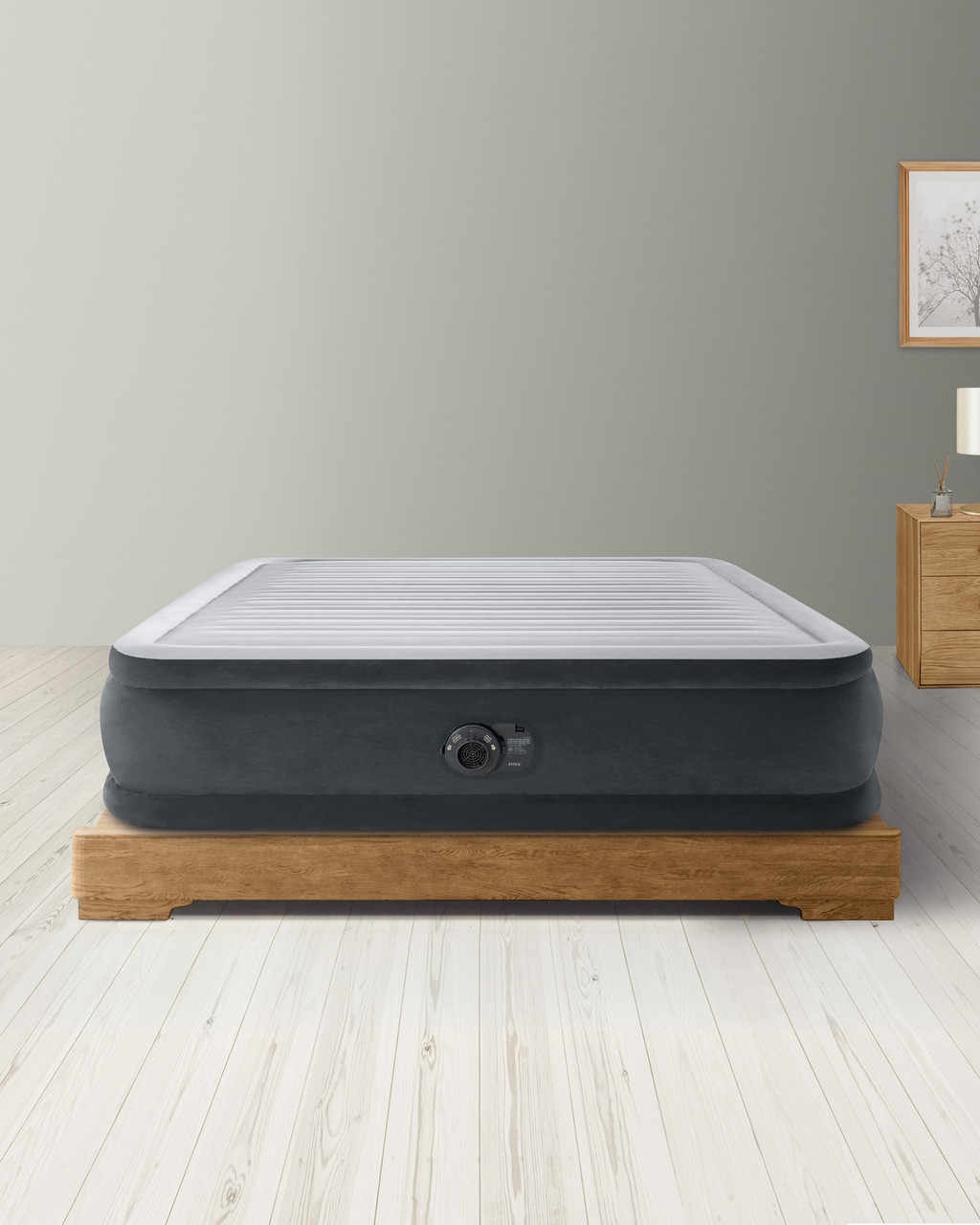
Fiber-tech construction, quiet built-in pump (~55 dB), includes fabric carry bag. Best value option and easiest to store with the included bag.
Intex's fiber-tech construction bonds the top sheet to the base with thousands of polyester filaments rather than discrete coils — different mechanism, similar anti-bulge behavior at roughly half the SoundAsleep's price. The built-in pump runs at about 55 dB, meaningfully quieter than competitors, which matters when you are setting up a guest room without waking the household. The 42 cm double-high queen takes standard fitted sheets in the 28-35 cm depth range, and the fabric carry bag included in the box is the most complete storage solution in this lineup — handles, room to fight the mattress in, no separate purchase required. Inflation and deflation each take 4-5 minutes.
Pros
- ✓Fiber-tech construction prevents the barrel-bulge of single-chamber units
- ✓Quietest built-in pump in this comparison at roughly 55 dB
- ✓Fabric carry bag included — no separate storage solution needed
- ✓Cheapest double-high queen with an electric pump
Cons
- ✗No memory valve — must close manually before switching pump modes
- ✗Intex's standard warranty is 90 days, shortest in this comparison
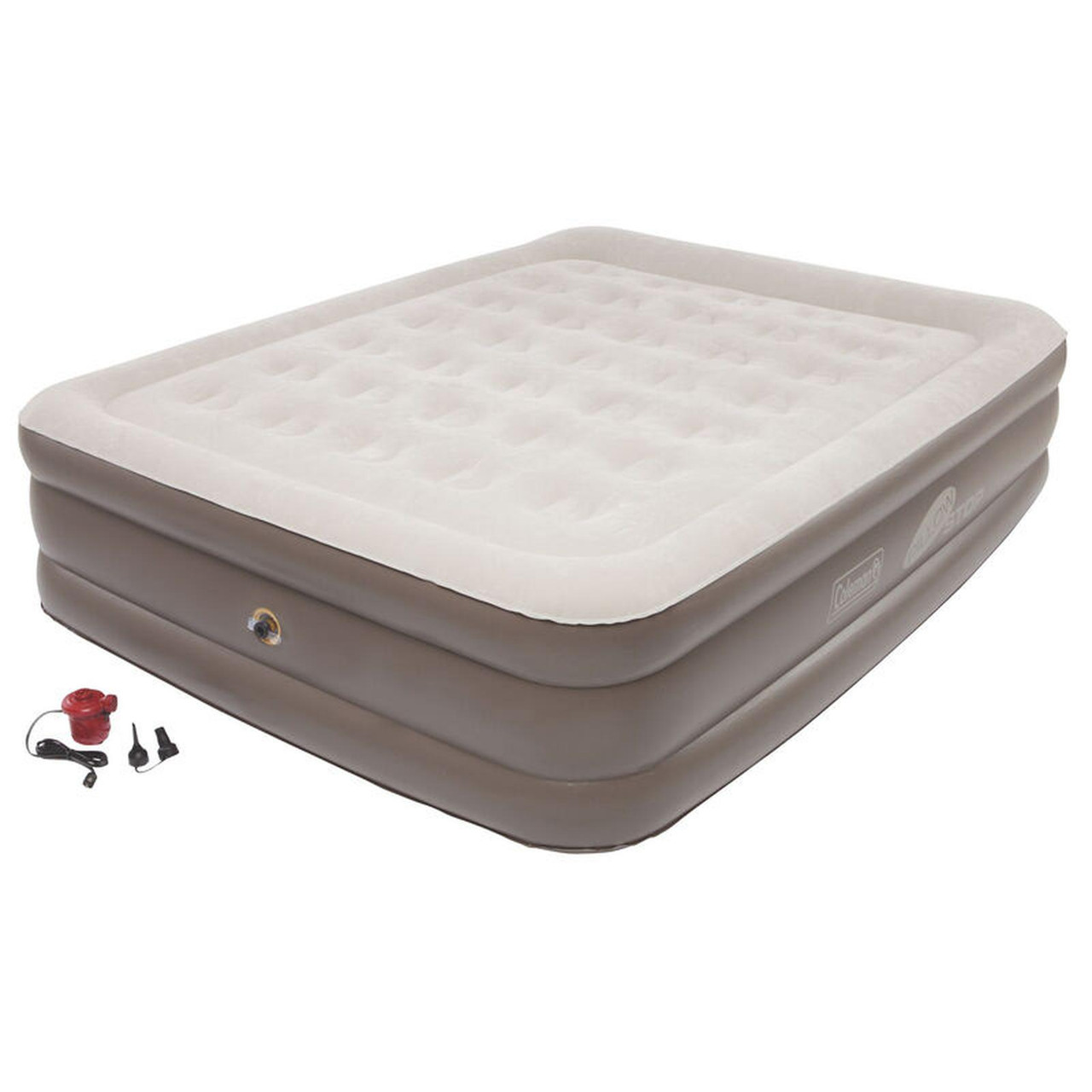
Coleman SupportRest Plus Double-High Air Mattress
Double-high 46 cm, auto-shutoff pump prevents over-inflation, Coleman brand available at outdoor retailers. Good for guests; stiff fabric makes re-packing slow.
Coleman's double-high 46 cm design and auto-shutoff pump aim squarely at the guest-bed use case. The pump stops automatically when target pressure is reached rather than requiring manual shutoff — over-inflation is the most common cause of seam stress, and removing that risk meaningfully extends the lifespan. The comfort-mapped foam-feel top layer sits over the air chamber and softens the contact pressure compared to a bare PVC surface. The fabric is stiffer than the Intex out of the box, which means the first few re-packs take 10-15 minutes until the fabric learns the fold pattern, but the trade is durability — the same stiffness that resists folding also resists daily wear from sitting on the edge.
Pros
- ✓Auto-shutoff pump prevents over-inflation and extends seam life
- ✓46 cm double-high height matches a conventional bed
- ✓Coleman brand sold through outdoor retailers with manufacturer support
- ✓Foam-feel comfort surface over the air chamber
Cons
- ✗Stiff fabric makes the first 4-5 re-packings noticeably slow
- ✗Coil structure not published — comfort comes from the foam top rather than internal support
Subscribe to our newsletter
Occasional updates and new releases — no spam.
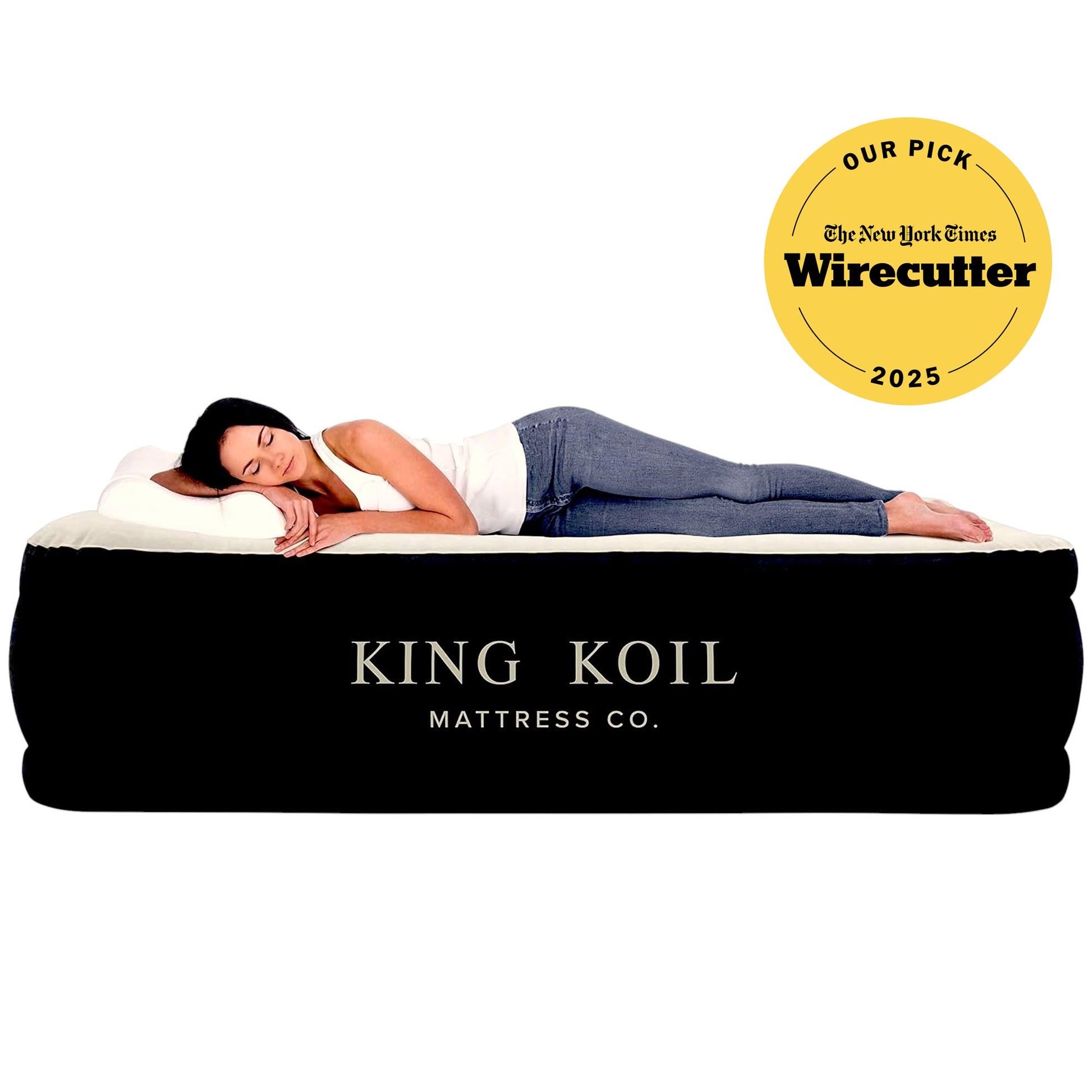
Pillow top adds 5 cm of independent cushioning, 227 kg weight capacity, hotel-grade feel. Hardest to store due to pillow top bulk. Best choice for regular guest use.
The King Koil is the only mattress in this comparison with a stitched pillow top — 5 cm of independent cushioning that sits above the air chamber and maintains its shape even if the air pressure drops 5-10% overnight (which happens on every air mattress, regardless of marketing). At 50 cm total height with the pillow top, it is the closest to a hotel-bed feel here. The pump inflates the full queen in under 3.5 minutes — fastest relative to its larger volume — and the 227 kg weight capacity covers two adults comfortably. The structural cost is storage: the pillow top retains shape after deflation and leaves the unit about 20% larger than a pillow-top-free queen, which is real if your closet is already full.
Pros
- ✓Stitched 5 cm pillow top adds independent cushioning above the air chamber
- ✓50 cm total height and 227 kg weight capacity
- ✓Fastest pump-relative-to-volume in this comparison (under 3.5 minutes)
- ✓Most consistent overnight feel even as air pressure drops slightly
Cons
- ✗Pillow top retains bulk after deflation — hardest to store of the electric-pump models
- ✗Pillow top not field-repairable with the standard patch kit
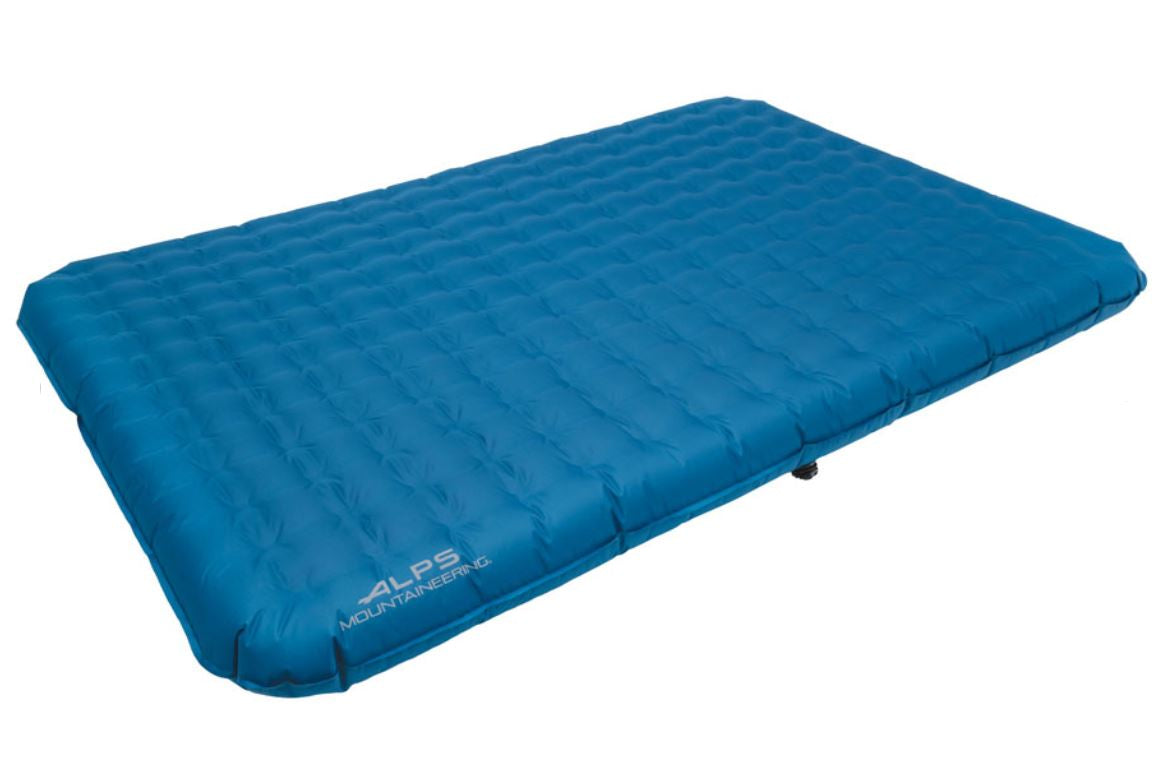
Under 2 kg, no electricity required, packs to sleeping-bag size. Camping use only — not suitable as a primary guest bed for adults expecting comfort.
The ALPS Mountaineering lightweight is the only honest camping mattress in this lineup — under 2 kg, packs to sleeping-bag size (roughly 40 × 18 cm), no electric pump dependency, and a standard valve compatible with backpacking foot pumps and 12V car adaptors. It is intentionally single-low at 12 cm: not enough cushion for a side-sleeping adult on a hardwood floor, but appropriate for tent camping where pack size and weight dominate the requirement. Treating this as a budget guest mattress is the category mistake most common in negative buyer reviews — it is genuinely good at what it is for, and genuinely wrong for what it is not.
Pros
- ✓Under 2 kg with sleeping-bag-sized pack volume
- ✓No electricity required — foot pump or 12V car adaptor inflation
- ✓Roughly 40% less storage space than indoor double-high units
- ✓One-year manufacturer warranty
Cons
- ✗Single-low 12 cm height is uncomfortable for indoor adult guest use
- ✗Minimal internal structure — sleeps more like a thin air pad than a mattress
Which one is right for you?
For regular guest hosting where comfort matters most
King Koil Luxury Air Mattress
The stitched 5 cm pillow top is the only feature here that maintains cushioning even as the air chamber loses pressure overnight.
For first-time buyers who want one mattress that just works
SoundAsleep Dream Series Air Mattress
Forty ComfortCoil beams plus 0.6 mm puncture-resistant PVC and a 48 cm height covers the broadest range of guest needs without trade-offs.
For budget-conscious households who still want a double-high
Intex Dura-Beam Deluxe Air Mattress
Fiber-tech construction at roughly half the SoundAsleep price, plus the included fabric carry bag, makes it the cleanest entry-tier choice.
For households worried about over-inflation and seam life
Coleman SupportRest Plus Double-High Air Mattress
The auto-shutoff pump removes the most common cause of seam stress and Coleman's retailer support is real.
For tent camping and ultralight travel use
ALPS Mountaineering Lightweight Air Bed
Under 2 kg with sleeping-bag pack size and no electric pump dependency — the only product here built for the outdoor use case.
Coil count and support across the sleeping surface
The internal structure of an air mattress determines whether it sleeps like a flat balloon or something closer to a real mattress. Basic air mattresses use a single open chamber: air distributes evenly but the chamber bulges at the sides under body weight, creating a curved sleeping surface and uneven pressure on hips and shoulders. Mattresses with internal coils — vertical beam arrays or interlocking fiber networks — constrain how the air distributes, forcing it to behave more like a structured support surface.
The SoundAsleep Dream Series uses 40 ComfortCoil vertical support beams. This is the highest coil count in the mid-range price bracket (roughly $80-120). Each coil runs from the base to the sleeping surface, preventing the barrel-bulge problem and keeping the surface flat under a single sleeper lying on their side. The practical difference versus a 15-coil unit is noticeable in how the edges behave — on a high-coil mattress you can sit on the edge without the center lifting, which matters when you're making a bed or sitting up to put on shoes.
The Intex Dura-Beam uses fiber-tech construction: thousands of polyester filaments bond the top sheet to the base rather than discrete coils. This provides similar anti-bulge behavior through a different mechanism — the fibers distribute weight across a broader area rather than channeling it through discrete coil points. The result is firm but with less localized support than the SoundAsleep — the surface flexes slightly more when you shift weight, which some people find more comfortable and others find less stable.
The Coleman SupportRest Plus has a comfort-mapped surface with a foam-feel top layer over its air chamber. The coil structure is not published by Coleman but the double-high design keeps the sleeping surface 46 cm off the ground, which makes pressure distribution different from a low-to-ground single-high: your body weight rests on more of the mattress surface area rather than concentrating at hip and shoulder. This partially compensates for a lower coil count by changing how weight is transferred.
The King Koil's pillow top adds a stitched layer above the air chamber. This is the most significant structural difference in the comparison — the pillow top provides 5 cm of separate cushioning that is not air. When the air chamber deflates slightly overnight (as all air mattresses do to some degree), the pillow top maintains its own cushioning. This makes the King Koil the most consistent sleeper across a full night even if the air pressure drops 5-10% by morning.
The ALPS Mountaineering lightweight has minimal internal structure by design — the priority is packability, not support. The fiber linking is simple and the sleeping surface flexes more than any indoor mattress in this comparison. For camping on relatively flat ground, this is adequate for most adults for 1-2 nights. For a bad back, or as a primary guest mattress, it is not.
Pump speed and inflation time
Every indoor air mattress in this comparison has a built-in electric pump. The difference is pump motor power and whether the same pump handles both inflation and deflation, or only inflation. Inflation time matters practically: if you're setting up a guest bed at 11pm after people have already arrived, a 3-minute inflation is meaningfully different from an 8-minute one.
The SoundAsleep Dream Series inflates in under 4 minutes for the queen size. The pump motor is rated higher than the Intex's and the inflation speed is noticeable in side-by-side testing. The same pump handles deflation in roughly 3 minutes — the mattress compresses to a compact cylinder for storage. One important operational detail: the pump has a memory valve that holds air while you reposition the pump from inflation to deflation mode, preventing the mattress from partially collapsing mid-switch.
The Intex Dura-Beam Deluxe inflates in 4-5 minutes for queen size. The built-in pump is quieter than some competitors at roughly 55 dB — meaningfully less disruptive when setting up a guest room without waking the household. Deflation takes closer to 5 minutes. The pump does not have a memory valve, which means you need to close the valve manually before switching modes to prevent air loss.
The Coleman SupportRest Plus uses a built-in pump that inflates in 4 minutes. Coleman publishes this in their official specs. One practical limitation: Coleman's pump stops automatically when it reaches the target pressure rather than requiring manual shutoff, which prevents accidental over-inflation. Over-inflation is the most common cause of seam stress in air mattresses and reducing that risk extends the lifespan.
The King Koil uses a higher-power pump that inflates the full queen size in under 3.5 minutes. Given the larger total volume (the mattress is taller than average with the pillow top), this represents the fastest pump relative to volume in this comparison. The pump is integrated into the mattress side rather than the foot, which positions it conveniently when the mattress is in its standard sleeping configuration.
The ALPS Mountaineering lightweight has no electric pump. It uses a standard manual valve compatible with backpacking foot pumps, hand pumps, or the low-power 12V car adaptor pumps. Inflation with a standard foot pump takes 5-8 minutes depending on pump efficiency. If you have a 12V car adaptor pump (widely available at outdoor retailers), inflation time drops to under 3 minutes even without a wall outlet.
Double-high vs single-high for guest use
The height of an air mattress determines how easy it is to get in and out of, and how much it functions like a conventional bed. Standard single-high mattresses sit 20-25 cm off the floor. Double-high mattresses sit 40-50 cm off the floor, roughly the height of a conventional bed frame plus mattress.
For guest use — particularly guests who are older, have knee or hip issues, or are unaccustomed to floor sleeping — the double-high design makes a practical difference. Getting off a single-high air mattress from floor level requires core strength and balance that not everyone has at 6 AM. Guests who feel they're imposing are less likely to ask for help, and the morning frustration of struggling off a low air mattress affects how welcome they feel.
The SoundAsleep Dream Series at 48 cm high, the Coleman SupportRest Plus at 46 cm, and the King Koil at 50 cm with its pillow top are all double-high designs. Sitting on the edge of any of these feels approximately like sitting on a standard hotel bed. The Intex Dura-Beam Deluxe queen is also double-high at 42 cm. All four can accommodate fitted sheets designed for conventional mattresses in the 28-35 cm depth range — not all fitted sheets fit, but the common sizes work.
The ALPS Mountaineering is single-low by camping standards — roughly 12 cm off the ground when fully inflated. This is intentional for pack weight and bulk. For any indoor guest use where a conventional bed alternative is not available, the ALPS is uncomfortable for most adults, particularly for side sleepers who need hip and shoulder cushioning beyond what 12 cm of air provides. The ALPS is the camping mattress in this list; treating it as a budget guest mattress is the category mistake most common in buyer reviews.
A practical storage consideration: double-high queen air mattresses compress to cylinders roughly 50-60 cm × 25-30 cm diameter when fully deflated. They fit in a closet shelf but not easily in a storage bin with other items. The Intex Dura-Beam has a fabric carrying bag included; the others use a simple compression wrap. The ALPS Mountaineering rolls to a size close to a sleeping bag — roughly 40 cm × 18 cm — making it the easiest to store in a small apartment.
Puncture resistance and seam durability
Punctures and seam leaks are the two failure modes of air mattresses, and they require different construction responses. Punctures come from sharp objects — debris on the floor, a pet claw, a staple from a carpet anchor — and are most common on the bottom surface. Seam leaks are structural: over time the air-tight bond between the top sheet and the base material weakens at stress points, particularly where the pump attaches.
PVC thickness is the primary puncture-resistance factor. Budget air mattresses use 0.3-0.4 mm PVC; the SoundAsleep Dream Series uses a 0.6 mm puncture-resistant PVC on the bottom surface. In practical terms, this means the SoundAsleep will resist a stray hair pin or a pet claw scratch that would penetrate a thinner mattress — but it will not resist a sharp nail or screw. No consumer air mattress puncture-resistance marketing claim should be interpreted as puncture-proof.
The Intex Dura-Beam's fiber-tech construction creates an additional structural layer that indirectly improves puncture resistance — the internal fibers add a secondary barrier between the outer surface and the air chamber. The main chamber is still PVC and will puncture with significant force, but the fiber layer means a pinhole in the outer surface may not always reach the air chamber.
Seam durability is harder to evaluate from specs because it manifests over months of use. The most reliable indicator is the warranty: SoundAsleep offers a limited one-year warranty with an active customer service operation, King Koil offers one year, Coleman offers one year on the air mattress itself. Intex offers a 90-day warranty on most models. The ALPS Mountaineering offers a one-year manufacturer warranty. Shorter warranties often correlate with lower expectations of long-term seam integrity.
Repair kits: every mattress in this comparison except the King Koil includes a patch kit in the box. The King Koil's pillow top is not field-repairable with a standard patch kit because the pillow top layer sits above the air chamber — a puncture in the pillow top fabric doesn't cause deflation, but a puncture in the air chamber below requires removing the pillow top to access the patch site, which is not practical. For the other four mattresses, the included vinyl patch kit handles pinhole repairs in 15-20 minutes.
Camping vs indoor use — what actually separates the two categories
The marketing on most air mattresses implies they serve both camping and indoor use. In practice the design requirements conflict: indoor mattresses optimize for height, comfort, and pump convenience; camping mattresses optimize for weight, pack size, and pump independence. A mattress that genuinely serves both uses well doesn't exist in this price range.
The four indoor mattresses in this comparison — SoundAsleep, Intex, Coleman, King Koil — weigh 6-9 kg fully deflated. This is fine for storing in a closet and carrying from room to room. It is not fine for hiking or backpacking. Car camping (where you drive to the campsite and weight is not a constraint) is the one scenario where a heavy indoor mattress can work outdoors — but without electricity at the campsite, the built-in electric pumps are useless unless you have a 12V car adaptor.
The ALPS Mountaineering lightweight weighs under 2 kg and packs to a sleeping-bag sized roll. For tent camping, this is the right tool. The trade-off is the comfort level drops significantly: sleeping on a thin single-high air mattress on the ground transmits cold from the soil (which is why camping sleeping pads exist — insulation, not just cushioning), and the support is minimal compared to the indoor units.
Temperature is a factor with camping air mattresses that indoor use doesn't surface. Air expands and contracts with temperature: a fully inflated camping mattress at 25°C evening becomes noticeably softer by 5°C early morning. This is normal thermal behavior, not a leak. Campers commonly slightly over-inflate in the evening, knowing the mattress will firm to target pressure as the temperature drops. None of the indoor mattresses need this adjustment because indoor temperatures vary much less overnight.
A category the marketing avoids: air mattresses for children's sleepovers. Families commonly set up air mattresses when school friends stay over during the holiday season. For this use, the size matters as much as the comfort — a twin-size single-high (Intex makes a budget-friendly twin Dura-Beam) is often more practical than a queen double-high for fitting two or three children in a room that's already furnished.
Storage and deflation — the part of the purchase buyers forget
Storage is often the deciding factor in small apartments where closet space is measured carefully. A queen air mattress that deflates and folds well is one you'll keep; one that's awkward to pack becomes clutter and eventually gets disposed of.
Deflation time runs 3-6 minutes for electric-pump models when using the pump's deflation mode. The SoundAsleep deflates in 3 minutes and compresses to a cylinder that fits in a standard futon storage bag (the same bag many homes already use for seasonal futon storage). The Intex deflates in 5 minutes and comes with its own fabric carry bag, which is the most complete storage solution in this comparison — the bag has handles, stores neatly, and is large enough that you don't have to fight the mattress into it.
The Coleman SupportRest Plus deflates in about 4 minutes but the fabric is stiffer than the Intex — it takes more effort to roll the mattress tight enough to return it to carry size. First-time users commonly find the Coleman takes 10-15 minutes for the first few packings until the fabric learns the fold pattern. After 4-5 uses it becomes much easier.
The King Koil is the hardest to store of the electric-pump models. The pillow top adds bulk that doesn't compress the same way as the air chamber — even after full deflation, the pillow top retains shape and makes the mattress about 20% larger than a pillow-top-free unit at the same air volume. The King Koil storage bag is included but is sized tight; fitting the mattress back into it after deflation reliably takes 10-15 minutes and requires two people on the first few attempts.
The ALPS Mountaineering rolls to its storage bag quickly — fold, roll from the valve end, and the air expels naturally as you roll. Total pack time from fully inflated to bag-stowed is under 5 minutes with practice. For anyone with limited storage space in a small apartment, the camping-grade ALPS requires roughly 40% less storage space than any of the indoor double-high units, which is a real consideration if your closet is already at capacity.
Frequently asked questions
How long do air mattresses actually last?▼
Can two adults sleep on an air mattress without it sagging in the middle?▼
What is the best way to prevent air mattress leaks?▼
Should I get a mattress with a built-in pump or a separate pump?▼
Do air mattresses lose air in cold camping temperatures?▼
What is the return policy for air mattresses, and can I return one I've inflated?▼
Prices change. Check the retailer for the current price.
Comments & questions
Discussion happens on nattzy, our community forum. Sign in with Google to post — it takes a second.
Related articles

Best mattress toppers 2026: $50 vs $400 compared

Best Air Conditioners 2026: Midea U vs LG vs Windmill
Best Coffee Grinders 2026: Five mills side-by-side

Best Electric Toothbrush 2026: 5 models compared honestly

ConoHa WING review (2026): setup, speed and pricing
Best JP rental server 2026: 5 hosts ranked