Best Camping Tents 2026: 5 Compared
Five 2-person tents from $130 to $550, covering the range from budget car-camping domes to sub-2-pound ultralight shelters that backpackers obsess over. Fit and waterproof rating for your specific climate type matter most.
Quick answer
The REI Passage 2 is the best camping tent for most weekend campers — a genuine freestanding 3-season tent without expert-level pricing. Choose the Big Agnes Copper Spur HV UL2 at 2 lbs 6 oz if you carry it far, the MSR Hubba Hubba 2 for real weather with dual vestibules, or the Coleman Sundome 2 for occasional car camping.
We assessed each option on coverage breadth, real-traveler review consistency, value vs alternatives, customer service responsiveness, and limitations buried in fine print.
Best Overall Value: The REI Passage 2 hits the sweet spot for new backpackers and weekend campers who want a real 3-season tent without paying expert-tier prices. Aluminum DAC poles, a polyester rain fly, and freestanding pitch cover the practical bases at roughly half the cost of an MSR Hubba Hubba 2.
Top picks ↓Top picks
Related articles


Best value backpacking tent at ~$200 — aluminum DAC poles, polyester rain fly, single 8.5 sq ft vestibule, 3 lbs 14 oz packed. Covers 2-5 night 3-season trips without price-premium features. The right starting point for new backpackers and versatile weekend campers. Limitation: single vestibule; fly doesn't extend as low as MSR in heavy rain.
The REI Passage 2 hits the sweet spot for new backpackers and weekend campers who want a real 3-season tent without paying expert-tier prices. Aluminum DAC poles, a polyester rain fly, and freestanding pitch cover the practical bases at roughly half the cost of an MSR Hubba Hubba 2. The single 8.5 sq ft vestibule handles two pairs of boots and a daypack but won't fit two full backpacking packs side by side. At 3 lbs 14 oz packed it isn't ultralight, but the structural durability and 40-inch peak headroom feel surprisingly livable for the price. REI's repair program means a broken pole tip gets fixed rather than triggering a full replacement.
Pros
- ✓Aluminum DAC poles hold structure under real wind loads
- ✓Freestanding design pitches on rocky or hard ground
- ✓Polyester fly resists long-term UV and water aging
- ✓REI repair program covers pole and zipper failures
Cons
- ✗Single vestibule limits gear storage for two backpackers
- ✗Fly doesn't reach as low as MSR or NEMO in driving rain

Ultralight benchmark at ~$550 — 2 lbs 6 oz packed, simultaneous fly-and-inner pitch, dual vestibules, high-volume floor design with near-vertical walls. For backpackers who have decided weight is the primary constraint. Limitation: silnylon fly ages faster than polyester; high price hard to justify for occasional campers; lower durability than heavier alternatives.
At 2 lbs 6 oz packed, the Copper Spur HV UL2 is the ultralight benchmark for backpackers who count every ounce. The hub-and-pole system pitches the fly and inner together — a real advantage in foul weather, where most competitors force you to expose the mesh inner before getting cover. Dual vestibules totaling 15.5 sq ft give each occupant covered gear storage, and the near-vertical walls (the HV in the name stands for high volume) recover floor area that comparably light tents lose. The silnylon fly is the trade-off: it ages faster than polyester and absorbs water over multi-night rain. Worth the price for backpackers who do real mileage; hard to justify for occasional campers.
Pros
- ✓2 lbs 6 oz packed — lightest tent in this comparison
- ✓Simultaneous fly-and-inner pitch protects gear in rain
- ✓Dual vestibules with curved doors maximize usability
- ✓Near-vertical HV walls add real interior volume
Cons
- ✗Silnylon fly absorbs water and ages faster than polyester
- ✗Premium price hard to justify for weekend campers
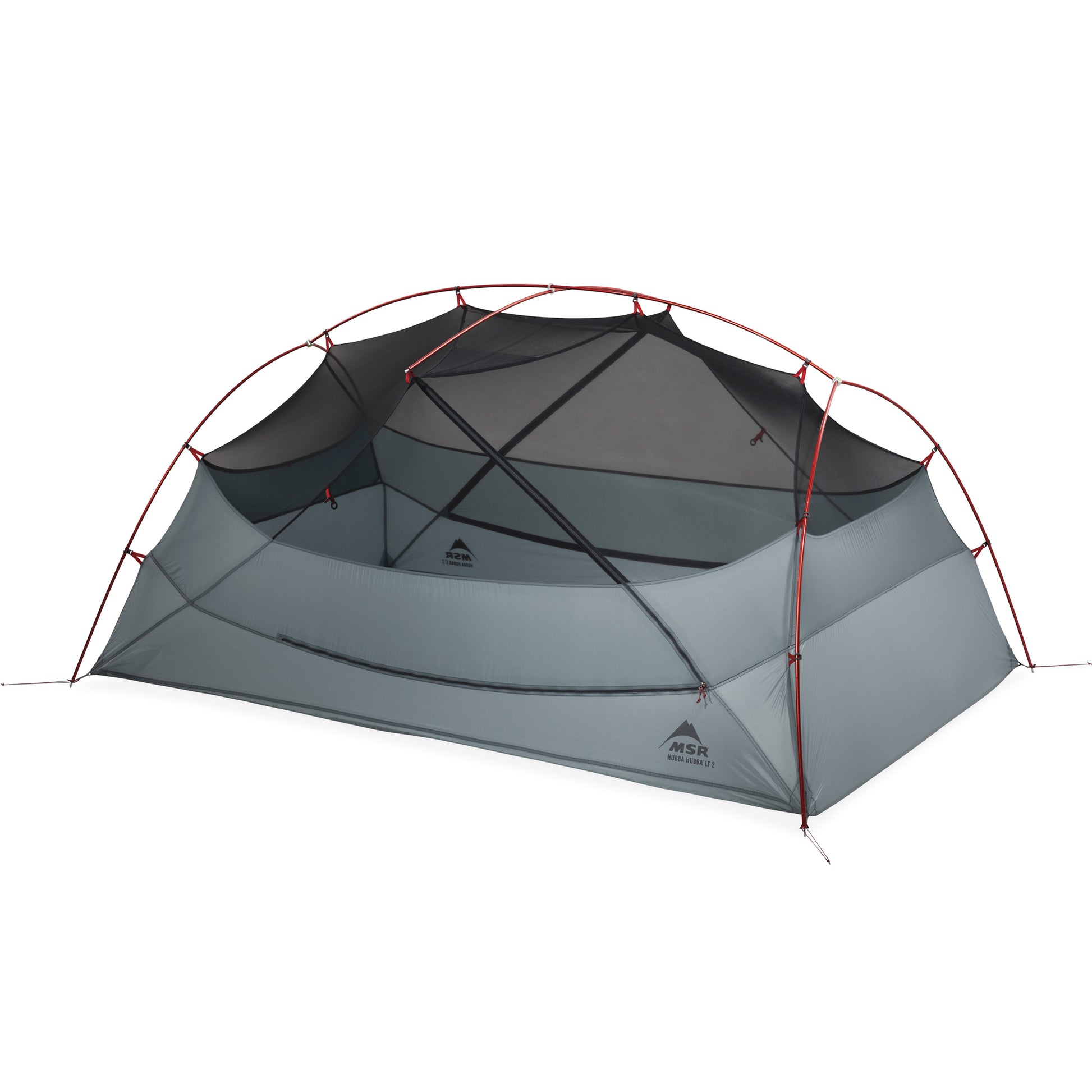
Expert 3-season choice at ~$450 — dual vestibules (17.7 sq ft combined), full-coverage rain fly, DAC Featherlite NSL aluminum poles, 3 lbs 14 oz. The tent for campers who encounter real weather regularly. Limitation: same weight as REI Passage 2 at twice the price — the cost premium buys weather performance and dual vestibule access, not lighter weight.
The MSR Hubba Hubba 2 is the tent campers reach for when weather is on the menu. Dual vestibules totaling 17.7 sq ft give each person their own door and covered gear storage, and the full-coverage rain fly reaches close to the ground so wind-driven rain has nowhere to sneak in. DAC Featherlite NSL aluminum poles maintain structure under gusts that would flex fiberglass. The 28.6 sq ft floor and 40-inch headroom are typical for the backpacking category, and at 3 lbs 14 oz packed it's the same weight as the REI Passage 2 — you're paying the price premium for weather geometry and dual access, not lighter weight. The right pick for campers who actually get caught in storms.
Pros
- ✓Dual vestibules at 17.7 sq ft combined — most in this comparison
- ✓Full-coverage rain fly with near-ground contact
- ✓DAC Featherlite NSL poles hold up in sustained wind
- ✓MSR's structural track record across decades of use
Cons
- ✗Same weight as REI Passage 2 at roughly twice the price
- ✗Pitch takes practice to get fly tensioned correctly
Subscribe to our newsletter
Occasional updates and new releases — no spam.
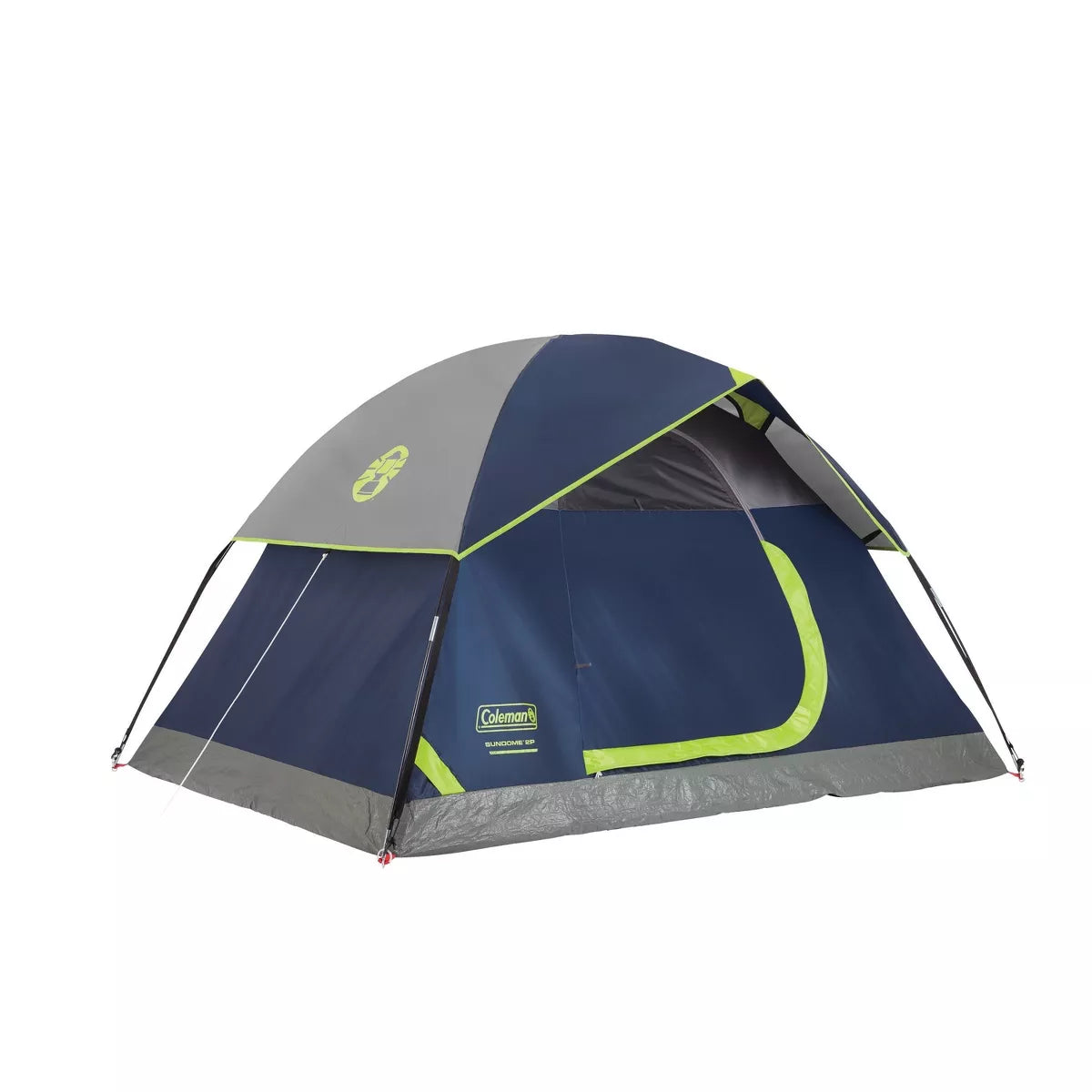
Best budget car-camping tent at ~$130 — 35 sq ft floor, 4 ft headroom, fast setup, proven Coleman reliability for two decades. Correct for car camping, festivals, and weekend trips where weight is irrelevant. Limitation: fiberglass poles flex in wind; partial fly leaves door exposed in rain; not suitable for serious weather or backpacking.
The Coleman Sundome 2 is the right tent if you'll pull it out of a car trunk twice a year. At roughly $130 it offers the largest interior in this comparison — 35 sq ft of floor and 4 ft of headroom — making it genuinely comfortable for two people who want to sit up, change clothes, and ride out an afternoon rain shower. The E-Port and Coleman's decades-long track record at this price point mean it sets up in minutes and holds up across summers of casual use. The structural limits are real, though: fiberglass poles flex in sustained wind, the partial fly leaves the door zone exposed in driving rain, and at 4 lbs 14 oz it has no business in a backpacking pack. Stay below treeline and out of serious storms.
Pros
- ✓35 sq ft floor and 4 ft headroom — most spacious here
- ✓Sub-$130 price proven across decades of Coleman production
- ✓Sets up in under 10 minutes with minimal practice
- ✓Wide retail availability for parts and replacement
Cons
- ✗Fiberglass poles flex and can snap in sustained wind
- ✗Partial fly exposes door zone in driving rain

Best versatile 3-season tent at ~$400 — 42-inch headroom (highest of any backpacking tent here), dual vestibules (16 sq ft), polyester fly, 3 lbs 9 oz packed. Works for both car camping and 3-season backpacking. Limitation: heavier than ultralight options; more expensive than REI Passage 2 without a clear single-use advantage; smaller brand presence on trail.
The NEMO Dagger 2P is the versatile middle option for campers who want modern interior comfort without the ultralight price tag. At 42 inches it has the highest peak headroom of any backpacking tent here — you can sit upright, put on boots without hunching, and ride out a rainy morning without feeling trapped. Dual vestibules totaling 16 sq ft handle gear access from both sides, the polyester rain fly resists long-term aging better than silnylon, and the stable pole geometry handles 3-season conditions confidently. At 3 lbs 9 oz packed it splits the difference between the REI Passage 2 and the Copper Spur UL2. NEMO has less trail ubiquity than REI or MSR, but the tent itself is genuinely well-built.
Pros
- ✓42-inch headroom — highest of any backpacking tent here
- ✓Dual vestibules at 16 sq ft combined for both occupants
- ✓Polyester fly outlasts silnylon under sustained rain
- ✓3 lbs 9 oz balances weight against real livability
Cons
- ✗Costs more than REI Passage without ultralight payoff
- ✗Smaller brand presence makes replacement parts less common
Which one is right for you?
For weekend backpackers starting out
REI Co-op Passage 2 Tent
Aluminum DAC poles and freestanding pitch cover real 3-season trips at roughly half the price of expert tents.
For ultralight thru-hikers
Big Agnes Copper Spur HV UL2 Tent
2 lbs 6 oz packed with simultaneous fly-and-inner pitch — the lightest credible 2-person shelter here.
For storm-prone trips
MSR Hubba Hubba 2 Tent
Dual vestibules and full-coverage fly keep wind-driven rain away from both doors and stored gear.
For casual car campers
Coleman Sundome 2 Tent
35 sq ft floor and 4 ft headroom at sub-$130 make it the right pickup-twice-a-year tent.
For mixed-use campers who want comfort
NEMO Dagger 2P Tent
42-inch headroom and dual vestibules deliver modern livability without ultralight pricing or durability trade-offs.
Freestanding vs trekking-pole-supported: which design actually makes sense
Freestanding tents stand on their own before staking — you pitch the inner, attach the rain fly, and have a functional shelter before driving a single stake. Non-freestanding tents (including trekking-pole-supported designs like the Big Agnes Copper Spur and NEMO Dagger in their vestibule configurations) require stakes to hold the structure. On rocky ground, frozen soil, or hardened desert, stakes that won't fully seat can make non-freestanding tent setup genuinely difficult. Freestanding designs eliminate that constraint: you can pitch a freestanding tent on a slab of granite, reposition it before staking, and know the structure will hold even if a stake pulls loose.
The trade-off is weight and packed size. Freestanding tents use rigid pole systems that add weight — an additional 3-6 ounces compared to a comparable non-freestanding shelter. For car camping, the difference is irrelevant. For backpackers covering 15-mile days with a 25-pound pack, 6 ounces is a meaningful penalty. Trekking-pole-supported shelters eliminate the pole weight entirely by using poles you're already carrying, but they demand that you own poles of the right length and are willing to sacrifice some structural redundancy.
The practical hierarchy: freestanding tents (REI Passage 2, MSR Hubba Hubba 2, Coleman Sundome 2, NEMO Dagger 2P) are correct for most campers. Trekking-pole designs reward experienced ultralight backpackers who have already committed to a pole-based system. The Big Agnes Copper Spur HV UL2 is technically semi-freestanding — the inner stands without poles, but needs the fly and stakes for full weather protection.
Packed weight: the number that matters for backpacking
Packed weight is the total weight you carry, including all stakes, stuff sacks, and components. Trail weight (sometimes called trail weight or minimum weight) is what manufacturers often advertise — it excludes stuff sacks and sometimes a stake set. The gap between the two can reach 6-8 ounces on some tents. When comparing tents, use packed weight to understand what you're actually lifting.
The weight spread across these five tents is extreme. The Coleman Sundome 2 at 4 lbs 14 oz is a car-camping shelter — carrying it 10 miles uphill is a decision you'd regret. The Big Agnes Copper Spur HV UL2 at 2 lbs 6 oz is the ultralight benchmark: at this weight, you're giving up headroom, weather durability, and convenience features to save ounces that matter over 50 miles of cumulative backpacking. The REI Passage 2 at 3 lbs 14 oz sits in the practical middle — lighter than budget alternatives, heavier than ultralight options, but with structural durability and interior volume that shorter trips demand. The MSR Hubba Hubba 2 at 3 lbs 14 oz and the NEMO Dagger 2P at 3 lbs 9 oz occupy the same capable-but-not-ultralight tier.
For backpackers who will cover more than 3 nights per trip, every pound in the pack becomes felt on day two. The realistic target for a shelter that two people carry together is under 4 lbs packed — all five tents in this comparison except the Coleman hit that target. When the shelter weight is split between two hikers, even the MSR Hubba Hubba 2's 3 lbs 14 oz becomes less than 2 lbs each.
Weather rating and storm performance: understanding the spec
Tent weather ratings are not standardized across manufacturers. '3-season' covers a range from 'fine in calm rain' to 'suitable for shoulder-season snow'. What actually determines storm performance is rain fly coverage, seam sealing quality, pole strength, and pole count. A tent with a full-coverage rain fly that reaches near the ground performs better in wind-driven rain than a higher-rated tent with a fly that stops short of the ground — the gap between fly and ground creates a channel for water to blow in.
The Coleman Sundome 2 uses a basic fly that covers the top and sides but leaves the door vestibule partially exposed. In light rain this is adequate; in sustained wind-driven rain the door and lower tent wall get wet. The tent is correctly categorized as a fair-weather car camping shelter, not a 3-season backpacking tent. Its two fiberglass poles (versus aluminum on the other four tents) also flex more than aluminum under wind load, which reduces structural integrity in high gusts.
The MSR Hubba Hubba 2 and NEMO Dagger 2P both use full-coverage rain flies with near-ground contact and dual vestibules that keep water away from both doors. Their aluminum DAC pole systems maintain structure under wind loads that would flex fiberglass. The Big Agnes Copper Spur HV UL2 uses a lighter silnylon fly that is weather-resistant but less durable long-term than the polyester flies on the MSR and NEMO — silnylon absorbs water over time and the fly dimensions tighten slightly when wet, which can compromise pitch quality in multi-night rain.
Vestibule space: the feature that determines gear storage
A vestibule is the covered area between the tent door and the outer rain fly — the zone where you store boots, wet gear, and a pack you don't want inside the sleeping area. In practice, a tent without a vestibule means wet gear comes inside or stays outside in the rain. For car camping where you have a vehicle nearby, vestibule space is a convenience. For backpacking in multi-day rain, a vestibule is the difference between dry gear in the morning and wet gear you're putting on cold.
Vestibule size varies significantly across these tents. The REI Passage 2 has a single 8.5 sq ft vestibule — adequate for two pairs of boots and a daypack, not adequate for two full backpacking packs. The MSR Hubba Hubba 2 has two vestibules totaling 17.7 sq ft, one per door, which gives each person in the tent their own covered gear storage. The NEMO Dagger 2P has two vestibules totaling 16 sq ft with a similarly independent access model. The Big Agnes Copper Spur HV UL2 has two vestibules at 15.5 sq ft combined — less total square footage but high usability due to the curved door design. The Coleman Sundome 2 has no real vestibule — the E-Port configuration provides limited coverage at the door but not protected gear storage.
For trips with early-morning dew or overnight rain, the vestibule question is more practical than almost any other spec. Retrieve your boots from a dry vestibule versus fishing them out of a wet tent porch or the sleeping area — the usability difference is significant across a 4-day trip.
Setup time and livability: what the interior actually feels like
Setup time depends on pole system complexity, clip vs. sleeve pole attachment, and whether the tent pitches inner-first or fly-first. Inner-first tents require that you pitch the inner body (mesh typically) before attaching the rain fly — in rain, you're setting up an absorptive mesh inner before getting cover. Fly-first or simultaneous designs let you deploy weather protection before the sleeping area, which matters when the tent goes up in a downpour. The Big Agnes Copper Spur HV UL2 uses a hub-and-pole system that deploys fly and inner simultaneously — a meaningful advantage in foul weather.
Interior livability depends on headroom and floor area. The NEMO Dagger 2P has the highest headroom of the backpacking tents here at 42 inches — you can sit upright comfortably, put on boots without hunching. The REI Passage 2 at 40 inches is similar. The Big Agnes Copper Spur HV UL2 at 40 inches has excellent floor area for its weight — the HV in the name stands for high volume, and the near-vertical walls recover more floor area at sleeping height than comparably light tents. The Coleman Sundome 2 has 4 ft headroom — the most of any tent here, which is what you expect from a heavier car-camping design built for volume over weight.
For two actual people in a 2-person tent, floor area matters more than headroom. Most backpacking 2-person tents measure 28-32 sq ft of floor area. The NEMO Dagger 2P at 30 sq ft and the MSR Hubba Hubba 2 at 28.6 sq ft are typical. The Coleman Sundome 2 at 35 sq ft offers the most floor area, but the 4 lbs 14 oz weight makes the extra space a car-camping benefit only.
Where each fits
If you want the best all-around 3-season backpacking tent that doesn't demand ultralight sacrifice, the REI Passage 2 at around $200 represents the right balance. The aluminum DAC poles, polyester rain fly, and 8.5 sq ft vestibule cover the needs of 2-5 night trips without the price premium of the MSR or NEMO. The honest limitation: single vestibule means one door worth of gear storage; the fly doesn't extend as low as the MSR in heavy rain; and at 3 lbs 14 oz it's not a lightweight tent for serious backpackers.
If you're willing to pay the weight premium for a sub-2.5-lb tent and do multi-night backpacking trips, the Big Agnes Copper Spur HV UL2 at around $550 is the ultralight benchmark. The simultaneous pitch, dual vestibules, and high-volume floor design make it more livable than its weight suggests. The honest limitation: the silnylon fly ages faster than polyester; the price is difficult to justify for occasional campers; the tent's durability under sustained heavy weather is lower than the heavier alternatives.
If you want the best-built freestanding 2-person backpacking tent without the ultralight price, the MSR Hubba Hubba 2 at around $450 is the expert choice. Dual vestibules, full-coverage fly, MSR's track record for structure in sustained wind and rain, and a versatile pitch that works on most surfaces. The honest limitation: similar weight to REI Passage 2 at nearly twice the price; the cost is justified by weather performance and vestibule access, not by lighter weight.
If you want a tent for car camping, festivals, and weekend trips where weight is irrelevant, the Coleman Sundome 2 at around $130 is the correct choice. It's inexpensive, sets up in minutes, has the most interior headroom and floor space of any tent here, and Coleman's reliability at this price point is proven across decades. The honest limitation: the fiberglass poles won't hold structure in sustained wind; the partial fly leaves the door exposed in rain; it's a fair-weather shelter with no business being used in a serious mountain storm.
If you want the best combination of weight, livability, and weather protection without choosing between them, the NEMO Dagger 2P at around $400 is the versatile recommendation. The 42-inch headroom, dual vestibules, polyester fly, and stable pole geometry cover both casual car camping and 3-season backpacking. The honest limitation: heavier than ultralight options; costs more than the REI without a clear single-use-case advantage; NEMO is a smaller brand with less trail ubiquity than REI or MSR.
Verdict
For most campers doing mixed weekend trips — some car camping, some trail trips under 4 nights — the REI Passage 2 at $200 is the sensible starting point. The price is accessible, the shelter is capable in real 3-season conditions, and REI's warranty and repair program mean the tent gets fixed rather than replaced when a pole tip breaks.
The MSR Hubba Hubba 2 is the right tent for campers who experience real weather regularly — the dual vestibule access and fly geometry make a material difference in multi-day rain. The Big Agnes Copper Spur HV UL2 is for backpackers who have decided that pack weight is the primary constraint and are willing to pay and accept durability trade-offs for it. The NEMO Dagger 2P is the versatile middle option for campers who want modern headroom and livability without the ultralight price. The Coleman Sundome 2 is the correct choice if you pull it out of a car trunk twice a year.
Frequently asked questions
What is the difference between a 2-person tent and a 1-person tent in practice?▼
What does '3-season tent' mean, and is it rated for snow?▼
How important is a freestanding tent for backpacking?▼
How do I reduce condensation inside a tent?▼
Is the Big Agnes Copper Spur worth the price over the REI Passage?▼
Prices change. Check the retailer for the current price.
Comments & questions
Discussion happens on nattzy, our community forum. Sign in with Google to post — it takes a second.
Related articles

Best Packing Cubes 2026: Organized, Compressed, Ready

Best Passport Holder 2026: RFID, Slim, Travel Ready
Best Air Purifier 2026: 5 models compared honestly

ConoHa WING review (2026): setup, speed and pricing
Best JP rental server 2026: 5 hosts ranked
Best LED Face Masks 2026: 3 Light Therapy Devices Compared