Best Telescopes for Beginners 2026: 5 Picks From $269
WriterPickly Editorial
Updated 2026-10-07
Most first telescopes end up in a closet because the owner could not find anything with them. The two questions that matter are how much light the telescope collects, set by its aperture, and how you will find objects: by star-hopping, with a phone app, or with motors that do it for you.
Quick answer
The Celestron StarSense Explorer DX 130AZ at $499.95 is the one to buy for most beginners: a 130mm reflector with a phone dock and app that show you where to push the tube. The Sky-Watcher Heritage 130 at $269 has the same 130mm aperture and 650mm focal length on a small tabletop base, without the app. The Sky-Watcher Classic 200P at $629 gathers the most light here with an 8-inch mirror, but weighs 45 lb assembled. The Seestar S30 Pro at $699 is a smart telescope that points itself and builds images on your phone. The Celestron NexStar 6SE at $1,199 is the motorized GoTo upgrade.
We did not run our own testing on these telescopes. Judging optics means using each one under the same sky, and conditions change night to night. What we did instead: took aperture, focal length, mount type and included eyepieces from Celestron, Sky-Watcher and Seestar product pages, filled gaps on the Sky-Watcher models from the retailer Astronomics, checked prices on the makers' own stores on October 6, 2026, and read owner reviews in volume. Sky-Watcher's own store showed the Classic 200P in stock on its product page but unavailable in its product data, so check availability before ordering.
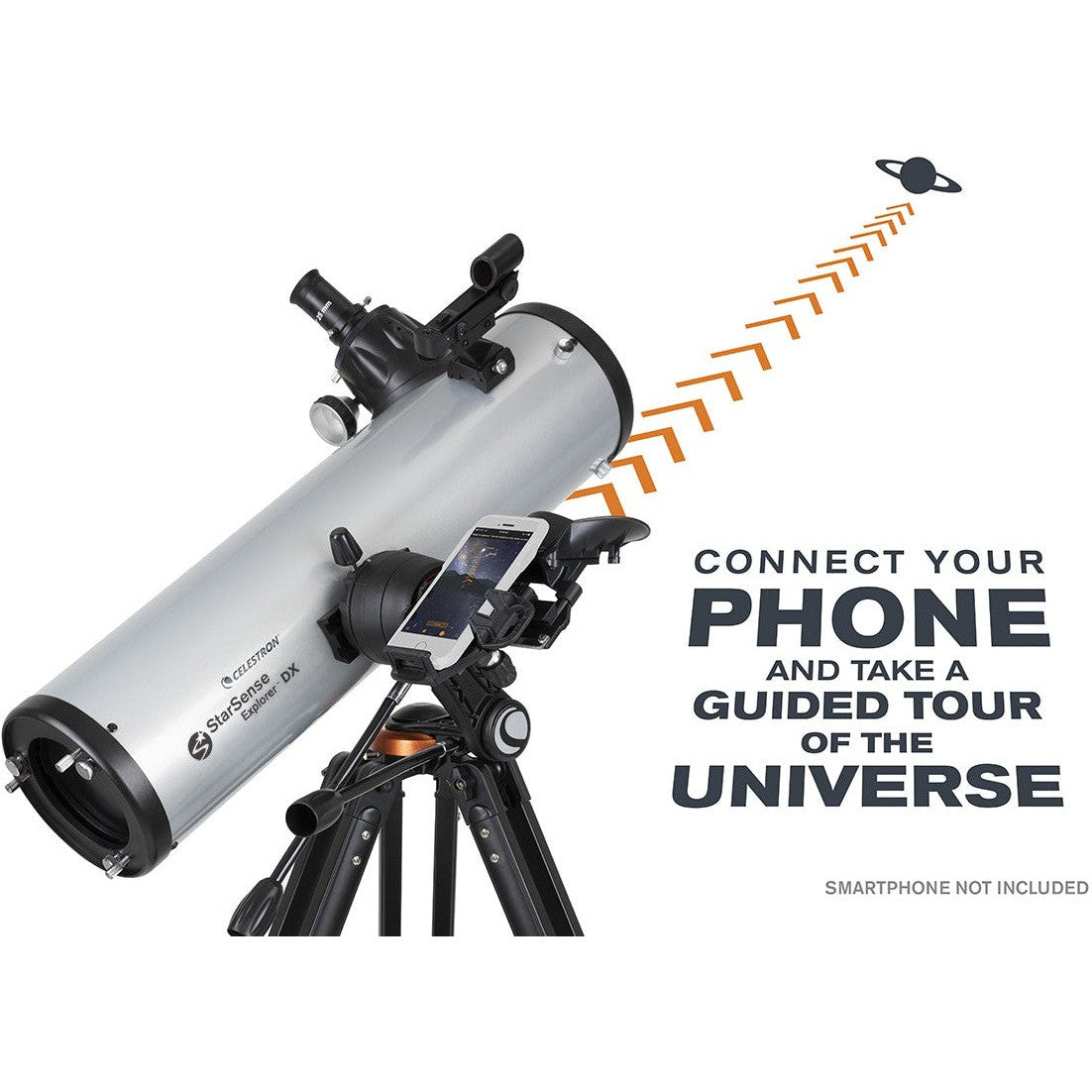
🏆 Best overall: The StarSense Explorer DX 130AZ is a 130mm f/5 Newtonian reflector with a 650mm focal length and a parabolic primary mirror, at $499.95. Celestron includes 25mm and 10mm eyepieces for 26x and 65x, a StarPointer red dot finder, a full-height tripod, an accessory tray and the phone dock.
Top picks ↓Related articles



1★ Best Pick🏆 Best overallCelestron StarSense Explorer DX 130AZ
130mm reflector with phone dock, tripod and two eyepieces.
The StarSense Explorer DX 130AZ is a 130mm f/5 Newtonian reflector with a 650mm focal length and a parabolic primary mirror, at $499.95. Celestron includes 25mm and 10mm eyepieces for 26x and 65x, a StarPointer red dot finder, a full-height tripod, an accessory tray and the phone dock. The app recognizes the sky through your phone's camera and points you to targets, which solves the problem most beginners have. Older phones are not supported: Celestron lists Android 12 or iOS 18 and later.
Pros
- ✓Phone app guides you to targets
- ✓130mm parabolic mirror
- ✓Full-height tripod included
Cons
- ✗Needs a recent phone
- ✗18 lb kit
2💰 Best budgetSky-Watcher Heritage 130 Tabletop Dobsonian

130mm tabletop Dobsonian. Needs a table or stand.
The Heritage 130 is a tabletop Dobsonian with a 130mm parabolic mirror, 650mm focal length and f/5, the same optical specification as the StarSense Explorer DX 130AZ, for $269 on Sky-Watcher's store. Astronomics lists 25mm and 10mm eyepieces and a red dot finder in the box. The tube collapses for storage. There is no app or motor, so you find objects with a chart, and you need a table or stand to put it on.
Pros
- ✓130mm aperture for $269
- ✓Collapsible tube
- ✓Nothing to power or pair
Cons
- ✗Needs a table or stand
- ✗No help finding objects
3🔭 Most apertureSky-Watcher Classic 200P Dobsonian

8-inch Dobsonian. 45 lb assembled.
The Classic 200P is an 8-inch (203mm) Dobsonian with a 1200mm focal length at f/5.9, listed at $629 on Sky-Watcher's store, down from $725. Sky-Watcher fits a parabolic mirror, a 2-inch Crayford focuser with 1.25-inch adapter, a 9x50 finder and two eyepieces, which Astronomics lists as 25mm and 10mm Plössls for 48x and 120x. It gathers the most light of any telescope here. At 45 lb assembled it is two trips outside, and the solid tube takes up floor space.
Pros
- ✓8-inch mirror
- ✓9x50 finder
- ✓2-inch focuser
Cons
- ✗45 lb assembled
- ✗Availability unclear on Sky-Watcher's store
Subscribe to our newsletter
Occasional updates and new releases — no spam.
4📱 Best smart telescopeSeestar S30 Pro Smart Telescope

Smart telescope with camera. No eyepiece.
The Seestar S30 Pro is an all-in-one smart telescope at $699 from Seestar. It has a 30mm, 160mm f/5.3 four-element apochromatic lens with ED glass, a Sony IMX585 camera, a second wide-angle camera, built-in light pollution and dark field filters, 128GB of storage and a 6000mAh battery that Seestar rates at about 6 hours. It weighs 1.65 kg. It points and tracks by itself and stacks images on your phone. There is no eyepiece, and a 30mm lens shows far less fine detail on planets than a 130mm mirror.
Pros
- ✓Points and images by itself
- ✓Light pollution filter built in
- ✓1.65 kg
Cons
- ✗No eyepiece
- ✗30mm aperture limits planet detail
5🚀 Best GoTo upgradeCelestron NexStar 6SE Computerized Telescope
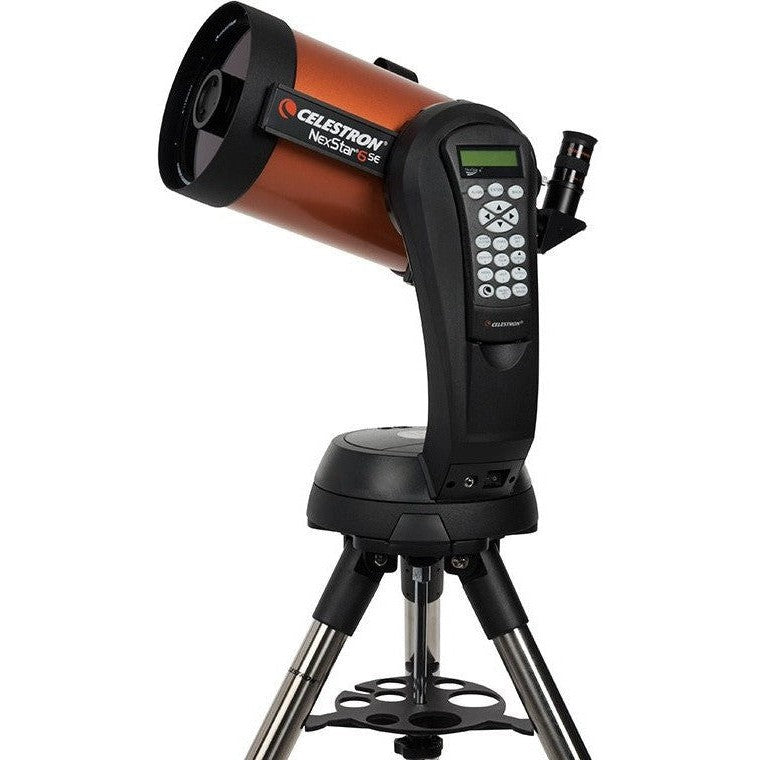
150mm computerized GoTo. 8 AA batteries not included.
The NexStar 6SE is a 150mm Schmidt-Cassegrain with a 1500mm focal length at f/10, on a computerized single-arm alt-azimuth mount, at $1,199. Celestron lists SkyAlign alignment on three bright objects, a database of 40,000+ objects, a 25mm eyepiece for 60x, a star diagonal and a StarPointer finder. The long focal length suits the Moon and planets. It runs on 8 AA batteries, not included; Celestron also lists a 12V input, so a separate power pack is an option.
Pros
- ✓Finds and tracks objects
- ✓Compact tube for a 150mm
- ✓Long focal length for planets
Cons
- ✗$1,199
- ✗Batteries not included
Aperture, focal length and what you will see
Aperture is the diameter of the main mirror or lens, and it decides how much light reaches your eye. More light means fainter galaxies and nebulae become visible. Sky-Watcher says the 130mm Heritage 130 collects 319% more light than the human eye and the 8-inch Classic 200P is 816 times brighter than the eye.
Focal length, divided by the eyepiece's focal length, sets magnification. Celestron lists 26x with the 25mm eyepiece and 65x with the 10mm on the 650mm StarSense Explorer DX 130AZ. On the 1200mm Classic 200P, Astronomics lists 48x and 120x with the same two eyepiece sizes. Low power is what you use most of the time; high magnification on a shaky night only enlarges the blur.
Saturn's rings, Jupiter's cloud bands and moons, and craters on the Moon are within reach of every telescope here. From a city, galaxies look like faint smudges in any telescope you look through; the smart telescope gets around this by stacking camera exposures.
| Telescope | Aperture | Focal length | Mount | Price seen |
|---|---|---|---|---|
| Celestron StarSense Explorer DX 130AZ | 130mm | 650mm, f/5 | Manual alt-az, phone app | $499.95 |
| Sky-Watcher Heritage 130 | 130mm | 650mm, f/5 | Manual tabletop Dobsonian | $269 |
| Sky-Watcher Classic 200P | 203mm (8 in) | 1200mm, f/5.9 | Manual Dobsonian | $629 |
| Seestar S30 Pro | 30mm | 160mm, f/5.3 | Motorized alt-az, camera | $699 |
| Celestron NexStar 6SE | 150mm | 1500mm, f/10 | Computerized GoTo | $1,199 |
Finding objects: by hand, by app or by motor
A Dobsonian is a reflector sitting on a simple swivel base. You push the tube where you want it. The Heritage 130 and Classic 200P work this way, with a red dot or 9x50 finder to aim. It costs the least per millimeter of aperture, but you need a star chart and some patience to locate anything fainter than a planet.
The StarSense Explorer DX 130AZ adds a dock for your phone. Celestron says the app uses the phone's camera to recognize the star pattern overhead, works without a cell signal, and then shows arrows that guide you to the target. Celestron lists support for Android 12 and later and iOS 18 and later, iPhone XR or newer. You still move the telescope by hand, with slow-motion controls on both axes.
The NexStar 6SE has motors. After you align it on three bright objects, Celestron says it can find and track any of 40,000+ objects in its database. It needs 8 AA batteries, not included, or a 12V supply.
A smart telescope like the Seestar S30 Pro has no eyepiece. It points itself, takes repeated exposures with a built-in camera and assembles an image on your phone. It is the easiest way to see color in a nebula from a city, but you are looking at a screen, not through glass.
Weight, storage and setup
A telescope you can carry outside in one trip gets used more. Astronomics lists the Classic 200P at 20 lb for the tube and 25 lb for the base, 45 lb in all. The StarSense Explorer DX 130AZ kit is 18 lb, according to Celestron, and the NexStar 6SE is 28 lb. Seestar lists the S30 Pro at 1.65 kg (3.6 lb).
The Heritage 130 tube collapses for storage and keeps its collimation, Sky-Watcher says. Astronomics lists it at 14.75 inches long retracted. As a tabletop model it needs a sturdy table, a stool or a flat wall to sit on; set on the ground you would be kneeling to look through it.
Reflectors such as the Heritage 130, StarSense Explorer DX 130AZ and Classic 200P occasionally need their mirrors realigned with a few screws, an adjustment called collimation. The NexStar 6SE's Schmidt-Cassegrain design and the sealed Seestar need it rarely or not at all.
How these picks were chosen
We chose telescopes from established makers with published specifications, one for each common way of getting started: a budget tabletop, an app-assisted reflector, a large manual Dobsonian, a smart telescope and a computerized GoTo. We first looked at the Seestar S50, but Seestar's own US store showed it unavailable when we checked, so the S30 Pro takes its place. Celestron AstroMaster, Unistellar, Dwarflab and Vixen telescopes are not covered here, and that is a limit of this page.
Recommendations are editorial. No brand paid for placement, and the links on this page are affiliate links that may earn Pickly a commission at no extra cost to you.
Frequently asked questions
What size telescope should a beginner buy?▼
Is a reflector or a refractor better for a beginner?▼
Can I see planets from the city?▼
Does the StarSense app work without internet?▼
Can I look through a smart telescope?▼
Can I look at the Sun with these telescopes?▼
What should I buy first after the telescope?▼
Check the details of the products in this article
- Celestron StarSense Explorer DX 130AZ$499.95Reference price
- Sky-Watcher Heritage 130 Tabletop Dobsonian$269〜$305Reference price
- Sky-Watcher Classic 200P Dobsonian$629〜$725Reference price
- Seestar S30 Pro Smart Telescope$699Reference price
- Celestron NexStar 6SE Computerized Telescope$1,199Reference price
Prices change. Check the retailer for the current price.
Comments & questions
Discussion happens on nattzy, our community forum. Sign in with Google to post — it takes a second.
Still deciding? Ask the community your own question — Post a question on nattzy ↗