Best Electronic Drum Set 2026: 5 Home Kits Compared
Electronic drums are bought to be quiet, and most buyers discover the wrong kind of quiet. The pads are fine; it is the kick drum thumping through the floor that brings the neighbours to the door.
Quick answer
The Roland TD-07KV is the kit to buy: all-mesh pads that can be tensioned like real heads, a Roland module that responds convincingly to dynamics, and Bluetooth audio for playing along to songs, at a price well below the flagship tiers. The Alesis Nitro Max gets you mesh heads for the least money, the Roland TD-02KV fits the smallest room, the Yamaha DTX6K-X has the quietest pad surface, and the Alesis Command Mesh SE is for players who feel cramped on small pads.
We did not run our own testing on any of these kits. Doing it properly would mean a treated room, a calibrated sound level meter at the pad and a vibration sensor on the floor below — we have none of that. What we did instead: took the published specifications from Roland's, Yamaha's and Alesis's own product pages and manuals, checked current prices against major US music retailers and Amazon, and read owner reviews in volume, keeping only the complaints that repeat across many buyers — hi-hat pedals that lose calibration, kick towers that walk across the floor, cables that fail at the rack — rather than first-week impressions. Where a feature or figure is the manufacturer's claim rather than an independent measurement, we say so in the text.
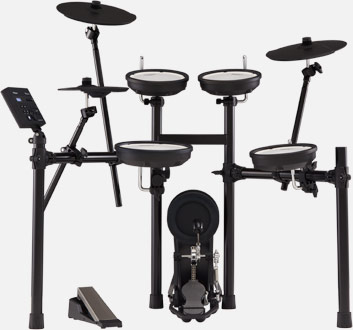
🏆 Best overall: The TD-07KV is the pick because it gets the two things that shape daily practice right at once: tensionable mesh on every drum and a Roland module that follows dynamics closely enough that soft playing actually sounds soft. Bluetooth audio makes playing along to songs effortless.
Top picks ↓| Product | Price | Link |
|---|---|---|
| $1,100〜$1,400Reference price | ||
| $400〜$500Reference price | ||
| $600〜$750Reference price | ||
| $1,300〜$1,700Reference price | ||
| $650〜$850Reference price |
Top picks
Related articles


The TD-07 range includes several kits (TD-07DMK, TD-07KV, TD-07KX) with different pads and racks; confirm the listing is the KV and compare the pad list.
The TD-07KV is the pick because it gets the two things that shape daily practice right at once: tensionable mesh on every drum and a Roland module that follows dynamics closely enough that soft playing actually sounds soft. Bluetooth audio makes playing along to songs effortless. It is not cheap, and like most Roland kits it needs a kick pedal and a throne on top of the box price.
Pros
- ✓Mesh heads on snare, toms and kick
- ✓TD-07 module responds well to dynamics
- ✓Bluetooth audio for playing along
Cons
- ✗Kick pedal usually sold separately
- ✗Costs well over double the Nitro Max
Often sold both alone and in bundles with a throne and headphones; compare the bundle price against buying those items separately.
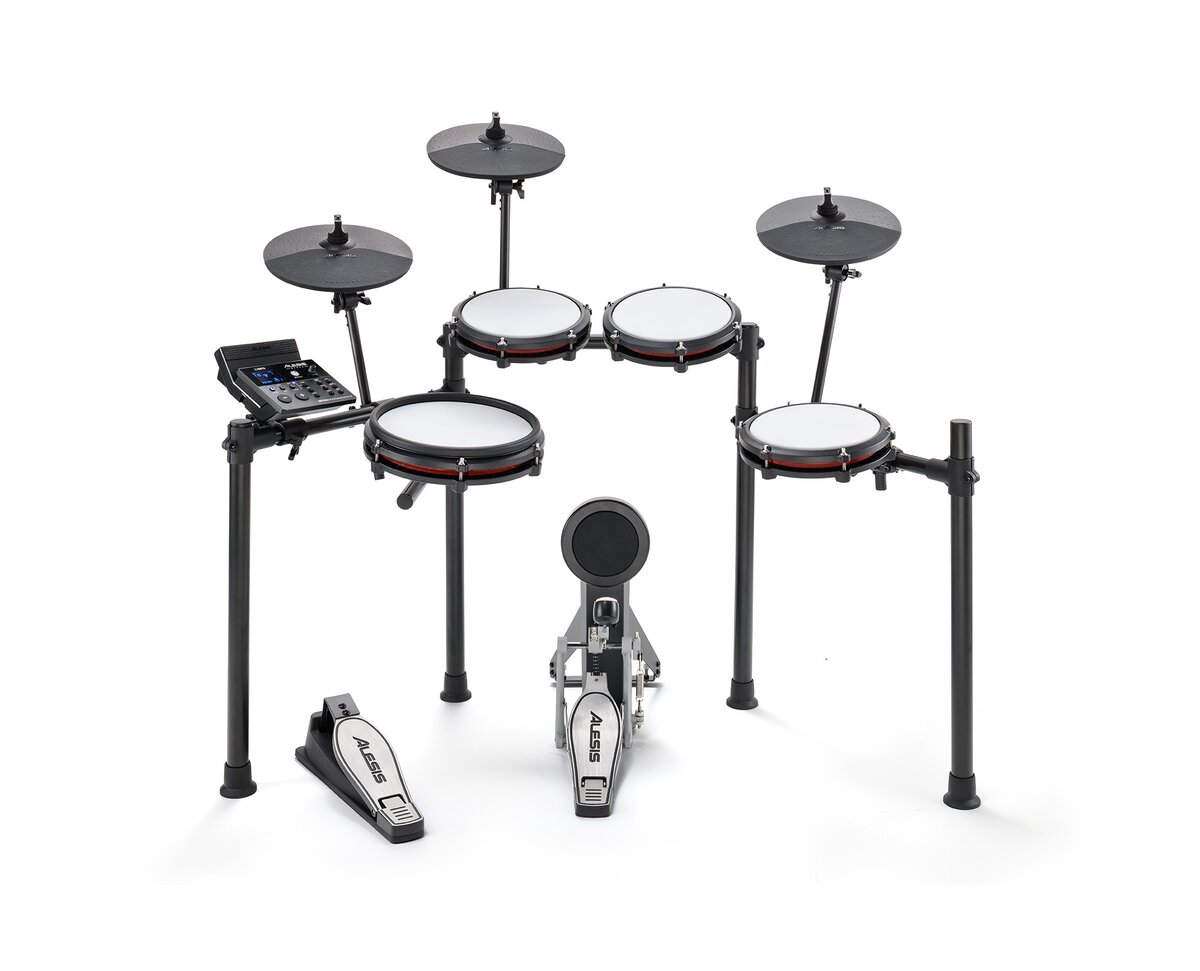
The Nitro Max is the cheapest way to get an all-mesh eight-piece kit, and it ships with a kick pedal and Bluetooth, so it is close to complete out of the box. The trade-offs show up over months rather than days: owner reviews repeatedly mention the hi-hat controller drifting and the small pads feeling crowded for adult players. As a first kit for a beginner or a teenager, it is hard to argue with.
Pros
- ✓All-mesh pads at the lowest price here
- ✓Kick pedal included
- ✓Bluetooth for streaming songs
Cons
- ✗Hi-hat controller often needs recalibration
- ✗Small pads feel cramped for larger players
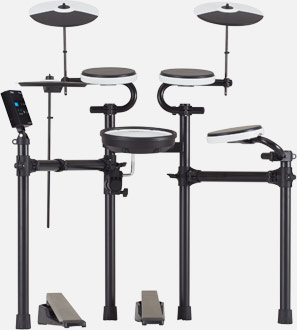
Do not confuse it with the TD-02K, which has rubber pads throughout; the V in KV is the mesh snare.
The TD-02KV is Roland's answer for a bedroom corner. The snare is mesh, which is the drum you hit most, while the toms are rubber to keep the price down. The small rack takes little floor space and Roland's module is a step above budget brands for feel. The rubber toms are louder than the rest of the kit, and players who outgrow it tend to want more pads.
Pros
- ✓Most compact footprint here
- ✓Mesh snare where it matters most
- ✓Roland module at an entry price
Cons
- ✗Rubber toms are louder in the room
- ✗Limited room to expand later
Subscribe to our newsletter
Occasional updates and new releases — no spam.
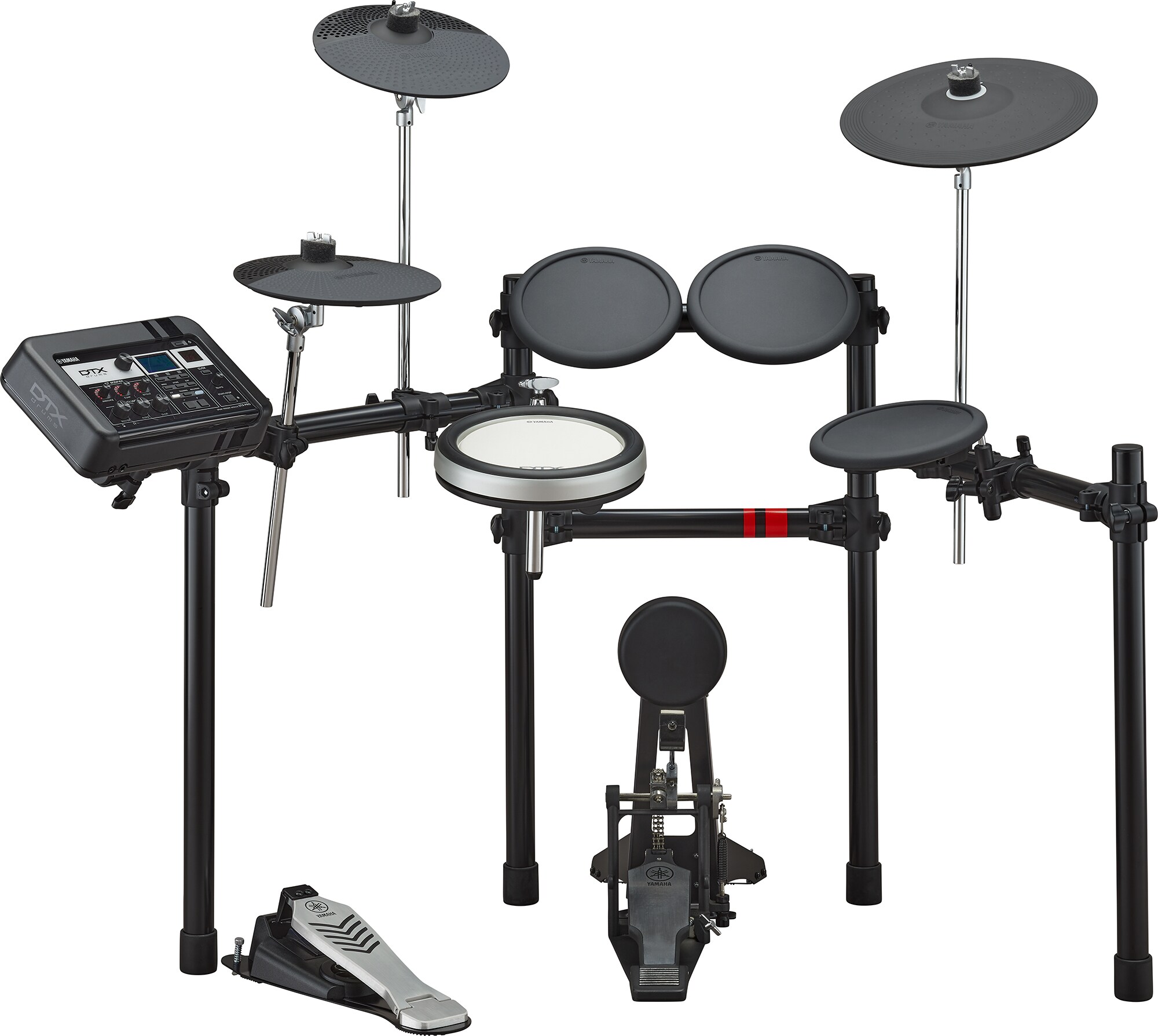
Yamaha also sells DTX6K2-X and DTX6K3-X versions with different pads — compare the listed pad lineup, not just the name.
The DTX6K-X is built around Yamaha's TCS silicone pads and the DTX-PRO module. Yamaha claims TCS is quieter than rubber with a natural feel, and owner reviews largely back the noise claim. The module is highly regarded for its acoustic-drum samples and dynamic response. It costs more than the TD-07KV, and the silicone surface feels different from mesh, which some players love and some do not.
Pros
- ✓TCS pads are quiet to strike
- ✓DTX-PRO module sounds natural
- ✓Larger layout feels closer to acoustic
Cons
- ✗Most expensive kit here
- ✗Silicone feel is not the same as mesh
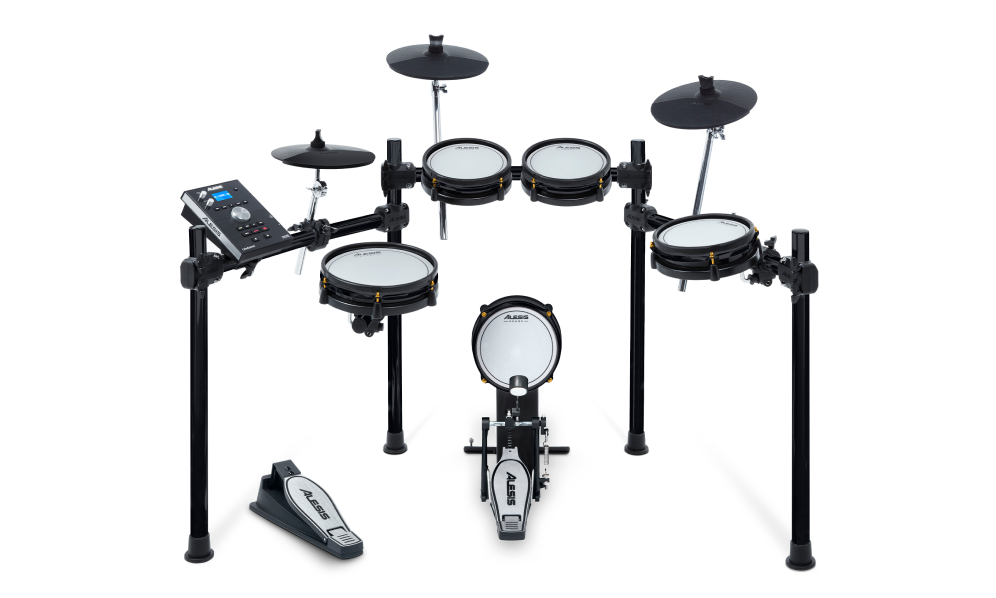
Some listings are the older Command Mesh without SE; check the model name and the pad sizes in the photos.
The Command Mesh SE steps up from the Nitro line mainly in pad size, which matters more than it sounds: bigger targets make fills less cramped and let adult players sit at a more natural distance. It keeps mesh throughout and sits between the Nitro Max and the Rolands on price. Reviewers still mention the Alesis hi-hat and module as the weaker points compared with Roland and Yamaha.
Pros
- ✓Larger mesh pads than the Nitro line
- ✓More natural spacing for adult players
- ✓Mid-range price
Cons
- ✗Hi-hat response less refined than Roland or Yamaha
- ✗Takes more floor space
Pad material decides how loud the kit is in the room
There are three pad surfaces at home-kit prices: mesh, rubber and Yamaha's textured cellular silicone (TCS). Mesh heads are woven fabric tensioned over a drum shell, so they rebound like an acoustic head and can be tightened or loosened to taste. Rubber pads are solid, give a harder rebound and make a clearly audible 'tock' with every hit. TCS is Yamaha's own solid-silicone surface; the manufacturer's claim is that it is quieter than rubber with a feel closer to a real head, and owner reviews broadly agree on the noise point.
For someone practising at night in the same room as a sleeping partner, mesh or TCS is the difference between being tolerated and not. That is why the Roland TD-02KV, which pairs a mesh snare with rubber toms, is the compromise option here: the drum you hit most is quiet, the toms are not.
Mesh feel also matters for technique. A player who later moves to an acoustic kit finds the transition easier from tensioned mesh than from rubber, which rewards heavier strokes and hides sloppy rebounds.
The real noise problem is the kick drum through the floor
Airborne pad noise stays mostly in the room. The kick pedal is different: every stroke drives a beater into a pad bolted to a frame sitting on the floor, and that impact travels through the building structure. In an apartment, the person below hears a steady thud long after the snare noise has become inaudible. No choice of pad material fixes this, and all five kits here share it.
The fix is decoupling the kit from the floor. Players build risers from a plywood deck on tennis balls or foam, and there are commercial isolation platforms, including Roland's Noise Eater line. Owner reviews are consistent that a riser does more for downstairs neighbours than anything the kit itself does. Budget for one if you live above anyone.
A second complaint that repeats across all brands: kick towers creep forward under the pedal. A rug or a drum mat under the whole kit is effectively mandatory, not optional.
The sound module and hi-hat are where price shows
Every kit here uses a fixed hi-hat pad plus a separate foot controller rather than a real hi-hat stand; true stand-mounted hi-hats arrive in more expensive kits. The difference between these five is in how finely the module reads that controller — how smoothly a sound moves from closed to half-open to open, and whether a foot 'chick' sounds right.
Roland's TD-07 and Yamaha's DTX-PRO modules are where the step up is most audible in owner reviews: dynamics feel graded rather than stepped, and ghost notes on the snare register without jumping in volume. The Alesis modules sound good for the price, but reviewers repeatedly mention the hi-hat controller needing recalibration and a narrower usable range between soft and hard.
For playing along to music, Bluetooth audio on the TD-07KV and Nitro Max lets you stream songs from a phone into the headphone mix without a cable. The other kits accept an audio input by cable; check the listing if wireless matters to you.
Footprint, rack and what you actually need to add
A home kit's rack decides how much floor it takes and how well it stays put. The TD-02KV is the most compact here and is designed around a small rack for tight rooms. The Command Mesh SE and DTX6K-X take noticeably more space because their pads are larger and more spread out, which also makes them feel more like an acoustic layout.
The price on the box is rarely the full price. The Nitro Max is the one kit here whose standard listing includes a kick pedal; for the others, confirm whether a pedal is included. Most buyers also need a drum throne, a pair of sticks and closed-back headphones, and, as above, a floor riser if anyone lives below.
Frequently asked questions
Are electronic drums actually quiet?▼
Is mesh worth it over rubber pads?▼
Do these kits come with a kick pedal and throne?▼
Can I use an electronic kit to record or with drum software?▼
Prices change. Check the retailer for the current price.
Comments & questions
Discussion happens on nattzy, our community forum. Sign in with Google to post — it takes a second.
Still deciding? Ask the community your own question — Post a question on nattzy ↗
Related articles

Best JP rental server 2026: 5 hosts ranked
Best Noise Cancelling Headphones 2026: 5 Flagships

Best Electric Toothbrush 2026: 5 models compared honestly
Best Air Purifier 2026: 5 models compared honestly
Best LED Face Masks 2026: 3 Light Therapy Devices Compared
Best Robot Vacuums 2026: 5 Models Compared Honestly