Best Training Sandbags 2026: 5 Compared
A training sandbag is fundamentally different from a barbell or dumbbell in one key way. Weight range and build quality determine long-term value far more than feature lists.
Quick answer
Rogue's training sandbag earns the top spot on construction: a 1000D Cordura shell with reinforced seam stitching and top, side, and bottom handles survives throwing, dragging, and dropping, with modular filler bags for sand, rice, or gravel at $175-250. REP Fitness uses 900D Cordura for $80-130, GORUCK's welded webbing handles suit loaded carries, Viking Strength's shell geometry is shaped for shouldering, and Cerberus supplies Strongman Corporation events at 150-450 lbs.
Sandbags were evaluated on shell material denier and seam construction, filler bag quality and closure, handle placement and grip surface under load, maximum rated capacity vs real-world usable load, and price per kilogram of capacity — durability and handle quality weighted highest because a failed handle during a heavy shouldering attempt is genuinely dangerous.
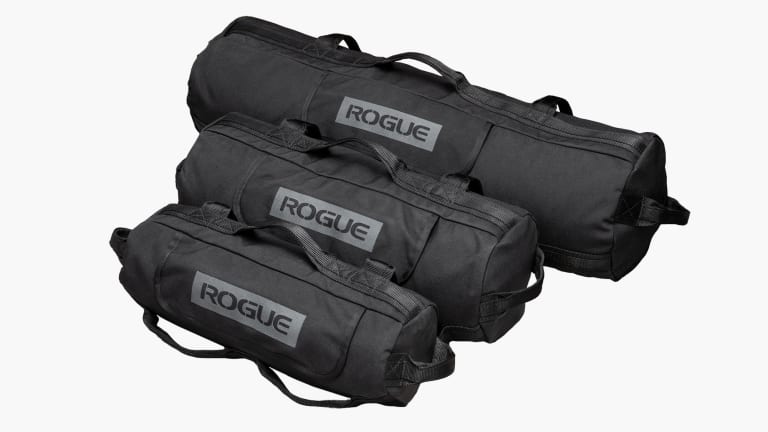
Rogue Fitness Training Sandbag
Best Overall: Rogue's 1000D Cordura shell, reinforced seam stitching, and multiple integrated handles (top, side, bottom) make it the sandbag you can throw, drag, and drop on rough surfaces without the outer shell failing. The modular filler bag system lets you use sand, rice, or gravel.
Top picks ↓| Product | Price | Link |
|---|---|---|
| $175Reference price | ||
| $80Reference price | ||
| $100Reference price | ||
| $100Reference price | ||
| $2.50Price as of 2026-09-24 |
| Product | Shell material | Max load | Handles | Filler system | Sizes | Price | Seams | Origin | Optimized for | Grip panel | Used in | Grab points | Price range |
|---|---|---|---|---|---|---|---|---|---|---|---|---|---|
| Rogue Fitness Training Sandbag | 1000D Cordura | 150–300 lbs (by size) | Top, side, bottom integrated | Modular bags | Small / Large / XL | ~$175–250 | — | — | — | — | — | — | — |
| REP Fitness Training Sandbag | 900D Cordura | 50–150 lbs | Top, side grips | Modular | 50 / 100 / 150 lb | ~$80–130 | — | — | — | — | — | — | — |
| GORUCK Training Sandbag | 1000D Cordura | varies by size | Welded webbing | — | — | ~$100–175 | Sealed | Military rucksack heritage | — | — | — | — | — |
| Viking Strength Training Sandbag | Heavy-duty fabric | ~100–200 lbs | — | — | — | ~$100–150 | — | — | Shouldering | Yes — two-hand clean pull | — | — | — |
| Cerberus Strength Training Sandbag | Competition-grade | 150–450 lbs | — | — | — | — | — | — | — | — | Strongman Corporation events | Multiple | ~$150–300 |
Top picks
Related articles


1000D Cordura shell, multiple integrated handles (top/side/bottom), modular filler system, 150-300 lb max. $175-250. Best for commercial gyms and aggressive home gym use — construction handles being thrown, dropped, and dragged. Most expensive but most durable.
Rogue's 1000D Cordura shell, reinforced seam stitching, and multiple integrated handles (top, side, bottom) make it the sandbag you can throw, drag, and drop on rough surfaces without the outer shell failing. The modular filler bag system lets you use sand, rice, or gravel. The price ($175–250 for shell plus fillers) is the highest in this comparison and is justified by the construction quality — it won't need replacing.
Pros
- ✓1000D Cordura shell built for commercial gym abuse
- ✓Multiple handle positions cover all sandbag movements
- ✓Modular filler bags for sand, rice, or gravel
Cons
- ✗Most expensive option — $175–250 for shell + fillers
Score breakdown
| Shell material | 1000D Cordura |
| Max load | 150–300 lbs (by size) |
| Handles | Top, side, bottom integrated |
| Filler system | Modular bags |
| Sizes | Small / Large / XL |
| Price | ~$175–250 |

900D Cordura, reinforced handles, modular filler, 50-150 lb sizes. $80-130. Best value for regular home gym use — adequate durability for most home training at significantly lower cost than Rogue. Most versatile handle system for non-competition training.
REP's 900D Cordura shell and reinforced handle system deliver adequate durability for consistent home gym use at significantly less than Rogue — $80–130 versus $175–250. The handle placement (top and side grips) covers the full range of sandbag exercises. For home gym athletes who train hard but aren't throwing the bag on commercial gym concrete daily, REP provides better value than the Rogue premium.
Pros
- ✓900D Cordura adequate for regular home gym use
- ✓50–150 lb sizes cover most training ranges
- ✓Significantly cheaper than Rogue at comparable capacity
Cons
- ✗900D Cordura less robust than Rogue's 1000D for daily abuse
Score breakdown
| Shell material | 900D Cordura |
| Max load | 50–150 lbs |
| Handles | Top, side grips |
| Filler system | Modular |
| Sizes | 50 / 100 / 150 lb |
| Price | ~$80–130 |

1000D Cordura, military construction standards, welded webbing handles. $100-175. Best for rucking events and sustained loaded carries — built for GORUCK events and military fitness training. Handle system prioritizes carrying over barbell-style lifting.
GORUCK's military construction heritage shows in the welded webbing handles and sealed seams — this bag is built for sustained loaded carries under field conditions, not for repeated drops in a gym. The top handle is the strongest single attachment point in this comparison. Best for athletes training for GORUCK events or military fitness tests where carrying endurance is the primary demand.
Pros
- ✓Military-standard welded webbing handles
- ✓1000D Cordura with sealed seams for field durability
- ✓Built specifically for sustained loaded carries
Cons
- ✗Handle system optimized for carrying, not barbell-style lifting
Score breakdown
| Shell material | 1000D Cordura |
| Max load | varies by size |
| Handles | Welded webbing |
| Seams | Sealed |
| Origin | Military rucksack heritage |
| Price | ~$100–175 |
Subscribe to our newsletter
Occasional updates and new releases — no spam.

Optimized shell geometry for shouldering, grip panel for clean pull, 100-200 lb. $100-150. Best for strongman shouldering-focused training — handle placement matches shouldering movement pattern better than generic designs.
Viking Strength's shell geometry is optimized for shouldering — the grip panel on top creates a secure two-hand pull during the clean phase, which generic single-handle designs make significantly harder. Handle placement matches the shouldering movement pattern better than any other bag in this comparison. For athletes specifically programming sandbag shouldering rather than mixed conditioning, this is the purpose-built tool.
Pros
- ✓Shell geometry optimized for shouldering movement
- ✓Grip panel allows secure two-hand pull in clean phase
- ✓Handle placement matches strongman competition movements
Cons
- ✗Less versatile for conditioning circuits vs multi-handle designs
Score breakdown
| Shell material | Heavy-duty fabric |
| Optimized for | Shouldering |
| Grip panel | Yes — two-hand clean pull |
| Max load | ~100–200 lbs |
| Price | ~$100–150 |

Cerberus Strength Training Sandbag
Competition standard construction, 150-450 lb capacity, used in Strongman Corporation events. $150-300. Best for actual strongman competition training — competition-equivalent equipment. Load capacities exceed most home gym needs.
Cerberus supplies Strongman Corporation events — if you are training for actual sanctioned strongman competition, this is competition-equivalent equipment. Load capacities (150–450 lbs) exceed what most home gym users need, and at $150–300 it is priced for competitive athletes who need to replicate exact event conditions in training. For general fitness, the other options in this list are a better fit.
Pros
- ✓Competition standard — used in Strongman Corporation events
- ✓150–450 lb capacity for advanced strength athletes
- ✓Multiple grab points for varied loading positions
Cons
- ✗Load capacities and price exceed most home gym needs
Score breakdown
| Shell material | Competition-grade |
| Max load | 150–450 lbs |
| Used in | Strongman Corporation events |
| Grab points | Multiple |
| Price range | ~$150–300 |
Which one is right for you?
For commercial gym or CrossFit box use
Rogue Fitness Training Sandbag
1000D Cordura and welded handles survive repeated drops, drags, and throws on concrete — the construction quality commercial use demands.
For home gym athletes on a budget
REP Fitness Training Sandbag
900D Cordura and a complete handle system at roughly half the Rogue price — the right balance of durability and cost for non-commercial training.
For GORUCK or military fitness prep
GORUCK Training Sandbag
Military construction standards and the strongest top carry handle make this the purpose-built tool for rucking events and loaded-carry conditioning.
For athletes programming sandbag shouldering
Viking Strength Training Sandbag
Shell geometry and grip panel placement match the shouldering movement pattern better than any generic sandbag design in this comparison.
For sanctioned strongman competition prep
Cerberus Strength Training Sandbag
Competition-equivalent equipment at 150–450 lb capacities — the only bag here that replicates actual Strongman Corporation event conditions exactly.
Sandbag training vs free weights: what the shifting load actually does
A sandbag's shifting center of gravity recruits core stabilizers (deep spinal muscles, obliques, transverse abdominis) continuously throughout a movement — not just at the sticking point or during the eccentric phase. A deadlift with a sandbag recruits the same primary movers as a barbell deadlift, but the constant micro-adjustments required to manage the shifting load add a layer of stabilizer demand absent from the fixed weight. Over time, this translates to better performance in real-world carrying tasks and sports movements that involve controlling unstable loads.
Sandbag exercises also develop grip strength differently than barbells. Carrying a 100 lb sandbag in a bear hug, over one shoulder, or by a single handle requires different grip patterns than gripping a barbell — the soft, irregular surface forces an adaptive grip response that thick bar training only partially replicates. This is why sandbag carries are a standard component of combat sports conditioning: the grip demand mirrors the grappling context.
The limitation of sandbags compared to barbells: progressive overload is less precise. You can change resistance in a sandbag by adjusting filler weight, but this requires emptying and refilling rather than adding a plate. This makes sandbags better suited to conditioning and strongman-style training than precise strength programming. The sweet spot is using sandbags for carries, cleans, shouldering, and loaded walks while using barbells for precise strength work.
Rogue Fitness sandbag: the built-for-abuse standard
The Rogue Fitness sandbag uses a 1000D Cordura shell with reinforced stitching, multiple integrated handles (top, side, and bottom), and heavy-duty zipper closures on the inner filler bag. The construction is commercial gym quality — designed to be thrown, dropped, dragged, and used on rough surfaces without the shell failing. The modular filler bag system allows using sand, rice, or gravel as fill, with the outer shell protecting against filler bag puncture.
Rogue sandbags come in Small (150 lb max load), Large (200 lb max), and XL (300 lb max) shell sizes. For home gym use, the Small (75-150 lb filled) handles essentially all sandbag exercises — sandbag shouldering, cleans, carries, and bearhug squats. At $175-250 for the shell plus filler bags, it's the most expensive option in this comparison. The price is justified by the material quality and handle system — the handles on cheaper bags frequently fail under the stress of shouldering and repeated drops.
For commercial gyms, CrossFit boxes, and serious home gyms where equipment is used aggressively, the Rogue is the correct investment. For casual home use, the cost is harder to justify given that cheaper alternatives perform the same exercises adequately.
REP Fitness and GORUCK: the practical mid-range options
REP Fitness sandbags use 900D Cordura (slightly less robust than Rogue's 1000D) with reinforced handles and a modular filler system. Available in 50 lb, 100 lb, and 150 lb maximum load sizes, REP provides a complete system at $80-130 — significantly less than Rogue at comparable load capacities. The construction quality is adequate for regular home gym use, and the handle placement (top, side grips) covers the full range of sandbag exercises.
GORUCK training bags are distinguished by their military heritage — the brand originated making rucksacks for military use, and the training bags use similar construction standards: welded webbing handles, sealed seams, and 1000D Cordura. The GORUCK sandbag is built primarily for rucking (loaded carries) and GORUCK-style events, and the handle system reflects this: the top carrying handle is the strongest point, and the overall design prioritizes durability under sustained loaded walking.
For athletes training for events (GORUCK events, obstacle races, military fitness tests) that involve rucking and loaded carries, GORUCK is the purpose-built option. For general strongman-style training, REP Fitness provides the better value with a more versatile handle system.
Viking Strength and Cerberus: the strongman-focused options
Viking Strength sandbags are designed specifically for strongman training — the shell geometry is optimized for shouldering (lifting the bag to one shoulder from the floor), and the handle positions match strongman competition movements. The grip panel on the top allows secure two-hand grip during the pull phase of a shouldering movement, which cheap sandbags with single top handles make much harder. At $100-150, Viking Strength is in the mid-range but optimized for specific movements.
Cerberus Strength sandbags are used in legitimate strongman competitions — the brand supplies to Strongman Corporation events and other official competitions. The heavy bag (150-450 lb) construction is competition-standard: reinforced shell, multiple grab points, and a load capacity that exceeds other options in this comparison. For athletes training for actual strongman competition, Cerberus provides competition-equivalent training equipment. For general fitness, the load capacities exceed what most home gym users need.
The right sandbag depends on your use case: Rogue or GORUCK for durability-first and varied home gym use; REP for value-conscious buyers doing general fitness; Viking Strength for shouldering-focused programming; Cerberus for competition strongman training.
Frequently asked questions
What should you fill a training sandbag with?▼
What exercises can you do with a training sandbag?▼
How heavy should your training sandbag be?▼
Prices change. Check the retailer for the current price.
Comments & questions
Discussion happens on nattzy, our community forum. Sign in with Google to post — it takes a second.
Related articles
Best Water Bottle 2026: Stanley vs Hydro Flask vs Thermos

Best Posture Corrector 2026: Wearable Tech vs Brace

Best Electric Toothbrush 2026: 5 models compared honestly
Best Air Purifier 2026: 5 models compared honestly

ConoHa WING review (2026): setup, speed and pricing
Best JP rental server 2026: 5 hosts ranked