Best Smith Machine 2026: 5 Compared
Smith machines look interchangeable in photographs and are not. Almost all of the price difference is steel thickness and how the bar is guided, and both only become obvious once the load gets heavy.
Quick answer
If the machine will see heavy loads for years, the Body-Solid GS348Q is the one: commercial-spec 2x3 inch 11-gauge uprights and a counter-balanced bar that neither flex nor bind at weights where lighter frames complain. The Force USA G3 packs rack, Smith bar on linear bearings and a functional trainer into one footprint, Titan's bushing-guided machine adds plate storage mid-price, the Marcy MD-9010G bundles cage, pulleys, pull-up bar and bench, and the Sunny SF-BH6810 is the compact entry point.
We did not run our own thermal or load testing. Doing that honestly would need a calibrated psychrometric chamber for the air conditioners and an instrumented load cell rig for the Smith machines, neither of which we have. What we did instead: pulled every published specification from each manufacturer's own product page and manual, cross-checked current pricing against major retailer listings, and read owner reviews at volume — filtering for reports that describe a measurable failure or a repeated complaint rather than a first-week impression. Where a number is a manufacturer claim rather than an independent measurement, we say so in the text.
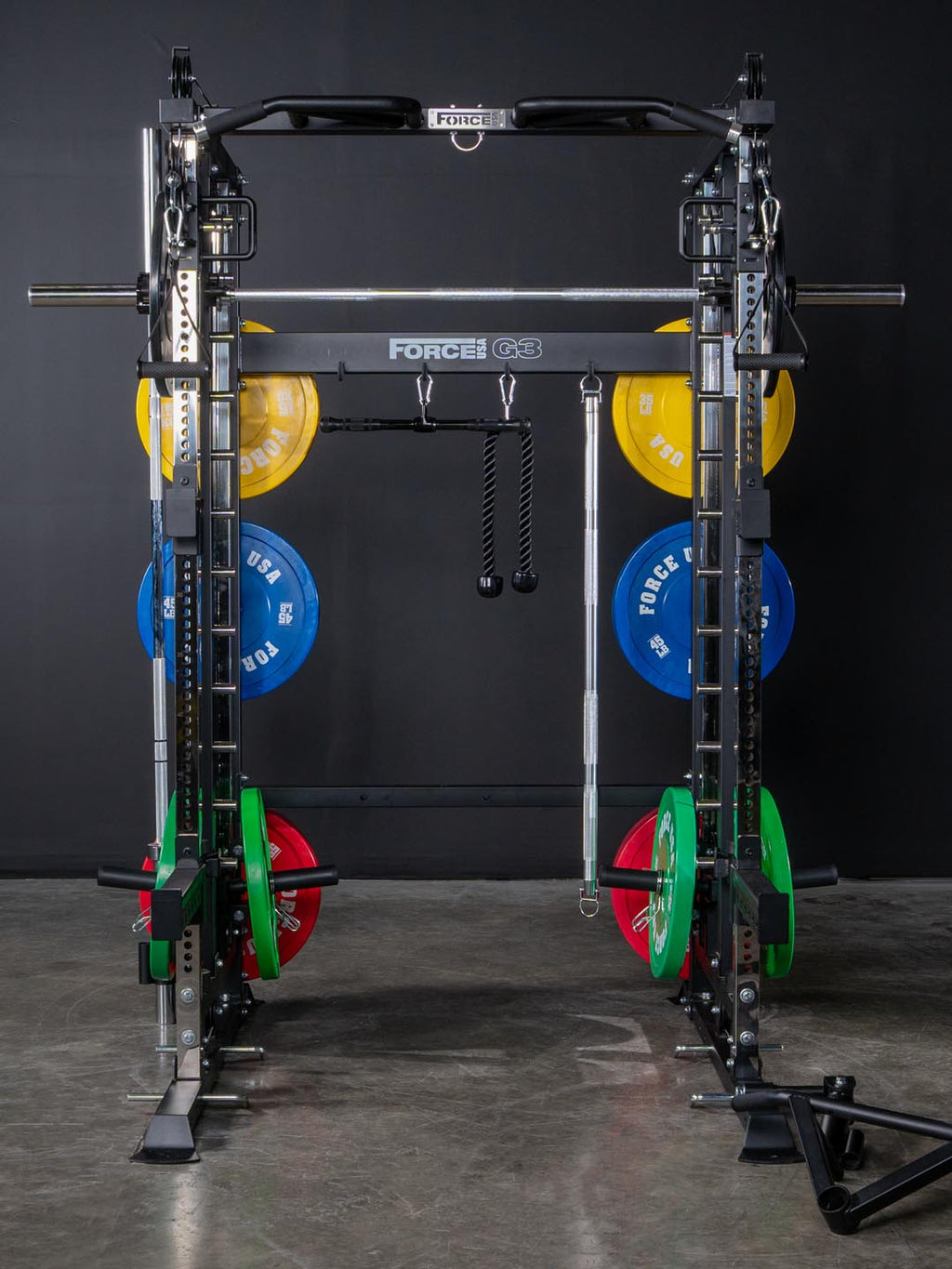
🏆 Best all-in-one: The G3 is the answer when one machine has to be the whole gym. Power rack, Smith bar on linear bearings, and a functional trainer share a single frame, and a bench fits inside the rack.
Top picks ↓| Product | Price | Link |
|---|---|---|
| $1,800〜$2,400Reference price | ||
| $2,000〜$2,600Reference price | No partner store here — this opens an Amazon search. | |
| $1880.99Price as of 2026-10-04 | ||
| $1249.97Price as of 2026-10-04 | ||
| $550〜$850Reference price |
Top picks
Related articles
.png?v=1640040616)

The G3 has several attachment bundles; confirm which attachments the listing includes.
The G3 is the answer when one machine has to be the whole gym. Power rack, Smith bar on linear bearings, and a functional trainer share a single frame, and a bench fits inside the rack. Judged purely as a Smith machine it is not the strongest frame here; judged as a garage gym in one footprint, nothing else on this list competes.
Pros
- ✓Rack, Smith and cable trainer in one frame
- ✓Linear bearings on the Smith bar
- ✓Bench fits inside the rack
Cons
- ✗Not the strongest frame as a pure Smith machine
- ✗Large footprint and long assembly

Bench and plate storage are separate purchases on this model.
The GS348Q is the one to buy if the machine is going to see heavy loads for years. Commercial-spec 2x3 inch 11-gauge uprights and a counter-balanced bar mean it does not flex or bind at weights where lighter frames start to complain. It is a dedicated Smith machine — no cable station, no pull-up bar — and it is priced accordingly.
Pros
- ✓Commercial-grade 11-gauge frame
- ✓Counter-balanced bar starts near zero
- ✓No flex or binding under heavy load
Cons
- ✗Expensive
- ✗Smith function only — no pulley station
- ✗Heavy to move and assemble

Titan revises models frequently — check the current spec sheet on the listing rather than older reviews.
Titan's Smith machine is the sensible step up from the entry tier. Bushing-guided rather than bearings, but on a frame stiff enough that the bushings are the only thing you notice. Integrated plate storage is genuinely useful in a small room. The obvious pick if the commercial frames are out of budget and the entry machines feel flimsy.
Pros
- ✓Meaningfully stiffer than entry-level frames
- ✓Integrated plate storage
- ✓Reasonable price for the build
Cons
- ✗Bushings, not linear bearings
- ✗No counter-balance on the bar
Subscribe to our newsletter
Occasional updates and new releases — no spam.

Bench is included; check its rated capacity separately from the frame's.
The MD-9010G is the most equipment per dollar here: Smith cage, pulley station, pull-up bar and a bench in one purchase. That is a complete beginner home gym at a price the dedicated machines do not approach. The compromise is frame stiffness — it is a lighter build, and it shows as you add weight.
Pros
- ✓Cage, pulleys, pull-up bar and bench included
- ✓Best value as a complete setup
- ✓Good for a first home gym
Cons
- ✗Lighter frame flexes under heavy load
- ✗Bench and pulleys are basic
- ✗Lower weight ceiling

Confirm the bar weight capacity before planning progression on this frame.
The SF-BH6810 is the entry point and should be read as one: a fixed bar path, a modest weight ceiling, and a compact footprint. For light loads, controlled high-rep work, and a small room it does the job at a price nothing else here matches. It is not the machine to buy if the plan is progressive heavy squatting.
Pros
- ✓Lowest price here
- ✓Compact footprint
- ✓Adequate for light and high-rep work
Cons
- ✗Low weight ceiling
- ✗Frame flexes as load increases
- ✗Not suited to heavy progressive loading
Steel gauge and frame geometry
The single best predictor of how a Smith machine feels under load is the upright: its cross-section and its wall thickness. Commercial-grade frames are typically 2x3 inch tube in 11-gauge steel; entry-level machines use thinner wall and smaller section, which is why they flex visibly at loads the heavier frame does not notice.
Frame flex is not only a comfort issue. A frame that twists under an uneven load puts the bar carriage slightly out of alignment with its guides, which is what produces the binding and the graunching sound owners report at heavy weight. The Body-Solid GS348Q is the commercial-spec frame in this group; the Sunny SF-BH6810 is at the other end.
Check the stated weight capacity, and then check whether it is quoted for the bar, the rack, or the whole machine — manufacturers are not consistent about this, and a headline capacity is often the frame total rather than what the bar carriage is rated for.
Bushings, bearings, and bar angle
The bar runs on either bushings or linear bearings. Bushings are cheaper and have more static friction, so the bar needs a firmer initial push and feels less smooth on the first inch of travel. Linear bearings glide from the start. On a light machine with bushings this is tolerable; combined with frame flex it is the main source of the 'sticky' feel.
Bar angle is the other structural choice. A vertical Smith bar travels straight up and down; an angled Smith bar (typically 7 to 12 degrees) follows a path closer to a natural squat or press. Angled machines suit squatting and pressing better; vertical machines are simpler and are what most budget units use. Neither is wrong, but they are not the same movement.
Counter-balancing matters for the starting weight. A counter-balanced bar can start effectively near zero; an uncounterbalanced bar carries its own weight, often 15 to 30 lb, which sets the floor for every exercise.
Footprint, ceiling height and getting it into the room
Most Smith machines need 7.5 to 8 feet of ceiling clearance for the frame, plus enough headroom above that for overhead pressing if you intend to do it. A standard 8-foot basement ceiling with ductwork is where plans commonly fail — measure to the lowest obstruction, not to the ceiling.
Footprint is typically in the range of 4 to 7 feet wide and 5 to 8 feet deep depending on whether the machine includes a pulley station and plate storage. Add at least two feet of clearance on the loading sides; the stated footprint is the frame, not the space you need to use it.
These machines arrive in several heavy boxes and are assembled in place. Assembly is usually a half-day job for two people, and the frame cannot practically be moved once loaded with plates. Decide the final position before you start.
What you give up versus a power rack
The fixed bar path is the whole point and the whole limitation. It removes the stabilisation demand, which is what makes a Smith machine usable without a spotter and useful for controlled, higher-rep work. It also means the stabilising musculature does less, and the bar path is not the one your body would choose.
For most home gyms the honest answer is that a power rack with safety arms covers more training and costs less. The Smith machine earns its place when training alone at loads where a failed rep is a real risk, when rehabilitating around an injury that needs a controlled path, or in the all-in-one machines where the Smith is one function among several.
That last case is why the Force USA G3 exists — it is a power rack, a Smith machine and a functional trainer in one frame, which is a different purchase decision from a dedicated Smith machine.
Frequently asked questions
Smith machine or power rack?▼
Why does the bar feel heavier on some machines?▼
How much ceiling height do I need?▼
Is a cheap Smith machine safe?▼
Prices change. Check the retailer for the current price.
Comments & questions
Discussion happens on nattzy, our community forum. Sign in with Google to post — it takes a second.
View the discussion thread on nattzy ↗
Still deciding? Ask the community your own question — Post a question on nattzy ↗